
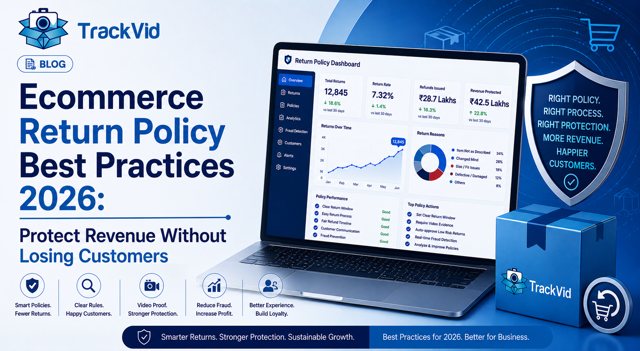
For ecommerce sellers on Shopify, Amazon, eBay, Etsy, Flipkart and global marketplaces. Updated May 2026.
Your return policy is the second thing most shoppers check before they buy. Eighty-one percent of consumers review a seller's return policy before completing a purchase, according to ReturnPrime data. Seventy-one percent say a bad return experience would stop them buying again. And 92 percent say they are more likely to buy from a brand that made their last return easy.
These numbers explain why most ecommerce return policy advice focuses entirely on the customer experience side: make it easy, make it clear, make it generous. That advice is not wrong. But it is incomplete, and in 2026 it is dangerously so.
The other side of those numbers: return fraud accounts for 15.1 percent of all ecommerce returns, costing retailers over $103 billion annually. Return abuse in apparel rose 13 percent year on year, according to Signifyd's State of Commerce 2026 report. And 44 percent of merchants who implemented return fees to reduce fraud saw fraud increase anyway.
The best ecommerce return policy best practices for 2026 do not choose between customer experience and fraud protection. They achieve both, by addressing the one element most return policy guides ignore entirely: what happens when you need to enforce your policy against a fraudulent claim.
A policy is only as strong as the evidence available to back it.
Why Return Policies Fail in 2026: The Enforcement Gap
Every ecommerce return policy states conditions. Item must be returned in original condition. Package must be unopened. Return must be initiated within 30 days. Tags must be attached.
These conditions are reasonable. The problem is what happens when a buyer violates them and claims otherwise.
A buyer returns a used garment and claims it arrived with a defect. Your policy says "returns accepted for damaged goods." The buyer's claim matches your policy's criteria. You have no independent proof of the garment's condition when it left your warehouse. The claim is processed.
A buyer sends back an empty box. Your policy says "full refund for missing items." The buyer claims the product was never in the box. You have no video of the box being sealed with the product inside. The refund is processed.
A buyer files a damage claim using an AI-generated photo. Your policy covers damage claims. You have no dispatch-side documentation showing the product was in perfect condition when shipped. The claim is evaluated based on the buyer's fabricated image and your written account. Neither is independently verifiable.
In all three cases, your policy is clear. The enforcement fails because the evidence to support it does not exist. This is the enforcement gap that 2026's ecommerce return policy best practices must address.
A return policy without proof of dispatch is a set of rules with no enforcement mechanism. The moment a buyer sends back an empty box, the policy is irrelevant.
The 2026 Return Policy Landscape: What the Data Shows
Before outlining what works, it is worth understanding what the current market looks like so your policy benchmarks against reality.
As of early 2026, 65.2 percent of merchants now charge return fees for mail-in returns, with an average fee of $9.04, according to eFulfillmentService's Return Crisis analysis. This represents a structural market shift, five years ago, free returns were close to universal.
The consumer response is complex. Eighty-two percent of consumers still say free returns are a factor in where they choose to shop, according to Ringly.io research. At the same time, 70 percent of shoppers say they are willing to pay for a premium, convenient return experience, according to Loop Returns data from April 2026.
On the fraud side: 57 percent of merchants saw more refund and policy abuse in 2024 than the year before, according to MRC data. Return abuse in apparel rose 13 percent year on year according to Signifyd. And more merchants saw fraud increase after implementing return fees than decrease, a 44 to 42 percent split, according to Happy Returns and NRF research from January 2026.
These numbers draw one clear conclusion: policy changes alone, tighter windows, fees, stricter conditions, do not reliably reduce fraud. They affect customer behaviour at the margins but do not remove the structural incentive to commit fraud when sellers lack dispatch-side evidence.
The Seven Ecommerce Return Policy Best Practices for 2026
Best Practice 1: Write for clarity above all else
The number one driver of accidental disputes is a return policy customers cannot understand. If your policy requires interpretation, customers default to contacting their bank rather than your support team. Every condition should be stated in plain language with a specific example. "Items must be returned unworn and with original tags attached" is clear. "Returns subject to condition assessment at our discretion" is not.
Clarity also functions as a fraud deterrent. A buyer who understands exactly what evidence is required to support a claim has less room to construct a vague dispute.
Best Practice 2: Segment your policy by product category
A single return policy applied uniformly to fashion, electronics, beauty, and home goods is miscalibrated for all of them. Return rates in 2026 average 25 percent for apparel, 11 to 15 percent for electronics, 4 to 12 percent for beauty, and 15 to 20 percent for home goods, according to Branvas category benchmarking published April 2026.
The fraud patterns in each category also differ. Fashion sees wardrobing and swap returns. Electronics sees switcheroo fraud and counterfeit returns. Beauty sees false condition claims. Each requires different evidence and different policy conditions.
Segment your return policy by the category's specific risk profile and build the corresponding evidence system for each segment.
Best Practice 3: Use exchange-first incentives to capture revenue before refunds
Over 60 percent of ecommerce brands now offer free exchanges while restricting free refunds, according to WiserReview. Fifty-one percent of merchants offer an average incentive of $11.28 to encourage exchanges or store credit over cash refunds.
This approach is supported by the data: it retains revenue that a refund would lose, reduces the financial incentive for opportunistic fraud (the buyer cannot monetise the return as cash), and gives the brand a second opportunity to satisfy the customer with the correct product.
Best Practice 4: Set return windows that are long enough to reduce urgency
Counter-intuitively, longer return windows reduce return volumes in certain categories. Customers who know they have 60 days feel less urgency to return immediately after purchase. The 30-day standard creates decision pressure that generates more returns than a 45 or 60-day window.
This does not apply universally, electronics and high-value items should have tighter windows. But for apparel and lifestyle categories where the primary driver of returns is fit uncertainty, a longer window reduces the urgency that drives bracketing and impulse returns.
Best Practice 5: Make the refund process faster than the dispute process
Fifty-two percent of customers skip contacting the seller entirely before filing a chargeback, according to Chargebacks911 research. The primary reason is that filing a dispute with their bank is perceived as faster and more reliable than requesting a refund from the merchant.
The fix is structural. Your refund process must be visibly simpler, faster, and more certain than a bank dispute. If your refund takes 9 to 10 business days, the current industry average, and a bank dispute can resolve in 3 days, you are incentivising chargebacks over returns. Automate your refund workflow to complete within 48 to 72 hours of receiving the return.
Best Practice 6: Require photo or video documentation for damage and defect claims
Any return that cites damage, defect, or wrong item should require the buyer to submit documentation before the return is authorised. This single requirement filters a significant share of fraudulent damage claims.
In 2026, this practice must account for AI-generated documentation, requiring photos that show the product in context with the buyer's current environment rather than isolated product images reduces the usefulness of AI-generated fakes. A photo showing the alleged damage alongside today's newspaper or a recognisable background element cannot be plausibly AI-generated.
Best Practice 7: Back your policy with dispatch-side evidence
This is the best practice that determines whether all the others are enforceable.
Your policy says items must be returned in original condition. Without dispatch-side documentation, you cannot prove what original condition was for a specific order. Your policy says damage claims require evidence. Without your own dispatch evidence, you are evaluating the buyer's claim against your written account, two unverifiable positions.
Order-linked packing video recorded at the moment of dispatch gives every condition in your policy an enforcement mechanism. You stated the item was dispatched correctly. Here is the order-linked timestamped video that independently verifies it.
TrackVid creates this documentation automatically for every order. When the shipping label is scanned, recording begins. The video is linked to the Order ID in real time, stored in indexed cloud, and retrievable in under two minutes when any dispute requires it. Your return policy becomes enforceable because the evidence to back it was created before any dispute existed.
For sellers processing high volumes across multiple platforms, Amazon, Shopify, eBay, Flipkart, TrackVid covers every channel from a single system, with evidence formatted for each platform's specific dispute mechanism.
Related: See how TrackVid makes your return policy enforceable →
The Return Policy + Evidence Stack: What Best-in-Class Looks Like
The brands with the lowest fraud-adjusted return loss in 2026 are not the ones with the most restrictive policies or the highest return fees. They are the ones who have built three things simultaneously.
A clear, fair customer-facing policy that makes the legitimate return process easy, fast, and predictable, reducing accidental disputes and building the trust that drives repeat purchase.
Condition and abuse screening that identifies high-risk returns before processing, serial returner analysis, flagging accounts with unusual return patterns, requiring documentation for damage claims.
Dispatch-side evidence infrastructure that makes every policy condition enforceable, order-linked packing video that independently verifies what was dispatched for every order, creating the proof layer that turns written policy into defensible rules.
The first two are well-covered by existing tools and guides. The third is the gap that most return policy strategies miss, and it is where the recoverable fraud losses are concentrated.
How a UK DTC Brand Made Its Return Policy Actually Work
Sophie manages operations for a womenswear brand based in London selling on Shopify and Etsy. Her return policy had always been clear: items must be returned unworn, with tags attached, in original packaging.
In practice, she was losing several hundred pounds per month to returns that violated every one of those conditions but that she could not contest. Buyers returned worn items and claimed defects. She had no dispatch-side evidence of original condition. Claims were processed.
She tightened the policy language. She added a return fee. Neither produced a meaningful change in fraud losses.
She then added order-linked packing video to every dispatch. Within 60 days, three separate condition fraud attempts were filed. She retrieved the packing videos showing the products with tags attached, unworn, in original packaging, and filed disputes with that footage. All three were contested successfully.
Her monthly fraud loss in the following quarter dropped 71 percent. Not because the policy changed. Because for the first time, the policy had evidence behind it.
Five Questions to Test Whether Your Return Policy Is Actually Enforceable
- When a buyer claims an item arrived damaged, can you produce an order-linked video showing that item in undamaged condition at the moment of packing for that specific Order ID? If not, your damage claim policy has no independent enforcement mechanism.
- When a buyer returns a different item and claims it is what you sent, can you show platform-accepted video evidence of the original item going into the box for that order? If not, swap fraud against you is structurally uncontestable.
- Can you retrieve the dispatch documentation for any specific order from 30 days ago in under two minutes? If retrieval takes longer, you will consistently miss the shorter claim windows on multiple platforms.
- What percentage of the returns you identify as policy violations do you successfully recover through claims? If this number is below 50 percent, your evidence is the limiting factor, not your policy.
- Has your fraud rate changed since you last tightened your return policy or added return fees? If it has not decreased, the 2026 data suggests your policy changes are not reaching the buyers committing fraud.
Book a free TrackVid Demo Today
In one session, you will see how TrackVid turns your written return policy into an enforceable system with order-linked dispatch evidence for every order, and where your current evidence gap is allowing policy violations to succeed unchallenged.
Frequently Asked Questions
What are ecommerce return policy best practices in 2026?
The seven best practices for 2026: write for clarity with specific plain-language conditions; segment policy by product category to match the fraud risk profile of each; use exchange-first incentives to capture revenue before refunds; set return windows long enough to reduce urgency-driven returns; make your refund process faster than the bank dispute process; require photo or video documentation for damage and defect claims; and back your policy with order-linked dispatch evidence that makes every condition enforceable. The last practice is the most commonly missed and the most impactful for fraud reduction.
Does charging a return fee reduce ecommerce fraud?
Only partially, and less reliably than most sellers expect. In 2026 data, 44 percent of merchants who implemented return fees saw fraud increase versus 42 percent who saw a reduction, according to Happy Returns and NRF research. Return fees deter casual or opportunistic fraud but not organised or high-value fraud where the full purchase price recovery exceeds the fee by a large margin. The most reliable fraud deterrent is making fraudulent claims fail consistently, which requires dispatch-side evidence, not fee friction.
How to write an ecommerce return policy that stops abuse?
Write conditions in specific plain language with no ambiguity. Segment by product category to match risk profiles. Require photo or video documentation with clear requirements for damage and defect claims. Make exchanges easier than refunds through incentives. And critically, build the dispatch-side evidence infrastructure that makes your conditions enforceable. A policy that states "item must be returned in original condition" is only as enforceable as your ability to prove what original condition was. Order-linked packing video provides that proof independently for every order.
What is the best ecommerce return policy to reduce fraud without hurting conversion?
A 30 to 45-day return window with free exchanges and paid mail-in returns for standard orders, supported by clear damage claim documentation requirements and an exchange-first incentive. For fraud specifically, the policy structure matters less than the evidence infrastructure behind it. A lenient policy backed by order-linked dispatch evidence allows you to offer a positive customer experience while contesting fraudulent claims with independent proof. Sellers using TrackVid's evidence system maintain competitive return policies while winning 65 to 90 percent of fraud disputes where packing video is submitted.
Ecommerce return policy best practices kya hain 2026 mein?
2026 mein best practices mein 7 cheezein hain: clear language mein policy likhna, category ke hisaab se alag policies, exchange-first incentives dena, return window ko itna lamba rakhna ki urgency na ho, refund process ko bank dispute se faster banana, damage claims ke liye documentation require karna, aur sabse important, dispatch-side evidence create karna. Yeh last point sabse zyada miss hota hai. Agar aapke paas har order ki packing video hai jo Order ID se linked hai, toh aapki return policy actually enforceable hai, chahe buyer kuch bhi claim kare. TrackVid at trackvid.in yeh evidence automatically create karta hai.
Sources: ReturnPrime Return Policy Statistics 2026, eFulfillmentService Return Crisis Report February 2026, Happy Returns and NRF Returns Landscape January 2026, Ringly.io Ecommerce Return Statistics March 2026, Loop Returns Consumer Paid Returns April 30 2026, Signifyd State of Commerce 2026, Branvas Return Rate by Category April 28 2026, eMarketer US Ecommerce Returns May 2026, WiserReview Ecommerce Return Statistics 2026, Chargebacks911 Chargeback Field Report 2026, TrackVid seller data.
TrackVid is a video proof and claim management platform used by 1,100+ ecommerce sellers on Amazon, Shopify, eBay, Flipkart, AJIO, Myntra and Snapdeal. Officially authorised by Snapdeal. Makes your return policy enforceable with order-linked dispatch evidence for every order. Learn more at trackvid.in.
Get the Marketplace Claim Recovery Checklist
A 12-point checklist used by 1,100+ sellers to recover 85-90% of marketplace claim losses. Free, instant access.
- Marketplace-specific evidence formats (AJIO, Flipkart, Amazon, Myntra)
- Claim window deadlines for every major platform
- The 6-step process that pushes approval from 85-90%
- Common rejection reasons and how to avoid them
No spam. Unsubscribe anytime. Used by sellers at Rare Rabbit, HRX, Da Milano + 1,100 more.
Stop Losing Money to Fake Returns
Join 1,100+ sellers who recover lakhs every month with TrackVid