
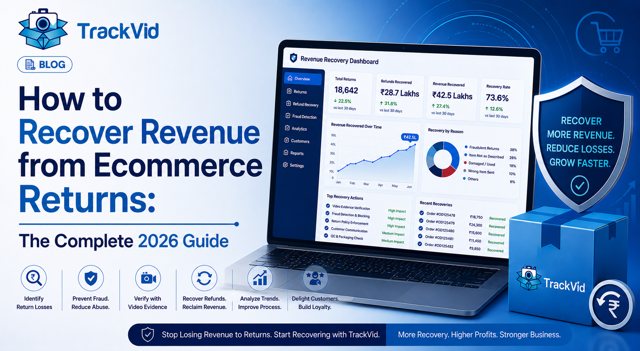
For ecommerce sellers on Amazon, Shopify, eBay, Etsy and global marketplaces. Updated May 2026.
Returns do not have to be pure loss. Most ecommerce sellers treat every return as a cost to absorb and a revenue line to write off. The brands growing fastest in 2026 treat returns as two separate recovery problems, and they are solving both.
The first problem is customer retention: when a buyer returns a product, can you keep the revenue inside the business by converting the return into an exchange, a store credit, or a future purchase? Sixty percent of ecommerce brands now offer free exchanges while restricting cash refunds, according to WiserReview, because the data shows that retained customers have measurably higher lifetime value than refunded ones.
The second problem is fraud claim recovery: when a fraudulent or invalid return is filed, can you recover the loss through a dispute claim? Most sellers write these off without filing. The ones who file with the right evidence recover 65 to 90 percent of fraudulent return losses. The ones without structured evidence recover under 25 percent.
Most guides on how to recover revenue from ecommerce returns cover the first problem in detail and ignore the second entirely. That is where the real money is. For a seller processing 300 orders per day at a 20 percent return rate and a 15 percent fraud rate within those returns, the monthly fraud loss exposure sits at approximately $17,500 at a $65 average order value. With a 25 percent claim win rate, $4,375 is recovered. With a 75 percent win rate and the right evidence system, $13,125 is recovered. The difference, $8,750 per month, is not a marginal improvement. It is a structural change in how the business performs.
This guide covers both recovery streams completely: the customer retention strategies that convert returns into revenue, the inventory recovery methods that extract value from returned product, and the fraud claim recovery system that recovers losses most sellers currently write off.
Understanding the Full Cost of a Return Before You Can Recover It
Recovering revenue from ecommerce returns starts with knowing what you are actually losing. Most sellers know their return rate. Very few know their total cost per return.
Processing an online return costs between $15 and $30 in direct costs, inbound shipping, warehouse labour, inspection, and restocking, according to Claimlane's 2026 return cost analysis. A separate estimate from Pitney Bowes puts the cost at 21 percent of the original order value. At a $65 average order value, 21 percent means $13.65 in processing cost per return, before accounting for any loss on the product itself.
Only 48 percent of returned items are resold at full price, according to Eightx's 2026 benchmark data. The other 52 percent are sold at a discount, liquidated, donated, or destroyed. This means the true cost of a return includes not only the refund and processing overhead but also the margin haircut on resale.
For a brand at 20 percent return rate processing 300 daily orders, that means 60 returns per day. At $20 average processing cost, $1,200 per day in direct costs. Over a month, $36,000 in processing costs alone. At the 52 percent impaired resale rate, a significant additional share of refunded product comes back at below-original margin.
The three categories of revenue recovery address different parts of this cost structure:
Stream 1: Customer retention. Keeping the revenue inside the business by converting the return into an exchange or store credit.
Stream 2: Inventory recovery. Extracting maximum value from returned product through grading, refurbishment, and tiered resale channels.
Stream 3: Fraud claim recovery. Recovering losses from fraudulent or invalid returns through dispute mechanisms on Amazon, Shopify, eBay, card networks, and other platforms.
Most brands have some form of Stream 1 and Stream 2. Almost none have a structured Stream 3. That is where the largest uncaptured recovery sits.
Stream 1: Converting Returns Into Revenue, The Exchange-First Framework
The most direct way to recover revenue from ecommerce returns is to prevent the refund from leaving the business. When a buyer returns a product, a well-designed returns experience offers alternatives to a cash refund that retain the revenue while satisfying the customer.
Exchange-first incentives. Sixty percent of ecommerce brands now offer free exchanges while restricting or charging for cash refunds, according to WiserReview 2026 data. The underlying logic is straightforward: a buyer who exchanges retains a relationship with the brand, retains the revenue, and generates a second fulfillment opportunity. A buyer who receives a cash refund is gone.
Exchange conversion rates improve significantly with incentives. Bonus store credit, offering $10 credit on a $65 return value if the buyer exchanges rather than refunds, converts a meaningful proportion of returns that would otherwise have been cash refunds. The brands winning on revenue retention in 2026 are those that treat returns as a revenue retention moment rather than a cost event, according to Loop Returns' 2026 Global Ecommerce Report.
Store credit over cash refund. Offering store credit of equal or greater value than the refund retains revenue inside the business. Over 60 percent of brands now default to store credit as the primary resolution path, with cash refund as a secondary option, according to WiserReview. For the seller, store credit converts a guaranteed outflow into a likely future purchase.
Instant exchange before return. Some platforms allow merchants to ship the replacement item before the return is received, eliminating the friction of the traditional "return first, then reorder" cycle. Buyers who receive the replacement quickly are significantly more likely to complete the exchange and remain loyal customers.
Returnless resolution for low-value items. For products where the cost of processing the return exceeds the product value, a returnless refund, where the buyer keeps the item and receives a refund or credit, eliminates processing cost entirely. The buyer retains a positive experience and the seller avoids the reverse logistics overhead on an item that cannot be economically restocked.
Stream 2: Recovering Value from Returned Inventory
Not all revenue recovery happens at the buyer interaction stage. A meaningful share of return losses comes from returned product that is either not inspected or not optimally processed for resale.
Return grading and condition verification. The first step to maximising resale value from returned inventory is grading every return at receipt, not blindly issuing a refund and inspecting the product weeks later. Leading operators in 2026 require photo or video documentation of return condition before approving claims, according to Redo's March 2026 industry guide. This single step reduces fraudulent refund approvals, creates a condition record for every item, and enables tiered resale pricing based on actual condition rather than assumed condition.
Tiered resale channels. A graded return can be resold through multiple channels at different price points. A product that comes back in original condition can be relisted at full price. A product with minor cosmetic damage can be relisted as "Grade B" at 70 to 85 percent of original price. A product that is non-functional can be sold for parts or liquidated. Each tier generates more value than a single-channel approach that dumps all returns into liquidation.
Refurbishment for high-value items. For electronics, appliances, and high-value accessories, a professional refurbishment process restores items to a condition that supports full or near-full price resale. The cost of refurbishment, typically $10 to $40 depending on category, is recovered many times over when it enables a $200 return to sell at $170 rather than being liquidated at $40.
Return data as a product improvement signal. The returns your brand receives contain the most honest feedback your customers ever give you. Return reasons mapped by SKU, category, and buyer segment reveal patterns that can reduce future return rates: sizing guide gaps, photography that misrepresents product dimensions, product quality issues in specific components, and listing accuracy problems. Claimlane's 2026 analysis shows that a brand doing $10 million in revenue that reduces its return rate by just 5 percentage points saves approximately $700,000 annually in processing costs and retained revenue.
Every point of return reduction flows directly to contribution margin. At $10 million or more in revenue, a single percentage point is worth $100,000 or more annually in recovered margin, plus avoided processing costs, according to Eightx's 2026 benchmarking data.
Stream 3: Fraud Claim Recovery, The Revenue Stream Most Sellers Ignore
This is the recovery stream that most guides on how to recover revenue from ecommerce returns do not cover. It is also where the most immediately recoverable money sits for the majority of mid-volume sellers.
The structure of the problem is straightforward. A percentage of every seller's returns are fraudulent, swap returns, empty box returns, false damage claims, and invalid non-receipt claims. In 2026, the fraudulent return rate sits at approximately 15.1 percent of all returns, according to eFulfillmentService data. For a seller receiving 60 returns per day, roughly 9 of those returns are fraudulent.
Most sellers do not file claims on these. Some do not detect the fraud. Some detect it but assume the claim will fail. Some file but lose consistently because they have no independent evidence. The result is the same: the loss is written off.
The claim recovery rate depends entirely on evidence quality. Without structured dispatch documentation, the industry average claim win rate on fraudulent returns is under 25 percent, according to TrackVid seller data. With order-linked packing video as primary evidence, that rate climbs to 65 to 90 percent.
The financial implication is significant. At 9 fraudulent returns per day and a $65 average order value, the monthly fraud exposure is approximately $17,550. At a 25 percent win rate: $4,387 recovered. At a 75 percent win rate: $13,162 recovered. The $8,775 monthly difference is the recoverable revenue that most sellers are currently writing off because their evidence system does not support a winnable claim.
What a Fraud Claim Recovery System Requires
Recovering fraudulent return losses through dispute claims requires two operational components. Most sellers have neither.
Component 1: Dispatch evidence, proof of what went out.
An order-linked packing video recorded at the moment of dispatch. When the shipping label is scanned, recording begins automatically. The video captures the correct product being packed for the specific Order ID, with the AWB visible and the product's condition clearly shown. It is linked to the Order ID at the time of recording, timestamped, and stored in indexed cloud.
This is the evidence that wins "materially different," "wrong item returned," and "item not as described" dispute claims across every platform, Amazon A-to-Z, Shopify chargebacks, eBay Resolution Centre, and card network representment. It independently verifies what was dispatched without relying on the seller's written account.
Component 2: Return receipt evidence, proof of what came back.
When a suspicious return arrives, the parcel is weighed before opening, and the opening is recorded on camera in a single continuous take from sealed parcel to fully revealed contents. This creates the second half of the before-and-after evidence chain: dispatch video shows the correct product going out, opening video shows the fraudulent or empty return coming back.
Together, the two videos independently document the fraud. A dispute filed with this evidence package has no credible counter-evidence from the buyer's side. Platforms including Amazon, Shopify, eBay, and card networks evaluate this as primary independently verifiable proof.
How TrackVid Automates Stream 3 Recovery
TrackVid handles Component 1 of the fraud claim recovery system automatically. Every packing event is recorded when the shipping label is scanned. Every video is linked to the Order ID, SKU, and AWB in real time. Every recording is stored in searchable cloud and retrievable by Order ID in under two minutes, inside the response window of every dispute channel.
For Amazon sellers, this means the packing video for any disputed order is available for SAFE-T submission within minutes of the claim arriving. For Shopify sellers, the same video is available for chargeback representment. For eBay sellers, it is ready for the Resolution Centre. For AJIO sellers, TrackVid additionally detects incoming "CCTV required" claim emails and responds automatically, no manual step, no missed windows.
The practical result is that Stream 3 recovery, which most sellers currently achieve at under 25 percent, becomes a systematised process achieving 65 to 90 percent on disputes where the evidence is submitted.
The difference between writing off fraudulent return losses and recovering them is not the merits of your case. It is whether you have evidence that was created before the dispute existed.
This is the revenue stream that the exchange-first frameworks and inventory grading guides do not address. The $8,000 to $15,000 per month that most mid-volume sellers are currently absorbing as unrecoverable fraud losses is recoverable, with the right evidence system in place before the next fraudulent return arrives.
Related: See how TrackVid's automated dispatch evidence system works →
Building Your Complete Return Revenue Recovery Stack
The most effective approach combines all three streams into a coordinated system.
Customer-facing returns experience converts return requests into exchanges and store credit at the highest possible rate, retaining revenue inside the business. This is handled through your returns portal, Loop Returns, ReturnPrime, Redo, or your own custom flow, with exchange-first incentives, store credit bonuses, and clear return policy conditions that guide buyers toward retention before refund.
Return receipt operations grade every returned item on arrival, create condition records, route items into the appropriate resale or refurbishment channel, and use return reason data to feed back into product, listing, and operations improvements. This is a warehouse operations layer, not a software layer.
Fraud claim recovery infrastructure creates dispatch-side and receipt-side evidence for every order, detects fraud at return, files claims with the full two-video evidence package, and tracks claim outcomes by platform to continuously improve the evidence system. This is where TrackVid operates.
The three streams address different parts of the return loss problem. Customer retention addresses willing buyers. Inventory recovery addresses the product. Fraud claim recovery addresses bad actors. Together, they convert what most ecommerce sellers treat as a fixed cost into a recoverable and reducible one.
Five Questions That Tell You How Much Recovery You Are Currently Missing
- What is your current claim win rate on fraudulent returns, as a specific number? If you cannot name it without calculation, you are not tracking the single most important metric in Stream 3 recovery.
- Of the returns you identify as fraudulent this month, what percentage will you file a dispute claim for? If the answer is below 80 percent, you are absorbing fraud losses without attempting recovery.
- Can you retrieve the dispatch packing video for any order from 30 days ago in under two minutes? If not, your Stream 3 evidence does not exist within the response windows of most dispute channels.
- What percentage of your returns are currently converted to exchanges rather than refunded as cash? If you do not know this number, you cannot measure whether your Stream 1 retention is working.
- Of the returned items processed this month, what percentage were resold at full price, at a discount, and at liquidation value? The spread between full-price resale and liquidation determines your Stream 2 recovery efficiency.
Book a free TrackVid Demo Today
In one session, you will see how TrackVid closes the Stream 3 gap, the fraud claim recovery revenue that most sellers are currently writing off, and exactly how much of your current fraud return exposure is recoverable with structured dispatch evidence.
Frequently Asked Questions
How do I get money back from ecommerce returns?
There are three recovery streams. Stream 1, customer retention: convert return requests to exchanges or store credit using incentives, keeping revenue inside the business before a cash refund is issued. Over 60 percent of ecommerce brands now offer free exchanges while restricting cash refunds, with exchange conversion rates improving significantly when bonus credit incentives are offered. Stream 2, inventory recovery: grade returned items on arrival, route them through tiered resale channels based on condition, and use refurbishment for high-value items. Stream 3, fraud claim recovery: file dispute claims with order-linked packing video evidence for fraudulent returns. Sellers using TrackVid's automated evidence system recover 65 to 90 percent of fraudulent return losses through filed claims, compared to under 25 percent for sellers without structured dispatch evidence.
Is it possible to recover revenue lost to ecommerce returns?
Yes, substantially, across all three recovery streams. Customer-facing exchange-first policies retain 40 to 60 percent of return requests as exchanges or store credit rather than refunds, keeping revenue inside the business. Grading and tiered resale recover meaningful value from returned inventory that would otherwise be liquidated. Fraud claim recovery is the most commonly overlooked stream: for a seller at 300 orders per day with a 15 percent fraudulent return rate, improving the claim win rate from 25 percent to 75 percent through structured evidence recovers approximately $8,000 to $10,000 per month that would otherwise be written off. Returning all three streams to efficiency converts ecommerce returns from a fixed cost into a recoverable and reducible one.
What is the best way to reduce revenue lost from returns as an ecommerce seller?
The highest-impact changes by revenue recovered are: first, implement exchange-first return policies with bonus credit incentives, this captures return revenue before it leaves the business and requires only a policy and portal change; second, build order-linked dispatch evidence for every order, this is the infrastructure that enables fraud claim recovery and unlocks Stream 3; third, grade and route returned inventory into tiered resale channels rather than a single liquidation path. The exchange-first change often has the fastest ROI because it affects every return. Dispatch evidence has a compounding ROI because every fraudulent return becomes winnable rather than a write-off.
How do ecommerce sellers recover fraudulent return losses?
By filing dispute claims through the relevant platform or payment processor within the claim window, with order-linked packing video as primary evidence. For Amazon sellers, this means SAFE-T claims or A-to-Z dispute responses with packing video showing the correct product packed for the specific Order ID. For Shopify sellers, chargeback representment with the same video evidence. For eBay, the Resolution Centre. The critical requirement is that the dispatch video was created before the dispute, at the time of packing, linked to the Order ID, timestamped. Evidence created after the dispute arrived has no independent verifiability. TrackVid at trackvid.in automates this dispatch recording for every order, enabling sellers to file and win fraud claim disputes across all platforms simultaneously.
What percentage of ecommerce return losses can actually be recovered?
It depends heavily on the evidence system in place. For Stream 1 retention, exchange-first policies with well-designed incentives convert 40 to 60 percent of return requests into exchanges or store credit, retaining that share of revenue. For Stream 2 inventory recovery, grading and tiered resale can recover 60 to 90 percent of product value compared to outright liquidation, depending on condition. For Stream 3 fraud claim recovery, sellers without structured dispatch evidence recover under 25 percent of fraudulent return losses through claims. Sellers using TrackVid's order-linked packing video recover 65 to 90 percent on disputes where evidence is submitted. Across all three streams combined, the portion of total return losses that is genuinely irrecoverable is significantly smaller than most sellers assume.
Sources: Claimlane How to Reduce Ecommerce Returns 2026, Eightx Average Ecommerce Return Rate 2026, Loop Returns 2026 Global Ecommerce Retention Benchmarks Report, Signifyd Ecommerce Return Optimization February 2026, eFulfillmentService 2026 Ecommerce Trends Return Crisis, Redo Ecommerce Returns Statistics March 2026, WiserReview Ecommerce Return Statistics 2026, Pitney Bowes BOXpoll Return Cost Survey via Signifyd, TrackVid seller data and case studies.
TrackVid is a video proof and claim management platform used by 1,100+ ecommerce sellers globally. Automates the dispatch evidence layer that enables fraud claim recovery, Stream 3 of ecommerce return revenue recovery. Officially authorised by Snapdeal. 85-90% claim win rates on fraudulent return disputes. Learn more at trackvid.in.
Get the Marketplace Claim Recovery Checklist
A 12-point checklist used by 1,100+ sellers to recover 85-90% of marketplace claim losses. Free, instant access.
- Marketplace-specific evidence formats (AJIO, Flipkart, Amazon, Myntra)
- Claim window deadlines for every major platform
- The 6-step process that pushes approval from 85-90%
- Common rejection reasons and how to avoid them
No spam. Unsubscribe anytime. Used by sellers at Rare Rabbit, HRX, Da Milano + 1,100 more.
Stop Losing Money to Fake Returns
Join 1,100+ sellers who recover lakhs every month with TrackVid