
For Indian sellers on Amazon, Flipkart, AJIO, Myntra and Meesho. Updated April 2026.
Most sellers approach ecommerce returns the same way. They look at the return rate, feel frustrated, try to improve product descriptions, and hope next month is better.
That approach solves maybe half the problem.
The other half, and often the more expensive half, is what happens after the return lands back in your warehouse. How much of that loss do you actually recover? What percentage of your claims get approved? And how many of those write-offs were avoidable with the right system?
Returns will always exist in Indian ecommerce. Fashion return rates sit between 25 and 35 percent depending on category. During festive seasons, the number climbs to 40 percent for some sellers. That is not going to change dramatically no matter how good your product photos are.
What can change is how much of that loss you absorb versus how much you recover.
This guide covers both sides. How to reduce returns before they happen, and how to reduce return losses after they do.
Why Returns Are Costing You More Than You Think
Before getting into tactics, the real number needs to land.
Processing a single return costs between 20 and 65 percent of the item's original value, when you account for return shipping, restocking, quality checking, re-labelling, and lost selling days. That math hits hard when your return rate is 25 percent.
For COD orders specifically, return-to-origin rates in India run between 20 and 40 percent. High-risk pincodes and repeat returners drive a disproportionate share of this, with some research suggesting that 40 to 60 percent of RTO losses come from a small group of habitual offenders.
Across all of this, Indian ecommerce sellers collectively lose an estimated ₹2 lakh crore annually to return-related costs. That includes refunds, logistics, and the write-offs that accumulate when claims cannot be proved.
The number is large. But the more relevant number is yours specifically. What percentage of your own return-related losses do you actually recover each month? For most sellers, that answer is somewhere between uncomfortable and unknown.
Part One: Reducing Returns Before They Happen
These five tactics address the most common reasons Indian sellers see high return rates. None of them require expensive tools. Most require only discipline and attention.
1. Get your product content right, actually right
The single biggest driver of returns in Indian ecommerce is expectation mismatch. A customer receives something that does not look or feel like what the product page showed. They return it.
This sounds obvious. But most sellers underestimate how far their product content is from genuinely accurate.
Blurry images shot in poor lighting. Size charts that do not reflect actual garment measurements. Product titles that oversell the material quality. Descriptions that use vague language like "premium fabric" without specifying the composition. Each of these is a return waiting to happen.
Fix the specifics. If you sell kurtas, list the exact fabric percentage (60% cotton, 40% polyester), the actual chest measurement for each size rather than just S/M/L/XL, and photos on a real model with the model's height and the size worn mentioned in the caption. Returns from expectation mismatch drop significantly when the content is genuinely accurate rather than aspirationally accurate.
2. Flag and manage high-risk COD orders
Not all orders carry the same return risk. COD orders have significantly higher RTO rates than prepaid. Within COD, orders from certain pincodes, with certain order values, or from customers with a history of returns, are far more likely to come back.
Most marketplace seller panels give you enough data to identify patterns. Build a simple internal list of pincodes with consistently high RTO rates and either disable COD for those areas or add a confirmation call before shipping. For repeat returners, you can request prepaid payment only, or flag the account for extra verification.
This is not about refusing customers. It is about managing risk intelligently before the shipment goes out rather than absorbing the loss after it comes back.
3. Improve packaging to reduce transit damage returns
A meaningful percentage of returns in Indian ecommerce come back with complaints of damage, and a portion of those are genuine transit damage cases that could have been prevented.
Fragile products, electronics, ceramics, glassware, and even structured garments need packaging that matches what actually happens during last-mile delivery in India. Boxes get stacked, compressed, and sometimes dropped. If your product is arriving damaged regularly, the return rate is showing you a packaging problem, not a customer problem.
Test your packaging end to end. Ship a sample to yourself using the same courier and route. What arrives is what your customer gets.
4. Collect return reason data and use it
Every return carries information. A customer who returns because "product looks different from image" is telling you to fix your photography. A customer who returns because "size too small" is telling you your size chart is off. A cluster of returns citing "quality issue" is a supplier quality signal.
Most sellers collect this data passively and never act on it. Build a simple return reason tracker, even in a spreadsheet, and review it weekly across your top 20 returned products. The patterns will show you exactly where to focus.
One month of consistent return reason analysis will tell you more about your actual product problems than any amount of guesswork.
5. Use customer reviews as a pre-return intervention
When a customer is unsure about a size, a fabric, or a product detail, they either guess and buy, or they leave. If they guess and buy wrong, they return.
Customer reviews, particularly photo reviews from verified buyers, significantly reduce this guessing. A photo of a real customer wearing your kurta in a specific size, posted alongside a review that says "fits true to size, I am 5'4 and bought medium," removes the uncertainty that causes a return before it happens.
Actively request photo reviews after purchase. Incentivise them within platform guidelines. They are one of the most efficient return-reduction tools available to Indian sellers, and most do not use them systematically.
A Seller Story From Delhi That Changes the Framing
Vikram runs an apparel business from Delhi. He sells on Amazon and Myntra, about 350 orders a day in normal months, higher during sales.
He spent six months improving his product content. Better photography, accurate size charts, revised descriptions. His return rate dropped from 31 percent to around 24 percent. That was a genuine improvement and worth every rupee spent on it.
But when he sat down to calculate his monthly return-related loss, something surprised him. Even at 24 percent returns, his actual financial damage was not going down proportionally.
The reason was in his claims.
Of the returns that involved wrong items, damaged products, or swap fraud, he was successfully claiming back less than 20 percent of the eligible amount. The rest was written off. Not because the fraud did not happen. Because he could not prove what he had originally packed and shipped.
His return rate problem was half solved. His return loss problem was untouched.
This is the second half of the conversation that almost nobody in Indian ecommerce is having.
Part Two: Reducing Return Losses After They Happen
Reducing your return rate from 30 percent to 24 percent is meaningful. But if your claim success rate stays at 20 percent, you are still absorbing most of the fraud loss.
The sellers who genuinely reduce their return-related financial damage work on both sides simultaneously. They prevent what they can, and they build systems to recover what they cannot prevent.
Here is what the recovery side looks like in practice.
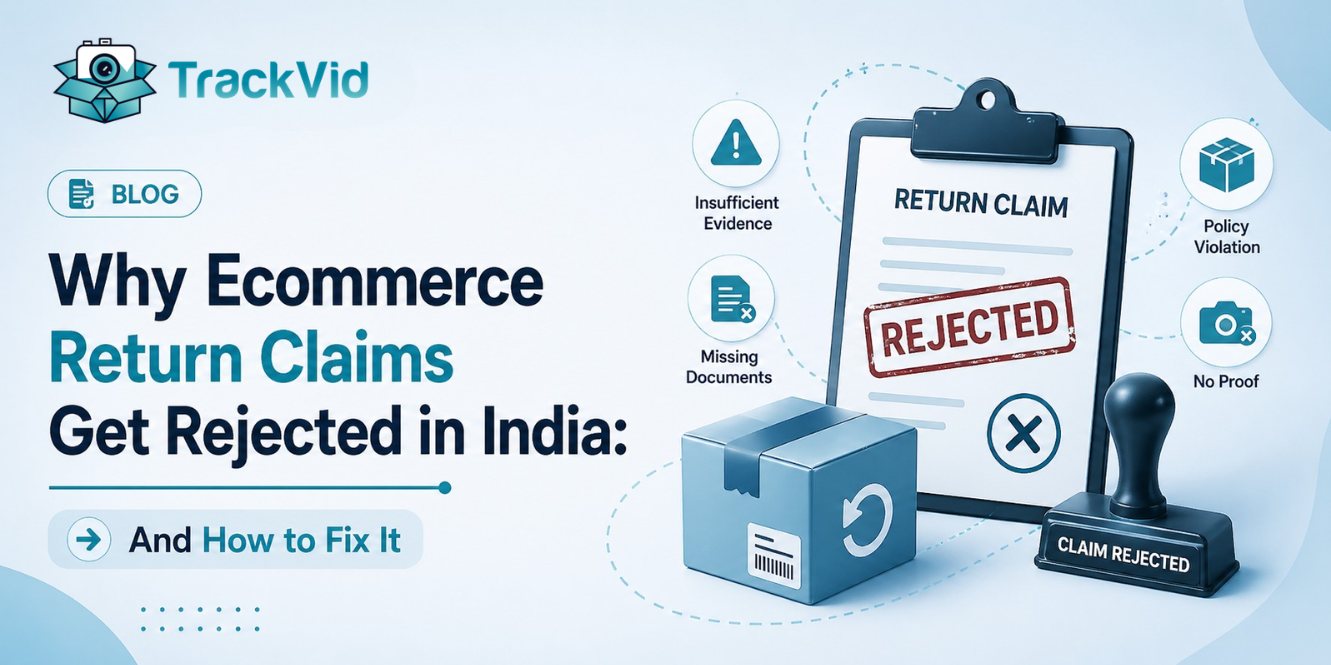
Understand why claims get rejected
When a return arrives with the wrong product inside, or with a damaged item that was not damaged when packed, the seller's instinct is to file a claim. The claim gets rejected. The seller concludes that claims do not work.
The real reason claims fail is not that platforms ignore them. It is that the proof submitted is not structured enough to be verified.
Photos of the wrong item that came back do not prove what was originally sent. A handwritten complaint does not prove anything. CCTV footage, which most sellers assume is sufficient, is almost never accepted because it is not linked to a specific Order ID, not searchable by order, and not retrievable within the claim window of 24 to 48 hours.
The marketplace standard for a successful claim is video proof of the packing, linked to the specific Order ID, recorded at the time of packing. Most sellers simply do not have this. So claims fail, and the loss gets written off.
Build a proof system at the packing stage
The sellers who consistently win return claims do not fight harder after the dispute. They build their evidence before the dispute happens.
Every order that leaves their warehouse is recorded at the moment of packing. The video is automatically linked to the Order ID, SKU, and AWB number at the time of recording, not reconstructed later. When a return comes in and they need to file a claim, they search the Order ID, the video loads in seconds, and they submit structured proof.
The result is a claim success rate that is fundamentally different from sellers relying on CCTV or photo evidence.
Read more: VMS for Ecommerce, how Indian sellers are winning fake return claims
This is exactly what TrackVid does for Indian marketplace sellers.
TrackVid is a video proof and claim management platform built specifically for sellers on Amazon, Flipkart, AJIO, Myntra, and Meesho. It works with your existing cameras, links every packing video to every order automatically, and stores everything in searchable cloud storage. When a dispute arises, the retrieval takes seconds, not hours.
For AJIO sellers, this matters in an even more specific way. AJIO requires order-level packing video for claims, and without it, claims are often rejected automatically before any human review. TrackVid's automation detects the "CCTV required" emails from AJIO and responds with the correct video proof without any manual effort from your team.
The shift this creates is from absorbing fraud losses to recovering them. Sellers using structured video proof report claim success rates that are dramatically higher than the industry average of under 25 percent.
TrackVid converts every packing video into usable, structured evidence that marketplaces accept. That is the difference between a recording and a proof system.
Four Questions to Audit Where Your System Stands Right Now
Answer these honestly before assuming your current operations are protecting you.
- Can you retrieve the packing video for a specific order from last week right now, in under two minutes, by searching the Order ID? If the answer is no, you have surveillance footage. You do not have a proof system.
- What is your claim success rate this month, as a specific number? If you cannot name it, your return losses are invisible to you. Invisible losses do not get fixed.
- When a customer flags a return as "wrong item received," how long does it take your team to find and submit the packing proof to the marketplace? If the answer is longer than a few hours, you are losing claims that were winnable.
- If your order volume doubled next month, would your return management process hold without breaking? If no, your ceiling is operational, not commercial.
These questions point to exactly where recoverable revenue is sitting uncollected every month.
The Number That Should Change How You Think About This
Reducing your return rate from 30 percent to 25 percent is a five percentage point improvement. That is worth pursuing.
But if you simultaneously increase your claim success rate from 20 percent to 70 percent on the returns that do happen, the financial impact of that second change is often larger than the first.
Most sellers spend all their energy on prevention and almost none on recovery. The sellers who are genuinely protecting their margins in Indian ecommerce are working both levers at the same time.
The goal is not zero returns. The goal is to stop writing off losses that a structured system could recover.
See How a Proof System Works in Your Operations
TrackVid works with your existing warehouse cameras. Setup takes under 15 minutes. And the revenue recovered from claims in the first few months typically covers the cost many times over.
If you are selling on Amazon, Flipkart, AJIO, or Myntra and seeing consistent claim rejections, or if you simply do not know your actual recovery rate, one session is usually enough to see exactly where the gaps are.
Book a free TrackVid Demo Today
In that session, you will see precisely where your return-related losses are going and what a structured recovery system looks like in your specific operation. See pricing plans that fit your monthly volume.
Frequently Asked Questions
What is the average ecommerce return rate in India?
Return rates in Indian ecommerce average around 17 percent overall, but fashion and footwear categories see rates of 25 to 35 percent year-round. During festive sale seasons, return rates can climb to 40 percent for some sellers.
What causes high return rates in Indian ecommerce?
The most common causes are expectation mismatch (product looks different from listing), sizing issues, COD order cancellations at the door, transit damage, and return fraud where customers send back a different product. Fashion has the highest return rates because customers cannot try products before buying.
How do I reduce COD returns in ecommerce?
Flag high-risk pincodes and disable COD for areas with consistently high RTO rates. Identify repeat returners and request prepaid payment from those accounts. Use confirmation calls before shipping high-value COD orders. Accurate product descriptions and realistic imagery also reduce COD return rates significantly.
Why do ecommerce return claims get rejected?
Most claims are rejected because the proof submitted is not order-linked or structured enough for marketplace verification. Photos of returned items do not prove what was originally packed. CCTV footage is rejected because it is not searchable by Order ID and cannot be retrieved within the claim window. Marketplaces require video proof linked to the specific order at the time of packing.
What is the best way to win return claims on Amazon and AJIO?
Record every order packing with video that is automatically linked to the Order ID, SKU, and AWB at the time of packing. When a dispute arrives, retrieve the specific video by Order ID and submit it as structured proof. For AJIO specifically, respond to "CCTV required" emails within the claim deadline. TrackVid automates this entire process for Indian marketplace sellers.
Can reducing returns actually improve my profit margins?
Yes, meaningfully. A return costs 20 to 65 percent of the item's original value to process. Cutting your return rate by even 5 percentage points and recovering 50 percent more on the claims that do happen typically adds 8 to 15 percent back to your monthly margin. The compounding effect of working both prevention and recovery is what separates sellers who scale profitably from those who scale into losses.
Sources: Instamojo India ecommerce returns data, Pragma RMS research, Shopify India, National Retail Federation returns report, TrackVid internal seller data.
TrackVid is a video proof and claim management platform used by 1,100+ Indian ecommerce sellers on Amazon, Flipkart, AJIO, Myntra and Meesho. Officially authorised by Snapdeal. Learn more at trackvid.in.




Get the Marketplace Claim Recovery Checklist
A 12-point checklist used by 1,100+ sellers to recover 85-90% of marketplace claim losses. Free, instant access.
- Marketplace-specific evidence formats (AJIO, Flipkart, Amazon, Myntra)
- Claim window deadlines for every major platform
- The 6-step process that pushes approval from 85-90%
- Common rejection reasons and how to avoid them
No spam. Unsubscribe anytime. Used by sellers at Rare Rabbit, HRX, Da Milano + 1,100 more.
Stop Losing Money to Fake Returns
Join 1,100+ sellers who recover lakhs every month with TrackVid