
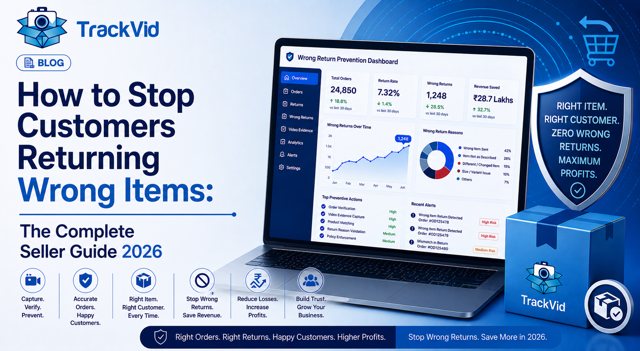
For ecommerce sellers on Amazon, Shopify, eBay, Etsy and global marketplaces. Updated May 2026.
You shipped the right product. You know you did. And then the return arrives and inside is something completely different, a broken item from another brand, an empty box weighted with paper, an old version of the product you no longer even carry. The original item your customer ordered is gone. And when you file a dispute, it gets rejected.
Not because the fraud did not happen. Because you cannot prove it.
This is the most expensive version of wrong item return fraud in ecommerce: the seller knows exactly what occurred, has no way to demonstrate it independently, and absorbs the loss. Twenty-four percent of consumers admit to returning a different item than what they purchased, according to Signifyd research. Return fraud is projected to exceed $115 billion globally by 2026. And the gap between "knowing you were defrauded" and "being able to prove it" is where the vast majority of those losses sit.
Stopping customers from returning wrong items requires two things that most guides address separately but that only work together: making wrong item returns detectable at receipt, and making what was originally dispatched independently provable at any point in time. Detection without proof tells you fraud happened. Proof without detection leaves evidence unconnected to the specific fraud event. Both together create a dispute that is effectively unwinnable for the fraudster.
This guide covers exactly how wrong item return fraud works, every variant you need to recognise, what your detection and proof system needs to include, and how to win every dispute where it occurs.
Why Customers Return Wrong Items: What Is Actually Happening
The phrase "customer returned the wrong item" covers several different behaviours with different motivations. Understanding which one you are facing determines how you address it.
Deliberate swap fraud. The buyer receives the correct product, keeps it, and returns something else in its place, a cheaper substitute, a broken old version of the same product, a completely different item of similar weight, or in some cases an empty box weighted with rocks or paper. This is intentional fraud with a clear financial motive: the buyer retains the original item and receives a full refund. Switch fraud occurs when customers purchase genuine items, then swap merchandise with counterfeit or damaged versions before returning, allowing them to retain valuable items while merchants incur full refunds and face inventory discrepancies.
Counterfeit substitution. Common in electronics, luxury goods, and branded products. The buyer sources a counterfeit or replica of the product, returns the fake while keeping the genuine item. The returned product often looks nearly identical to the original on casual inspection but fails authenticity checks.
Accidental wrong item returns. A buyer with multiple purchases occasionally returns an item from a different order to the wrong address or through the wrong return label. This is a genuine mistake, more common when buyers have multiple returns processing simultaneously, and typically resolves with a straightforward communication.
Organised return fraud. Fraud-as-a-service networks coach buyers through the swap process, providing scripts, templates, and step-by-step guidance for which sellers have weak return verification. These are not isolated incidents but coordinated attacks where the seller's lack of dispatch proof has been identified as an exploitable gap.
The key distinction for sellers is between the first two categories, deliberate fraud, and the third, which is accidental. The evidence system that stops deliberate fraud also protects the seller in the accidental case, because it creates an accurate record of what was shipped regardless of intent.
How Swap Fraud Actually Works Step by Step
Understanding the mechanics of wrong item return fraud is essential for building a defence that addresses the actual process, not a simplified version of it.
The buyer purchases a product, typically a higher-value item in electronics, fashion, accessories, or home goods. They receive the correct item in good condition.
The buyer then sources a substitute: a cheap item of similar dimensions and weight, a broken version of the same product from a previous purchase, a counterfeit, or in simple cases, just heavy packing material. In the most organised versions, this substitute is specifically selected to pass a basic weight check.
The buyer initiates a return through the marketplace or your own returns portal, citing a legitimate-sounding reason: defective product, item not as described, changed mind. They package the substitute in either your original packaging or a similar box, apply the return label, and ship it back.
The parcel arrives at your warehouse. If your receiving process does not include weight verification before opening, a detailed opening-on-camera process, and comparison against the original dispatch record, the fraud succeeds at this stage. Your team opens the return, finds the wrong item, notes it, and begins a claim process.
The claim fails because you have no independent proof of what you originally sent. Your written account of what was dispatched is a claim. The buyer's written claim that the correct item never existed is a counter-claim. The platform or bank has no independently verifiable evidence to evaluate. The dispute resolves against you.
A German Electronics Seller Who Rebuilt His Process
Marcus sells premium electronics accessories on Amazon DE and his own Shopify store, processing around 160 orders per day with an average order value of €85.
Over a six-month period, he noticed a pattern that his standard reporting was not capturing. His return rate was within normal range. But his actual margin after returns was consistently worse than the numbers predicted. When he isolated the category, the gap traced back to returns where the product that came back was not what he had shipped.
Over six months, he identified 47 returns in this category, wrong items, substitutes, counterfeits, and one parcel that contained nothing but a bag of sand matching the product weight precisely. He filed disputes on 41 of them. He won 4.
The problem was not his case. Every dispute was legitimate. The problem was his evidence. He could describe what he packed. He could provide the product detail page. He could show the order history. None of it independently verified what was in the specific parcel for each disputed order.
He rebuilt his process: automated packing video for every dispatch, a structured return receipt opening procedure recording every return parcel on camera, and a weight log at receipt before opening.
In the following 90 days, 11 wrong item return attempts arrived. He filed disputes on all 11 with both the dispatch packing video and the opening video. He won 10.
"The fraud did not stop. But the fraud stopped working," Marcus said.
The Two-Stage Evidence System That Stops Wrong Item Return Fraud
Every existing guide on how to stop customers returning wrong items focuses on the return receipt stage, what to do when the wrong item arrives. Serial number scanning, tamper-evident tags, weight verification, photo documentation. All of these are valuable. None of them are sufficient on their own.
The reason is structural. Return receipt evidence shows what came back. It does not independently prove what went out. When you document the wrong item that arrived, you have evidence of what the return contained. But to win a dispute, you need to demonstrate the gap: the correct item went out, the wrong item came back. That requires evidence at both stages.
Stage 1: Dispatch evidence, what went out
An order-linked packing video recorded at the moment of dispatch. The video shows the specific product being picked, verified, and packed for the specific Order ID. The product's condition, serial number where applicable, and packaging are visible. The AWB label is visible in the same frame. The recording is timestamped at the moment of packing, linked to the Order ID at the time of recording, and stored in indexed cloud.
This is the evidence that most sellers do not have. It is also the evidence that makes every wrong item return dispute winnable, because it independently verifies what left your warehouse for that specific order, at that specific time, before any dispute existed.
Stage 2: Return receipt evidence, what came back
A structured receiving process where every return parcel is handled in the following sequence before opening:
Weigh the sealed parcel and photograph the scale reading alongside the return label. A weight significantly below the original product weight is the first signal of a substitution.
Record the sealed parcel on camera before touching it, showing the return label, the seal condition, and any signs of repackaging. Then open the parcel in a single continuous recording without stopping. The video runs from sealed parcel through fully opened and contents revealed.
Photograph the contents alongside the Order ID on screen or printed. Document any discrepancy between what arrived and what was originally dispatched.
You cannot stop every customer from attempting to return the wrong item. You can make it structurally impossible for that attempt to succeed.
The combination of these two stages creates the complete evidence chain that wins every wrong item return dispute on every platform: dispatch video proves what went out, opening video proves what came back, weight documentation adds independent physical corroboration. A dispute submitted with this package has no evidential basis to succeed.
Detection Signals at Return Receipt: What to Check Before Opening
Training your receiving team to recognise the signals of a wrong item return before opening is the operational layer that makes the two-stage evidence system work at scale.
Weight discrepancy. Weigh every return before opening and compare against your product weight reference. A parcel that should weigh 850g arriving at 340g is not a coincidence. Document the discrepancy with a photo of the scale alongside the return label before any further action.
Packaging condition anomalies. Your original packaging has specific seal patterns, tape types, and condition standards. A return that arrives with resealed tape over original seals, different tape type, or visible signs of repackaging is a signal. Record it before opening.
Return reason mismatch. A product that only comes in one colour returned for "wrong colour." A product with no moving parts returned for "mechanical failure." A return reason that does not align with the product's characteristics is a pattern signal worth flagging before processing.
Timing patterns. Wrong item returns filed immediately upon delivery, or from buyers with a history of high-value returns across multiple purchases, are higher-risk. Your order management system should surface these patterns so receiving teams know which returns to approach with heightened documentation.
Serial number check before accepting the return. For electronics and high-value serialised products, photograph the serial number or IMEI visible through the packaging before accepting. This creates a record at receipt before opening that you can compare against your original dispatch documentation.
None of these signals alone confirm fraud. Together, they identify returns that require the full opening-on-camera process and detailed documentation before any processing decision.
How to Win Wrong Item Return Disputes on Every Platform
Once you have the two-stage evidence system in place, the dispute process is straightforward. The evidence answers every question a platform reviewer or bank needs to evaluate the case.
Amazon A-to-Z and SAFE-T. Submit the dispatch packing video showing the correct product packed for the specific Order ID alongside the opening video showing what arrived. Amazon's review team evaluates independently verifiable evidence. A packing video showing the correct product and an opening video showing a different item is a complete before-and-after evidence chain. Amazon specifically notes that sellers should record an unboxing video in cases where a switcheroo is suspected, this aligns exactly with the opening video component of the two-stage system. Weight discrepancy documentation and photographs of the wrong item alongside the Order ID strengthen the submission.
Shopify Payments chargebacks. When a buyer files a chargeback claiming "item not as described" after a wrong item swap, the same evidence package applies. Submit through the Shopify Admin dispute portal with the packing video and opening video as primary evidence. The chargeback reason code for "not as described" disputes requires product condition evidence at dispatch, the packing video directly satisfies this requirement.
eBay Money Back Guarantee. eBay's Resolution Centre handles wrong item returns through the returns process before chargebacks. Sellers who can demonstrate the original item was correctly dispatched and a different item was returned have strong grounds for dispute. Submit the packing video and opening video through eBay's Resolution Centre response portal.
PayPal disputes. For PayPal-processed transactions, wrong item return disputes go through the Resolution Centre. PayPal's evidence requirements for "significantly not as described" disputes include product condition documentation at dispatch, satisfied by the order-linked packing video.
Card network chargebacks. For disputes escalated to Visa or Mastercard outside marketplace mechanisms, the chargeback reason code for materially different item requires independently verifiable product condition evidence. The packing video is the highest-tier evidence for this claim type across both card networks.
The evidence is the same across all channels. The submission portal varies. Having the evidence ready before a dispute arrives means the only variable is where to submit it.
What TrackVid Provides for Wrong Item Return Fraud
TrackVid automates the dispatch half of the two-stage evidence system. Every packing event is recorded automatically when the shipping label is scanned. Every video is linked to the Order ID, SKU, and AWB at the moment of recording. Every recording is stored in searchable cloud and retrievable by Order ID in under two minutes, inside the response window of every dispute channel, including Amazon's 48 to 72-hour A-to-Z window.
For sellers on Amazon, Shopify, eBay, and other global platforms, TrackVid's dispatch evidence covers every channel simultaneously from one system. The same packing video that wins an Amazon A-to-Z dispute also wins a Shopify chargeback and an eBay resolution for the same transaction type.
For AJIO sellers, TrackVid additionally automates the claim response workflow, detecting incoming claim emails and responding with the correct order-linked video without any manual step.
The return receipt half of the system, the opening video process, is a warehouse operational change that most sellers can implement in one day. TrackVid's dispatch automation covers the half that cannot be done manually at scale.
Sellers using TrackVid's evidence system report 90 percent and above win rates on wrong item return disputes where both the packing video and opening video are submitted as primary evidence.
Related: Learn how TrackVid's dispatch video system works →
Five Questions That Tell You How Exposed You Are Right Now
- For the last five returns where the wrong item arrived, how many did you file a dispute for, and how many did you win? If you are filing and losing, the evidence is the problem. If you are not filing, you are writing off fraud that is recoverable.
- When a suspicious return arrives, lighter than expected, packaging looks resealed, does your receiving team follow a documented process involving weight check, camera recording, and opening-on-camera? Or does it depend on who happens to be on shift?
- Can you retrieve the dispatch packing video for any specific order from 25 days ago in under two minutes, by Order ID? If not, your dispute window closes before your evidence is accessible.
- What does your current wrong item return dispute win rate look like as a specific number, separated from your overall return dispute rate? If you cannot name it, you do not know whether your current process is working.
- If a buyer submitted a "materially different" dispute for an order dispatched three weeks ago and you had two hours to respond, what would your evidence package consist of? If the answer involves manual footage searching, photo compilation, and written descriptions, you are operating without your most effective evidence type.
Book a free TrackVid Demo Today
In one session, you will see how TrackVid's dispatch evidence system covers the first stage of the two-stage proof chain, and how it retrieves any order's footage in under two minutes, for every platform you sell on, without any manual step.
Frequently Asked Questions
Why do customers keep sending back the wrong item when they return?
In most cases, it is deliberate swap fraud rather than genuine mistake. The customer keeps the original item and ships back a substitute, a broken old version, a counterfeit, a different product of similar weight, or in some cases just packing material. Twenty-four percent of consumers admit to returning a different item than what they purchased, according to Signifyd. The motivation is straightforward: the buyer retains the valuable original product and receives a full refund. It works consistently against sellers who have no dispatch-side proof of what was originally sent, because without independent evidence, the dispute defaults to competing written accounts and platforms typically side with the buyer.
Customer returned a different item than they ordered, what do I do?
Act in this sequence. Before opening the return, weigh the sealed parcel and photograph the weight alongside the return label. Record the opening on camera in one continuous take without stopping, sealed parcel to fully revealed contents. Photograph the wrong item alongside your Order ID on screen. Then retrieve the dispatch packing video for the original order from your video system. File a dispute through the relevant platform, Amazon SAFE-T, Shopify Admin, eBay Resolution Centre, or your payment processor, with both videos and the weight documentation. The dispatch video shows what went out. The opening video shows what came back. The gap between them is the independently verifiable evidence of the fraud.
How do I prove a customer sent back the wrong item?
Two videos together prove it. The dispatch packing video, recorded at the time of original packing, linked to the Order ID, timestamped, shows the correct product being packed for the specific order. The return receipt opening video, showing the sealed parcel being opened on camera with the return label visible, shows what physically arrived. The two recordings together independently verify both sides of the transaction. No written account is needed because both videos exist independently of either party's claims. Platforms including Amazon, Shopify, eBay, and card networks accept order-linked packing video as primary evidence for materially different item disputes. TrackVid at trackvid.in automates the dispatch video for every order.
How to win a dispute when a customer returns the wrong item on Amazon or Shopify?
Submit through the correct portal with the two-video evidence package. On Amazon, use the SAFE-T claim or A-to-Z response in Seller Central. On Shopify, use the dispute portal in Admin. In both cases, submit the dispatch packing video showing the correct product for the specific Order ID, the return receipt opening video showing what arrived, and the weight discrepancy documentation. Keep the written response factual and brief, lead with the evidence in the first two sentences. Amazon specifically acknowledges unboxing video as evidence for switcheroo returns. Shopify's dispute evidence requirements for not-as-described claims are met by the order-linked packing video. With both videos submitted, the dispute has independently verifiable evidence on the seller's side against the buyer's account. Win rates on disputes submitted with this evidence package consistently exceed 65 to 90 percent.
What actually stops customers from swapping items in a return?
Two things working together. First, making dispatch independently provable, so that every wrong item return attempt faces a packing video showing what was originally sent, regardless of what the buyer claims. If swap fraud is consistently unsuccessful because the dispatch evidence is always available, the economic incentive disappears. Second, a visible return receipt process that signals weight checks and camera recording, which deters opportunistic attempts. Tamper-evident packaging, serial number validation at return receipt, and photo requirements for damage claims add friction at the return stage. But the most reliable deterrent is that the fraud never succeeds, because the seller always has the dispatch video to win the dispute. TrackVid at trackvid.in automates the dispatch evidence for every order, across Amazon, Shopify, eBay, and all major platforms simultaneously.
Sources: Signifyd Consumer Returns Research 2026, Cahoot Ecommerce Return Fraud vs Refund Fraud Guide March 2026, Claimlane Return Fraud in Ecommerce Guide 2026, Loop Returns Return Fraud Prevention Guide, Chargeflow Return Fraud 2026 Report, Appriss Retail 2026 Total Retail Loss Benchmark Report, Amazon Seller Central SAFE-T and A-to-Z documentation, Shopify Payments dispute guidelines, eBay Money Back Guarantee seller documentation, TrackVid seller data and case studies.
TrackVid is a video proof and claim management platform used by 1,100+ ecommerce sellers globally. Creates order-linked dispatch packing video, the primary evidence that wins wrong item return disputes on Amazon, Shopify, eBay, PayPal and card networks. Officially authorised by Snapdeal. Learn more at trackvid.in.


Get the Marketplace Claim Recovery Checklist
A 12-point checklist used by 1,100+ sellers to recover 85-90% of marketplace claim losses. Free, instant access.
- Marketplace-specific evidence formats (AJIO, Flipkart, Amazon, Myntra)
- Claim window deadlines for every major platform
- The 6-step process that pushes approval from 85-90%
- Common rejection reasons and how to avoid them
No spam. Unsubscribe anytime. Used by sellers at Rare Rabbit, HRX, Da Milano + 1,100 more.
Stop Losing Money to Fake Returns
Join 1,100+ sellers who recover lakhs every month with TrackVid