
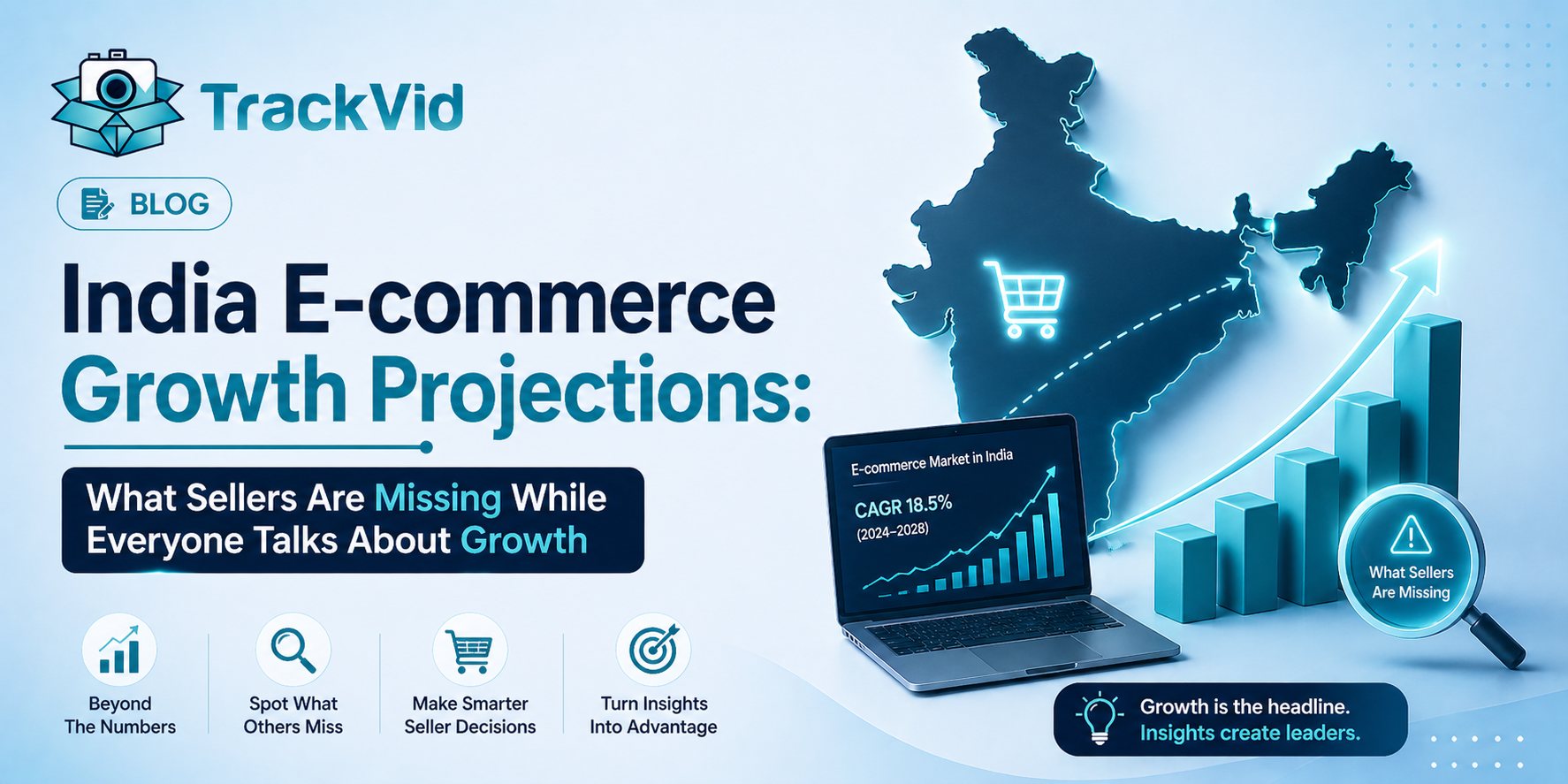
India e-commerce growth projections show the market crossing $200 billion by 2026 and heading toward $350 billion by 2030, driven by Tier 2 and Tier 3 demand, logistics expansion, and mobile-first buyers. But growth does not automatically mean higher profit for sellers.
Most sellers are celebrating order volume while quietly bleeding 8% to 15% of revenue through returns, disputes, and operational inefficiencies.
That gap is where the real story is.
The Problem Nobody Talks About in India E-commerce Growth
Everyone is quoting market size. Nobody is talking about margin erosion.
India e-commerce growth projections look incredible on paper. Reports from Invest India and RedSeer Consulting show aggressive expansion.
But here is the ground reality:
- More orders means more returns
- More COD orders means higher fraud risk
- More competition means thinner margins
If your backend systems are weak, growth amplifies your losses.
Growth without control systems turns revenue into leakage at scale.
What India E-commerce Growth Projections Actually Mean
India e-commerce growth projections are driven by three major shifts:
1. Tier 2 and Tier 3 Explosion
Cities beyond metros are contributing over 60% of new customers (RedSeer).
These buyers:
- Prefer Cash on Delivery
- Have higher return rates
- Are more price-sensitive
This directly increases operational risk.
2. Logistics and Faster Delivery
Companies like Delhivery and Ecom Express are enabling faster shipping across India.
Good for customer experience.
Bad for sellers who are not tracking fulfillment accuracy.
3. Marketplace Dependency
Platforms like Amazon and Flipkart dominate distribution.
But:
- They control dispute resolution
- They demand proof
- They rarely side with sellers without evidence
Indian Seller Story: The Reality Behind Growth
A D2C apparel seller in Surat scaled from 300 orders/day to 1,200 orders/day in 8 months.
Revenue went up.
Profit did not.
Here is what happened:
- Return rate jumped from 18% to 28%
- "Item missing" claims increased
- Marketplace disputes doubled
- Monthly loss: ₹6–8 lakhs
The founder initially blamed logistics.
Then customers.
Then platforms.
But the real issue was simple:
They had zero proof system.
Data Behind India E-commerce Growth Projections
Let's break the numbers with sources:
- India e-commerce market expected to reach $200B by 2026 (Invest India)
- Projected CAGR of 18% to 22% through 2030 (RedSeer)
- Return rates in fashion category: 25% to 40% (industry estimates, RedSeer)
- COD orders still make up 50%+ in many categories (industry reports)
Now combine this:
More orders + high returns + weak proof = predictable loss
In India e-commerce, returns are not an exception. They are a cost center.
India E-commerce Growth Projections and Hidden Risks
India E-commerce Growth Projections Increase Fraud Exposure
As volume increases, fraud scales with it.
Common patterns:
- Empty box claims
- Wardrobing in fashion
- Item swapping
Without proof, sellers lose disputes automatically.
India E-commerce Growth Projections Increase Operational Errors
Packing mistakes rise with volume.
At 100 orders/day, you can manage manually.
At 1,000 orders/day, you cannot.
Mistakes become systemic.
India E-commerce Growth Projections Increase Platform Pressure
Marketplaces are tightening policies.
They expect:
- Video proof
- Timestamp validation
- Order-level evidence
No proof = no reimbursement.
What Smart Sellers Are Doing Differently
The difference is not effort.
It is systems.
Smart sellers:
- Track every order at packing level
- Link proof to Order ID and AWB
- Store evidence in searchable format
- Respond to disputes quickly
They treat operations like a system, not a process.
Where Most Sellers Still Get It Wrong
They think recording videos is enough.
It is not.
Problems with typical setup:
- Videos are not linked to orders
- Files are hard to retrieve
- No structured proof format
- Manual claim filing
This breaks under scale.
The Shift from Recording to Proof Systems
This is where most sellers need to wake up.
Recording is passive.
Proof is actionable.
If your video cannot win a dispute, it is useless.
How TrackVid Fits into This Problem
This is where TrackVid comes in, but not as a camera tool.
TrackVid is a proof system.
TrackVid converts every packing video into structured, order-linked proof that marketplaces accept.
TrackVid links every order to its packing video at the moment of packing.
TrackVid removes manual effort from claim filing, especially for platforms like AJIO.
You can check how it works here.
Or directly see it in action: book a free demo.
This is not about recording.
It is about recovering lost revenue.
Self-Diagnosis: Are You Actually Ready for Growth?
Ask yourself honestly:
- Can you pull a packing video for any order in under 30 seconds?
- Do your videos clearly show SKU, packaging, and sealing?
- Are your dispute claims getting accepted consistently?
- Do you know how much revenue you lose to returns monthly?
- Is your system scalable beyond your current order volume?
If the answer is no to even two of these, your growth is fragile.
FAQ: India E-commerce Growth Projections
What are India e-commerce growth projections for 2030?
India e-commerce is expected to reach $350 billion by 2030 with strong growth from non-metro cities. This growth increases both opportunity and operational complexity for sellers. Platforms demand better proof systems as volume rises.
Why are India e-commerce growth projections important for sellers?
They show where demand is going, but also highlight operational risks. More orders bring more returns and disputes. Tools like TrackVid help sellers manage this scale effectively.
How does growth affect return fraud in India e-commerce?
As order volume increases, fraud scales proportionally. Categories like fashion see higher abuse rates. Sellers without proof systems lose claims regardless of fault.
How can sellers prepare for India e-commerce growth projections?
They need to build systems, not processes. This includes proof tracking, structured data, and automated claim workflows. TrackVid helps convert packing activity into usable proof.
What is the biggest risk in India e-commerce growth?
Margin erosion. Many sellers grow revenue but lose profit due to returns, errors, and disputes. Without visibility, losses go unnoticed.
Do marketplaces support sellers in disputes?
Only when proof is clear and structured. Marketplaces prioritize customer trust. Sellers need strong evidence systems to win claims consistently.
Final Thought
India e-commerce growth projections look exciting.
But growth alone is not a strategy.
If your backend cannot support scale, you are just increasing your losses faster.
The winners in this market will not be the fastest growing sellers.
They will be the ones who control their operations.
Book a free TrackVid Demo Today
In one session you will see exactly where your recoverable revenue is going.

Get the Marketplace Claim Recovery Checklist
A 12-point checklist used by 1,100+ sellers to recover 85-90% of marketplace claim losses. Free, instant access.
- Marketplace-specific evidence formats (AJIO, Flipkart, Amazon, Myntra)
- Claim window deadlines for every major platform
- The 6-step process that pushes approval from 85-90%
- Common rejection reasons and how to avoid them
No spam. Unsubscribe anytime. Used by sellers at Rare Rabbit, HRX, Da Milano + 1,100 more.
Stop Losing Money to Fake Returns
Join 1,100+ sellers who recover lakhs every month with TrackVid