
For online sellers and D2C brands on Shopify, Amazon, eBay, and global marketplaces. Updated May 2026.
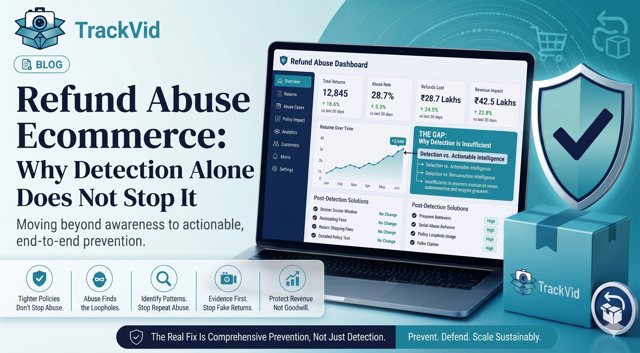
Refund abuse ecommerce is now the top attack type for 47 percent of global merchants, according to the Merchant Risk Council's 2026 Global eCommerce Payments and Fraud Report. It surpassed payment fraud as the primary concern for nearly half the merchants surveyed. And unlike payment fraud, which checkout tools are designed to catch, refund abuse operates entirely in the territory those tools cannot reach.
The distinction matters because most merchants treat refund abuse as a customer service problem rather than a fraud problem. They tighten return windows. They add restocking fees. They write stricter policies. These steps reduce legitimate return friction. They do not stop the customers who know exactly how to stay inside policy language while systematically extracting value from it.
Refund abuse is not a policy problem. It is an evidence problem. The customers committing it are operating within the letter of your return policy. The only way to contest their claims is to have order-level documentation that proves what was dispatched. Without it, every contested refund abuse claim defaults in the customer's favour because the merchant has no independent verification of what left their warehouse.
Why Refund Abuse Is Harder to Stop Than Payment Fraud
Payment fraud is detectable at the transaction level. Device fingerprinting, velocity checks, and behavioral scoring identify patterns that do not match legitimate buyer behavior. The fraud signal exists before the order ships.
Refund abuse has no fraud signal at checkout. The buyer is real. The card is valid. The transaction is genuine. The behavior that makes it abuse happens after fulfillment, across the return process, and often within the explicit terms of the merchant's own policy.
According to Signifyd's State of Commerce 2026, return abuse surged 64 percent between January 2024 and May 2025. Across the same period, 57 percent of merchants reported rising refund and policy abuse, according to MRC data. These numbers are rising because the tactics are working. The majority of contested refund abuse claims resolve in the customer's favor because merchants cannot produce order-level proof that distinguishes a legitimate return from an abused one.
Checkout fraud tools do not help here. They are not designed to help here. They were built to screen transactions. Refund abuse operates in the transaction's aftermath.
The detection-first approach that most merchants take, identifying suspicious return patterns and flagging repeat claimants, is necessary but insufficient. Flagging a serial returner does not give you the evidence to contest their current claim. Pattern recognition tells you the problem exists. It does not give you the proof to resolve the dispute.
The Three Types of Refund Abuse That Are Growing Fastest
Understanding which form of refund abuse is hitting your store determines what prevention and evidence measures apply.
Wardrobing
Wardrobing is the practice of purchasing an item for a specific use, using it as intended, and then returning it in a condition that appears unused. Fashion is the most affected category, where buyers purchase for events, weddings, or occasions and return the item afterwards. Electronics see wardrobing on products bought for travel, camping, or temporary use.
The challenge with wardrobing is that the item is often returned in a condition that meets the return policy's "undamaged" standard even after use. The merchant accepts the return, restocks the item, and discovers the problem on second sale or through gradual inventory degradation.
Wardrobing is difficult to contest after the fact because the item physically meets return criteria. The defence is documentation created at dispatch: packing video showing the item in pristine condition, which, when compared against the return condition at receipt, creates a clear before-and-after record. Without this, there is no disputable evidence of the change in condition.
Bracketing
Bracketing occurs when a customer purchases multiple versions of a product, intending to keep one and return the rest. It is extremely common in fashion, where buyers order three sizes knowing they will return two. In isolation, this is a buyer behaviour, not necessarily fraud. At scale or in systematic form, where buyers repeatedly over-order across multiple merchants with high return rates on premium items, it becomes policy abuse.
The return cost falls entirely on the merchant: reverse logistics, restocking time, inspection, and repackaging. According to NRF data, the cost to process a returned item ranges from $10 to $65 depending on category and handling. A buyer who brackets across ten orders per year, keeping one item from each, generates significant operational cost that the merchant absorbs as a standard business expense.
Evidence-based prevention for bracketing focuses on the return-side documentation: photographing and recording the condition of returned items at receipt, and maintaining a customer-level return history that can trigger review for accounts with high multi-item return rates.
Serial Returners and Policy Exploitation
Serial returners are the smallest segment by customer count but the highest loss segment by impact. According to Claimlane 2026 research, 5 to 10 percent of a typical brand's customer base drives 30 to 40 percent of all returns. Within that group, serial returners systematically exploit return policies: claiming items arrived damaged when they did not, claiming items were wrong when they were correct, or filing chargebacks on fulfilled orders after the return window closes.
This category blurs into outright fraud but operates within grey zones that make it difficult to classify definitively. The claims are filed individually and often appear as isolated incidents to customer service teams. The pattern only becomes visible in aggregate.
Policy exploitation is the same behaviour applied to specific return terms. Buyers file claims on the exact last day of the return window. They claim the exact threshold damage category that triggers full refund without inspection. They exploit the specific language of the policy in ways that technically comply but clearly do not reflect the policy's intent.
Toronto Seller Elena: £0 of Evidenced Loss, AUD $8,900 of Absorbed Loss
Elena runs a D2C skincare and beauty brand from Toronto, selling through her Shopify store and two wholesale channels at approximately 220 orders a day. Her products sit in the CAD $60 to $140 range, a price point where individual return disputes are meaningful but not individually alarming.
For eighteen months, her return rate held steady at 14 percent. She had a clear return policy, a fair restocking fee for opened products, and a customer service team that handled disputes professionally. Her overall business looked healthy. Her margins did not.
When Elena pulled her return data by claim type, the picture was different from what the headline rate suggested. Approximately 30 percent of her returns cited "arrived damaged." Another 22 percent cited "wrong product." Both categories received full refunds without restocking fees under her policy.
She began reviewing these returns more carefully. A significant portion of the "arrived damaged" returns showed packaging wear consistent with extended use rather than transit damage. Several "wrong product" returns contained a different product than what she had dispatched but no documentation proving what she had dispatched in the first place. She believed these claims were false. She had no evidence to contest them.
Her customer service team could note the inconsistency and flag the account. They could not prove what had left her warehouse for order number 22041 specifically. Without that proof, every dispute resolved under her policy's benefit-of-the-doubt terms: refund issued.
I could see the pattern. I could not prove any individual claim was wrong. Without proof of what I sent, my policy was working against me.
After Elena implemented order-linked packing video, the immediate change was in the evidence available for disputes. When a "wrong product" claim arrived for order 22041, she retrieved the packing video for that order, which showed the correct product being packed and sealed. She submitted this alongside the return documentation showing a different product received back. The dispute was resolved in her favour.
Over 90 days, her contested refund abuse success rate moved from near zero to above 70 percent on cases where packing video was available for comparison. Her effective return fraud rate, the portion of returns she previously absorbed as uncontestable, dropped from 30 percent of her return volume to under 8 percent.
The second change was behavioural. Several customer accounts that had filed repeated damage and wrong-item claims within the prior six months filed no new claims after the first successful contest. The documentation infrastructure that made abuse claims contestable also removed the low-risk environment that had made them attractive.
Why Detection Alone Does Not Stop Refund Abuse
Detection tells you who is abusing your policy. Evidence determines whether you can do anything about it.
Most refund abuse prevention guides focus on detection: identify serial returners through return rate tracking, flag accounts above a threshold, and apply manual review or policy restrictions. This approach is correct and necessary. It does not solve the underlying evidence problem.
When a flagged customer files a "wrong item received" claim, flagging their account does not give you proof that you sent the correct item. Your customer service team can note that this account has filed five similar claims in twelve months. They still cannot produce the order-level documentation that proves what was dispatched for this specific order, today.
Detection without documentation puts merchants in the position of knowing they are being defrauded and being unable to prove it per order. The abuse continues because the individual dispute remains unresolvable. The documentation infrastructure is what converts the fraud from uncontestable to contestable.
The two layers of refund abuse prevention are detection, identifying who is abusing your policy, and documentation, being able to prove what was dispatched at the order level. Most merchants have the first. Almost none have the second.
Related: Ecommerce fraud prevention: why post-purchase fraud is the gap checkout tools miss →
How Dispatch Documentation Changes the Economics of Refund Abuse
The economic logic of refund abuse is straightforward. A fraudulent return claim works when the cost of filing it is near zero and the expected return is positive. For the customer, the cost of filing is a few minutes. The expected return is a refund. The merchant absorbs the loss because contesting the claim requires more time and effort than the refund value justifies.
Dispatch documentation changes this calculation in two ways.
First, it makes individual claims contestable. When a merchant can produce order-linked packing video for a disputed order in under two minutes, the "wrong item" or "arrived damaged" claim has to survive direct comparison with footage showing what was packed. Claims that cannot survive this comparison fail, which means the expected return on filing them drops from a near-certain refund to a probable loss.
Second, it changes which merchants get targeted. Systematic refund abusers, whether individuals or organised operations, evaluate their targets based on expected success rates. Merchants with systematic dispatch documentation are not cost-effective targets. Their individual claim success rates are too low. These abusers move to merchants without documentation, where every claim is effectively uncontestable by default.
This deterrence effect is not theoretical. Merchants who implement order-linked packing video consistently report that the accounts responsible for the highest return abuse volumes reduce their claim frequency after their first several losses, according to TrackVid seller data. The documentation infrastructure does not just help win individual disputes. It removes the conditions that make systematic abuse rational.
How TrackVid Closes the Evidence Gap for Refund Abuse
The dispatch documentation layer that makes refund abuse contestable requires one operational capability: every fulfilled order needs a packing video linked to its Order ID, created at the moment of packing, stored in searchable cloud, and retrievable in under two minutes when a dispute arrives.
TrackVid provides this infrastructure for ecommerce sellers globally. Every packing session is recorded automatically and linked to the Order ID, SKU, and dispatch reference. Videos are stored in indexed cloud searchable by order number. When a refund abuse claim arrives, the merchant retrieves the exact packing video for the disputed order and compares it against the return documentation.
The comparison is the evidence. Packing video showing a pristine item dispatched, against a return showing wear or a different product, is the independent verification that turns an uncontestable claim into a winnable dispute. TrackVid works with existing warehouse cameras. Setup takes under 15 minutes.
Book a free TrackVid Demo Today
In one session, you will see your current return abuse rate by claim type, which categories are creating your highest uncontested losses, and what order-level documentation coverage looks like across your fulfillment volume.
Five Questions to Know If Refund Abuse Is Costing You More Than You Think
- What percentage of your returns cite damage or wrong product compared to genuine size or preference returns? If damage and wrong-item returns significantly exceed your category benchmark, a portion of those are likely abuse rather than genuine claims. The question is whether you can prove it per order.
- Do your contested refund abuse claims resolve in your favour at a rate above 50 percent? If your success rate on contested abuse claims is below 30 percent, you have a documentation problem, not a detection problem. You are identifying the right cases but lacking the evidence to win them.
- Can you retrieve the packing video for a specific disputed order in under two minutes? If the answer requires accessing warehouse CCTV archives manually, you cannot produce dispatch evidence before your dispute deadline under high-volume conditions. Documentation needs to be indexed and searchable, not archived.
- Do you track return claim rates by customer account over time? Serial returners represent 5 to 10 percent of customers but drive 30 to 40 percent of returns, according to Claimlane 2026. Without account-level return tracking, you cannot identify this group or make evidence-based decisions about future orders from those accounts.
- After you successfully contest a refund abuse claim, does that account typically file new claims? If successful contests reduce repeat claim activity from the same account, your documentation infrastructure is functioning as a deterrent. If claims continue at the same rate regardless of contest outcomes, you are managing individual disputes without addressing the underlying risk signal.
Frequently Asked Questions
What is refund abuse in ecommerce?
Refund abuse in ecommerce occurs when customers exploit return policies to obtain refunds for items they intend to keep, used, or never received as described. It ranges from wardrobing, buying for specific use and returning as unused, to serial returning, filing repeated damage or wrong-item claims across multiple orders. Unlike payment fraud, refund abuse uses legitimate customer accounts and valid transactions, which means it passes every checkout fraud filter. According to the Merchant Risk Council's 2026 report, 47 percent of global merchants now identify refund abuse as their top attack type, up from third place in 2023.
How to stop refund abuse on my online store?
Stopping refund abuse requires two layers: detection and documentation. Detection involves tracking return rates by customer account, flagging accounts above your return rate threshold, and identifying claim type patterns such as disproportionate damage or wrong-item claims. Documentation involves creating order-linked packing video for every fulfilled order so that when a disputed claim arrives, you can produce independent evidence of what was dispatched for that specific order. Detection tells you who is abusing your policy. Documentation gives you the evidence to contest individual claims. Most merchants have detection tools but lack order-level documentation, which means they can identify abuse patterns without being able to resolve individual disputes.
What is wardrobing fraud in ecommerce?
Wardrobing is a form of refund abuse where a customer purchases an item for a specific one-time use, such as an event or occasion, uses it as intended, and then returns it in a condition that superficially meets the return policy's "unused" standard. Fashion and electronics are the most affected categories. The return passes inspection because the damage from use is not obvious at surface level. Wardrobing is difficult to contest without dispatch documentation because the item physically meets return criteria. Order-linked packing video showing pristine condition at dispatch, compared against return condition at receipt, creates a before-and-after record that makes condition changes visible and contestable.
How to identify serial returners on my online store?
Serial returners are best identified through account-level return rate tracking over a 90 to 180 day rolling window. Flag any account whose return rate exceeds twice your store average, particularly when the claimed return reasons cluster on damage or wrong-item categories rather than size or preference. According to Claimlane 2026 research, 5 to 10 percent of a typical merchant's customer base drives 30 to 40 percent of total returns. Within that group, a smaller subset files claims specifically designed to maximise refund success, typically by citing categories that trigger full refund under policy terms. Account-level tracking is necessary to see this pattern, which is invisible at the order level.
Does refund abuse count as fraud?
Refund abuse occupies a spectrum between policy exploitation and outright fraud. On the exploitation end, buyers use return policies as intended but at a frequency or in a pattern that imposes disproportionate costs on the merchant. On the fraud end, buyers file false claims about product condition, wrong items, or non-delivery on orders that were correctly fulfilled. The distinction matters for how claims are contested: policy exploitation is addressed through policy restrictions and account-level rules, while false claims are contested through dispute processes with order-level documentation. According to Chargebacks911, first-party misuse, which includes refund abuse, now accounts for a significant portion of all ecommerce chargeback losses and is the primary driver of rising dispute rates for merchants in 2026.
Why is refund abuse increasing in 2026?
Refund abuse is increasing in 2026 for three interconnected reasons. First, return policies became more generous across ecommerce during the pandemic period and many merchants have not rolled them back, creating more exploitable terms. Second, economic pressure increases consumer willingness to exploit flexible policies. Third, and most significantly, organised Refund-as-a-Service operations have professionalised the process, providing one-click dispute tools that make filing false claims nearly effortless, according to CyberSource 2026 research. According to Signifyd's State of Commerce 2026, return abuse surged 64 percent between January 2024 and May 2025. The merchants experiencing the sharpest increases are those with generous policies and weak post-purchase documentation.
What is the difference between refund fraud and refund abuse?
Refund fraud involves filing explicitly false claims, such as claiming an item never arrived when it did, or claiming damage that did not exist. Refund abuse operates within the policy's terms while exploiting its intent, such as wardrobing, over-ordering with planned returns, or filing claims at the outer edge of the return window. In practice the line between them blurs: many refund abuse cases involve false product condition claims that technically constitute fraud. For merchants, both categories require the same defence infrastructure. Order-linked packing video is the primary evidence for both false damage claims and genuine damage claims, because it establishes the product's condition at dispatch and makes any condition change between dispatch and return visible and verifiable.
How to protect my ecommerce store from refund abuse?
Protecting your store from refund abuse requires three practical steps. First, implement account-level return tracking to identify serial returners and accounts with disproportionate claim rates. Second, add order-linked packing video documentation to your dispatch process through a system like TrackVid, which records every fulfillment and links it to the Order ID. This gives you independent verification of what was dispatched for any specific order when a disputed claim arrives. Third, systematically contest false damage and wrong-item claims with packing video evidence. Consistent successful contests change the risk calculation for both individual abusers and organised operations. Merchants who contest abuse claims with order-level evidence consistently report reduced repeat claim rates from the same accounts, according to TrackVid data. Learn more at trackvid.in.
Sources: Merchant Risk Council 2026 Global eCommerce Payments and Fraud Report, Signifyd State of Commerce 2026, Claimlane 2026 Return Fraud Research, Chargebacks911 2026 Chargeback Field Report, CyberSource 2026 Global Fraud Report, NRF Return Fraud Survey 2026, TrackVid internal seller data
TrackVid is a video proof and claim management platform used by 1,100+ ecommerce sellers globally. Officially authorised by Snapdeal. Learn more at trackvid.in.


Get the Marketplace Claim Recovery Checklist
A 12-point checklist used by 1,100+ sellers to recover 85-90% of marketplace claim losses. Free, instant access.
- Marketplace-specific evidence formats (AJIO, Flipkart, Amazon, Myntra)
- Claim window deadlines for every major platform
- The 6-step process that pushes approval from 85-90%
- Common rejection reasons and how to avoid them
No spam. Unsubscribe anytime. Used by sellers at Rare Rabbit, HRX, Da Milano + 1,100 more.
Stop Losing Money to Fake Returns
Join 1,100+ sellers who recover lakhs every month with TrackVid