
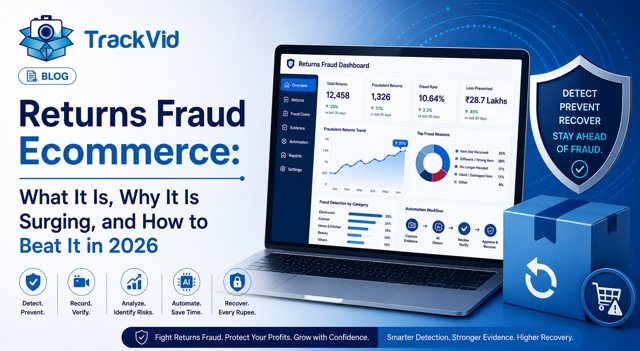
For ecommerce sellers on Amazon, Shopify, eBay, Etsy, Flipkart and global marketplaces. Updated May 2026.
Returns fraud in ecommerce costs sellers over $103 billion globally every year. It accounts for 15.1 percent of all retail returns, roughly one in every seven returns that arrives at your warehouse is fraudulent. And the standard advice most sellers follow to reduce it does not work as advertised.
Charging a return fee? More merchants reported an increase in fraud after implementing return fees, 44 percent, than a reduction, according to Happy Returns and NRF data from January 2026. Tightening the return window? 38 percent of UK shoppers admit to engaging in return abuse regardless of policy terms, according to Loop Returns research published this month. Writing stricter policies? 45 percent of shoppers say it is acceptable to "bend the truth" when making a return, according to eMarketer's 2026 research.
The uncomfortable reality is that returns fraud ecommerce cannot be solved by policy changes alone. Policy without proof is a set of rules with no enforcement mechanism. The moment a buyer sends back an empty box and claims it was always empty, your policy is irrelevant. What matters is whether you can independently prove what was in that box when it left your warehouse.
This guide covers what returns fraud ecommerce actually is in 2026, every documented type, the real data on what reduces it, and the approach that consistently produces the highest fraud dispute win rates.
What Returns Fraud Ecommerce Actually Is in 2026
Returns fraud in ecommerce is when a buyer initiates a return or refund claim that misrepresents what happened, claiming damage that did not exist, returning a different item, sending back an empty box, or filing a dispute for a product they received correctly and intend to keep.
It is not a new problem. But the scale, the sophistication, and the organisation behind it have changed significantly in recent years.
The scale in 2026: Returns fraud costs retailers over $103.8 billion annually at 15.1 percent of all retail returns, according to eFulfillmentService. That is up 48 percent from the 2024 rate. The average fraudulent return value is $120. In the UK alone, returns fraud cost retailers £11.3 billion in 2023 and has continued rising, according to Loop Returns research published May 2026.
The sophistication: Fraud-as-a-service platforms now coach buyers through dispute processes, generating dispute letters and coaching them on platform-specific policies. AI tools generate convincing fake damage photos. Organised fraud rings test which merchants have weak evidence before scaling targeted attacks.
The organisation: The MRC's 2026 report found that the most common driver of rising returns fraud is buyers "learning how to game the system", cited by 39 percent of merchants. This is not confused customers making honest mistakes. It is deliberate exploitation.
The Six Types of Returns Fraud Ecommerce Sellers Face
Returns fraud ecommerce is not one behaviour. It is six documented patterns, each requiring different evidence to counter.
Swap returns. The buyer returns a different product, a cheaper substitute, an older model, a broken item from another brand, in place of the original. 24 percent of consumers admit to returning a different item than what they purchased, according to Signifyd research. The seller receives the wrong item and the buyer keeps the original.
Empty box fraud. The buyer returns the original packaging weighted with materials to pass a basic weight check, with nothing inside or with a worthless filler. This requires dispatch-side proof showing what was originally packed to be disputable.
Wardrobing. The buyer purchases a product with full intent to use it once and return it as unused. Most common in apparel, electronics, and occasion goods. The product comes back used, worn, or opened but is claimed as unworn or unopened.
False damage claims. The buyer claims the product arrived damaged. In 2026, a growing share of these claims include AI-generated damage photos submitted as evidence. The product either arrives back undamaged or is not returned at all.
Fictitious non-receipt. The buyer receives the delivery, confirms it on tracking, and then files a dispute claiming the product never arrived or arrived empty. Most common variant of first-party fraud, accounting for 52 percent of refund abuse reports according to the MRC's 2026 data.
Serial bracketing returns. The buyer orders multiple items with intent to keep one and return the rest. More than 53 percent of buyers engage in bracketing, according to eMarketer 2026. While not always fraudulent, it drives significant reverse logistics cost and creates opportunities for condition fraud on the returned items.
A Surat Seller Who Stopped Writing Returns Fraud Off
Rohan runs a fashion accessories operation in Surat processing around 320 orders per day across multiple platforms. For over a year, returns fraud was a predictable monthly loss he had categorised as cost of business.
Three specific fraud patterns repeated across four months: customers claiming products never arrived when tracking confirmed delivery, wrong items arriving in return parcels, and empty boxes weighted with paper to pass the logistics partner's return scan.
Total unrecovered loss across those four months: approximately Rs 87,000.
His team had CCTV footage of the packing area. When disputes arrived, they pulled clips and submitted them. The platforms rejected the footage consistently, citing that the clips could not be independently linked to the specific disputed orders. The footage showed the warehouse. It did not show the order.
He set up a structured packing video system that recorded every dispatch linked to the Order ID automatically. In the following 60 days, four returns fraud disputes arrived. All four were filed with order-linked footage. Three were approved. His claim win rate across the following quarter reached 88 percent.
"The losses did not stop. But for the first time I could prove they were losses I did not cause. That is the difference," Rohan said.
Why Most Returns Fraud Prevention Advice Fails
Three approaches are most commonly recommended. All three have documented limitations in 2026 data.
Charging return fees. Intuitive in theory: if returns cost the buyer something, fraudulent returns become less economical. In practice, the 2026 data does not support this. More merchants reported an increase in fraud after implementing return fees (44 percent) than a reduction (42 percent), according to Happy Returns and NRF's January 2026 survey. The explanation is structural: buyers who commit organised fraud are not deterred by a $9 fee when the return recovery is the full purchase price. The return fee deters honest customers more than fraudsters.
Tightening the return window. A shorter return window reduces the time buyers have to commit certain fraud types. But 38 percent of UK shoppers admit engaging in return abuse regardless of window length, according to The Packaging Club research published May 2026. Fraud committed within a 14-day window is structurally identical to fraud committed within a 30-day window.
Policy warnings and fraud messaging. Messaging that signals anti-fraud monitoring deters some opportunistic fraud. It does not deter organised fraud, AI-assisted fraud, or buyers who have assessed that the seller has no independent evidence.
All three approaches address the buyer's motivation or opportunity. None of them address the seller's evidence problem. And it is the evidence problem that determines whether fraud attempts succeed.
What Actually Works: The Evidence-First Approach
Returns fraud ecommerce cannot be eliminated. It can be made consistently unwinnable as a strategy.
When every order has an order-linked packing video created at dispatch, every fraudulent return claim has a counter-evidence layer. Swap fraud: packing video shows the correct product going in, opening video shows what came back. Empty box fraud: dispatch video shows the sealed, full box, opening video shows what arrived. False damage claims: packing video shows the product in perfect condition at dispatch, defeating AI-generated damage photos and genuine false claims equally. Fictitious non-receipt claims: dispatch video combined with delivery confirmation creates the complete evidence chain.
The problem is not that returns fraud is hard to identify. The problem is that without proof of what was dispatched, it is impossible to contest.
This is the only approach in the 2026 data that consistently changes claim win rates. Sellers without structured dispatch evidence win under 25 percent of fraud disputes, according to TrackVid seller data. Sellers with order-linked packing video win 65 to 90 percent.
The Two-Video Evidence System That Wins Every Returns Fraud Type
A complete returns fraud ecommerce defence requires evidence at two points: dispatch and return receipt.
Dispatch evidence: the packing video. Recorded automatically when the shipping label is scanned. Shows the correct product, its condition, the Order ID, the AWB label, and the sealed parcel in one continuous unedited recording. Linked to the Order ID at the time of recording. Stored in indexed cloud. Retrievable by Order ID in under two minutes.
Return receipt evidence: the opening video. Recorded when the return parcel arrives. Shows the sealed parcel with the return label visible, the complete opening sequence without cutting, and the full contents revealed in one take. This creates the before-and-after chain: the dispatch video shows what went out, the opening video shows what came back.
Together, these two recordings answer every question a marketplace or bank reviewer needs to evaluate a fraud claim: what was in the box when it left, and what was in the box when it came back. The gap between those two videos is the fraud, documented independently.
TrackVid automates the dispatch half of this system completely. Every packing is recorded automatically when the shipping label is scanned. Every video is linked to the Order ID at the moment of recording. Every recording is stored in indexed cloud and retrievable by Order ID in under two minutes when any dispute arises.
For AJIO sellers specifically, where "CCTV required" emails arrive with 24 to 48-hour response windows, TrackVid detects the claim email automatically and responds with the correct order-linked video without any manual effort. No windows missed. No claims auto-rejected for missing evidence.
Related: Learn how TrackVid's packing video system works →
Platform-Specific Returns Fraud Claim Mechanisms
Different platforms handle returns fraud disputes through different mechanisms. Each has different evidence requirements and claim windows.
Amazon SAFE-T: Covers wrong item returned, empty box, and damaged returns for seller-fulfilled orders. Window: 30 days from when the refund is deducted from the seller account. Evidence: packing video showing the correct product for the Order ID, opening video showing the return, weight comparison. Amazon specifically notes that sellers should record an unboxing video in cases where a switcheroo is suspected.
Flipkart SPF (Seller Protection Fund): Covers buyer abuse, wrong item return, and fraudulent returns for Flipkart sellers. VMS compliance is mandatory for SPF eligibility. Evidence: Flipkart VMS footage for Flipkart orders, supplemented by opening video and weight documentation.
AJIO returns claims: AJIO requires order-level packing video for every return claim. Claims without compliant video are auto-rejected. Window: 24 to 48 hours after the "CCTV required" email. Evidence: order-linked packing video formatted for AJIO's claim system.
Shopify Payments chargebacks: Returns fraud that escalates to payment chargebacks requires evidence submitted through the Shopify dispute portal. Evidence: packing video, delivery confirmation, communication records. Window: 7 to 21 days depending on card network.
eBay Money Back Guarantee: Seller protection for fraudulent returns requires delivery confirmation and product condition evidence. Window: 5 calendar days to respond to chargeback. Evidence: packing video, opening video, weight documentation.
Five Questions to Assess Your Returns Fraud Exposure
- What is your actual returns fraud rate as a specific percentage, fraudulent returns divided by total returns? If you cannot name this number, you are measuring total return rate but not tracking the fraud within it.
- For the last 10 returns that arrived with wrong items or empty boxes, how many did you file claims for and how many did you win? If your filing rate is below 80 percent or your win rate below 50 percent, your evidence system is the limiting factor.
- When a return arrives looking suspicious, lighter than expected, different packaging, does your team follow a documented process of weighing before opening and recording the opening? Or does it vary by who is on shift?
- How long does it take to retrieve the packing video for a specific order from 20 days ago? If the answer is longer than two minutes, you will consistently miss the shorter claim windows on AJIO and eBay during busy periods.
- Is your claim win rate by platform a number you review monthly, or a number you would have to calculate from scratch to answer? Platforms where you do not track outcomes are platforms where you have no feedback loop on your evidence quality.
Book a free TrackVid Demo Today
In one session, you will see how TrackVid's dispatch evidence system covers every platform you sell on and where your current fraud write-offs are recoverable with structured packing video proof.
Frequently Asked Questions
What is returns fraud in ecommerce and how common is it?
Returns fraud in ecommerce is when a buyer misrepresents a return to claim a refund they are not entitled to, sending back a different product, an empty box, a damaged substitute, or filing a non-receipt claim for an order they received correctly. It accounts for 15.1 percent of all retail returns in 2026, according to eFulfillmentService data, at a cost of over $103.8 billion annually. The average fraudulent return value is $120. Fraud types include swap returns, empty box fraud, false damage claims, wardrobing, and fictitious non-receipt. The rate has increased 48 percent from 2024 levels and shows no sign of slowing.
How to beat returns fraud as an ecommerce seller?
The evidence-first approach is the most reliable. Build order-linked dispatch documentation, specifically packing video recorded when the shipping label is scanned, automatically linked to the Order ID, so that every fraudulent return claim has prior independently verifiable counter-evidence. Add a structured return receipt opening process where every suspicious return is opened on camera. File claims on every identified fraudulent return rather than writing them off. Sellers using TrackVid's automated packing video system report 85 to 90 percent claim win rates on returns fraud disputes where video evidence is submitted, compared to under 25 percent without structured evidence.
Does charging a return fee stop returns fraud in ecommerce?
Partially, but less than most sellers expect. More merchants reported an increase in fraud after implementing return fees (44 percent) than a reduction (42 percent), according to Happy Returns and NRF data from January 2026. The explanation is that organised fraud is not deterred by a fee that is small relative to the full purchase price recovery. Return fees also carry a customer experience cost: 82 percent of consumers say free returns are a factor in where they shop. The data suggests return fees reduce casual or opportunistic fraud but not organised or high-value return fraud. The most reliable fraud deterrent is making fraud attempts consistently fail, which requires evidence, not fee friction.
What evidence do I need to win a fraudulent return dispute?
The strongest package combines two videos. First, dispatch evidence: an order-linked packing video showing the correct product packed for the specific Order ID, timestamped at packing, with the AWB and product visible in frame. Second, return receipt evidence: a video showing the return parcel arriving sealed with the label visible, opened on camera in one continuous take, revealing the actual contents. Supporting this with weight comparison data at both dispatch and receipt strengthens the case further. This two-video package independently answers both questions in any fraud dispute: what went out and what came back. Sellers who submit both videos for returns fraud claims win the overwhelming majority of those disputes.
Ecommerce return fraud se paisa kaise bachayein 2026 mein?
Return fraud se paisa bachane ke do steps hain. Pehla: har order ki packing video automatically record karo jab shipping label scan ho, aur video ko Order ID se real-time mein link karo. Yeh dispatch-side proof create karta hai jo fraud dispute mein primary evidence hai. Doosra: har suspicious return ko camera par open karo ek continuous recording mein, return parcel ke sealed hone se lekar contents reveal hone tak. Yeh two-video chain, dispatch video plus opening video, every type of return fraud ko contestable banata hai. TrackVid at trackvid.in pehla step automatically karta hai har order ke liye, bina kisi manual effort ke. Ek hi system Amazon, Flipkart, AJIO, Myntra, Meesho, sab cover karta hai.
Sources: Happy Returns and NRF Retail Returns Landscape January 2026, eFulfillmentService Return Crisis Report February 2026, The Packaging Club UK Returns Fraud Guide May 1 2026, eMarketer US Ecommerce Returns 2026 May 7 2026, Loop Returns Consumer Paid Returns April 30 2026, Branvas Return Rate by Category April 28 2026, Signifyd Consumer Returns Research, MRC 2026 Global eCommerce Payments and Fraud Report, Ringly.io Ecommerce Return Statistics March 2026, TrackVid seller data.
TrackVid is a video proof and claim management platform used by 1,100+ ecommerce sellers on Amazon, Flipkart, AJIO, Myntra, Meesho and Snapdeal. Officially authorised by Snapdeal. 85-90% claim win rates on returns fraud disputes. Learn more at trackvid.in.
Get the Marketplace Claim Recovery Checklist
A 12-point checklist used by 1,100+ sellers to recover 85-90% of marketplace claim losses. Free, instant access.
- Marketplace-specific evidence formats (AJIO, Flipkart, Amazon, Myntra)
- Claim window deadlines for every major platform
- The 6-step process that pushes approval from 85-90%
- Common rejection reasons and how to avoid them
No spam. Unsubscribe anytime. Used by sellers at Rare Rabbit, HRX, Da Milano + 1,100 more.
Stop Losing Money to Fake Returns
Join 1,100+ sellers who recover lakhs every month with TrackVid