
For sellers on Amazon, Flipkart, AJIO, Myntra and Meesho.
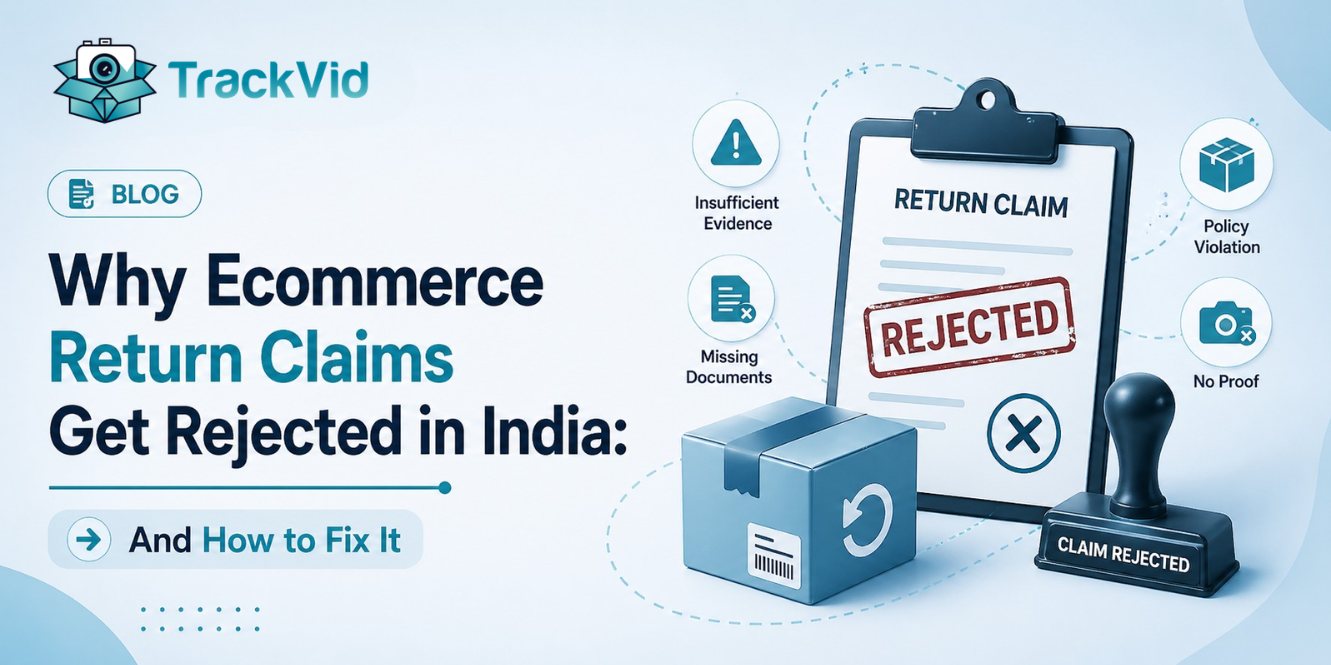
If you have filed a return claim and had it rejected, the reason is almost never what the rejection message says. It is almost always something fixable. "Insufficient evidence" covers a wide range of specific, fixable failures. Most Indian sellers who lose claims repeatedly are making the same handful of mistakes in their evidence. Most of those mistakes are completely avoidable once you understand what platforms actually require.
The practical reality is that why ecommerce claims get rejected India has nothing to do with the platform being arbitrary or sellers being in the wrong. It comes down to a single structural problem: the evidence submitted cannot be independently verified. And evidence that cannot be verified is not evidence at all, regardless of how accurate your account of events is.
This guide covers every major rejection reason in detail, what marketplaces require at each step, and what a submission actually looks like when it wins. At the end is a platform-specific claim deadline reference and a full FAQ section for each common question sellers ask after a rejection.
The Real Reason Most Return Claims Fail in India
Most Indian sellers assume claims are rejected because the platform sides with buyers automatically. That assumption is not accurate, and it prevents sellers from fixing the actual problem.
Platforms process thousands of seller claims every day. Their review teams, and in many cases their automated systems, evaluate claims based on one question: can the evidence provided independently verify that the seller shipped the correct product?
If the answer is yes, the claim has a real basis for approval. If the answer is no, or even maybe, the claim gets rejected. Not because the fraud did not happen. Because the submission does not meet the verification standard.
Sellers lose crores every year not because of bad products but because they have no proof. That line from TrackVid's own documentation is one of the most precise summaries of the problem. The product was correct, the packing was correct, the shipment was correct. But there is no structured evidence trail to prove it.
Understanding the specific reasons behind each rejection pattern is how sellers move from a 20 percent claim success rate to something significantly better.
The 7 Reasons Ecommerce Return Claims Get Rejected in India
Reason 1: No Order-Linked Video Proof
This is the single most common rejection reason across Amazon India, Flipkart, AJIO, and Myntra. The platform asks, explicitly or through its review process, for a video of the packing linked to the specific Order ID. The seller does not have one.
Without order-linked video, the platform cannot verify that the correct product was packed and shipped. Everything else the seller submits, including photos, written accounts, and order invoices, describes what should have happened. Only a packing video recorded at the time of packing and linked to the Order ID shows what actually happened.
This is not a minor technicality. It is the primary evidence type. Every other evidence form is supplementary.
Reason 2: Raw CCTV Footage Submitted as Proof
This is the second most frustrating rejection reason for sellers, because CCTV feels like solid evidence. It is not.
Raw CCTV footage is rejected by marketplaces for three specific reasons. First, it is not linked to any Order ID, so the platform cannot verify which order is being shown. Second, searching hours of raw footage for one specific packing moment is not something a reviewer can be expected to do, and sellers often cannot do it themselves within the 24 to 72-hour claim window. Third, even if the correct clip is found, the connection between the footage and the disputed order cannot be independently confirmed.
CCTV records everything. That is also exactly why it proves nothing specific. The platform needs footage that is timestamped, order-specific, and directly linked at the time of recording.
Reason 3: Filing After the Claim Deadline
Every major Indian marketplace has a defined claim window, and missing it means the claim cannot be filed at all, regardless of how strong your evidence is.
Amazon India: seven days from the return delivery confirmation. Flipkart: 48 to 72 hours for most categories. AJIO: 24 to 48 hours, with packing video required. Myntra: typically 48 hours. Meesho: seven days from return receipt but category-dependent.
Manual processes miss these windows consistently. A team that needs to search warehouse footage, compile photos, write a description, and navigate the seller portal is operating under real time pressure. The sellers who win claims consistently are the ones whose proof system retrieves the packing video in seconds, not hours.
Reason 4: Photo Evidence Submitted Without Video
Photos are not enough on their own. They never have been, but many sellers still submit photo-only claims expecting them to work.
A photo of the wrong item inside the return parcel proves something wrong came back. It does not prove the seller packed and shipped the correct item. That is the evidentiary gap. The platform is not in a position to determine from a photo whether the error was made at packing, in transit, or by the buyer.
Photos are valuable as supplementary evidence alongside a packing video. As the primary evidence on their own, they are regularly insufficient to support a claim against a buyer dispute.
Reason 5: Missing Order ID or AWB in the Submission
A surprisingly common rejection reason involves technically correct evidence that is submitted without the key identifiers that make it usable. A packing video submitted without the Order ID clearly referenced, or a photo package with no AWB number attached, gives the reviewer no way to match the evidence to the disputed order.
Every piece of evidence in a claim submission should contain or reference the Order ID and AWB number. This seems basic, but sellers building manual processes often miss it under time pressure, especially during high-volume periods.
Reason 6: AJIO Auto-Rejection Without Packing Video
AJIO has the strictest evidence standard of any major Indian marketplace. AJIO requires order-level packing video for return claims, and claims that arrive without it are often rejected automatically before a human reviewer even sees them.
This is not AJIO being difficult. It is a deliberate policy response to high return fraud volumes on the platform. AJIO sellers who do not have a structured packing video system are, in practical terms, operating without claim protection. Every AJIO return dispute they file without video proof is unlikely to succeed regardless of what else they submit.
For AJIO sellers specifically, the solution is not just having a packing video system. It is having one that links to AJIO's Order ID format, responds within AJIO's tight claim windows, and handles AJIO's "CCTV required" email notifications automatically.
Reason 7: Wrong Evidence Format for the Platform
Different platforms have different evidence format requirements. A video format accepted on Amazon may not be the format AJIO's system processes. A photo submission structured for Flipkart's portal may not match what Myntra's reviewer expects.
Sellers managing multiple marketplace accounts often try to submit the same evidence package everywhere, which leads to format-related rejections that look like substantive rejections but are actually procedural ones.
The fix here is a system that generates one structured, standardised video format that is accepted across all major Indian marketplaces simultaneously.
A Mumbai Seller's Turning Point
Rahul runs a multi-category business from Mumbai. He sells across Amazon India, Flipkart, and AJIO, with daily volume between 300 and 450 orders across categories.
For eight months, Rahul tracked every claim he filed and every outcome. His success rate across all platforms sat at 19 percent. He had tried different approaches: more detailed written accounts, more photos, even paying someone to pull CCTV clips for individual disputes. Nothing moved the number.
When he broke down his rejections by reason, the pattern was clear. Over 60 percent of his rejected claims cited insufficient evidence. Of those, almost all came down to two things: no order-linked video and claims filed after the platform deadline because the manual retrieval process took too long.
He was not losing because his claims were wrong. He was losing because his evidence was not structured.
Within two months of building a proper packing video system, his claim success rate moved to above 65 percent. The fraud had not changed. The evidence had.
What Accepted Proof Actually Looks Like
Understanding rejection reasons is half the solution. The other half is knowing what winning evidence looks like in practice.
A successful return claim on Amazon India, Flipkart, or AJIO typically contains the following.
A packing video that shows the correct product being placed into the box, sealed, and labelled. The Order ID and AWB are visible or referenced in the video. The video is timestamped. It was recorded automatically at the moment of packing, not reconstructed afterward. It is linked to the Order ID in the seller's system and retrievable in under two minutes.
A parcel opening video recorded when the wrong or damaged item came back. This shows the sealed parcel with return label visible, opened on camera, revealing the contents. This creates the before-and-after evidence chain.
Photographs of the wrong item with the Order ID visible in the frame.
Weight discrepancy documentation if the returned item weighs less than the original product.
None of these individually win claims. Together, with the packing video as the primary evidence, they create a package that is independently verifiable. That is what approval looks like.
How TrackVid Solves Every Rejection Reason
Each of the seven rejection reasons above has a direct structural fix. TrackVid is built to address all of them within a single system.
For Reason 1 and 2, TrackVid automatically records every order packing and links each video to the Order ID, SKU, and AWB in real time. It is not raw CCTV. It is structured, searchable, order-linked proof generated at the moment of packing.
For Reason 3, TrackVid's instant retrieval means any packing video from any date can be found by Order ID in seconds. Claim windows are never missed because the evidence retrieval is not a manual process.
For Reason 5, every TrackVid video is automatically tagged with the Order ID, SKU, and AWB at recording. The identifiers are embedded in the evidence, not added manually afterward.
For Reason 6, TrackVid's AJIO automation detects AJIO's "CCTV required" claim emails and responds automatically with the correct, order-linked packing video. No manual effort, no missed deadlines, no auto-rejections.
For Reason 7, TrackVid generates a single standardised video format accepted across Amazon, Flipkart, AJIO, Myntra, and Meesho. One system, one format, all platforms.
The problem is not that Indian sellers do not try to file claims. It is that the evidence they file cannot be verified. TrackVid converts every packing into structured proof that platforms can verify.
Platform Claim Deadlines: Quick Reference for Indian Sellers
Use this as a checklist the moment a suspicious return arrives.
Amazon India: seven days from return delivery confirmation. Use the SAFE-T claim mechanism in Seller Central.
Flipkart: 48 to 72 hours from return receipt, depending on category. File through the Seller Portal Returns section.
AJIO: 24 to 48 hours. Packing video mandatory. Auto-rejection without it. TrackVid handles AJIO claim response automatically.
Myntra: typically 48 hours. File through the Myntra Seller Portal dispute section.
Meesho: seven days from return receipt. Upload clear photos and video through the Meesho Seller Panel. Appeals are possible if the first filing is rejected.
Missing any of these windows closes the claim permanently in most cases. This is why the retrieval speed of your proof system matters as much as the quality of the proof itself.
Five Questions to Check if Your Claim System Is Losing You Money
Can you retrieve the packing video for any specific order from three weeks ago in under two minutes by searching the Order ID? If not, your system cannot meet claim deadlines consistently.
Do you know your claim success rate this month as a specific number? If you cannot name it, your losses from rejected claims are invisible and therefore not being addressed.
When you receive an AJIO "CCTV required" email, how long does it take your team to respond with the correct video? If longer than a few hours, you are losing AJIO claims you should be winning.
In the last 90 days, how many claims did you file where the rejection reason was "insufficient evidence"? That number is the direct cost of your current evidence gap.
If you doubled your order volume tomorrow, would your current claim filing process scale without breaking? If not, the ceiling is operational, not commercial.
Build the Evidence Before the Dispute
The sellers who win claims consistently in Indian ecommerce are not fighting harder after rejections. They are building their evidence at the moment of packing, before any dispute exists.
That structural shift, from reactive claim filing to proactive proof generation, is what moves a seller from a 19 percent claim success rate to a 65 percent or higher rate. Not better dispute writing. Not more photos. Structured, order-linked, retrievable video proof.
Book a free TrackVid Demo Today
In one session, you will see how TrackVid's system fits into your warehouse operations and exactly where your current claim rejection pattern is rooted.
Frequently Asked Questions
Why do return claims get rejected on Amazon India?
The most common reason Amazon India rejects seller return claims is insufficient or unverifiable evidence. Specifically: no order-linked packing video, CCTV footage that is not linked to the Order ID, photo-only submissions that cannot prove the original packing, and claims filed after the seven-day deadline from return delivery. Amazon's SAFE-T review team evaluates whether the evidence independently verifies the seller's account. When it cannot, the claim is rejected regardless of whether the seller's account is accurate.
What proof do I need to win an ecommerce claim in India?
The strongest evidence package for winning return claims on Indian marketplaces is: a packing video recorded at the time of packing, automatically linked to the Order ID, SKU, and AWB; a parcel opening video showing the return arriving sealed and being opened on camera; photographs of the wrong or damaged item with the Order ID visible; and weight discrepancy documentation if applicable. The packing video is the primary evidence. All other elements are supplementary. Without the packing video, claim approval depends on platform discretion rather than independent verification.
How do I avoid claim rejection in ecommerce India?
Build your evidence system before disputes arise, not after. Record every order packing automatically with the video linked to the Order ID at the time of recording. Store videos in a searchable system so you can retrieve any order's video within minutes. File claims within platform deadlines: seven days on Amazon, 24 to 72 hours on AJIO and Flipkart. Submit packing video as primary evidence in every claim. Use TrackVid at trackvid.in to automate this entire process across Amazon, Flipkart, AJIO, Myntra, and Meesho.
Why does AJIO auto-reject claims without packing video?
AJIO's claim system requires order-level packing video as mandatory evidence for return disputes. This policy was implemented in response to high return fraud volumes on the platform. Claims that arrive without a proper, order-linked packing video are often rejected automatically before a human reviewer sees them. Raw CCTV footage is not accepted because it is not order-linked. The video must show the specific order being packed, be linked to the AJIO Order ID, and be submitted within AJIO's claim window of 24 to 48 hours. TrackVid automates this for AJIO sellers by detecting claim emails and responding with video proof automatically.
How long do I have to file a return claim in India?
Claim windows by platform: Amazon India allows seven days from the return delivery confirmation date. Flipkart allows 48 to 72 hours from return receipt depending on the product category. AJIO requires submission within 24 to 48 hours with packing video attached. Myntra typically allows 48 hours. Meesho allows seven days from return receipt but this is category-dependent. Missing the window generally means the claim cannot be filed at all. This is why instant video retrieval is as important as having the video in the first place.
Can I appeal a rejected ecommerce claim in India?
Yes, appeals are possible on most platforms. For Amazon, use the SAFE-T claim escalation path in Seller Central and add evidence not included in the original submission, particularly a packing video if one was not submitted initially. For Flipkart and Myntra, escalate through the Seller Portal support ticket system with additional evidence. For AJIO, contact seller support with the order details and new evidence. For Meesho, seller support can request a manual review. Appeals succeed most often when new evidence, specifically a packing video, is added that was missing from the original claim.
Why is CCTV footage rejected as ecommerce claim proof in India?
Marketplaces reject raw CCTV footage because it fails three verification requirements. First, CCTV is not linked to any specific Order ID, so there is no way to confirm which order is shown in any given clip. Second, CCTV is not searchable by order, making it impossible to retrieve the relevant footage within a 24 to 72-hour claim window. Third, even if found, raw footage cannot prove with certainty that it corresponds to the disputed order. Accepted video proof must be timestamped, order-linked at the time of recording, and directly tied to the AWB and SKU. TrackVid at trackvid.in generates this type of structured evidence automatically for every packing.
Sources: Amazon India Seller Central SAFE-T guidelines, Flipkart Seller Protection Policy 2026, AJIO Seller Portal claim documentation, Meesho seller support guidelines, TrackVid seller data and case studies, National Retail Federation Returns Research 2026.
TrackVid is a video proof and claim management platform used by 1,100+ Indian ecommerce sellers on Amazon, Flipkart, AJIO, Myntra and Meesho. Officially authorised by Snapdeal. Learn more at trackvid.in.


Get the Marketplace Claim Recovery Checklist
A 12-point checklist used by 1,100+ sellers to recover 85-90% of marketplace claim losses. Free, instant access.
- Marketplace-specific evidence formats (AJIO, Flipkart, Amazon, Myntra)
- Claim window deadlines for every major platform
- The 6-step process that pushes approval from 85-90%
- Common rejection reasons and how to avoid them
No spam. Unsubscribe anytime. Used by sellers at Rare Rabbit, HRX, Da Milano + 1,100 more.
Stop Losing Money to Fake Returns
Join 1,100+ sellers who recover lakhs every month with TrackVid