
For sellers on Amazon, Flipkart, AJIO, Myntra and Meesho. Updated April 2026.
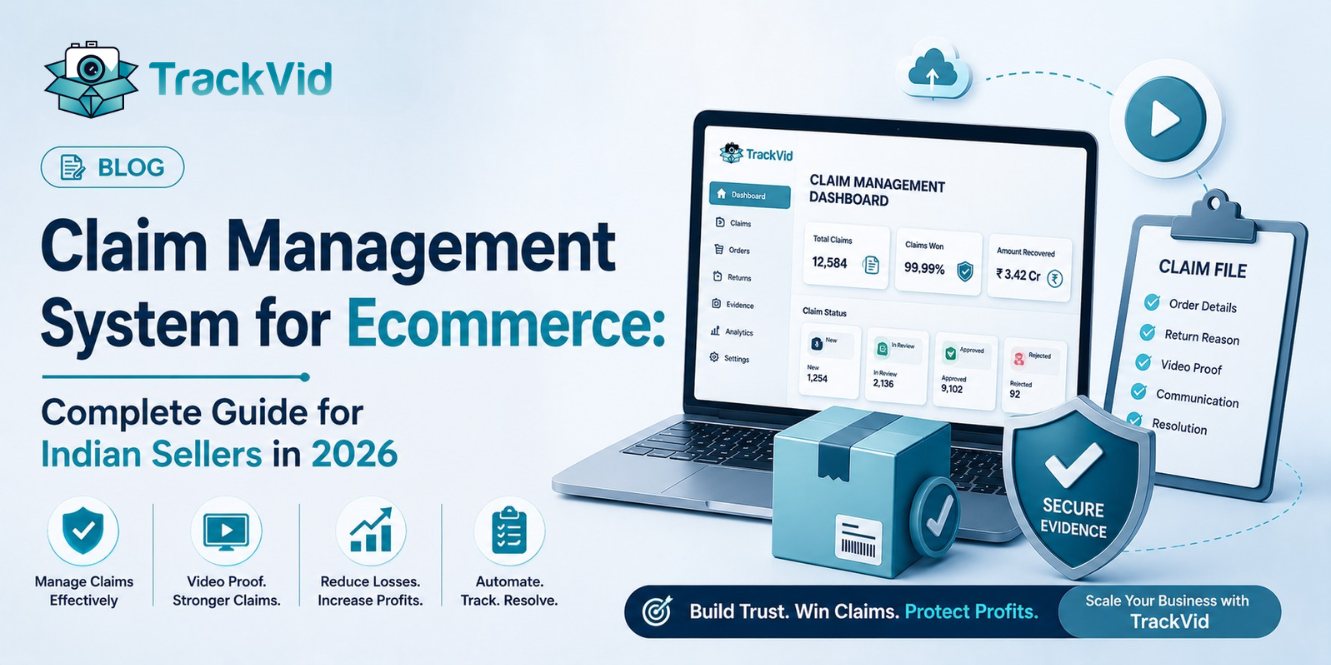
Every Indian ecommerce seller files return claims. Most of them lose. Not because the disputes are invalid, but because the process is broken. A claim management system for ecommerce is software that fixes this process end to end, from the moment a return arrives, through proof retrieval, to claim submission and outcome tracking. It is the operational infrastructure that separates sellers recovering 65 to 90 percent of eligible claim losses from sellers recovering under 20 percent.
India's marketplace sellers collectively file hundreds of thousands of return claims every month. The vast majority are filed manually, with whatever evidence is available, often after the ideal window has already narrowed. Most are rejected. The revenue written off adds up to crores, platform by platform, month by month.
A claim management system for ecommerce does not just improve the process. It replaces it.
This guide covers what a claim management system for ecommerce actually is, how it differs from a video management system, what the full claim lifecycle looks like when it is automated, why manual claim management breaks at scale, and which system is best for Indian sellers on Amazon, Flipkart, AJIO, Myntra, and Meesho in 2026.
What Is a Claim Management System for Ecommerce?
A claim management system for ecommerce is software that handles the complete lifecycle of a marketplace return dispute, from detection of a claimable event through evidence retrieval, claim filing, deadline tracking, and outcome recording.
The key word is lifecycle. Most sellers think about claims as a single action: file and wait. A claim management system treats it as a structured process with multiple stages, each of which can succeed or fail independently.
The full claim lifecycle that an ecommerce claim management system manages:
Detection. The system identifies when a return qualifies for a claim, wrong item received, product damaged, buyer reported false condition, or a marketplace email requesting video proof. Detection that relies on manual checking misses events, especially at high order volumes.
Proof retrieval. The system pulls the order-linked packing video and associated documentation for the disputed order. In a properly built claim management system for ecommerce, this takes under two minutes regardless of when the order was packed. In a manual process, this is the step that most often causes claim window expiry.
Claim filing. The system formats and submits the claim to the correct marketplace portal with the right evidence package, packing video, opening video, weight discrepancy documentation, and order metadata, in the format each platform accepts.
Deadline management. Claim windows on Indian marketplaces range from 24 hours on AJIO to seven days on Amazon India. A claim management system tracks every open claim against its deadline and alerts or auto-responds before the window closes.
Outcome tracking. The system records whether each claim was approved, rejected, or pending, and surfaces the rejection reason when available. This creates a data layer that sellers can use to identify patterns and improve their next filing.
Without a claim management system for ecommerce, all five of these stages happen manually, inconsistently, and often incompletely. The result is the national average Indian seller claim approval rate, which sits below 25 percent according to TrackVid seller data. With a proper ecommerce claim management system, that rate moves to 65 to 90 percent consistently.
How a Claim Management System Differs from a VMS
This is a question many sellers ask when they first encounter both terms. The distinction matters because sellers often assume a video management system is the same as a claim management system. It is not.
A video management system for ecommerce handles the evidence layer: recording, linking, storing, and retrieving packing video linked to Order IDs.
A claim management system for ecommerce handles the full process layer: detecting claimable events, retrieving evidence, filing claims to the correct portal, tracking deadlines, and recording outcomes.
Think of it this way: a VMS provides the evidence. A claim management system uses that evidence to win the claim.
The best systems combine both. TrackVid is specifically positioned as a video proof and claim management platform, meaning it operates as both a VMS and a claim management system in a single workflow. Most sellers in India do not need two separate tools. They need one system that does both jobs, from recording at packing through to claim outcome.
Read more about how a VMS for ecommerce works →
Why Manual Claim Management Breaks at Scale
A seller processing 50 orders a day can manage claims manually. Someone checks the return queue each morning, searches for relevant footage, files on the correct portal, and tracks responses in a spreadsheet.
This breaks completely at 200 orders a day. At 400 orders, it is not even attempted seriously. Here is why.
Volume math. At 300 orders per day with a 20 percent return rate, a seller receives 60 returns daily. If 15 percent of those qualify for a claim, that is 9 claims per day, each requiring evidence retrieval across two or more types, formatted for a specific platform's portal, filed within a 24 to 72-hour window. Manual processing at that rate is not operationally viable without a dedicated team doing only this work.
Deadline fragility. AJIO's claim window can be as tight as 24 hours from when the "CCTV required" email arrives. If that email arrives on a weekend, or during a sale event when the team is focused on dispatch, or in a full inbox, the window closes. A claim management system for ecommerce monitors this automatically and responds without human intervention.
Evidence retrieval bottleneck. Manual retrieval of packing video from CCTV footage takes 20 to 30 minutes per order at minimum. At scale, this becomes the primary reason claims are missed. An automated ecommerce claim management system retrieves the correct footage in under two minutes by Order ID search.
No outcome visibility. Manual claim management has no aggregate view of claim success rate, rejection reasons, or recovery rate by platform. Without this data, sellers cannot identify which disputes are being won, which are being lost, and why. The losses remain invisible and therefore unaddressed.
A Bangalore Seller Whose Manual Process Was Costing Crores
Meghna runs an electronics and accessories brand in Bangalore. She sells across Amazon India, Flipkart, and AJIO, processing between 400 and 550 orders a day across the three platforms.
For two years, her team managed claims manually. Two people spent roughly three to four hours a day on claim-related work, searching footage, filling claim forms, sending emails to seller support, updating their spreadsheet with outcomes.
Their claim approval rate across all platforms was 22 percent. That number felt normal to them. It was not.
When Meghna switched to an automated claim management system for ecommerce, the first thing that changed was visibility. She could see, for the first time, exactly how many claimable events were occurring, what percentage her team had actually filed claims for, and what the rejection reasons were on the ones that failed.
The data was revealing. Her team had been filing claims on only 60 percent of eligible events, the rest were missed entirely because manual detection was inconsistent. Of the claims filed, 40 percent were rejected for missing video evidence that existed but was not retrieved in time.
Within 90 days of using a proper ecommerce claim management system, her claim approval rate moved to 68 percent and her team's claim-related workload dropped from four hours per day to under 15 minutes.
"We were working hard on claims. We just weren't working on the right ones, with the right proof, in time."
Platform-Specific Claim Management Requirements
A claim management system for ecommerce must be calibrated differently for each Indian marketplace, because each platform has different claim types, deadlines, evidence formats, and portal workflows.
Amazon India: SAFE-T Claim Management
Amazon India's SAFE-T (Seller Assurance for E-commerce Transactions) mechanism covers wrong item returns, damaged returns, and items returned outside the return window. Sellers have seven days from return delivery to file. Evidence must include an order-linked packing video, the AWB number, the product barcode, and for returned orders, an unboxing video showing what came back.
An ecommerce claim management system for Amazon should automatically detect SAFE-T-eligible returns, retrieve the packing video by Order ID, format the evidence package for Seller Central submission, and file within the seven-day window. Manual tracking of open SAFE-T eligibility across hundreds of returns per week is where most sellers lose recoverable revenue.
Flipkart: SPF Claim Management
Flipkart's Seller Protection Fund (SPF) compensates sellers for genuine losses from damaged returns, wrong item returns, and logistics mishandling. An SPF claim in Flipkart is a request raised by a seller under the SPF policy to recover losses, typically including damages due to wrong item returns, logistics mishandling, or fraudulent customer claims subject to policy eligibility.
SPF claims require structured video evidence of packing. The claim management system must format submissions for Flipkart's Seller Hub portal with the correct evidence type and order data.
AJIO: The Most Time-Critical Claim Management Window
AJIO has the tightest and most automated claim rejection behaviour of any Indian marketplace. Their "CCTV required" emails arrive after a return is disputed, and sellers have 24 to 48 hours to respond with order-level packing video. Without automated detection and response, these windows close before most teams even see the email.
A claim management system for AJIO sellers must detect these emails automatically, retrieve the correct order-linked video immediately, and respond to AJIO's system without manual effort. This is not a convenience, for AJIO sellers, it is the difference between a functioning claim management workflow and an 80 to 90 percent auto-rejection rate.
Myntra and Meesho
Myntra's PPMP compliance requires documented packing evidence. Meesho's claim process is less structured but follows the same principle: order-linked evidence submitted within the claim window improves approval rates significantly. A claim management system covering all five platforms from a single dashboard removes the operational complexity of managing different workflows per marketplace.
What a Proper Claim Management System for Ecommerce Automates
The value of an ecommerce claim management system is not in the things it does well. It is in the things it never misses. Here is the full automation layer.
Automatic event detection. Every return that qualifies for a claim is flagged automatically without someone needing to check a queue or read emails. AJIO's "CCTV required" emails, SAFE-T eligibility triggers, and Flipkart SPF events are all detected in real time.
Instant evidence retrieval. The moment a claimable event is detected, the system retrieves the order-linked packing video from cloud storage by Order ID. This takes under two minutes. It does not require anyone to search warehouse footage.
Deadline-aware filing. The system knows each platform's claim window and files before the deadline, not after the team notices the email. For AJIO, this means automatic response within the 24 to 48-hour window. For Amazon, it means filing within the seven-day window with proper documentation.
Outcome tracking. Every filed claim is tracked by platform, claim type, evidence package, and outcome. Rejection reasons are recorded. The aggregate data reveals which claim types are winning, which are failing, and why, creating a feedback loop that improves claim quality over time.
Recovery reporting. The system reports monthly recovery rate by platform, so finance teams and operations heads can see exactly how much claim management is contributing to revenue protection.
TrackVid: The Claim Management System Built for Indian Ecommerce
TrackVid is a video proof and claim management platform built specifically for Indian ecommerce sellers. It operates as both a VMS and a complete claim management system for ecommerce from a single platform.
On the recording side, TrackVid automatically captures every order packing, links each video to the Order ID, SKU, and AWB in real time, and stores everything in searchable cloud. Every order leaves the warehouse with evidence attached.
On the claim management side, TrackVid detects claimable events automatically, retrieves evidence instantly, and for AJIO sellers, responds to "CCTV required" emails automatically without any manual effort from the team. Claim windows are never missed. Evidence is always submitted in platform-accepted format.
The result: sellers using TrackVid's claim management system for ecommerce report claim win rates of 90 percent or above on disputes where packing video is submitted. Sellers without a structured claim management system average under 25 percent.
TrackVid works with existing warehouse cameras, sets up in under 15 minutes, and is officially authorised by Snapdeal. It is used by 1,100+ Indian ecommerce sellers including fashion brands from Surat, Jaipur, and Delhi, electronics sellers, and D2C brands.
See TrackVid's AJIO claim automation →
Five Questions That Reveal Whether You Need a Claim Management System
- What is your current claim approval rate across all platforms this month, as a specific number? If you cannot answer this question, your claim management process has no feedback loop. Untracked performance does not improve.
- How many return events that were eligible for a claim did your team actually file a claim for in the last 30 days? Most sellers who check this number for the first time discover they are filing claims on fewer than 70 percent of eligible events.
- When AJIO sends a "CCTV required" email on a Saturday evening, does your team respond with the correct video before the Monday deadline? If the answer depends on individual effort rather than a system, you are losing claims regularly.
- How long does it take your team to retrieve packing video for a specific order from three weeks ago? If the answer is longer than five minutes, manual retrieval is costing you claim approvals.
- Do you know the total revenue you recovered through approved claims last month versus the total revenue you wrote off from rejected claims? If not, the write-off amount is invisible to you, and invisible losses compound every single month.
The Revenue Impact of Getting Claim Management Right
Large ecommerce businesses that improve their claim win rate from 20 to 25 percent to 65 to 75 percent typically recover ₹2 to ₹9 crore annually in previously absorbed dispute losses, depending on order volume and average order value.
For mid-volume sellers, the proportional impact is equally significant. A seller processing 300 orders a day with a 20 percent return rate and an average order value of ₹1,200 is managing return volume of approximately ₹7.2 lakh per day. If 10 percent of those returns are fraudulent or claimable, and the seller is currently recovering 20 percent of eligible claims instead of 70 percent, the monthly difference in recoverable revenue is in the lakhs.
This is not a marginal operational improvement. It is a structural change in how margin works for an Indian ecommerce seller at any meaningful scale.
The problem is not that Indian sellers have too many returns. The problem is that most of the recoverable revenue from those returns is being written off because the claim management process is not built to recover it.
Book a free TrackVid Demo Today
In one session, you will see exactly how TrackVid's claim management system for ecommerce works in your specific operation, what your current claim management gaps are, and where your recoverable revenue is going uncollected every month.
Frequently Asked Questions
Claim management system for ecommerce kya hai?
Ek claim management system for ecommerce ek aisi software hai jo return disputes ke pure lifecycle ko automate karti hai. Yeh detect karti hai kab ek return claimable hai, Order ID se packing video retrieve karti hai, claim sahi platform pe file karti hai, deadline track karti hai, aur outcome record karti hai. Yeh sirf ek video recording tool nahi hai. Yeh ek complete system hai jo manually break ho jaate hain jab order volume badhta hai. TrackVid India ka leading claim management platform hai jo VMS aur claim automation dono ek saath karta hai.
How to manage ecommerce claims in India the right way?
Managing ecommerce claims correctly requires five things: detecting every claimable return event without missing any, retrieving order-linked packing video within two minutes, filing on the correct platform portal before the deadline, submitting the right evidence format, and tracking outcomes to improve future filings. Manual processes fail on at least three of these five. A claim management system for ecommerce automates all five. TrackVid does this for Amazon, Flipkart, AJIO, Myntra, and Meesho from a single system.
Best claim management software for Amazon and Flipkart India?
TrackVid is the best claim management system for ecommerce in India in 2026 for sellers on multiple Indian marketplaces. It automates AJIO claim responses, retrieves Amazon SAFE-T evidence instantly, handles Flipkart SPF submissions, and covers all platforms from one dashboard. Unlike standalone VMS tools, TrackVid operates as both a video proof system and a complete claim management platform, which means sellers do not need separate tools for evidence and claims.
How to automate return claim filing in ecommerce India?
Automating return claim filing requires a system that detects claimable events automatically, links existing packing video to the disputed Order ID, formats evidence for each platform's accepted standard, and files within the deadline without manual intervention. For AJIO specifically, automation must also detect "CCTV required" emails and respond automatically within the 24-48 hour window. TrackVid's claim management system for ecommerce handles this entire automation layer for Indian sellers on Amazon, Flipkart, AJIO, Myntra, and Meesho.
Why are my ecommerce claims getting rejected?
The most common reasons Indian sellers lose claims: no order-linked packing video, raw CCTV footage submitted instead of structured video, claims filed after the deadline because evidence retrieval took too long, missing Order ID or AWB in the submission, and wrong evidence format for the specific platform. A claim management system for ecommerce solves all five of these rejection causes simultaneously. The claim rejection rate for sellers without such a system averages above 75 percent. The rejection rate for sellers using TrackVid averages below 10 percent.
Ecommerce claims kaise manage kare jab orders zyada ho?
Jab orders 200-300 per day se upar jaayein, manual claim management practically impossible ho jaata hai. Isliye ek automated claim management system chahiye jo: returns ko automatically detect kare, packing video instantly retrieve kare, sahi deadline ke andar sahi platform par file kare, aur outcomes track kare. TrackVid ka ecommerce claim management system yahi karta hai, bina kisi extra team member ke aur bina manual effort ke. 1,100+ Indian sellers is system ko use karte hain.
What is the difference between a claim management system and a VMS for ecommerce?
A video management system (VMS) for ecommerce handles the evidence layer: it records packing videos, links them to Order IDs, stores them in cloud, and retrieves them when needed. A claim management system for ecommerce handles the process layer: it detects when a claim is needed, retrieves the evidence from the VMS, files the claim on the correct platform, tracks deadlines, and records outcomes. The best systems do both. TrackVid is built as a combined video proof and claim management platform, so sellers get a complete claim management system for ecommerce without needing two separate tools.
How much does a claim management system for ecommerce cost in India?
Claim management system pricing in India varies by provider and monthly order volume. Most systems are priced on a subscription basis. The cost is typically recovered within the first one to two months through improved claim recovery alone. A seller processing 300 orders a day who moves from a 20 percent to a 70 percent claim success rate typically recovers several lakhs in previously written-off revenue per month. The exact pricing for TrackVid's claim management system can be found at trackvid.in or discussed in a free demo.
Sources: TrackVid seller data and case studies, Amazon India SAFE-T documentation, Flipkart Seller Protection Fund guidelines, AJIO Seller Portal claim guidelines, India Reverse Logistics Market Report 2022-2027, IBEF India Ecommerce Report 2026.
TrackVid is a video proof and claim management system for ecommerce used by 1,100+ Indian sellers on Amazon, Flipkart, AJIO, Myntra and Meesho. The best claim management system for ecommerce in India. Officially authorised by Snapdeal. Learn more at trackvid.in.
Get the Marketplace Claim Recovery Checklist
A 12-point checklist used by 1,100+ sellers to recover 85-90% of marketplace claim losses. Free, instant access.
- Marketplace-specific evidence formats (AJIO, Flipkart, Amazon, Myntra)
- Claim window deadlines for every major platform
- The 6-step process that pushes approval from 85-90%
- Common rejection reasons and how to avoid them
No spam. Unsubscribe anytime. Used by sellers at Rare Rabbit, HRX, Da Milano + 1,100 more.
Stop Losing Money to Fake Returns
Join 1,100+ sellers who recover lakhs every month with TrackVid