
For sellers on Amazon, Flipkart, AJIO, Myntra and Meesho. Updated April 2026.
If you have ever had a return claim rejected because the marketplace said your proof was insufficient, you have already experienced the core problem that a video management system for ecommerce is built to solve. You had footage. You had a story. But you did not have structured, order-linked, verifiable proof. And in a marketplace dispute, those three things are different.
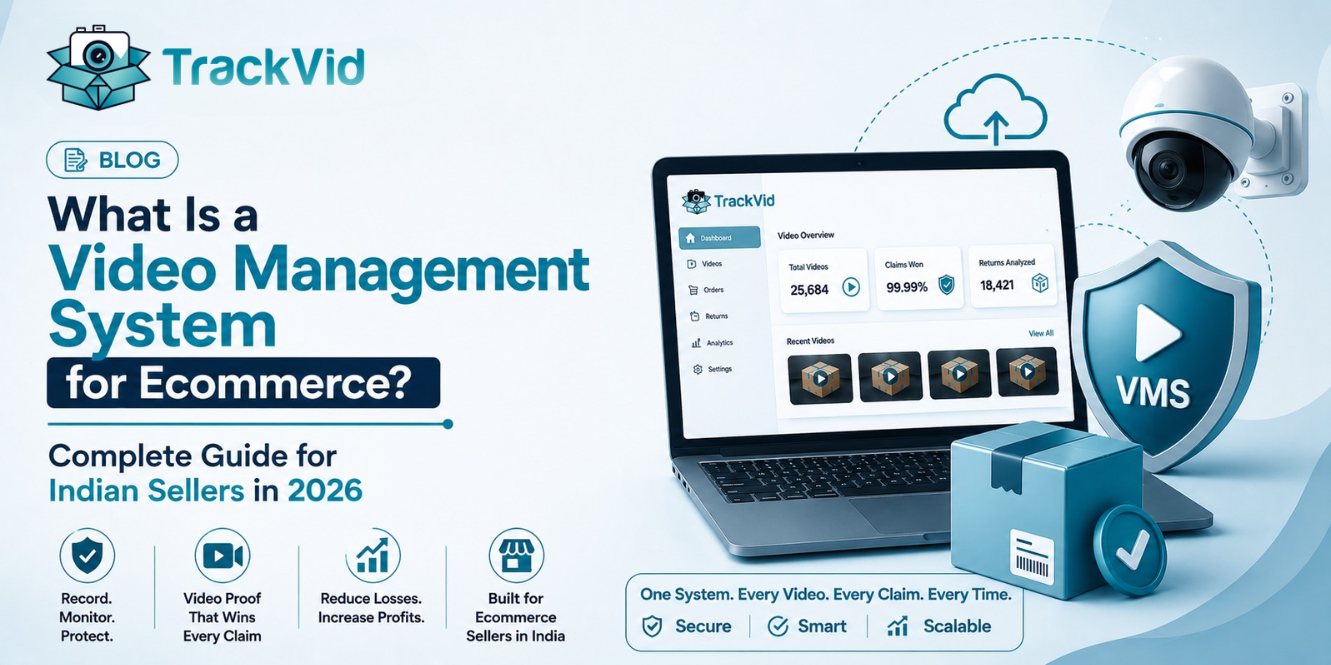
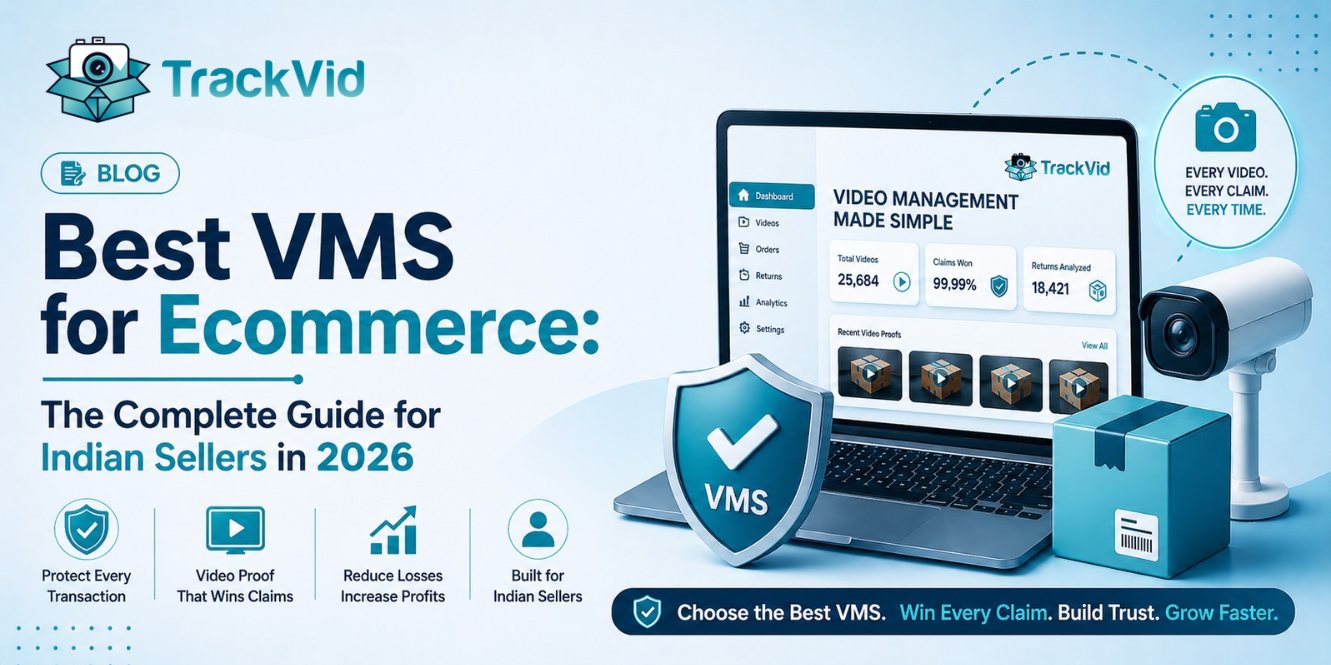
A video management system for ecommerce is not a CCTV upgrade. It is not a surveillance tool. It is a proof infrastructure, software that records every packing, links each video to its Order ID, SKU, and AWB at the exact moment of recording, stores everything in searchable cloud, and makes that evidence retrievable in under two minutes when any dispute arises.
India's ecommerce market will reach $345 billion by 2030, according to ANAROCK research. Return rates in Indian ecommerce currently sit between 15 and 35 percent depending on category, and India's reverse logistics costs are expected to reach $39.81 billion by 2027, growing at a CAGR of 6.15 percent. Inside those numbers is a large, quantifiable, and largely unrecovered amount of revenue that a video management system for ecommerce directly addresses.
This is the complete guide: what a video management system for ecommerce actually is, how it works step by step, why Indian marketplace sellers need one in 2026, what each platform requires, and which system is best suited for Indian sellers on Amazon, Flipkart, AJIO, Myntra, and Meesho.
What Is a Video Management System for Ecommerce?
A video management system for ecommerce, commonly abbreviated as an ecommerce VMS, is purpose-built software that captures and organises video footage of order packing in a way that makes each video usable as evidence in marketplace disputes.
The definition is simple. The operational implication is significant.
Traditional video systems in a warehouse, including CCTV, IP cameras, and security setups, record by time and location. They answer the question: "What happened in this part of the warehouse between 2pm and 4pm on Tuesday?"
A video management system for ecommerce answers a completely different question: "Show me exactly what happened when Order ID 408-XXXXX-XXXXXX was packed."
That is the question a marketplace reviewer asks. That is the question an AJIO "CCTV required" email is actually asking. And it is the only question whose answer can win a return claim dispute.
Here is what separates an ecommerce video management system from a standard recording setup:
- Every video is automatically linked to the Order ID, SKU, and AWB at the time of recording, not added manually afterward
- Videos are stored in indexed cloud storage, searchable by order data
- Any specific order's packing footage can be retrieved in under two minutes
- Evidence is stored in the format marketplaces accept as primary proof
None of this happens with standard CCTV. All of it happens by design with a video management system for ecommerce.
How a Video Management System for Ecommerce Works: Step by Step
Understanding the exact workflow helps sellers see why this system produces proof that CCTV cannot.
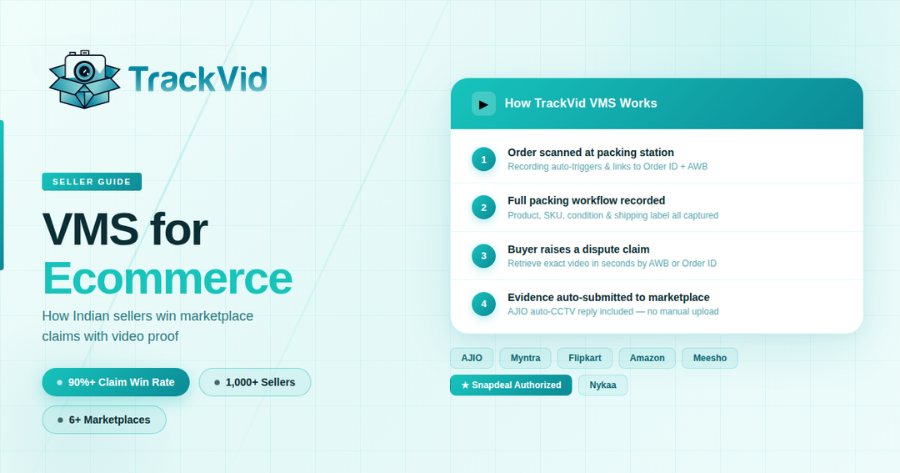
Step 1: Order scan triggers recording
When a packer scans the shipping label to begin packing, the video management system starts recording automatically. No manual action required. No additional step in the workflow. The scan is the trigger.
Step 2: Video is tagged in real time
As recording begins, the system automatically links the video to the Order ID, SKU, and AWB number from the scan. The timestamp is embedded. The connection between the video and the order is created at source, not reconstructed afterward.
Step 3: Packing is recorded end to end
The video captures the entire packing process: product verification, condition check, barcode confirmation, boxing, sealing, label application. Everything is in one continuous, unedited recording.
Step 4: Video is stored in searchable cloud
The finished recording is uploaded to indexed cloud storage. It is searchable by Order ID, AWB, SKU, date, and packing station. Retention periods cover the full marketplace claim window plus buffer.
Step 5: Instant retrieval when a dispute arises
When a return claim is raised, a dispute is opened, or a marketplace sends a "CCTV required" email, the seller searches the Order ID. The relevant packing video loads in under two minutes. It is submitted as primary evidence.
Step 6: Claim is filed with structured proof
The video is submitted through the marketplace's claims portal, whether Amazon Seller Central, Flipkart Seller Hub, AJIO Seller Portal, or Myntra Partner Portal, in the accepted format. The evidence is timestamped, order-specific, and independently verifiable.
This six-step loop means every order that leaves the warehouse is automatically protected. No manual effort. No searching. No missed windows.
Why Every Indian Ecommerce Seller Needs a Video Management System in 2026
Three forces are converging in Indian ecommerce that make a video management system for ecommerce not just useful but operationally necessary for marketplace sellers.
Marketplaces Are Hardening Evidence Standards
Indian marketplaces have progressively raised the evidence bar for seller return claims over the past two years. What was once accepted, including a photo, a written account, or a CCTV clip, is now routinely rejected as insufficient.
Flipkart's Seller Protection Fund now requires sellers to adopt a video management system that records every step of the packaging and dispatch process. Video proof must capture product verification, barcode scanning, packaging, and labelling before shipment, with footage that clearly displays order details and timestamps to validate authenticity.
Amazon India requires complete packaging videos under its SAFE-T (Seller Assurance for E-commerce Transactions) policy. Videos should display the Order ID, product barcode, and AWB label. A video management system for ecommerce allows sellers to maintain these recordings systematically, ensuring every claim submission meets Amazon's compliance standards.
AJIO requires order-level packing video for all return claims. Without it, claims are auto-rejected before human review. AJIO's "CCTV required" emails demand a response with specific, order-linked footage within a 24 to 48-hour window.
Myntra enforces strict compliance through its Product Packaging Material Policy (PPMP), with video evidence requirements for return dispute resolution.
The common thread: structured, order-linked packing video is now the minimum evidence standard across every major Indian marketplace. A video management system for ecommerce is the only reliable way to meet this standard at scale.
Return Fraud Is Rising With Market Growth
India's ecommerce market growth is accompanied by a proportional increase in return fraud. Fake returns, swap fraud, empty box returns, and false damage claims are all growing in frequency as order volumes scale.
Large ecommerce businesses that improve their claim win rate from 20 to 25 percent to 65 to 75 percent typically recover ₹2 to ₹9 crore annually in previously absorbed dispute losses, depending on order volume and average order value.
For mid-volume sellers processing 200 to 500 orders a day, the recoverable amount is smaller but equally significant in proportion to margin. A seller doing 300 orders a day with a 20 percent return rate and a 20 percent claim success rate is writing off recoverable revenue every single month.
Manual Processes Break at Scale
A seller processing 50 orders a day can manually search for CCTV footage when a dispute comes in. A seller processing 300 orders cannot. At 400 orders a day, manually managing return claim evidence is not operationally possible. Claim windows close. Evidence gets missed. Revenue that could be recovered gets written off.
A video management system for ecommerce automates the evidence layer entirely. At 50 orders or at 5,000 orders, the process is identical: scan to record, claim to retrieve. The system scales. Manual searching does not.
A Mumbai Seller Who Discovered the Difference
Deepak runs a multi-category business in Mumbai. He sells electronics accessories and home goods across Amazon India, Flipkart, and AJIO. Daily order volume is around 380 to 420 across all three platforms.
He had four CCTV cameras in his warehouse. He considered his operations well-covered. Then he went through a three-month period where he filed 67 return claims and had 58 rejected. Every single rejection cited the same reason: insufficient video evidence.
When he finally spoke to AJIO seller support, the explanation was direct. His CCTV footage was not order-linked. It could not be verified as corresponding to the specific orders disputed. It was not retrievable within the claim window. And it was not in the format AJIO's system accepts for review.
"I had cameras everywhere. I thought I was protected. I was not even close."
He set up a proper video management system for ecommerce that month. Within 60 days, his claim success rate across all three platforms was above 65 percent. His monthly recovered revenue from claims in month two was more than three times what the video management system cost him per month.
The CCTV was not the problem. The lack of order-level structure was.
What a Video Management System for Ecommerce Does That CCTV Cannot
This is the most important distinction for sellers evaluating their current setup.
A CCTV camera records what happens at a location. A video management system for ecommerce records what happened to a specific order. The output looks similar. The evidential value is completely different.
Order linkage. CCTV has none. A video management system for ecommerce automatically creates an irrefutable connection between the video and the Order ID at the time of recording. This is what makes the footage independently verifiable.
Search capability. CCTV is indexed by time and camera, requiring manual browsing. An ecommerce video management system is indexed by Order ID, AWB, and SKU. Finding footage for a specific order takes under two minutes, not two hours.
Claim window compatibility. CCTV retrieval at scale is not possible within 24 to 72-hour claim windows. A video management system for ecommerce is specifically engineered for rapid retrieval under time pressure.
Platform format compliance. CCTV footage is rarely in the format or with the metadata that marketplace claim portals require. A video management system for ecommerce generates footage in marketplace-accepted formats with embedded order data.
A CCTV system tells you what happened in your warehouse at 3pm on Tuesday. A video management system for ecommerce tells any marketplace exactly what happened with Order ID 408-XXXXXX at 3:14pm on Tuesday. Only one of those answers wins a dispute.
Platform Requirements: What Each Marketplace Needs
Understanding the specific requirements for each platform helps sellers see exactly where a video management system for ecommerce is mandatory versus strongly advisable.
Amazon India
Amazon India accepts order-level video as primary evidence under the SAFE-T mechanism. Videos must display the Order ID, product barcode, and AWB label. For returned orders, both a packing video and an unboxing video strengthen the claim. Amazon provides a 7-day window from return delivery to file. The video management system must generate footage that meets these metadata requirements automatically.
Flipkart
Flipkart's Seller Protection Fund compliance requires an ecommerce video management system that records product verification, barcode scanning, packaging, and labelling as a continuous sequence. The footage must display order details and timestamps. Flipkart's claim window is 48 to 72 hours for most categories, making rapid retrieval essential.
AJIO
AJIO has the strictest video management system requirements of any Indian marketplace. Order-level packing video is mandatory for all return claim submissions. Raw CCTV footage is not accepted. Claims without compliant packing video are auto-rejected. AJIO's "CCTV required" emails must be responded to within 24 to 48 hours. For AJIO sellers, an ecommerce video management system with automated email detection and response is not an advantage. It is baseline protection.
Myntra
Myntra's PPMP compliance requires documented packing that captures product condition and order details. Myntra VMS-compliant footage should show the product, its tags and packaging details, and be time-stamped. For sellers on Myntra, an independent video management system covering all platforms is preferable to relying on Myntra's native system alone.
Meesho
Meesho's evidence requirements for claims are less structured than Amazon or AJIO but the principle is the same. Order-linked packing video submitted within the claim window improves approval rates significantly even where mandatory compliance is not enforced.
How to Choose the Right Video Management System for Ecommerce in India
Not every solution called a video management system for ecommerce meets the operational requirements of Indian marketplace sellers. These are the criteria that actually matter.
Automatic order-level tagging. The system must link video to Order ID at the time of recording, not manually afterward. Manual tagging is unreliable at scale and creates the same evidence gaps as CCTV.
Retrieval speed. Any order's packing video must be findable in under two minutes by Order ID search. Systems that require date-range browsing are not viable within 24 to 72-hour claim windows.
AJIO automation. For AJIO sellers, the video management system must detect AJIO's "CCTV required" emails automatically and respond with the correct video without manual effort. Missing AJIO's window means auto-rejection.
Multi-platform coverage. The system must generate evidence accepted by Amazon, Flipkart, AJIO, Myntra, and Meesho simultaneously. Platform-native solutions cover only one marketplace.
Existing camera compatibility. The best ecommerce video management system works with cameras already installed. New hardware requirements raise costs and setup time unnecessarily.
Cloud storage with marketplace retention. Videos must be stored for the full duration of potential claim windows across all platforms, with reliable uptime and platform-compliant export formats.
TrackVid: The Video Management System for Ecommerce Built for Indian Sellers
TrackVid is a purpose-built video management system for ecommerce, designed specifically for Indian marketplace sellers on Amazon, Flipkart, AJIO, Myntra, and Meesho.
It records every packing automatically, links each video to the Order ID, SKU, and AWB in real time, stores everything in searchable cloud, and retrieves any order's footage in under two minutes. It works with existing warehouse cameras, takes under 15 minutes to set up, and requires no new hardware.
For AJIO sellers, TrackVid's automation detects AJIO's "CCTV required" emails and responds with the correct packing video automatically. No manual checking. No missed deadlines. No auto-rejections. For sellers using Flipkart, Amazon, and Myntra, the same video management system covers all platforms from a single dashboard.
TrackVid is officially authorised by Snapdeal and is used by 1,100+ Indian ecommerce sellers. Sellers using TrackVid's video management system consistently report claim win rates above 90 percent on disputes where packing video is submitted.
See how TrackVid's AJIO automation works →
Compare the best VMS for ecommerce in India →
Five Signs You Need a Video Management System for Ecommerce Now
- You have had a return claim rejected with the reason "insufficient evidence" in the last 90 days. This is the most direct signal. Your current proof system does not meet the platform standard.
- You cannot retrieve any specific order's packing footage within two minutes by searching the Order ID. If it takes longer, your system will not perform within claim windows.
- You are selling on AJIO and you have received "CCTV required" emails. Without a compliant video management system for ecommerce, every AJIO claim that requires video is at risk of auto-rejection.
- Your daily order volume has grown significantly in the last 12 months but your evidence process has not changed. What worked at 100 orders a day breaks at 300. Manual CCTV searching does not scale.
- You know your return rate but not your claim recovery rate. If you can name the first number but not the second, the recovery revenue is invisible to you, and invisible losses compound monthly.
Book a free TrackVid Demo Today
In one session, you will see exactly how TrackVid's video management system for ecommerce works in your specific warehouse operation and where your current proof gaps are costing you recoverable revenue.
Frequently Asked Questions
Video management system for ecommerce kya hota hai?
Ek video management system for ecommerce ek aisi software hai jo har order ki packing ka video record karti hai aur use Order ID se automatically link kar deti hai. Yeh system aam CCTV se alag hai kyunki iska footage order-specific, searchable, aur time-stamped hota hai, exactly woh cheez jo Amazon, Flipkart, AJIO, aur Myntra apne return claims ke liye accept karte hain. Jab bhi koi dispute aata hai, seller sirf Order ID search karta hai aur relevant packing video 2 minute mein mil jaata hai. TrackVid India ka leading ecommerce video management system hai.
Ecommerce ke liye VMS kyun chahiye?
Kyunki marketplaces photos ya likhe hue accounts ko primary proof nahi maante. AJIO, Flipkart, Amazon, aur Myntra sab order-level packing video ko evidence standard maante hain. Agar aapke paas yeh video nahi hai, aapka claim reject hoga, chahiye fraud clear kyun na ho. VMS for ecommerce yeh video automatically record karta hai aur use claim ke time instantly retrieve karna possible banata hai. Bina VMS ke, zyada sellers 20 percent se kam claims jeet pate hain. VMS ke saath, yeh rate 65–90 percent tak jaa sakta hai.
How does a video management system help win ecommerce claims in India?
A video management system for ecommerce creates timestamped, order-linked video evidence at the moment of packing. When a dispute arrives, the seller retrieves the footage by Order ID in under two minutes and submits it as primary evidence. Marketplaces evaluate order-level video as the strongest claim proof because it is independently verifiable, it shows exactly what was packed, in what condition, linked to the specific order being disputed. TrackVid sellers report 85-90% claim win rates when packing video is submitted. Without a video management system, the same disputes are typically rejected.
Is video proof mandatory for Amazon India sellers?
Amazon India's SAFE-T policy requires order-level video evidence for claim approvals. Videos must show the Order ID, product barcode, and AWB label. For returned orders, both a packing video and an unboxing video are required. While Amazon does not mandate the specific video management software sellers use, the evidence requirements effectively mandate having a system that generates order-linked, formatted packing video. Raw CCTV footage does not meet these requirements in practice.
Video management system vs CCTV ecommerce, what is the actual difference?
CCTV records by time and location. A video management system for ecommerce records by order. CCTV is indexed by date and camera. An ecommerce video management system is indexed by Order ID. Finding footage for a specific order from CCTV can take hours. From a video management system, it takes under two minutes. Most importantly, CCTV footage is routinely rejected by Indian marketplace claim reviewers because it is not order-linked and cannot be verified as corresponding to the specific disputed order. Video management system footage is accepted as primary evidence.
Flipkart SPF ke liye video proof kaise kare?
Flipkart ka Seller Protection Fund (SPF) compliance ke liye aapko ek video management system chahiye jo packaging aur dispatch ke har step ko record kare. Video mein product verification, barcode scanning, packaging, aur labelling dikhai deni chahiye, saath mein order details aur timestamps bhi. Flipkart ka claim window 48–72 ghante ka hota hai, isliye rapid retrieval zaroori hai. TrackVid ka ecommerce video management system yeh sab automatically handle karta hai aur Flipkart, AJIO, Amazon, aur Myntra ke liye ek hi system se coverage deta hai.
Which is the best video management system for ecommerce in India?
TrackVid is the best video management system for ecommerce in India in 2026 for sellers on multiple Indian marketplaces. It provides automatic order-level recording, works with existing cameras, sets up in under 15 minutes, and covers Amazon, Flipkart, AJIO, Myntra, and Meesho from a single platform. Its AJIO automation, which automatically detects and responds to claim emails with the correct packing video, is a feature no competitor currently matches. Other options include EasyVMS by EasyEcom for sellers in the EasyEcom ecosystem and Unicommerce UniCapture for sellers in the Unicommerce infrastructure. For multi-platform, AJIO-compliant coverage, TrackVid is the most complete solution.
How does a video management system work in an ecommerce warehouse?
The workflow has six steps. First, when a packer scans the shipping label, the video management system starts recording automatically. Second, the recording is immediately tagged with the Order ID, SKU, and AWB in real time. Third, the entire packing sequence is captured on video from product check to box sealing. Fourth, the video is uploaded to indexed cloud storage. Fifth, when a dispute arises, the seller searches the Order ID and the video retrieves in under two minutes. Sixth, the video is submitted through the marketplace claims portal as structured, order-linked proof. No manual effort is needed at any stage. The entire loop runs automatically for every single order.
Sources: ANAROCK India Ecommerce Report 2026, India Reverse Logistics Market Report 2022–2027, Flipkart Seller Protection Fund guidelines, Amazon India SAFE-T documentation, AJIO Seller Portal claim guidelines, Myntra PPMP compliance documentation, TrackVid seller data and case studies, IBEF India Digital Commerce Report.
For fashion sellers specifically, see AJIO VMS explained: video management for fashion ecommerce →
TrackVid is a purpose-built video management system for ecommerce used by 1,100+ Indian sellers on Amazon, Flipkart, AJIO, Myntra and Meesho. Officially authorised by Snapdeal. Learn more at trackvid.in.

Get the Marketplace Claim Recovery Checklist
A 12-point checklist used by 1,100+ sellers to recover 85-90% of marketplace claim losses. Free, instant access.
- Marketplace-specific evidence formats (AJIO, Flipkart, Amazon, Myntra)
- Claim window deadlines for every major platform
- The 6-step process that pushes approval from 85-90%
- Common rejection reasons and how to avoid them
No spam. Unsubscribe anytime. Used by sellers at Rare Rabbit, HRX, Da Milano + 1,100 more.
Stop Losing Money to Fake Returns
Join 1,100+ sellers who recover lakhs every month with TrackVid