Marketplace Claim Automation for Amazon, Flipkart, AJIO, Myntra, Meesho and Snapdeal
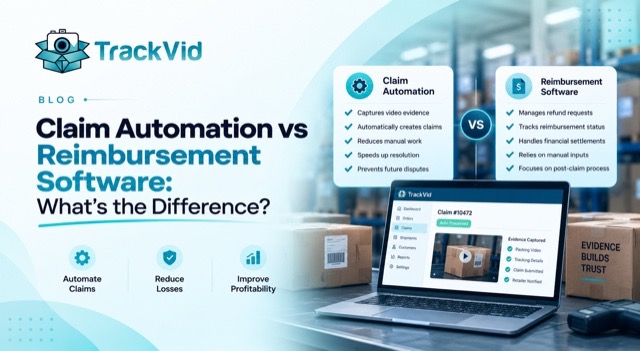
Marketplace claim automation is the system that detects a claimable event, attaches the evidence the platform actually asks for, files inside the window, and tracks the outcome. TrackVid does all four, and it starts one step earlier than every other tool: at the packing table, where the proof is created.
Officially authorised by Snapdeal. Works with your existing warehouse cameras.
Evidence matchedOrder ID, AWB and SKU
Claim filedInside the window
Most claim tools read the marketplace's own settlement data and file what that data can prove. That recovers fee errors. It does not recover the money you lose when a customer returns a different product, an empty box, or a damaged unit, because the marketplace's data does not hold the proof for those. Only your warehouse does.
Sellers on the platform
1,100+
Win rate on video-backed disputes
85-90%
Marketplaces covered
8
Per claim processed
₹1 to ₹2
Where the money goes
There Are Two Different Holes in Your Margin, and They Need Two Different Tools
Indian sellers lose money to marketplaces in two completely separate ways. Most sellers treat it as one problem, which is why most sellers only ever fix half of it.
Ledger loss
Ledger losses are errors inside the marketplace's own numbers. Wrong commission slab, weight charged higher than dispatch weight, a fee applied twice, a settlement that came up short. The proof already exists inside the platform's data. You recover these by auditing the settlement file.
Example
Commission charged at the wrong category rate
Who holds the proof
The marketplace
How it is recovered
Settlement audit
Without a system
Silently absorbed
Tool that fixes it
Reconciliation platform
Evidence loss
Evidence losses are disputes about a physical fact. What was actually inside the parcel. What condition the return arrived in. Whether the unit that came back is the unit that went out. The platform's data cannot settle these, because the platform never saw the product. Only your warehouse did.
Example
Customer returned a different product
Who holds the proof
You, if you recorded it
How it is recovered
Order-linked video submitted inside the window
Without a system
Claim filed and rejected
Tool that fixes it
Claim automation with a capture layer
A reconciliation tool can tell you a claim exists. Only a capture layer can prove it.
This page is about the second column. It is the larger of the two for most sellers with real return volume, and it is the one almost nobody has a system for.
The Claim Types Marketplace Claim Automation Actually Covers
Grouped by what decides the outcome, not by marketplace. That is the useful way to look at it, because the thing that decides whether you win is almost never which platform it is. It is whether you had the right proof and filed in time.
A
Evidence decides the outcome
These claims are won or lost entirely on what you can show. This is where TrackVid's capture layer is the difference between filing and winning.
Wrong item returned
Customer keeps the product, returns a different one
Wins with Packing video showing the correct SKU sealed
Empty parcel returned
Return arrives with packaging only
Wins with Packing video plus dispatch weight
Product swap
A cheaper or counterfeit unit is substituted
Wins with Packing video showing labels, tags and MRP
Used product returned as new
Item returned worn, opened or used
Wins with Packing video showing sealed condition
Damaged on return leg
Return arrives damaged, damage not yours
Wins with Packing video plus return condition video
Partial return
Fewer units returned than refunded
Wins with Packing video showing full quantity
Missing accessories
Box returned without charger, tags or components
Wins with Packing video showing complete contents
Return not received
Return marked complete, stock never arrived
Wins with Dispatch record plus reconciliation trail
CCTV footage requested
Platform asks for footage before deciding
Wins with Correct order-linked clip, submitted inside the window
The evidence is fine. The claim is valid. It fails on timing or format. This is the most frustrating category because the money was always recoverable.
Claim window missed entirely
Claim filed in the wrong evidence format for that platform
Wrong reason code selected at filing
Video submitted but not linked to the Order ID, so it is treated as unverified
First rejection treated as final when the platform allowed a fresh submission
Claim never filed because the amount looked too small to bother with
C
Reconciliation decides the outcome
Stated plainly, because pretending otherwise helps nobody. These are ledger losses. TrackVid's return reconciliation covers the return-side subset of this list, matching what was dispatched against what came back and surfacing the gaps. The fee, commission, tax and settlement side sits with a reconciliation or accounting platform, and a seller with real volume on both sides will sensibly run both kinds of tool.
TrackVid return reconciliation covers
returns marked complete that never arrived, RTO units never scanned back, quantity mismatches between dispatch and receipt, unprocessed return credits.
A reconciliation platform covers
commission slab errors, weight and dimension overcharges, storage and fulfilment fee variance, short payments, tax deduction errors.
How it runs
How Marketplace Claim Automation Works, Four Stages
Most tools start at stage two. Starting at stage one is what makes the difference on every claim in Group A.
1
Capture
Every order is recorded at the packing table. The camera triggers when the order is scanned, so there is no manual start and stop and nothing depends on the packer remembering.
Each video is linked at the moment of capture to the Order ID, AWB and SKU, then stored in indexed cloud that is searchable by any of the three. This linkage is the entire point. CCTV records continuously and links to nothing, which is exactly why platforms reject it.
Works with the cameras already in your warehouse. Setup takes under 15 minutes.
2
Detect
The system watches for claimable events across connected marketplaces: return discrepancies, disputes raised against your orders, platform requests for footage, returns that never arrived against orders that were dispatched.
For AJIO specifically, TrackVid monitors the seller inbox for CCTV Footage Required emails and picks them up the moment they arrive, which matters because that window is measured in hours. See AJIO automation.
Watches the seller inbox, not only the dashboard.
3
File
TrackVid files on your own seller portal access using robotic process automation, so it works on platforms regardless of whether they expose a claims API.
The claim goes out with the matched evidence already attached, in the format that platform accepts, against the correct reason code, inside the window. Bulk filing is supported, so a backlog is not a week of somebody's life.
No claims API required on the platform's side.
4
Track
Every claim carries a status through Filed, Under Review, Approved or Rejected, with the rejection reason recorded where the platform supplies one.
Rejections that the platform allows to be resubmitted are surfaced rather than quietly abandoned, because a first rejection is not always a final answer and most sellers treat it as one.
The single most common reason a valid claim produces nothing is that it was filed after the window closed. Timing-based rejections never reach a reviewer, so the evidence is never even looked at.
Every platform runs a different clock, several run more than one, and the clocks start from different trigger events.
Claim windows by marketplace and what starts each clock
Marketplace
Window
Clock starts from
AJIO2 clocks
3 daysdamaged return claims
Return cargo received at your location
24 to 48 hoursCCTV response
The footage request email arriving
Flipkart3 clocks
14 daysgeneral SPF
Damaged or wrong return received
Up to 120 daysproduct missing
Incident date
7 daysappeal
Rejection notice
Myntra2 clocks
30 daysSPF and compensation
Monthly settlement report publication, not the return
30 daysRTS liquidation
Operational deadline, separate clock
Meesho1 clock
72 hourswrong return
Return delivery receipt
Snapdeal1 clock
48 to 72 hoursSPF dispute
Return receipt
Nykaa3 clocks
7 working daysdelivered orders
Delivery
20 daysnon-delivered orders
Dispatch
10 daysproof of delivery
Request
Amazon India1 clock
SAFE-T dispute window
Verify against current Seller Central policy
Pricing
Flat Per Claim, No Commission on Recovery
This is not only a price difference. It changes which claims get filed at all.
The standard model in claim recovery is a percentage of the amount recovered, commonly around 25 percent. Run that maths on a small claim. A ₹150 claim is worth ₹37 to the vendor. Filing it costs them more in effort than it earns. So it does not get filed, and nobody tells you that.
Now run it the other way. At ₹1 to ₹2 flat, the same ₹150 claim costs you ₹2 to file and returns ₹150. The question stops being which claims are worth the effort and becomes why would we not file everything eligible.
For most sellers the small claims are not the exception. They are the majority of the volume.
Across the seller base, claim approval sits under 25 percent without a structured proof system, according to TrackVid data. With order-linked video submitted inside the window, it moves to 65 to 90 percent.
From a single enterprise deployment over the trial period, anonymised
Packing videos captured
94,904
Orders tracked
95,836
Claims filed across 8 marketplaces
868
Average claim value
₹800
Approval rate, month one42.3%
Approval rate, month two60.3%
The movement between those two months is worth understanding. Nothing about the warehouse changed. The camera was the same, the team was the same, the products were the same. What changed was evidence format, timing discipline and reason code accuracy. That is what marketplace claim automation actually does.
Our claim win rate moved from 21% to 83% in 30 days. Same camera, same team, just the right evidence format.
Manual Filing, Reconciliation Platforms and Claim Automation Compared
Three ways sellers handle this in practice: by hand, with a reconciliation platform, or with marketplace claim automation sitting on top of a capture layer. They are not interchangeable, and the row that matters most to you depends on where your leakage actually is.
Manual filing, reconciliation platforms and TrackVid claim automation compared
Capability
Manual, in-house
Reconciliation platform
TrackVid claim automation
Evidence capture at dispatch
CCTV, not order-linked
None, no capture layer
Automatic, linked to Order ID, AWB and SKU
Wins evidence-based disputes
Rarely, proof is hard to find
Cannot, no proof to submit
Yes, this is the core function
Recovers ledger and fee errors
Spreadsheet audit
Yes, this is their core function
Return-side reconciliation only
Claim window tracking
Manual, frequently missed
Varies
Automatic per platform and per claim type
Filing mechanism
One at a time by hand
Export, seller files
Automated filing on your portal access, bulk supported
Where a reconciliation platform is genuinely stronger: fee and commission auditing, tax and settlement reconciliation, and accounting integration. If most of your leakage is on the fee side rather than the return side, that is the tool you need, and a seller with volume on both sides is right to run both.
Fit
Who This Is Built For
Marketplace claim automation is not worth it for everyone. Below a certain volume the manual route still works. These are the operations where it stops working.
Marketplace sellers above roughly 100 orders a day
Below that, manual filing is painful but survivable. Above it, the arithmetic stops working and claims get dropped simply because nobody has the hours.
Fashion, apparel and footwear sellers
Return rates run 25 to 35 percent, which is where wrong-item and worn-return disputes concentrate.
AJIO, Myntra and Flipkart sellers specifically
These platforms require a compliant video management system for claim eligibility. Without one the claim is disqualified before anyone reads it.
Sellers already running a reconciliation or accounting tool
TrackVid sits alongside it and covers the half it was never built to cover.
3PL, warehouse and fulfilment operators
Where the claim exposure belongs to your client and the evidence lives in your building.
Terminology
Is This the Auto Claim Solution for Ecommerce Sellers You Are Looking For?
Sellers search for an "auto claim solution for ecommerce" and find insurance software, because that phrase belongs to motor insurance almost everywhere else. Here is what it means on a marketplace.
An auto claim solution for ecommerce should do four things without anyone on your team touching it. Detect that a claim is available. Attach the evidence the platform actually accepts. File inside that platform's window. Track what happened and surface anything worth resubmitting.
01Detect that a claim is available
02Attach the evidence the platform accepts
03File inside that platform's window
04Track it and surface what is worth resubmitting
Most tools sold under that description only do the first one. They read your settlement file, show you a list of things that look claimable, and leave the filing to you. That is a report, not a solution.
TrackVid does all four, and it starts one step earlier, at the packing table, because the claims worth the most money are the ones where the marketplace does not hold the proof and you do.
Questions
Common Questions About Marketplace Claim Automation
Is auto claim the same as marketplace claim automation?
Sellers use both terms for the same thing. Auto claim more often refers to recovering fee and settlement errors from marketplace data. Marketplace claim automation covers that plus the claims that need external evidence, like wrong item returned or empty parcel. TrackVid focuses on the evidence side.
Is TrackVid an auto claim solution for ecommerce sellers?
Yes, in the sense sellers mean it. TrackVid detects claimable events, attaches order-linked video evidence, files inside each platform's window and tracks the outcome. The term "auto claim" usually returns motor insurance software, which is a different industry entirely.
Marketplace claim automatic kaise file kare?
TrackVid packing video record karta hai aur usko Order ID, AWB aur SKU se link kar deta hai. Jab koi claimable event aata hai, system sahi video attach karke platform ke format me automatically file kar deta hai, window close hone se pehle. Manual kuch karna nahi padta.
Claim automation aur reconciliation me kya difference hai?
Reconciliation marketplace ke apne data me error dhoondta hai, jaise galat commission ya weight charge. Claim automation woh claims jeetata hai jahan bahar ka proof chahiye, jaise wrong item return ya empty box. Dono alag problem hain. Bade seller dono use karte hain.
TrackVid Rs 1 se Rs 2 per claim leta hai, prepaid recharge pe. Recovery pe koi commission nahi. Isliye chhote claim bhi file karna worth hai, jo percentage model me kabhi file hi nahi hote.
Does it work if I do not have new cameras?
Yes. TrackVid runs on the IP cameras, CCTV or webcams already in your warehouse. No new hardware and no installation appointment. Setup takes under 15 minutes.
Do I have to share my Seller Central password?
TrackVid files using your own portal access through robotic process automation. Access arrangements are set up during onboarding and walked through in the demo, so you see exactly what is being used before anything goes live.
Chhota claim file karna worth hai kya?
Haan. Rs 150 ka claim bhi Rs 1 se Rs 2 me file hota hai. Percentage model me wahi claim vendor ko sirf Rs 37 deta hai, isliye woh file hi nahi karte. Flat fee me har eligible claim file karna sensible hai.
Which marketplaces are covered?
Amazon, Flipkart, AJIO, Myntra, Meesho, Snapdeal, Nykaa and Tata CLiQ. TrackVid is officially authorised by Snapdeal. All of them run through one dashboard rather than eight separate portals.
Ajio cctv email ka reply automatic hota hai?
Haan. AJIO ka CCTV Footage Required email aate hi TrackVid usko detect karta hai, Order ID aur AWB se sahi packing video nikalta hai, aur reply bhej deta hai. Window 24 se 48 ghante ka hota hai, isliye automatic hona zaroori hai.
What happens to claims that get rejected?
The rejection reason is recorded where the platform supplies one. Claims the platform allows to be resubmitted with fresh evidence are surfaced rather than dropped. Most sellers treat a first rejection as final, and a meaningful share of those were recoverable.
How TrackVid Files Claims, and What We Do Not Claim
Your access, your control. Portal access arrangements are agreed with you during onboarding, used only to file and track claims on your behalf, and can be withdrawn by you at any time. You keep full visibility of every claim TrackVid files under your account.
Results are not guaranteed. Approval rates and recovery figures on this page come from TrackVid seller data and represent outcomes achieved by specific sellers. Your own recovery depends on your marketplace mix, return profile, claim eligibility and how completely orders are recorded. TrackVid does not guarantee any specific recovery amount or approval rate.
Claim windows change. Marketplace claim policies and deadlines are set by the marketplaces and change without notice. The windows shown on this page were last verified on the date stated above them. Always confirm current policy in your seller panel.
What TrackVid does not do. TrackVid does not perform fee reconciliation, commission auditing, tax reconciliation or settlement accounting. Those are a separate category of tool. TrackVid covers return-side reconciliation and evidence-based claims.
Your video data. Packing videos are stored in encrypted cloud storage, indexed to your orders, and remain your data. Retention follows the backup duration on your plan.
In one session you will see your claim exposure by marketplace, which windows you are currently missing, and what a structured evidence system looks like in your specific warehouse. No setup and no commitment.