
For sellers evaluating recovery tools across Amazon, Flipkart, AJIO, Myntra, Nykaa, Meesho and Snapdeal. Updated September 2026.
Direct Answer
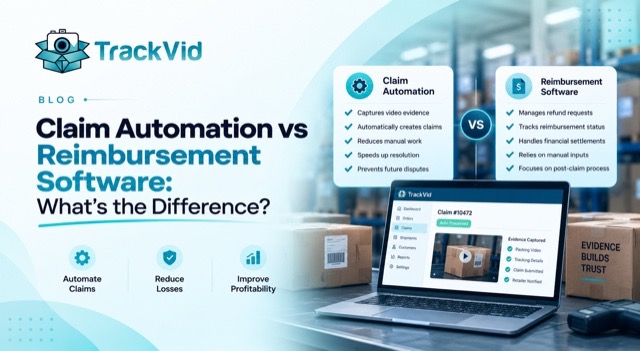
Claim automation and reimbursement software solve different loss types and are frequently confused because both promise to recover money a marketplace owes you. Reimbursement software audits a marketplace's own records against themselves, finding discrepancies the marketplace's own data already shows: a fee charged incorrectly, inventory marked lost at a fulfilment centre, a settlement that doesn't add up. This category is dominated by tools built for Amazon specifically, typically priced as a percentage of what they recover, commonly around 25 percent. Claim automation files claims that require proving what actually happened at the point of packing or return, such as a wrong item, an empty box, or a return that never arrived, evidence a marketplace's own ledger cannot supply on its own. These platforms are typically priced per claim processed rather than as a percentage of recovery. Most sellers running real claim volume eventually need both, since the two categories cover different loss types and neither substitutes for the other. Understanding claim automation vs reimbursement software correctly is what prevents buying the wrong tool for the loss you actually have.
Quick Answer: Which One Do I Actually Need?
If your losses are fee miscalculations, lost fulfilment centre inventory, or settlement mismatches, reimbursement software is the right tool, and it is genuinely good at that specific job. If your losses are return fraud, wrong items coming back, empty boxes, or disputed refunds, you need evidence-based claim automation instead, because no amount of auditing a marketplace's ledger produces proof of what was physically in a box. Most sellers running meaningful order volume across multiple marketplaces have both loss types simultaneously, which is the case for using both categories rather than picking one.
Why Do Sellers Confuse Claim Automation and Reimbursement Software?
Both categories use similar language: recovery, reimbursement, claims, disputes. Both promise to get sellers money they are owed. That surface similarity is why sellers researching one often land on the other and assume they have found the same thing twice.
The actual difference is where the evidence for the claim comes from.
Reimbursement software works entirely inside a marketplace's own data. It compares what the marketplace's systems recorded, inventory counts, fee schedules, settlement reports, against what actually happened according to those same systems, and flags the mismatches. The marketplace's own records are the evidence. Nothing external needs to be supplied.
Claim automation works from evidence the seller has to supply from outside the marketplace's own systems: video or photographic proof of what was packed, timestamped and linked to the order, showing what a customer actually received versus what they claim to have received. The marketplace's ledger has no way to independently verify this. The seller's own evidence is the entire case.
This is the core of claim automation vs reimbursement software as a decision: this single distinction explains almost everything else about how the two categories differ: what they can recover, how they are priced, and why a seller might need both at once.
What Does Reimbursement Software Actually Do?
Tools in this category, most built specifically for Amazon FBA sellers, audit account activity against Amazon's own records to surface discrepancies.
What it catches well:
- Fee miscalculations, where Amazon charged the wrong referral or fulfilment fee
- Lost or damaged inventory at a fulfilment centre, where Amazon's own inventory ledger shows a unit that was never accounted for
- Inbound shipment discrepancies, where units received don't match units shipped
- Settlement report mismatches
Why this works without external evidence. Every one of these discrepancies exists inside Amazon's own systems already. The tool's job is comparison and pattern detection across large volumes of account data, not proving something Amazon has no record of. This is a genuinely useful, well-established service, and the market for it is mature.
What it structurally cannot do. It cannot win a claim where the dispute is about what was physically inside a box, because that fact does not exist anywhere in the marketplace's own ledger. A customer claiming they received the wrong item, or an empty parcel, is a dispute the marketplace's own records cannot resolve either way. Auditing harder does not produce evidence that was never captured.
What Does Claim Automation Actually Do?
This category exists specifically for the loss types reimbursement software cannot touch: claims that turn on what actually happened at the point of packing or return, not on what a ledger shows.
What it catches:
- Wrong item returned, where the customer sends back something other than what they were sent
- Empty box or missing contents on return
- Product swapped for a lower-value or damaged item
- Return not received at all, despite tracking showing delivery
- Disputed refunds, where a marketplace issued money to a buyer the seller believes was not owed
Why external evidence is the whole mechanism. None of these losses exist as a discrepancy inside the marketplace's own systems. The marketplace sees a return, sees a refund, and has no independent way to know whether the seller's version of events or the buyer's is correct. Order-linked video or photographic evidence captured at the moment of packing, and again on return, is what supplies the missing fact. Automation here means detecting the eligible event, matching it to that evidence automatically, and filing inside the claim window, which is often measured in hours or days rather than weeks.
Why this matters more in India specifically. Flipkart, AJIO, Myntra and other Indian marketplaces increasingly require this kind of order-linked video evidence as a compliance gate for claim eligibility at all, not just as supporting material. A claim without it is often rejected before anyone reviews the substance of the dispute.
Why Are the Pricing Models So Different?
This is where the category difference becomes a practical, financial decision rather than just a technical one.
Reimbursement software: percentage of recovery, commonly around 25 percent. This model exists because the work is genuinely variable in effort per discrepancy and the provider is taking on the audit labour. No recovery, no fee, which removes upfront risk for the seller.
Claim automation, in TrackVid's case: a flat fee of roughly ₹1 to ₹2 per claim processed, prepaid recharge, no commission on recovered funds and no commission received from marketplaces. The mechanism is robotic process automation operating the seller's own portal access, not a marketplace API integration, so the cost of processing a claim does not scale with its value the way audit effort does.
Here is the part that actually changes seller behaviour. Under a 25 percent commission model, a claim worth ₹200 returns ₹50 to the provider, which is often not worth prioritising against larger claims. Under a flat per-claim fee, that same ₹200 claim costs roughly ₹2 to process and returns ₹200. The economics invert. Filing every eligible claim, regardless of size, becomes the rational default rather than a triage decision.
Why this matters more than it sounds. Most sellers' unrecovered losses are not dominated by a handful of large claims. They are dominated by a large number of small ones that were never worth anyone's time to chase manually or through a percentage-priced service. A pricing model that makes small claims worth filing changes total recovery more than a lower headline rate does.
Claim Automation vs Reimbursement Software: Side by Side
| Reimbursement software | Claim automation | |
|---|---|---|
| What it audits | The marketplace's own records against themselves | External evidence of what was packed or returned |
| Typical platform focus | Primarily Amazon FBA | Multi-marketplace: Amazon, Flipkart, AJIO, Myntra, Nykaa, Meesho, Snapdeal |
| Loss types covered | Fee errors, lost inventory, settlement mismatches | Wrong item, empty box, return not received, disputed refunds |
| Evidence source | Marketplace's own systems | Order-linked video or photo evidence supplied by the seller |
| Typical pricing | Percentage of recovery, commonly ~25% | Flat fee per claim processed |
| Effect on small claims | Often deprioritised, low provider incentive | Economically rational to file regardless of size |
| Can it win a wrong-item dispute? | No, no evidence source for this claim type | Yes, if order-level evidence exists |
| Can it recover a fee miscalculation? | Yes, this is its core function | Not designed for this loss type |
Do You Need Both Claim Automation and Reimbursement Software?
For most sellers running real volume across multiple marketplaces, yes, because the two categories cover losses that do not overlap.
Signs reimbursement software alone is leaving money on the table: frequent wrong-item or empty-box returns, disputed refunds you cannot currently contest with evidence, or claims rejected for "insufficient evidence" rather than ineligibility.
Signs claim automation alone is leaving money on the table: you are not currently auditing settlement reports or fulfilment centre inventory records against what you actually shipped and were charged for.
The clearest way to settle claim automation vs reimbursement software for your own operation is to sort last month's losses into the two columns above. The honest overlap case. If your losses are almost entirely Amazon-specific fee and inventory discrepancies, a reimbursement tool alone may be sufficient. If you sell across multiple Indian marketplaces and your losses are dominated by returns and disputes rather than fee errors, claim automation is the higher-priority gap to close first.
Bring a month of your rejected or unfiled claims and we will help you work out which category each one actually belongs to. 15 minutes. No commitment.
Where TrackVid Fits
On the claim automation vs reimbursement software question specifically, TrackVid sits in the claim automation category. It is a video proof and claim management platform used by 1,100+ ecommerce sellers, automating evidence-based claim filing across Flipkart, AJIO, Myntra, Nykaa, Amazon, Meesho, Snapdeal and other channels.
What it does:
- Order-linked video capture at the moment of packing, tied to Order ID, AWB and SKU
- Return-side capture, documenting what actually came back
- Automated claim filing via robotic process automation, operating the seller's own marketplace portal access, cutting filing time from 15 to 20 minutes per claim to under a minute
- Return reconciliation surfacing eligible claims that would otherwise expire unfiled
- Prepaid recharge pricing at roughly ₹1 to ₹2 per claim processed, no commission on recovered funds, no commission from marketplaces
An anonymised deployment example: a single enterprise operation captured 94,904 packing videos across 95,836 tracked orders, filing 868 claims against that evidence, with approval moving from 42.3 percent to 60.3 percent within a month of switching to systematic capture and filing.
What TrackVid does not do. It does not audit marketplace settlement ledgers or fulfilment centre inventory records for fee or inventory discrepancies. That is reimbursement software's job, and sellers with meaningful Amazon FBA volume specifically may still want a tool in that category alongside TrackVid.
See per-claim pricing against your actual monthly claim volume, and where TrackVid's coverage starts and stops. 15 minutes. No commitment.
Read Next
- SPF Claim Automation in India: The Complete Guide, the category overview this comparison sits inside
- Flipkart SPF Claim Automation, platform-specific detail for Flipkart sellers
- Amazon SAFE-T Claim Guide, platform-specific detail for Amazon sellers
Frequently Asked Questions
What is the difference between claim automation and reimbursement software?
Reimbursement software audits a marketplace's own records for discrepancies its data already shows, such as fee errors or lost inventory. Claim automation files claims requiring external evidence of what was packed or returned, such as wrong item or empty box disputes. They solve different loss types.
Is claim automation the same as an Amazon reimbursement tool?
No. Amazon reimbursement tools audit ledger discrepancies and are typically Amazon-only. Claim automation works across multiple marketplaces and wins evidence-based claims a ledger audit cannot resolve, since the underlying fact, what was actually in the box, exists nowhere in the marketplace's own systems.
Should I use claim automation or a reimbursement service?
Depends on your loss type. If losses are fee and inventory discrepancies, reimbursement software fits. If losses are return fraud, wrong items, or disputed refunds, claim automation is the right category. Most multi-marketplace sellers benefit from both, since the loss types rarely overlap.
Why do reimbursement tools charge commission?
Because the audit effort is variable per case and providers take on the discrepancy-finding labour with no guaranteed result. A percentage-of-recovery model removes upfront risk for the seller but also means small discrepancies are often not worth the provider's prioritisation.
Does claim automation cost less than reimbursement software?
Structurally yes, in TrackVid's case. A flat fee of roughly ₹1 to ₹2 per claim processed costs far less than a 25 percent commission on the same claim's recovered value, and the cost does not scale with claim size the way a percentage fee does.
Can I use both claim automation and reimbursement software?
Yes, and for most sellers running meaningful multi-marketplace volume this is the practical setup. The two categories cover different loss types, so using one does not reduce the value of the other.
Does a percentage-based pricing model affect which claims get filed?
Yes. Under commission pricing, small claims often return too little to the provider to justify prioritising them. Under flat per-claim pricing, the cost of filing a small claim is negligible relative to its recovery value, which makes filing every eligible claim, not just the large ones, the rational default.
Which category covers wrong item and empty box returns?
Claim automation. These disputes require proof of what was actually packed and what was actually returned, which is evidence a marketplace's own ledger does not contain and a reimbursement audit cannot produce.
Which category covers Amazon fee and inventory discrepancies?
Reimbursement software. These are found by comparing Amazon's own records against themselves, which is exactly what this category is built to do well.
Is one category better than the other?
Neither is universally better; they are not competing for the same loss type. The right question is which category matches your actual losses, and for sellers with both fee-related and evidence-related losses, the honest answer is usually both.
Sources: Amazon FBA reimbursement tool market pricing references, 2026; Flipkart Seller Protection Fund, AJIO, Myntra, Meesho, Nykaa and Snapdeal seller documentation, 2026; TrackVid platform data across 1,100+ ecommerce sellers; anonymised enterprise deployment data (94,904 packing videos, 95,836 tracked orders, 868 claims filed)
Marketplace claim policies and reimbursement tool pricing change periodically. Verify current terms directly before making a purchasing decision based on this guidance.
TrackVid is a video proof and claim management platform for ecommerce sellers, providing order ID-linked evidence capture and automated claim filing across major marketplaces on a prepaid per-claim pricing model. Learn more at trackvid.in.

Get the Marketplace Claim Recovery Checklist
A 12-point checklist used by 1,100+ sellers to recover 85-90% of marketplace claim losses. Free, instant access.
- Marketplace-specific evidence formats (AJIO, Flipkart, Amazon, Myntra)
- Claim window deadlines for every major platform
- The 6-step process that pushes approval from 85-90%
- Common rejection reasons and how to avoid them
No spam. Unsubscribe anytime. Used by sellers at Rare Rabbit, HRX, Da Milano + 1,100 more.
Stop Losing Money to Fake Returns
Join 1,100+ sellers who recover lakhs every month with TrackVid