
For sellers on Snapdeal, Amazon, Flipkart, AJIO, Myntra, Nykaa and Meesho. Updated September 2026.
Direct Answer
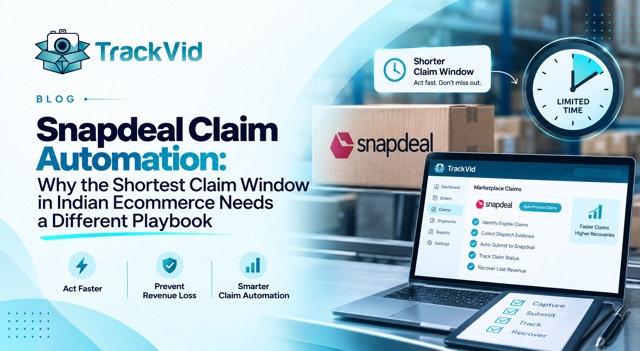
Snapdeal claim automation has to solve a narrower problem than other marketplaces do. Snapdeal's Seller Protection Fund claim window is one of the shortest in Indian ecommerce: sellers must submit an SPF dispute within 48 to 72 hours of receiving a returned item, with unboxing video or photo evidence attached through the seller panel. This is measurably tighter than most other major Indian marketplaces, where windows commonly run from several days to several weeks depending on claim type. A claim process that works fine on a longer-window platform routinely fails on Snapdeal simply because the evidence was not ready to submit inside the window, not because the underlying dispute was invalid. TrackVid is Snapdeal's officially authorised video and claim management partner for Snapdeal claim automation, which is the specific credential this guide exists to explain.
Quick Answer: What Makes Snapdeal Different?
Three things, together. First, the window: 48 to 72 hours from receiving a return, shorter than most competing marketplaces. Second, the evidence requirement is specific: unboxing video or photo evidence of the returned item's condition, not a general written explanation. Third, Snapdeal's reimbursement approach is graduated by issue severity rather than a simple approve-or-reject decision, which means the quality and specificity of evidence can affect not just whether a claim is approved but how much of it is.
Why Is Snapdeal Claim Automation a Different Problem?
Most Indian marketplace claim guides treat all platforms as roughly interchangeable: file within some number of days, attach evidence, wait for a decision. Snapdeal breaks that pattern in a way that matters operationally, not just as a policy footnote.
The window itself. Upon receiving a returned item back at your facility, Snapdeal's process requires inspecting the package and, where the item is damaged, used, swapped, or has missing parts, submitting a Seller Protection Fund dispute on the seller panel within 48 to 72 hours of that return being delivered back to you. Compare this to platforms where a claim window is measured in weeks: the operational margin for error on Snapdeal is a fraction of what sellers are used to managing elsewhere.
The evidence requirement is specific, not general. Snapdeal's process asks for unboxing videos or images at the point of inspecting the return. A written description of what was found is not the standard being asked for. This mirrors a pattern showing up across Indian marketplaces generally: video evidence tied to a specific moment in the process, not a narrative account after the fact.
Why this combination is harder than either factor alone. A short window is manageable if evidence is already prepared. A strict evidence requirement is manageable if there is time to gather it properly. Snapdeal sellers face both simultaneously: evidence has to already exist, in the right format, the moment a return is opened, because there is no time to reconstruct it after the fact.
Why Does the 48-to-72-Hour Window Break Manual Filing?
This is where manual claim processes, even well-run ones, tend to break specifically on Snapdeal.
What the manual process actually requires. Someone has to open every returned parcel, inspect it against what was expected, decide whether it qualifies for a dispute, record unboxing video or photos in an acceptable format, log into the seller panel, and submit before the window closes. On a platform with a 14-day or 120-day window, a return that sits unprocessed for a day or two is recoverable. On Snapdeal, that same delay can consume the entire window.
Where the failure actually happens. It is rarely a decision not to file. It is a returns desk working through a queue, a delay in someone reviewing footage, or a weekend falling inside the 48 to 72 hour clock. None of these are unusual operational realities. They are simply incompatible with a window this short unless evidence capture and filing are automatic rather than manual steps someone has to remember.
Why this compounds for multi-marketplace sellers specifically. A seller running Snapdeal alongside platforms with longer windows naturally develops habits tuned to the longer window, since that is where most of their claim volume and attention sits. Snapdeal's shorter clock does not adjust to match those habits, and it is usually the smaller, faster-moving channel that quietly loses the most claims to timing alone.
How Does Snapdeal's Reimbursement Structure Actually Work?
Worth understanding separately from the window, because it changes what "winning" a claim actually means on this platform.
Graduated by issue type, not binary. Rather than a straightforward approved-or-rejected outcome, Snapdeal's seller return resolution approach has historically reimbursed different issue categories at different percentages of the net payable amount, ranging from full reimbursement for more serious issues down to a smaller percentage for minor packaging-related damage. The exact current percentages by category should be confirmed directly in your seller panel, since these figures are set by Snapdeal and can be revised.
Why this matters for evidence quality specifically. On a platform with a binary outcome, evidence either meets the bar or it does not. On a graduated structure, sharper, more specific evidence, clearly showing the exact nature and extent of an issue, can plausibly affect which reimbursement tier a claim falls into, not just whether it is approved at all. Vague or low-quality unboxing footage is a bigger liability here than on a platform where the outcome is simply pass or fail.
The eligibility filter. Snapdeal's process also restricts disputes that appear invalid on their face, which reinforces why specific, verifiable evidence, rather than a general description of the problem, is what actually moves a dispute through review.
What Does "Officially Authorised" Actually Mean for Snapdeal Claim Automation?
TrackVid is Snapdeal's officially authorised video and claim management partner.
What this credential signals. An official authorisation reflects Snapdeal's own review and endorsement of the platform's compliance with its evidence and process standards, which is a different level of trust than a third-party tool simply claiming compatibility. For a seller deciding whether to trust a specific tool with Snapdeal's uniquely tight window, that distinction is worth knowing.
What to confirm directly for your specific setup. Any claims about processing speed or resolution timelines tied to authorised-partner status should be confirmed directly for your account and current volume rather than assumed from general marketing language, since the practical benefit can vary by claim type and current platform conditions.
If You Also Sell on Meesho
Meesho and Snapdeal are frequently run by the same seller as parallel channels, and the operational problems on each are genuinely different. Meesho's most damaging pattern is WFR, Wrong Forward Return, where the returned product does not match what was dispatched, along with returnless refunds processed without requiring a physical return at all. Both are covered in detail in a separate guide. This page focuses specifically on Snapdeal's window and evidence mechanics, which are a distinct problem from Meesho's fraud patterns even though the two platforms are often discussed together.
If Snapdeal and Meesho are both part of your channel mix, we will walk through both playbooks in one session. 15 minutes. No commitment.
Where TrackVid Fits
TrackVid is a video proof and claim management platform used by 1,100+ ecommerce sellers, and is Snapdeal's officially authorised claim automation partner.
What closes the specific gap this guide describes:
- Automatic, order-linked video capture at packing, so unboxing and dispatch evidence already exists before a return ever comes back, rather than being assembled under a 48 to 72 hour clock
- Return-side video capture, documenting the condition of what came back, matched to the original packing evidence for the same order
- Automated claim filing via robotic process automation on the seller's own Snapdeal panel access, cutting the time between a return being received and a dispute being filed to well inside the window
- Retrieval by order ID in under two minutes, which matters specifically on a platform where the window itself leaves almost no room for a slow evidence search
- Prepaid recharge pricing at roughly ₹1 to ₹2 per claim processed, no commission on recovered funds, no commission received from marketplaces
An anonymised deployment example: a single enterprise operation captured 94,904 packing videos across 95,836 tracked orders, filing 868 claims against that evidence, with approval moving from 42.3 percent to 60.3 percent within a month of switching to systematic capture and filing.
See what Snapdeal claim automation looks like against Snapdeal's specific window on real data. 15 minutes. No commitment.
Read Next
- SPF Claim Automation in India: The Complete Guide, the category overview this page sits inside
- Claim Automation vs Reimbursement Software, which category actually applies to Snapdeal-type evidence claims
Frequently Asked Questions
What is the Snapdeal SPF claim window?
48 to 72 hours from receiving a returned item back at your facility, one of the shortest claim windows among major Indian marketplaces, with unboxing video or photo evidence required through the seller panel.
How do I file a Snapdeal seller dispute?
Upon receiving a return, inspect the package, and if it is damaged, used, swapped, or missing parts, submit a Seller Protection Fund dispute on the Snapdeal seller panel within 48 to 72 hours, attaching unboxing video or photo evidence of the returned item's condition.
Does Snapdeal require unboxing video for claims?
Yes, unboxing video or photo evidence documenting the condition of the return is the standard evidence format Snapdeal's process asks for, rather than a general written explanation of what was found.
How long do I have to dispute a Snapdeal return?
48 to 72 hours from the return being delivered back to you. This is shorter than most other major Indian marketplace windows, which commonly run from several days to several weeks depending on claim type.
Who is Snapdeal's official claim automation partner?
TrackVid is Snapdeal's officially authorised video and claim management partner.
Why do Snapdeal claims get rejected?
Most commonly because evidence was not ready to submit inside the 48 to 72 hour window, or because unboxing footage was too general to verify the specific issue claimed, rather than because the underlying dispute itself was invalid.
Is Snapdeal's reimbursement all or nothing?
No. Snapdeal's return resolution approach has historically reimbursed different issue types at different percentages of the net payable amount rather than a single approve-or-reject outcome. Confirm current percentages directly in your seller panel, since these are set and revised by Snapdeal.
Can I use the same evidence for Snapdeal and other marketplaces?
The underlying order-linked packing and return video can support claims across marketplaces, but each platform has its own submission format and evidence standard, and Snapdeal's specific unboxing-video requirement and short window mean evidence needs to be ready to submit immediately rather than reformatted after the fact.
Does Snapdeal's short window affect multi-marketplace sellers differently?
Yes. Sellers running multiple channels naturally develop habits tuned to their higher-volume or longer-window platforms, and Snapdeal's much shorter clock does not adjust to match those habits, which is often why it quietly loses more claims than its share of total volume would suggest.
What should I check before choosing a Snapdeal claim automation tool?
Confirm order-linked retrieval speed against Snapdeal's 48 to 72 hour window specifically, not just general claims about automation, since a tool built around a longer-window platform's pace may not actually close the gap Snapdeal requires.
Sources: Snapdeal seller operations and SPF dispute documentation, 2026; Snapdeal seller return resolution policy documentation; TrackVid platform data across 1,100+ ecommerce sellers; anonymised enterprise deployment data (94,904 packing videos, 95,836 tracked orders, 868 claims filed)
Snapdeal's claim windows, evidence requirements and reimbursement percentages are set by Snapdeal and can change. Verify current terms directly in your seller panel before relying on this guidance for a specific claim.
TrackVid is a video proof and claim management platform for ecommerce sellers, and is Snapdeal's officially authorised video and claim management partner, providing order ID-linked evidence capture and automated claim filing on a prepaid per-claim pricing model. Learn more at trackvid.in.

Get the Marketplace Claim Recovery Checklist
A 12-point checklist used by 1,100+ sellers to recover 85-90% of marketplace claim losses. Free, instant access.
- Marketplace-specific evidence formats (AJIO, Flipkart, Amazon, Myntra)
- Claim window deadlines for every major platform
- The 6-step process that pushes approval from 85-90%
- Common rejection reasons and how to avoid them
No spam. Unsubscribe anytime. Used by sellers at Rare Rabbit, HRX, Da Milano + 1,100 more.
Stop Losing Money to Fake Returns
Join 1,100+ sellers who recover lakhs every month with TrackVid