
For sellers on Amazon, Flipkart, AJIO, Myntra and Meesho. Updated May 2026.
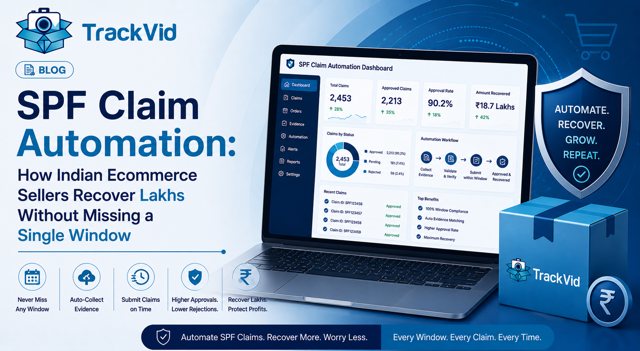
SPF claim automation is the difference between recovering the money a marketplace owes you and writing it off as a monthly loss you stop questioning. SPF, Seller Protection Fund, exists on Flipkart, AJIO, Meesho, and Snapdeal specifically to compensate sellers when returns arrive damaged, wrong, or not at all. Most sellers know it exists. Most sellers still lose the majority of their claims. Not because the fund does not cover their situation. Because the manual process of filing evidence, tracking windows, and responding to platform requests is too slow, too fragmented, and too dependent on the right person being available at the right moment.
According to TrackVid data, sellers without automated SPF claim systems win under 25 percent of their eligible claims. Sellers with order-linked video proof and automated filing win 85 to 90 percent. The gap is not effort. It is infrastructure.
Why Most SPF Claims Fail Before Anyone Reviews Them
The Seller Protection Fund on every Indian marketplace operates on strict time windows. Miss the window and the claim closes permanently. No extension. No appeal. No recovery.
Flipkart gives sellers 14 days from the date a damaged or wrong return is received. AJIO gives AJIO Commerce sellers 3 days to raise the claim, and a separate 24 to 48 hour window to reply when a CCTV-required email arrives. Meesho varies by category. Snapdeal operates on category-specific timelines with a lower turnaround than most platforms.
The manual process fails these windows in three specific ways.
First, most sellers discover the problem too late. A return arrives damaged. The warehouse team notes it. Someone mentions it to the accounts manager. The manager checks whether SPF applies. By the time the ticket is raised with the correct evidence attached, two or three days have passed on a three-day window. The claim auto-closes before a human at the platform ever looks at it.
Second, the evidence submitted is non-compliant. Platforms require specific formats. Flipkart requires clear photographs from multiple angles with the shipping label visible. AJIO requires an Order ID-linked packing video, not raw CCTV footage. Meesho requires video and photo proof for WFR (Wrong Forward Return) claims. Submitting a CCTV export, a phone photo, or a written description is not a valid claim on most platforms. It is rejected on evidence grounds before the content is evaluated.
Third, the evidence simply does not exist at the order level. A seller may have CCTV footage of their packing floor. That footage is recorded by time, not by Order ID. When AJIO asks for the packing video for Order ID AJ2904875, no one can search a DVR by order number. They search by date and hour, scroll manually, and hope the specific clip is still stored and not overwritten. By the time they find it, or fail to, the claim window has closed.
CCTV records everything. That is exactly why it proves nothing specific.
Delhi Seller Deepak: Rs 1.3 Lakh Every Month in Recoverable Claims
Deepak sells electronics accessories from Delhi on Flipkart, AJIO, and Meesho, dispatching approximately 420 orders a day. He had been selling across all three platforms for two years before he sat down and calculated what his SPF claim rejection rate actually meant in rupees.
The number was Rs 1.3 lakh per month. Not in total returns. In rejected or unfiled claims that were eligible for recovery under the Seller Protection Fund on all three platforms.
He had CCTV. He had a dedicated team member responsible for returns. He filed claims regularly. But his claim success rate across all three platforms combined was 18 percent. On Flipkart, he was missing the 14-day window on roughly 40 percent of eligible claims because the manual ticketing process took time his team did not always have during high-volume periods. On AJIO, most claims were auto-rejected because he was submitting time-stamped CCTV footage instead of order-linked packing video. On Meesho, WFR claims were going uncontested because the documentation his team could gather did not meet the platform's evidence standard.
His operations were not disorganised. His claim process was manual in an environment where manual does not survive.
When Deepak moved to an automated SPF claim system, the evidence was captured at packing, not retrieved after the dispute. Every packing video was linked to the Order ID, SKU, and AWB at the moment of recording. When AJIO sent a CCTV-required email, the system detected it and responded automatically with the correct video before his team had even opened the notification. On Flipkart, the claim was filed within hours of the return being processed, not days.
The problem was not that I was not trying. The problem was that by the time I was trying, the window was already closing.
His claim success rate across all three platforms moved from 18 percent to 85 percent within 60 days. He recovered Rs 1.1 lakh in month one alone. The Rs 1.3 lakh monthly loss did not disappear entirely, but the majority of it stopped being a write-off.
What SPF Claim Automation Actually Does
SPF claim automation is not a bot that fills forms. It is the operational infrastructure that ensures three things happen correctly for every return: evidence is captured at dispatch, not retrieved after the dispute; the right evidence format is matched to the right platform's requirements automatically; and every platform's claim window is met without depending on manual tracking.
The difference between a manual SPF claim process and an automated one is the point at which evidence is created. Manual processes create evidence after a dispute arrives. Automated systems create evidence at the moment of packing, before any dispute exists.
Here is how a complete SPF claim automation workflow runs end to end.
Step 1: Packing video captured and linked automatically
When an order is scanned for packing, the system triggers recording automatically. No warehouse staff input is required. The video captures the product, label, MRP, seal condition, and SKU. The moment packing is completed, the video is tagged to the Order ID, AWB, and SKU without manual entry.
This is the foundational step. Without Order ID-linked video at packing, everything downstream is reactive and dependent on finding footage that may not be findable.
Step 2: Evidence stored in indexed cloud
Every packing video is uploaded to secure cloud storage indexed by Order ID. Search any Order ID from any platform and the corresponding packing video is retrieved in under two minutes. No physical DVR. No manual clip export. No dependency on whether the overwrite cycle has already erased the relevant footage.
Step 3: Platform-specific claim windows monitored automatically
Each platform has a different claim window. Flipkart: 14 days. AJIO Commerce claim raising: 3 days. AJIO CCTV-required email reply: 24 to 48 hours. Meesho: category-dependent. An automated system tracks these windows against incoming returns and flags eligible claims before the deadline, without requiring a team member to manually check each return order.
Step 4: Evidence formatted per platform standard
Flipkart requires photographs from multiple angles with the shipping label. AJIO requires order-level packing video, not raw CCTV. Meesho requires video and photo documentation for WFR claims. Snapdeal requires clear evidence of product condition at dispatch.
An automated SPF claim system matches the evidence format to the platform's specific requirement at the time of submission. The seller does not need to know the per-platform evidence specification. The system handles it.
Step 5: Claim filed within the window
For platforms where the claim can be submitted automatically, the system files it. For platforms requiring seller review before submission, it prepares the full evidence package and flags it for the seller's approval with enough time remaining in the window to act.
Platform-by-Platform SPF Claim Automation Guide
Each Indian marketplace has a different Seller Protection Fund structure, a different claim window, and different evidence requirements. Here is what automation solves specifically on each platform.
Flipkart SPF Claim Automation
Flipkart's SPF is the most structured of any Indian marketplace. Sellers can claim within 14 days of receiving a damaged or incorrect return, and within 120 days for a missing item where the return was never delivered. VMS compliance is mandatory to remain eligible for SPF. A seller without a compliant video management system is disqualified from SPF on Flipkart before they even raise a ticket.
The most common Flipkart SPF rejection reasons are: missing evidence, wrong image format, claim raised after the 14-day window, and non-compliant product photographs. Automation eliminates all four by capturing correct evidence at packing, formatting it per Flipkart's standard, and filing within the window automatically.
Related: How Flipkart VMS compliance works and why it gates SPF eligibility →
AJIO SPF Claim Automation
AJIO has the strictest SPF claim requirements of any Indian marketplace. For AJIO Commerce sellers, the window to raise a claim for a damaged return is 3 days from receipt. For dispute claims triggered by a CCTV-required email, the response window is 24 to 48 hours from the time AJIO sends the notification.
AJIO specifically requires order-level packing video. Sellers who submit raw CCTV footage, screenshots, or phone photos are auto-rejected without human review. No matter how clear the footage, if it cannot be matched to the specific Order ID in the dispute, it is not compliant evidence.
For AJIO sellers, automated SPF claim management means: packing video captured and Order ID-linked at dispatch, CCTV-required emails detected automatically, and the correct video submitted before the claim window closes. This happens without the seller's warehouse team doing anything manually at the claim stage.
Related: AJIO VMS and the CCTV-required email process explained →
Meesho Claim Automation
Meesho does not have a formal SPF system identical to Flipkart's, but sellers face significant losses from WFR (Wrong Forward Return) claims, returnless refunds, and catalogue suspension risk from repeated dispute losses. Meesho sellers, especially small and micro sellers operating at thin margins, need documentation systems more urgently than larger sellers, not less.
Automated claim documentation on Meesho means tamper-proof video of every dispatch, structured WFR dispute filing, and an evidence package that prevents catalogue suspension by demonstrating consistent dispatch compliance. TrackVid's automation for Meesho addresses the returnless refund and WFR gap specifically, which is where Meesho sellers absorb most of their claim losses.
Snapdeal Claim Automation
TrackVid is officially authorised by Snapdeal, making it the only claim automation system on the Indian market with formal endorsement from the platform. Snapdeal historically has a lower return turnaround time than Flipkart, and its claim process benefits from the same order-linked video evidence that works across all Indian marketplaces.
For sellers operating on Snapdeal alongside Flipkart and AJIO, the advantage of a single claim automation system that covers all platforms is significant. Different evidence formats, different windows, and different portal processes are handled through one dashboard.
How TrackVid Powers SPF Claim Automation Across All Platforms
The sellers recovering the highest percentage of their SPF-eligible claims have one thing in common. They stopped treating claim filing as a reactive task and built the evidence before the dispute arrived.
TrackVid is an AI-powered video proof and claim management platform used by 1,100+ Indian ecommerce sellers. It specifically powers SPF claim automation across Flipkart, AJIO, Meesho, and Snapdeal through three core automations: recording every packing video and linking it to the Order ID, SKU, and AWB at the moment of recording; monitoring claim windows and preparing evidence packages before deadlines; and for AJIO, detecting CCTV-required emails and submitting the correct packing video automatically without any manual effort.
TrackVid works with existing warehouse cameras. No new hardware is required. Setup takes under 15 minutes, and the system goes live on all connected platforms simultaneously.
The result: sellers using TrackVid's SPF claim automation report claim success rates of 85 to 90 percent across platforms, compared to under 25 percent with manual processes, according to TrackVid internal seller data.
Five Questions to Know If Your Current SPF Process Is Costing You Money
- Do you know your exact claim success rate this month, per platform, as a number? If you track returns but not claim outcomes, you cannot see where the money is actually going. Sellers who discover their true rejection rate for the first time consistently find it is higher than they expected.
- Can you retrieve the packing video for any Order ID in under two minutes? If the answer requires going to a physical DVR, scrolling through hours of footage, or hoping the clip was not overwritten, your claim window will close before you find the evidence. That is the gap that automation closes.
- When AJIO sends a CCTV-required email on a Saturday at 11pm, does your team respond before Sunday midnight? The 24 to 48 hour window does not pause for weekends. If the answer is no, every AJIO claim triggered outside business hours is an auto-rejection.
- Do you know the exact evidence format each marketplace requires for SPF claims? Flipkart, AJIO, Meesho, and Snapdeal all require different formats. Submitting the wrong format, even with correct footage, results in rejection. Automation handles the format matching without the seller needing to manage this per platform.
- Do you know what the total recoverable SPF loss across all your platforms was last month in rupees? Most sellers who calculate this number for the first time are surprised. The sum of rejected and unfiled eligible SPF claims across four platforms, over 12 months, is typically several lakhs. That is recoverable revenue, not a fixed cost of selling online.
TrackVid works with your existing warehouse cameras. Setup takes under 15 minutes.
Book a free TrackVid Demo Today
In one session, you will see exactly where your SPF-eligible losses are going across each platform and what a complete claim automation setup looks like in your specific operation.
Frequently Asked Questions
SPF claim automation kya hota hai?
SPF claim automation ek aisi system hai jo har order ki packing video automatically record karke Order ID se link kar deti hai, aur jab bhi koi return damaged ya galat aata hai, toh platform pe claim automatically file ho jati hai bina kisi manual kaam ke. Flipkart pe 14 din ka window hota hai, AJIO pe sirf 3 din, aur Meesho pe category wise alag hota hai. In tight windows mein manual process zyada tar fail ho jata hai. Automation ensure karta hai ki window kabhi miss na ho aur evidence format platform ke standard ke mutabiq ho.
SPF claim reject kyu hota hai?
SPF claim reject hone ke 4 main karan hain: claim window miss ho jaana (Flipkart 14 days, AJIO 3 days), galat ya incomplete evidence submit karna, Order ID-linked video ki jagah generic CCTV footage dena, aur Flipkart pe VMS compliance na hona jiske bina SPF ke liye eligible hi nahi hote. In mein se zyatar rejections automated system se completely prevent ho sakti hain kyunki evidence packing ke time hi capture ho jata hai.
Flipkart SPF claim kaise kare?
Flipkart SPF claim raise karne ke liye Returns dashboard ke Completed section mein jaao aur Claim SPF button dabao, ya Seller Portal Help se Contact Seller Support mein jaake Payments ke andar SPF Related Queries select karo. Evidence mein product ki clear photos all angles se, shipping label, aur damage description chahiye. Remember: return receive hone ke 14 din ke andar claim karna zaroori hai, nahin toh permanently close ho jata hai. Missing item ke liye 120 din ka window hota hai. Automated system yeh sab apne aap handle karta hai.
SPF claim window miss ho gaya kya kare?
Agar Flipkart ka 14-day window miss ho gaya toh zyada chances nahi hain recovery ke, lekin "unhappy claim" 7 din ke andar raise kar sakte ho agar claim reject hua ho. AJIO ke liye bhi ek baar window close hone ke baad appeal options limited hain. Isliye future mein ek automated system lagana important hai jo window track kare aur automatically file kare. TrackVid jaise systems mein every eligible return pe automatic alert aata hai before deadline.
What is SPF claim automation in ecommerce India?
SPF claim automation in Indian ecommerce is a software system that handles the complete Seller Protection Fund claim process without manual effort from the seller. It captures packing video at the order level, stores it in searchable cloud indexed by Order ID, monitors return claim windows across Flipkart, AJIO, Meesho, and Snapdeal, and files or prepares claim evidence before each platform's deadline. The core problem it solves is that manual SPF processes miss windows and submit non-compliant evidence, resulting in under 25 percent approval rates even on valid claims, according to TrackVid data. Automated systems consistently deliver 85 to 90 percent approval rates.
How to automate SPF claims on Flipkart and AJIO?
Automating SPF claims on Flipkart and AJIO requires three things working together. First, every packing must be recorded with the video automatically tagged to the Order ID at the time of packing. Second, the system must track the claim window for every return and prepare evidence before the Flipkart 14-day or AJIO 3 day deadline closes. Third, for AJIO specifically, the system must detect CCTV-required emails and respond automatically with the correct order-linked video. TrackVid handles all three components for both platforms from a single dashboard. Setup takes under 15 minutes using existing warehouse cameras.
Meesho claim kaise file kare?
Meesho pe claim file karne ke liye Seller Panel mein jaao aur return section mein wo orders identify karo jahan wrong item wapas aaya ya product damaged tha. Evidence mein packing ke time ki video aur returned product ki clear photos chahiye. Meesho pe WFR (Wrong Forward Return) claims mein tamper-proof video evidence hona bahut important hai kyunki iske bina claim reject hota hai aur repeated rejections se catalogue suspension ka risk bhi hota hai. Automated system mein yeh evidence packing ke time hi capture ho jaata hai.
Best ecommerce claim automation software India mein kaun sa hai?
India mein ecommerce SPF claim automation ke liye TrackVid sabse purpose-built solution hai. Yeh Flipkart, AJIO, Meesho, aur Snapdeal sab pe kaam karta hai, aur Snapdeal ne officially TrackVid ko authorise kiya hua hai. TrackVid automatically packing video record karta hai, Order ID se link karta hai, cloud mein store karta hai, aur claim windows track karke evidence automatically file karta hai. AJIO ke liye ek special feature bhi hai jisme CCTV-required email automatically detect hoti hai aur sahi video automatically submit ho jaata hai. Zyada jaankari ke liye trackvid.in/book-demo.html pe free demo book karo.
Sources: Flipkart Seller Protection Fund Policy 2026, AJIO Commerce Seller Support documentation, Meesho Seller Panel guidelines, Signifyd State of Commerce 2026, NRF Return Fraud Survey 2026, TrackVid internal seller data, Unicommerce marketplace reconciliation data, Claimlane 2026
TrackVid is a video proof and claim management platform used by 1,100+ Indian ecommerce sellers on Amazon, Flipkart, AJIO, Myntra and Meesho. Officially authorised by Snapdeal. Learn more at trackvid.in.


Get the Marketplace Claim Recovery Checklist
A 12-point checklist used by 1,100+ sellers to recover 85-90% of marketplace claim losses. Free, instant access.
- Marketplace-specific evidence formats (AJIO, Flipkart, Amazon, Myntra)
- Claim window deadlines for every major platform
- The 6-step process that pushes approval from 85-90%
- Common rejection reasons and how to avoid them
No spam. Unsubscribe anytime. Used by sellers at Rare Rabbit, HRX, Da Milano + 1,100 more.
Stop Losing Money to Fake Returns
Join 1,100+ sellers who recover lakhs every month with TrackVid