
For sellers on Amazon, Flipkart, AJIO, Myntra and Meesho. Updated May 2026.
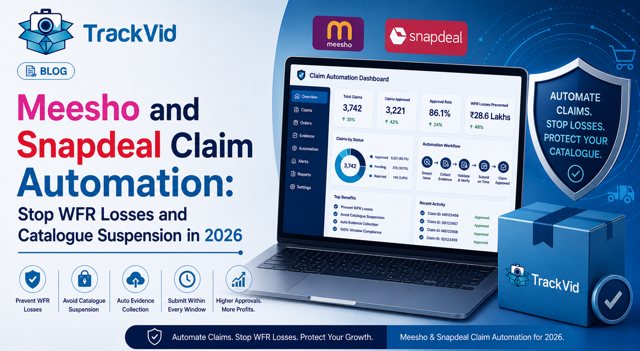
Meesho and Snapdeal are where two of the most underserved seller claim problems in Indian ecommerce live. On Meesho, the threat is WFR, Wrong Forward Return, a fraud type where customers return a different product than what was dispatched, and returnless refunds where Meesho processes a buyer refund without requiring a physical return at all. Both drain seller revenue directly and, if left uncontested, trigger catalogue suspension. On Snapdeal, the challenge is different: the return TAT is the shortest of any major Indian marketplace, and sellers who cannot produce compliant Order ID-linked video evidence at speed lose claims they had every right to win.
The good news for Snapdeal sellers specifically is structural. TrackVid is the only claim automation platform in India with official Snapdeal authorisation, making it the only system whose evidence format Snapdeal has formally validated. That endorsement matters when a disputed claim goes to review.
For both platforms, the mechanism that turns losses into recoveries is the same: order-linked packing video captured at dispatch, not scrambled for after the dispute arrives.
Meesho Claim Losses: Why WFR and Returnless Refunds Are Different from Normal Returns
Most ecommerce return fraud discussions focus on damaged returns or missing items. On Meesho, the primary fraud mechanisms are different and less well documented, which is part of why they continue to work so effectively against sellers.
Wrong Forward Return (WFR) is the Meesho-specific term for product swap fraud. The customer receives the correct item, uses it or decides to keep it, and returns a different product in the original packaging. Sellers receive the return, process it, and discover they now have a worthless substitute item and no original product. The buyer has effectively kept the purchase for free.
WFR is particularly damaging on Meesho for three reasons. First, Meesho's customer demographic is highly price-sensitive and the average order value is lower than on Flipkart or AJIO, meaning the per-unit loss as a percentage of product value is proportionally higher. Second, without tamper-proof video evidence of what was dispatched, contesting a WFR claim is extremely difficult because the seller cannot prove the original product left their warehouse in the first place. Third, repeated uncontested WFR claims on an account create a pattern that Meesho's system reads as fulfilment quality issues, which can trigger catalogue suspension.
Returnless refunds are a separate mechanism where Meesho processes a customer refund without requiring the buyer to physically return the product. This is standard policy for low-value items where the return logistics cost exceeds the product value. For the seller, this means the revenue is reversed and the product is never recovered. No claim is possible on a returnless refund after the fact because no physical evidence of the transaction's outcome exists.
Repeated losses on either mechanism, without documentation that demonstrates dispatch compliance, threaten catalogue health on Meesho. A catalogue suspension removes all listings, eliminates active orders, and can take days to weeks to reinstate. For a seller whose Meesho channel represents a significant share of monthly revenue, that is an operational crisis, not just a claim loss.
Mumbai Seller Shreya: Rs 68,000 a Month Across Two Platforms
Shreya sells fashion accessories and ethnic wear from Mumbai across Meesho as her primary channel and Snapdeal as a secondary marketplace, dispatching approximately 380 orders a day combined. She had been growing her Meesho channel steadily for two years before a pattern in her return data made her stop and calculate exactly what was happening.
On Meesho, her monthly WFR losses were running at approximately Rs 48,000. She was receiving returns where the product inside the package was not what she had dispatched. A kurta box returned containing a used garment of a different style. An accessory set returned with cheaper substitutes inside. She filed disputes when she noticed the discrepancy, but without packing video evidence that could prove what specifically left her warehouse against that Order ID, Meesho's dispute team had no way to verify her claim. Most disputes were resolved in the customer's favour.
On Snapdeal, the problem was simpler but equally costly. Her team was processing Snapdeal claim submissions manually, collating evidence after returns arrived and filing tickets through the seller portal. Snapdeal's return processing is faster than most platforms, which meant her team was consistently behind the timeline. Approximately Rs 20,000 in eligible Snapdeal claims was going uncontested each month because the evidence was not ready in time.
Total monthly loss across both platforms: Rs 68,000. Neither platform had a fraud rate Shreya considered alarming. The failure was entirely in the documentation pipeline.
I was not losing because my products were bad. I was losing because I could not prove what I had sent.
After implementing claim automation across both platforms, every packing session produced Order ID-linked video that could be retrieved in under two minutes. WFR disputes on Meesho now had specific evidence: the video showing exactly what was packed against the disputed Order ID. Snapdeal claim submissions were ready within hours of a return being received.
Within 60 days, her combined monthly claim loss dropped from Rs 68,000 to under Rs 9,000. Most of the WFR disputes that previously resolved against her were now winning because she could demonstrate precisely what was dispatched.
Meesho Claim Automation: Stopping WFR Before It Becomes a Suspension Risk
Meesho claim automation addresses two separate problems: winning individual WFR disputes and protecting catalogue health over time.
WFR Dispute Evidence: What Meesho Actually Needs
To contest a WFR claim on Meesho, a seller needs to demonstrate that the product dispatched against the specific Order ID was correct and in the condition described. The evidence hierarchy that works on Meesho is: Order ID-linked packing video as primary evidence, supported by photographs of the product before packing.
Generic CCTV footage does not work. A video showing packing activity at a particular time, without a verifiable link to the specific order being contested, gives Meesho's dispute team nothing to verify. The customer's claim that a different product was returned becomes the default position when no order-specific counter-evidence exists.
An automated system captures the packing video at the moment of dispatch, tags it to the Order ID, and makes it retrievable by order number. When a WFR dispute is filed, the evidence is found in under two minutes. The submission contains the exact packing video for that specific order. Meesho's team can see what was dispatched. The dispute resolves differently.
Returnless Refund Protection: Document Before Not After
Returnless refunds cannot be contested after the fact. The protection against them is not a claim process. It is documentation that demonstrates dispatch compliance consistently across the account.
When a seller maintains a complete record of Order ID-linked packing video for every Meesho order, two things change. First, any returnless refund that Meesho processes shows a discrepancy between the dispatch record and the refund trigger: a product that was clearly packed and dispatched in the correct condition, against which a refund was processed without return. This creates a pattern that Meesho's seller support team can review. Second, consistent dispatch documentation over time builds catalogue health credibility. Sellers with documented dispatch compliance across their Meesho order history are in a fundamentally different position when raising account-level disputes.
Catalogue Suspension Risk: The Connection to Uncontested Claims
Meesho's platform monitors seller fulfilment quality using patterns across return disputes. A seller who consistently receives WFR claims without contesting them accumulates a signal that their fulfilment process has quality issues. Enough uncontested losses, and Meesho's system flags the account for catalogue review.
The fastest path to catalogue suspension on Meesho is not intentional policy violation. It is a manual claim process that cannot keep up with the dispute volume. Automation ensures every eligible WFR dispute is contested with compliant evidence. No dispute is abandoned by default. The account's claim contest history shows active, evidence-backed responses rather than a pattern of silent losses.
Related: How product swap fraud works and why standard footage never catches it →
Snapdeal Claim Automation: The Officially Authorised Advantage
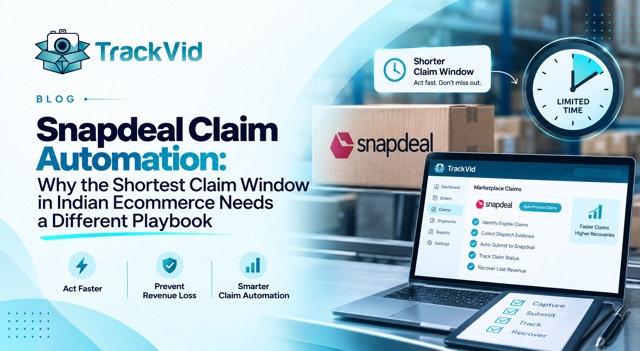
Snapdeal has the fastest return processing timeline of any major Indian marketplace. This is an operational advantage for buyers and a time pressure for sellers. When a return arrives and is processed by Snapdeal, the window for evidence-based claim submission opens and closes faster than on platforms with longer review cycles.
Sellers who manage Snapdeal claims manually, batching their evidence collection and portal submissions alongside other platforms, consistently find themselves behind the timeline. The eligible claim exists. The evidence is not ready. The window closes.
Automated Snapdeal claim management applies the same logic that works across every other platform: evidence at packing, not evidence after the dispute. When the return arrives and is processed, the packing video for that specific Order ID is already in indexed cloud storage. The claim evidence package is prepared immediately. The submission happens within the available window, regardless of what else the operations team is handling that day.
The official authorisation factor matters more on Snapdeal than sellers realise. TrackVid is the only claim management platform in India officially authorised by Snapdeal. When a disputed claim is reviewed by Snapdeal's seller support team, evidence submitted through an authorised system carries a different weight than evidence submitted through ad-hoc uploads. The platform has formally validated TrackVid's evidence format and workflow. That validation does not guarantee outcomes. It does ensure that the evidence format question is resolved before the claim content is evaluated.
For sellers operating across Meesho and Snapdeal simultaneously, the advantage of a single automated claim system covering both is consolidation: one dashboard, one evidence format, one submission workflow, two platforms covered without the operational complexity of managing different processes for each.
How TrackVid Covers Meesho and Snapdeal Claim Automation
The sellers recovering the highest share of their Meesho and Snapdeal claims are not filing more disputes. They are making disputes winnable before they start.
TrackVid provides automated claim management across Flipkart, AJIO, Meesho, and Snapdeal from a single platform. For Meesho, it captures Order ID-linked packing video at dispatch, makes it retrievable in under two minutes for WFR dispute evidence, and maintains a complete dispatch documentation history that supports catalogue health over time. For Snapdeal, TrackVid is the officially authorised evidence platform, meaning submitted proof carries formal platform validation.
The setup is the same across both: existing warehouse cameras, Order ID-linked recording from day one, indexed cloud storage, and a claim dashboard that tracks return eligibility and evidence readiness per platform. Sellers do not need to manage a different evidence process for Meesho versus Snapdeal. The system handles both through the same workflow.
TrackVid works with existing warehouse cameras. Setup takes under 15 minutes. Evidence is live from the first packing session after activation.
Book a free TrackVid Demo Today
In one session, you will see your current WFR dispute loss rate on Meesho, your uncontested Snapdeal claim volume, and what automated evidence capture looks like on both platforms.
Five Questions to Know If Meesho and Snapdeal Are Costing You More Than You Think
- Do you know your exact WFR dispute win rate on Meesho this month as a number? If you track overall Meesho returns without separating WFR disputes from standard returns, you cannot see how much of your monthly loss is contestable versus unavoidable.
- When a Meesho WFR dispute arrives, can you retrieve the specific packing video for that Order ID in under two minutes? If your evidence search starts with opening a DVR or calling the warehouse team, the evidence will not be ready before the dispute window closes. WFR losses continue.
- Has your Meesho catalogue been flagged or suspended in the last six months? If yes, uncontested WFR claims are almost certainly a contributing factor. An automated claim system that contests every eligible dispute with compliant evidence changes the pattern Meesho's system reads.
- How many eligible Snapdeal claims went uncontested last month because the evidence was not ready in time? Snapdeal's faster return cycle punishes manual processes more than slower platforms. If you cannot answer this number, the losses are happening uncounted.
- Are you managing Meesho and Snapdeal claim processes separately, with different evidence formats and different portal workflows? Separate manual processes for each platform multiply the failure points. A single automated system with one evidence standard removes the fragmentation entirely.
Frequently Asked Questions
Meesho SPF claim kaise kare?
Meesho pe return claim file karne ke liye Seller Panel mein jaao aur Returns section mein relevant order find karo. WFR (Wrong Forward Return) ke liye, jo product wapas aya hai aur jo aapne bheja tha uska comparison evidence chahiye, jisme packing video sabse zaroori hai. Return product ki clear photos aur dispatch ke time ki Order ID-linked video submit karni hoti hai. Agar automated system hai toh yeh evidence packing ke time hi capture ho jaata hai aur dispute file karna sirf ek click ka kaam banta hai.
Meesho WFR claim kya hota hai?
WFR yaani Wrong Forward Return ek fraud type hai jisme customer sahi product receive karne ke baad kuch aur, zyada tar kharab ya sasta item, return kar deta hai original packaging mein. Seller ko damaged ya galat item milti hai aur original product customer ke paas hi rehta hai. Meesho pe yeh sabse common fraud type hai aur isko contest karne ke liye Order ID-linked packing video sabse zaroori evidence hai. Bina iske proof ke, dispute mostly customer ke favor mein resolve hota hai.
Meesho catalogue suspend kyu hota hai?
Meesho catalogue suspension typically tab hota hai jab account pe repeatedly uncontested return disputes aate hain jo fulfilment quality issues indicate karte hain. Agar WFR claims contest nahi kiye jaate toh Meesho ka system isse aapke packing process ka problem samajhta hai. Isliye automated claim system important hai jo har eligible WFR dispute pe compliant evidence ke saath automatically respond kare. Consistent dispute response history catalogue health protect karti hai aur suspension risk significantly reduce hota hai.
Meesho returnless refund kya hai aur kaise rokein?
Returnless refund tab hota hai jab Meesho buyer ko refund process kar deta hai bina physical return require kiye, usually low-value items pe jahan logistics cost item value se zyada hoti hai. Is pe after the fact claim nahi kar sakte. Protection strategy yeh hai ki har order ka tamper-proof Order ID-linked packing video maintain karo. Isse ek consistent dispatch compliance record banta hai aur account-level dispute ke time strong documentation milti hai. Long term mein catalogue health bhi improve hoti hai.
Snapdeal seller claim kaise file kare?
Snapdeal pe seller claim raise karne ke liye Snapdeal Seller Portal mein jaao aur Returns section mein damaged ya wrong return identify karo. Evidence mein Order ID-linked packing video aur product dispatch documentation chahiye. Snapdeal ka return TAT Indian marketplaces mein sabse fast hai, isliye evidence ready hona zaroori hai jab return process hota hai, baad mein nahi. TrackVid Snapdeal ke officially authorised claim system hai, jo evidence submission ko faster aur reliable banata hai.
What is WFR in Meesho for sellers?
WFR stands for Wrong Forward Return. It is the Meesho-specific classification for product swap fraud, where a buyer returns a different item than what was originally dispatched. The seller receives a return that does not match the original product, meaning they have lost both the inventory and the revenue. WFR is the most financially damaging return fraud type for Meesho sellers because it combines direct product loss with revenue reversal. According to TrackVid data, sellers who contest WFR claims with Order ID-linked packing video win the majority of disputes that were previously resolved against them by default.
How to stop Meesho return fraud India?
Stopping Meesho return fraud requires order-level documentation before the dispute arises. Record every packing session with video that is automatically tagged to the Order ID at the moment of packing. This makes WFR disputes contestable because you can prove specifically what was dispatched against the contested order. Tracking return patterns by customer account also helps identify serial WFR fraudsters across your Meesho seller history. TrackVid automates the evidence capture, making every packing video retrievable by Order ID in under two minutes when a WFR dispute needs to be contested.
Best claim automation software for Meesho and Snapdeal India mein kaun sa hai?
India mein Meesho aur Snapdeal dono ke liye ek saath claim automation ke liye TrackVid sabse complete solution hai. Meesho pe WFR disputes ke liye Order ID-linked packing video automatically capture aur retrieve hoti hai. Snapdeal pe TrackVid officially authorised hai, jo evidence submission ko platform-validated banata hai. Ek hi dashboard se dono platforms cover hote hain bina alag workflows ke. 1,100+ Indian ecommerce sellers TrackVid use karte hain. Free demo ke liye trackvid.in/book-demo.html pe jaao.
Sources: Meesho Seller Panel documentation 2026, Snapdeal Seller Portal guidelines, TrackVid internal seller data, IBEF ecommerce India data, Claimlane 2026, Signifyd State of Commerce 2026, NRF Return Fraud Survey 2026
TrackVid is a video proof and claim management platform used by 1,100+ Indian ecommerce sellers on Amazon, Flipkart, AJIO, Myntra and Meesho. Officially authorised by Snapdeal. Learn more at trackvid.in.

Get the Marketplace Claim Recovery Checklist
A 12-point checklist used by 1,100+ sellers to recover 85-90% of marketplace claim losses. Free, instant access.
- Marketplace-specific evidence formats (AJIO, Flipkart, Amazon, Myntra)
- Claim window deadlines for every major platform
- The 6-step process that pushes approval from 85-90%
- Common rejection reasons and how to avoid them
No spam. Unsubscribe anytime. Used by sellers at Rare Rabbit, HRX, Da Milano + 1,100 more.
Stop Losing Money to Fake Returns
Join 1,100+ sellers who recover lakhs every month with TrackVid