
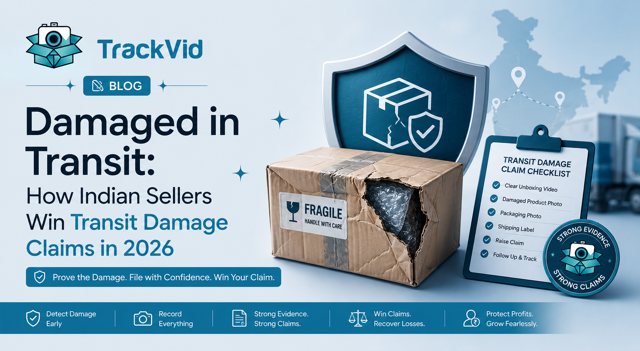
For sellers on Amazon, Flipkart, AJIO, Myntra and Meesho. Updated June 2026.
If a customer marks an order as received damaged and you are sure you packed it well, you are about to file a transit damage claim ecommerce dispute, and you will lose it without proof of the box leaving your warehouse intact. Damage claims are one of the main marketplace claim types Indian sellers file, alongside fake returns, loss in transit, and wrong-item returns. The carrier is usually liable for damage that happens after pickup, but liability follows the contract and, more importantly, follows the evidence. With monsoon running from June to September, rough handling and moisture exposure push damage rates up exactly when proof matters most.
Returns in India already sit between 15 and 35 percent depending on category, according to IBEF data, and sellers write off 8 to 15 percent of monthly revenue in unrecovered losses, according to TrackVid data. Damage is the slice of that loss sellers most often surrender, because they cannot separate damage they caused from damage the courier caused.
Why Transit Damage Claims Get Rejected
A transit damage claim ecommerce dispute fails for a simple reason. The seller can describe what they packed, but cannot prove the item's condition at the moment it left the warehouse.
The most common drivers of damage are weak or insufficient packaging, rough handling in transit, and environmental exposure such as rain and humidity. Two of those three are the courier's fault. The first is yours. The marketplace cannot tell which one applies from a photo of a broken item, so by default the loss sits with the seller.
Sellers typically try three things, and all three are weak.
They rely on packing photos, which show a sealed box but not the product going into it. They rely on CCTV, which records by time and location and cannot be searched by Order ID, so retrieving the exact packing moment takes hours. They rely on written descriptions, which carry no evidentiary weight in a dispute.
Flipkart SPF claims, as an example, require dispatch video, packing photographs, and the invoice, submitted through the seller portal. If the dispatch video does not exist or cannot be tied to the specific Order ID, the claim is rejected before anyone assesses the damage itself.
The problem is not the damage. It is proving the box left your warehouse perfect.
Who Is Responsible When Goods Are Damaged in Transit
For Indian ecommerce, responsibility splits across three parties, and the proof you hold decides which one absorbs the cost.
- The seller owns damage caused by inadequate packaging. Thin boxes, no cushioning, wrong-size cartons for fragile goods.
- The carrier owns damage from rough handling and exposure after pickup. Carriers are usually liable for in-transit damage, though compensation depends on the contract, including declared-value terms.
- The customer sometimes claims damage that did not happen, or damage they caused after delivery, as a route to a free return.
Without order-linked proof, all three of these collapse into one outcome: the seller pays. With proof that the item was intact and correctly packed at dispatch, you can push damage back onto the carrier where the contract allows, and you can defeat false damage claims from buyers outright.
How to File a Transit Damage Claim, Step by Step
A transit damage claim ecommerce dispute is won or lost on sequence and proof. The steps are similar across platforms, but each has its own window and portal.
Step 1: Capture condition at dispatch
Before anything ships, you need video showing the item intact and correctly packed, linked to the Order ID. This is the evidence the rest of the process depends on. Without it, every later step is guesswork.
Step 2: Identify the claim type fast
When a damage report arrives, decide quickly whether it is buyer-side, carrier-side, or genuine. Your dispatch clip tells you which, because it shows the exact condition the item left in.
Step 3: File inside the platform window
For Amazon, raise the issue through SAFE-T in Seller Central. For Flipkart, file through the SPF process in the seller portal, where a transit damage claim requires dispatch video, packing photographs, and the invoice. AJIO and Myntra have their own portals and short windows. Late filing is a common avoidable rejection.
Step 4: Attach order-linked proof, not generic footage
Submit the dispatch video tied to the specific Order ID and AWB, plus packing photos and the invoice. Generic CCTV that cannot be searched by Order ID is regularly rejected, so the linkage is what makes a transit damage claim stand.
Step 5: Escalate carrier liability where the contract allows
If the dispatch clip shows the item was sound at pickup, the damage is the carrier's, and you can pursue a carrier damage claim using the same proof, subject to declared-value terms.
The whole process collapses without Step 1. Everything after it is built on the dispatch clip.
Delhi Seller Vikram: Separating Real Damage From Free-Return Damage
Vikram runs a consumer electronics and accessories business in Delhi, shipping around 450 orders a day across Amazon and Flipkart. Fragile and high-value items mean damage disputes are a constant, and the monsoon months make it worse.
His problem was that he could not tell his own packing failures apart from courier damage apart from buyer fraud. Every damaged-on-arrival claim looked identical in the seller panel. He had cameras over the packing benches, but pulling the right clip from hours of CCTV by hand was so slow his team stopped trying.
He was losing about Rs 95,000 a month to damage claims he could not contest, plus the replacement cost of items that were probably fine when they shipped.
What changed was retrieval and linkage. Once every packing was recorded and linked to the Order ID, SKU, and AWB, his team could open any damage dispute, find the dispatch clip in under two minutes, and see the exact condition of the item as it was boxed. Genuine courier damage went to carrier claims with dispatch video attached. Buyer-side false damage claims were refused with the packing clip as evidence.
As Vikram put it, "Once I could see the item going into the box, half my damage losses turned out to be claims I should have won."
His contestable damage losses fell sharply within the first peak handling month, because for the first time the three kinds of damage were separable. The replacement shipments he used to send on reflex, just to close a complaint, dropped too, because he could now answer a false damage claim with the dispatch clip instead of conceding it.
How TrackVid Turns Damage Disputes Into Won Claims
The sellers who recover damage losses are not arguing harder after the dispute. They are capturing condition at dispatch, before anything goes wrong. That is what TrackVid (trackvid.in) is built to do.
TrackVid records every packing automatically and links each video to Order ID, SKU, and AWB at the moment of packing, then stores it in searchable cloud. When a transit damage claim ecommerce dispute arrives, you search the Order ID and the dispatch clip is in front of you in under two minutes, showing the item intact and correctly cushioned as it went into the box.
That single clip does two jobs. It supports a carrier damage claim by proving the damage occurred after pickup, and it defeats false buyer damage claims by proving the product shipped in good condition. The same order-linked video format is accepted across Amazon SAFE-T, Flipkart SPF, AJIO, Myntra, and Meesho, so you file the same proof everywhere without reformatting. For the full disputes view, see this Related: claim management system for ecommerce guide, and for the COD side of returns, this Related: COD return-to-origin guide.
Sellers who move from CCTV or photos to structured dispatch proof commonly lift claim success from under 25 percent to the 80-90 percent range, according to TrackVid data.
Five Questions to Audit Your Damage Claim Process Before Monsoon Peaks
1. Can you produce a video of the actual product going into the box for any Order ID in under two minutes?
If not, your damage claims rest on photos that prove a sealed box, not a sound product.
2. When a buyer claims damage, can you prove the item shipped intact?
If you cannot, every false damage claim becomes a paid return.
3. Are you filing carrier damage claims with dispatch video, or absorbing courier damage as your own?
Carriers are usually liable, but only against proof.
4. Does your packing record survive a weekend, a shift change, and a CCTV overwrite?
Time-and-location CCTV is overwritten and unsearchable. Order-linked video is not.
5. Do you know your monthly rupee loss to damage claims as a specific number?
If you cannot name it, you cannot tell how much of it was recoverable.
Schedule a free demo at trackvid.in/book-demo.html
In one session, you will see exactly where your recoverable revenue is going and what a structured proof system looks like in your specific operation. TrackVid works with your existing warehouse cameras. Setup takes under 15 minutes.
Frequently Asked Questions
Product damaged in transit who is responsible in india?
For ecommerce, the carrier is usually responsible for damage that happens after pickup, while the seller owns damage from weak packaging, and a buyer can falsely claim damage for a free return. Responsibility follows the contract and the proof, which is why dispatch video tied to the Order ID decides most cases.
How do I claim for a product damaged in transit?
File the platform's damage claim within its window, attach the dispatch video and packing evidence, and reference the Order ID and AWB. Flipkart SPF, for example, requires dispatch video, packing photographs, and the invoice, so a missing or unsearchable dispatch clip is the usual reason a transit damage claim ecommerce dispute is rejected.
Customer says item was damaged but I packed it fine. What can I do?
Without proof you will likely lose, because the marketplace cannot tell buyer-side damage from courier damage. With an order-linked packing video showing the item intact at dispatch, you can refuse a false damage claim and, where it was genuine courier damage, push the cost to the carrier. TrackVid stores that clip searchable by Order ID.
Flipkart damage claim rejected, what to do?
Check whether your submission included dispatch video tied to the exact Order ID, since SPF requires it. Most rejections come from missing or unsearchable dispatch proof rather than the damage assessment itself. A system that captures and retrieves that clip per order fixes the root cause.
Does monsoon increase ecommerce damage claims in India?
Yes. Environmental exposure such as rain and humidity is one of the three main damage drivers alongside weak packaging and rough handling, and the June to September monsoon raises both exposure and handling damage. That makes dispatch proof most valuable in exactly these months.
Is CCTV enough for a transit damage claim?
Usually not. CCTV records by time and location, cannot be searched by Order ID, and is often overwritten before you retrieve the clip. Marketplaces want order-linked dispatch video, which is why CCTV footage is regularly rejected as proof.
What is the best way to prove a damage claim for ecommerce in India?
Capture order-linked packing video at dispatch so you can prove the item's condition the moment it left the warehouse. TrackVid produces that proof in one format accepted across Amazon, Flipkart, AJIO, Myntra, and Meesho, used by 1,100+ Indian sellers.
Sources: IBEF (India ecommerce return rates), TrackVid seller data (claim success and revenue leakage), Flipkart SPF documentation requirements (dispatch video, packing photos, invoice), India carrier liability and goods-in-transit responsibility references, marketplace claim mechanisms (Amazon SAFE-T, Flipkart SPF).
TrackVid is a video proof and claim management platform used by 1,100+ Indian ecommerce sellers on Amazon, Flipkart, AJIO, Myntra and Meesho. Officially authorised by Snapdeal. Learn more at trackvid.in.



Get the Marketplace Claim Recovery Checklist
A 12-point checklist used by 1,100+ sellers to recover 85-90% of marketplace claim losses. Free, instant access.
- Marketplace-specific evidence formats (AJIO, Flipkart, Amazon, Myntra)
- Claim window deadlines for every major platform
- The 6-step process that pushes approval from 85-90%
- Common rejection reasons and how to avoid them
No spam. Unsubscribe anytime. Used by sellers at Rare Rabbit, HRX, Da Milano + 1,100 more.
Stop Losing Money to Fake Returns
Join 1,100+ sellers who recover lakhs every month with TrackVid