
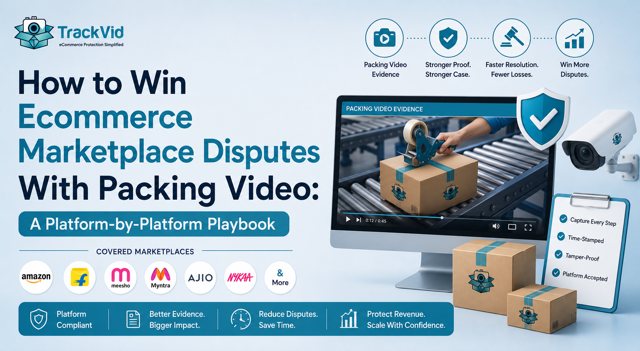
For sellers on Amazon, Flipkart, AJIO, Myntra, Meesho, Shopify and global marketplaces. Updated June 2026.
Direct Answer
Marketplace disputes are rarely lost because the seller was wrong. They are lost because the right evidence was not produced, in the format the platform accepts, inside the claim window. Each platform states all three differently, and the differences decide which claims are winnable.
Most marketplace disputes are not lost because the seller was wrong. They are lost because the seller could not produce the right evidence, in the format the platform accepts, inside the claim window. Get those three things right and you win claims you are currently writing off. That is what it means to win ecommerce marketplace disputes with packing video, and this is the platform-by-platform playbook for doing it.
The evidence that wins is order-linked dispatch video: a recording of the order being packed, tied to the Order ID and AWB, retrievable in seconds. What changes from platform to platform is the window and the submission process. Here is how each one works.
The Universal Principle: Right Evidence, Right Format, Right Window
Before the platform specifics, the rule that applies everywhere.
To win any marketplace dispute, your evidence has to satisfy three conditions at once. It has to be the right evidence, meaning order-linked proof of what you shipped, not general footage. It has to be in the right format, meaning tied to the specific Order ID and AWB the platform is asking about. And it has to arrive inside the right window, because a perfect piece of evidence submitted a day after the deadline wins nothing.
This is why raw CCTV fails on all three counts for most sellers. It is not order-linked, so it is the wrong format. Finding the clip takes hours, so it often misses the window. And even when submitted, platforms reject it as insufficient. Order-linked packing video is built to satisfy all three conditions by default, which is why it wins where CCTV loses.
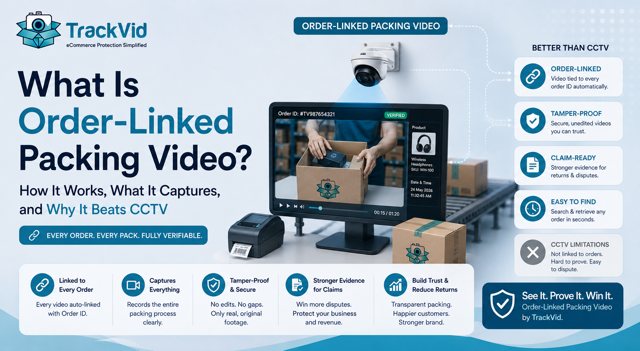
Related: How order-linked packing video works and why CCTV cannot match it
Amazon SAFE-T Claims
Amazon's SAFE-T process lets sellers on FBA and certain fulfilment models contest reimbursement decisions, particularly on returns where the item came back wrong, damaged, or not at all.
The window is tight. You typically have around 7 days from the relevant event to file, so speed matters. To win, submit order-linked evidence that shows what was dispatched for that specific Order ID: the item, its condition, the correct label, and the sealed parcel. When your packing video shows the correct product in correct condition leaving your facility, an empty-box or not-as-described claim becomes very hard for the buyer to sustain.
The common mistake is filing late or submitting evidence that is not tied to the order. A generic photo or unlinked footage gives the reviewer no reason to overturn the original decision.
Flipkart SPF Claims
Flipkart's Seller Protection Fund covers specified loss scenarios, including certain return and damage cases, when the seller can evidence their side.
The window here is shorter than Amazon's in practice, often requiring a response within 48 to 72 hours. That compresses the time you have to find and submit evidence, which is exactly where sellers relying on manual footage retrieval fall down. Order-linked video that surfaces in seconds keeps you inside the window comfortably. Submit the packing video for the disputed Order ID showing the item, label, and seal, and the claim rests on evidence rather than on your word.
The mistake that loses Flipkart claims is the retrieval delay. By the time a team has searched CCTV for the right clip, the window has often closed.
AJIO CCTV-Required Claims
AJIO's process is the one that catches the most sellers off guard. For many disputes, AJIO sends a CCTV-required email demanding footage of the pack within a short response window, commonly 24 to 48 hours.
This is brutal for two reasons. First, the window is short enough that a claim arriving on a Friday or before a holiday is easily missed. Second, AJIO expects order-linked footage, and raw CCTV that is not tied to the Order ID is rejected. So sellers lose these claims twice over: they miss the window, and even when they respond, the footage is not accepted.
Order-linked packing video solves both. The evidence for the specific order already exists and is retrievable immediately, and it is in the order-linked form AJIO expects. Better still, an automated system can respond to the CCTV-required email within the deadline without a human racing the clock.
Related: How claim management automates the AJIO response and the rest
Myntra, Meesho, and Other Platforms
The specifics vary, but the pattern is the same across Myntra, Meesho, and most marketplaces. Each has a dispute or claim mechanism, each has a response window, and each rewards order-linked evidence over general footage. Once you have order-linked packing video for every order, you are equipped for whatever any platform asks, because you are no longer scrambling to reconstruct proof after the fact. The proof already exists, indexed by Order ID, ready to submit.
The Mistakes That Lose Winnable Claims
Four mistakes account for most lost disputes that the seller should have won.
Missing the window. The evidence existed, but nobody responded in time because finding it took too long or the claim landed on a weekend.
Submitting unlinked evidence. General CCTV or a stray photo that is not tied to the Order ID gives the reviewer nothing to act on and is usually rejected.
Not filing at all. Many sellers stop contesting because the effort of gathering evidence for each claim is not worth it at volume, so they write off claims they could have won.
Inconsistent proof. Some orders are recorded, some are not, so the seller can only contest a fraction of disputes. Coverage has to be every order, automatically, or the gaps become the losses.
Every one of these traces back to the same root: proof that is not captured automatically, per order, at the moment of packing.
An Ahmedabad Seller Who Started Winning
Neha runs a fashion label out of Ahmedabad, shipping around 400 orders per day across Amazon, Flipkart, and AJIO.
Her dispute record was the problem every multi-marketplace seller recognises. On Amazon she filed SAFE-T claims late because pulling evidence took her team too long. On Flipkart the 48 to 72 hour window closed before she could respond. And AJIO's CCTV-required emails were the worst, because even when she answered in time, her raw CCTV was rejected for not being order-linked. Her claim success rate sat well below a quarter.
Once every order was recorded and linked to its Order ID automatically, the pattern changed. The evidence for any disputed order was retrievable in seconds and in the accepted format, so responses went in inside every platform's window, and the claims started resolving in her favour.
"The disputes did not change. My evidence did. I was losing claims I should have won, purely because I could not get the right footage to the right place in time. Once the proof was automatic and linked to the order, the same claims started going my way."
Neha's turnaround was not about filing more claims or arguing harder. It was about having order-linked evidence ready for every order, so that winning became a matter of submitting proof rather than reconstructing it.
How TrackVid Automates Winning
TrackVid is built to win marketplace disputes with packing video, end to end, and it is already used by 1,100+ Indian ecommerce sellers. On disputes where packing video is submitted, sellers report claim win rates of 90 percent or above, against an industry average under 25 percent without structured proof, according to TrackVid data.
The platform records every order and links the video to the Order ID, AWB, and SKU automatically. It detects claimable events, retrieves the matching evidence, and for AJIO responds to CCTV-required emails within the deadline without a human chasing it. That is how the four mistakes above get removed: coverage is every order, evidence is always order-linked, retrieval is instant, and the response goes in inside the window.
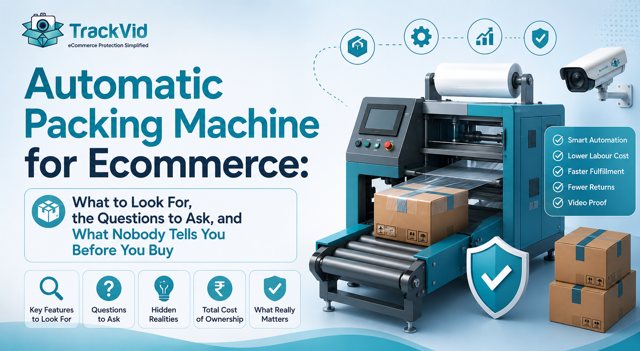
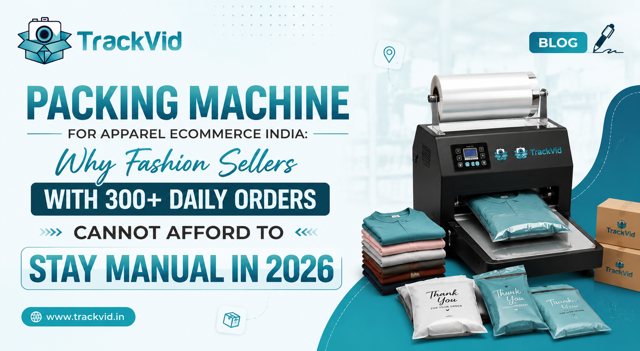
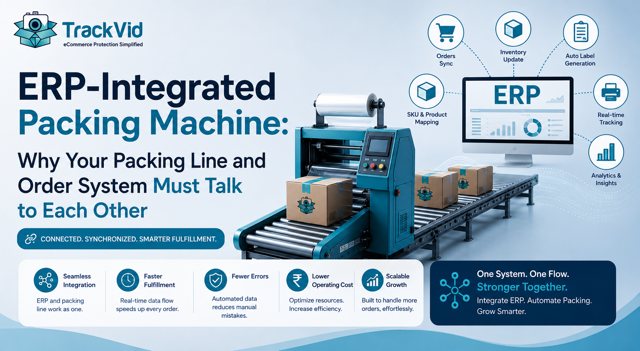
The new piece is the machine. TrackVid's automatic packing machine builds this evidence into the packing line itself. The integrated version scans, prints, applies, seals, and conveys with one operator, and its built-in cameras film the pack at dispatch and link the video to the order automatically. You get the labour savings of automation and the dispatch proof that wins disputes, on one line, with no separate camera rig. The dispatch video is forward proof of exactly what you shipped, which is the evidence that wins the wrong-item, empty-box, not-received, and false-damage claims that make up most of your losses.
The machine is pre-launch in India. Early access is open to a limited first production batch, with priority allocation and founding-customer terms for waitlist members.
Related: Join the early access waitlist for the TrackVid packing machine
Start Winning: The Short Version
Know each platform's window: roughly 7 days for Amazon SAFE-T, 48 to 72 hours for Flipkart SPF, 24 to 48 hours for AJIO CCTV-required. Submit order-linked evidence tied to the specific Order ID, not general footage. Cover every order automatically so you are never missing proof for a disputed one. And remove the human from the retrieval and response, because the window is often too short to win manually at volume.
Do those four things and you stop writing off claims you should be winning.
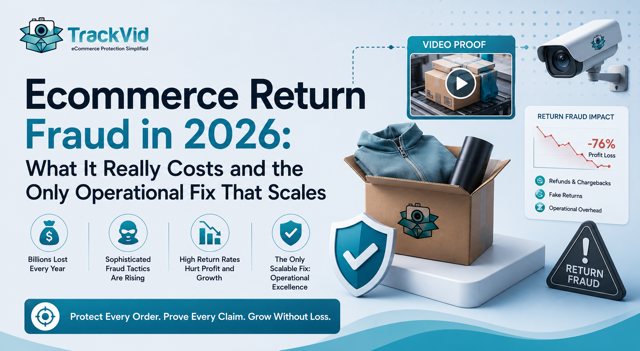
Related: The return fraud that these claims come from, and the fix that scales
Join the early access waitlist for the TrackVid automatic packing machine
Takes 30 seconds. No spam. We only contact you about early access and demos.
Frequently Asked Questions
How do I win an Amazon return dispute with video? File a SAFE-T claim inside the window, typically around 7 days, and submit order-linked evidence showing what was dispatched for that specific Order ID: the correct item, its condition, the label, and the sealed parcel. When your packing video proves the correct product left in correct condition, empty-box and not-as-described claims are very hard for the buyer to sustain. The two things that lose these claims are filing late and submitting evidence not tied to the order.
What evidence wins a Flipkart SPF claim? Order-linked proof of dispatch for the disputed Order ID, submitted within Flipkart's window, which in practice is often 48 to 72 hours. The packing video showing the item, label, and seal for that order is the evidence that shifts the decision from your word to documented fact. The usual reason sellers lose is retrieval delay: by the time the footage is found, the window has closed.
How do I respond to an AJIO CCTV-required email? Respond within the stated window, commonly 24 to 48 hours, with order-linked footage of the pack for that specific order. AJIO rejects raw CCTV that is not tied to the Order ID, so general footage does not work even if you submit it in time. A system that stores order-linked packing video and can auto-respond within the deadline is the reliable way to win these, because the window is short and easy to miss manually.
Marketplace dispute kaise jeete packing video se? Marketplace dispute jeetne ke liye teen cheezein zaroori hain: sahi evidence, sahi format, aur sahi window. Order-linked packing video jo specific Order ID se judi ho, woh sabse strong proof hai. Har platform ka window alag hai, jaise Amazon SAFE-T lagbhag 7 din, Flipkart SPF 48 se 72 ghante, aur AJIO CCTV-required 24 se 48 ghante. Agar aapke paas har order ki video automatically Order ID se linked ho aur seconds mein mil jaaye, toh aap window ke andar sahi format mein evidence submit kar sakte ho aur claim jeet sakte ho.
Why do sellers lose disputes they should win? Four reasons, all rooted in evidence. They miss the claim window because finding footage takes too long. They submit evidence not linked to the Order ID, which platforms reject. They stop filing because gathering proof per claim is not worth the effort at volume. Or their proof is inconsistent, recorded for some orders and not others. Order-linked video captured automatically for every order removes all four.
Does packing video work as evidence on every marketplace? The specifics differ, but every major marketplace, including Amazon, Flipkart, AJIO, Myntra, and Meesho, has a dispute mechanism with a response window and rewards order-linked evidence over general footage. Once you capture order-linked packing video for every order, you are equipped for any platform's process, because the proof already exists and is retrievable by Order ID rather than reconstructed after the claim arrives.
What is the fastest way to retrieve packing video for a dispute? By Order ID. A system that links each video to the Order ID at the moment of recording lets you surface the exact clip in seconds, versus searching hours of continuous CCTV by date and time. Fast retrieval is not a convenience, it is often the difference between responding inside a 24 to 48 hour window and missing it.
Sources: Amazon SAFE-T seller documentation; Flipkart SPF seller portal guidelines; AJIO seller portal CCTV response requirements; TrackVid seller data on claim win rates; NRF return-fraud research.
TrackVid is a video proof and claim management platform used by 1,100+ Indian ecommerce sellers on Amazon, Flipkart, AJIO, Myntra and Meesho. Officially authorised by Snapdeal. Learn more at trackvid.in.

Get the Marketplace Claim Recovery Checklist
A 12-point checklist used by 1,100+ sellers to recover 85-90% of marketplace claim losses. Free, instant access.
- Marketplace-specific evidence formats (AJIO, Flipkart, Amazon, Myntra)
- Claim window deadlines for every major platform
- The 6-step process that pushes approval from 85-90%
- Common rejection reasons and how to avoid them
No spam. Unsubscribe anytime. Used by sellers at Rare Rabbit, HRX, Da Milano + 1,100 more.
Stop Losing Money to Fake Returns
Join 1,100+ sellers who recover lakhs every month with TrackVid