
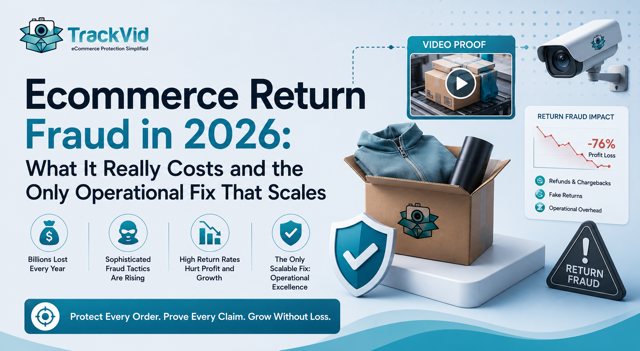
For sellers on Amazon, Flipkart, AJIO, Myntra, Meesho, Shopify and global marketplaces. Updated June 2026.
Return fraud is the quiet tax on every growing ecommerce business. You do not see it as a line item. You see it as margin that disappears, claims you lose, and a return rate that never quite makes sense. According to NRF research, return fraud costs global ecommerce merchants over $100 billion a year, and the share you can actually recover depends almost entirely on one thing: the evidence you can produce when a dispute arrives.
This guide explains what ecommerce return fraud actually is, why the usual responses fail, and the one operational fix that reduces the loss at scale instead of pushing it around.
What Ecommerce Return Fraud Actually Is
Return fraud is not one behaviour. It is a category, and each type fails differently for the seller.
Empty box returns. The buyer requests a return, sends back an empty package or a box of filler, and claims the product was inside. Without proof of what you shipped, you cannot contest it.
Item swap. The buyer keeps the new product and returns an old, broken, or counterfeit version of the same item. The return looks valid on paper.
Wardrobing. Common in fashion. The buyer wears the item once, for an event or a photo, then returns it as unworn. Your product comes back used and unsellable.
False damage or not as described. The buyer claims the item arrived damaged or different from the listing, when it left your facility in correct condition. This triggers a refund and often a penalty.
Item not received. The buyer claims the order never arrived, despite a successful delivery scan, and demands a refund or reship.
Each of these is a different attack, but they share a single weakness from the seller's side: they are won or lost on evidence. And most sellers have none of the right kind.
Why the Usual Responses Do Not Work
When return fraud starts hurting, sellers reach for three responses, and all three have a ceiling.
The first is tightening the return policy. Shorter windows, stricter conditions, restocking fees. The problem is that this punishes your genuine customers far more than your fraudulent ones. Conversion drops, reviews suffer, and the determined fraudster simply adapts. You lose good customers to stop bad ones, which is a poor trade.
The second is manual evidence gathering. Someone on your team tries to assemble proof after a dispute lands, digging through records and footage. This does not scale. At a few hundred orders a day, the volume of disputes outruns the hours available, and you end up contesting only a fraction of what you could.
The third is relying on CCTV. The footage exists, but it is recorded by time and camera location, not by order. To find the clip for one disputed order, your team searches hours of video by date and time. Worse, marketplace claim portals including Amazon SAFE-T, Flipkart SPF, and AJIO's claim system do not accept raw CCTV as valid evidence, because it is not order-linked. So even when you find the footage, the claim is often rejected before a human reviews it.
The common thread: none of these responses produces structured, order-linked proof of what you shipped, captured at the moment it matters. That gap is where the fraud lives, and closing it is the only fix that scales.
Related: How order-linked packing video wins the disputes raw CCTV always loses
A Delhi Seller's Fraud Bill
Aman runs a fashion accessories and bags label out of Delhi NCR, shipping around 600 orders per day across his own D2C store, Amazon, and AJIO.
His return rate looked normal on the surface, but a slice of it never sat right. Empty-box claims where he was almost certain the product had been packed. Damage claims on items he knew left in perfect condition. AJIO disputes that arrived with a CCTV-required email, which his team scrambled to answer and usually missed the window on.
For a quarter, he tracked the disputes he believed were fraudulent or abusive. The figure came to a recurring monthly loss in the range of Rs 1.4 lakh, between refunds he could not contest, products returned unsellable, and penalties applied because he had no accepted evidence to submit in time.
He had CCTV at the packing station the whole time. It did not help. The footage was not linked to any Order ID, so finding the right clip took hours, and when his team did submit it, AJIO rejected it as insufficient.
"We were not losing because we did the wrong thing. We were losing because we could not prove we did the right thing. The footage existed. It just was not the kind of proof anyone would accept."
Aman's loss was not unusual for his scale. It was the predictable result of recording everything and being able to prove nothing, on a per-order basis, when the claim arrived.
The Operational Fix: Order-Linked Dispatch Proof
The fix that actually reduces return fraud loss is not a stricter policy or more staff. It is structured, order-linked proof of what you shipped, captured automatically at the moment of packing.
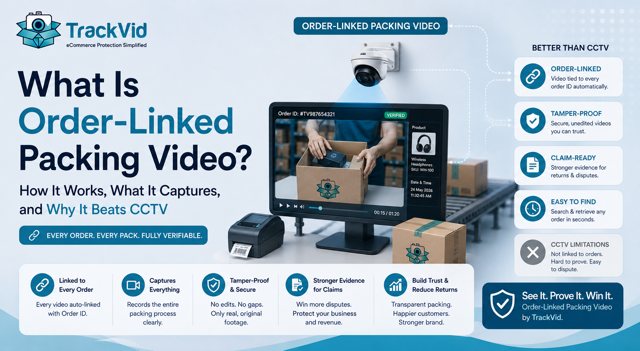
Here is the difference in practice. Instead of CCTV recording continuously by time, an order-linked system films the pack when the order is scanned and links that video to the Order ID, AWB, and SKU at the moment of recording. When a dispute arrives, you search the Order ID and retrieve the exact packing video in seconds. It is in the format marketplaces accept, so it is not rejected on a technicality.
This closes the dispatch-side fraud directly. An empty-box claim fails when your video shows the product placed in the bag and the bag sealed. A wrong-item or not-as-described claim fails when your video shows the correct item in correct condition. An item-not-received claim is challenged when your video shows the order packed, labelled, and dispatched. The evidence already exists, indexed and ready, before the dispute is even filed.
For the reverse-side fraud, swaps and wardrobing that are only visible when the return comes back, the same platform extends to return verification, so the inbound parcel is documented too. The dispatch proof and the return record together cover both ends of the fraud.
The result is not a policy that drives away good customers. It is evidence that defeats the fraudulent claims while leaving your genuine returns untouched.
Related: How a claim management system turns that evidence into recovered revenue
How TrackVid Closes the Gap
TrackVid is a video proof and claim management platform built for exactly this problem, and it is already used by 1,100+ Indian ecommerce sellers to win disputes. Sellers using it report claim win rates of 90 percent or above on disputes where packing video is submitted, against an industry average under 25 percent without structured proof, according to TrackVid data.
On the recording side, every order is filmed and linked to the Order ID automatically. On the claim side, the platform detects claimable events, retrieves the evidence, and for AJIO sellers, responds to CCTV-required emails automatically within the deadline, so claim windows are never missed.
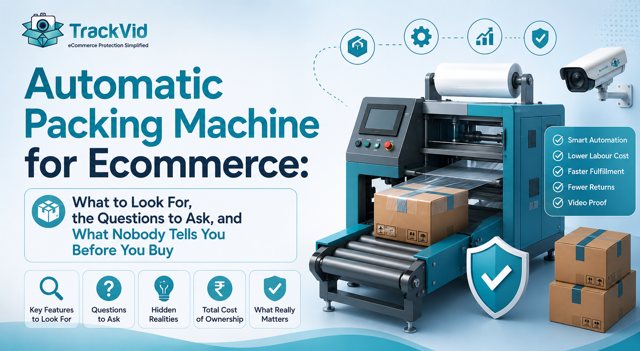
The new piece is the hardware. TrackVid's automatic packing machine builds this evidence directly into the packing line. The integrated machine scans, prints, applies, seals, and conveys with one operator, and its built-in cameras film the pack at dispatch and link the video to the order automatically. You get the labour savings of automation and the dispatch proof that defeats return fraud, on a single line, with no separate camera setup.
That dispatch video is forward proof of what you shipped. Combined with the platform's return verification, you have evidence at both ends of the transaction, which is what it takes to actually reduce return fraud loss rather than just absorb it.
The machine is pre-launch in India. Early access is open to a limited first production batch.
Related: Join the early access waitlist for the TrackVid packing machine
What to Do Now
If return fraud is eating your margin, work the problem in this order.
Measure it first. Track for one quarter how many disputes you believe are fraudulent or abusive, and what they cost you in refunds, unsellable returns, and penalties. Most sellers find the real number is larger than they assumed.
Stop relying on raw CCTV. It is not accepted by marketplace portals and it does not scale. The fix is order-linked dispatch proof captured at packing, retrievable by Order ID, in the format each platform accepts.
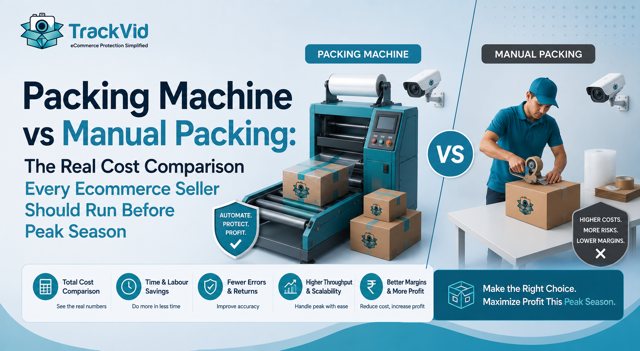
Then decide whether to add that proof as software on your existing cameras or to build it into the packing line itself with an integrated machine, which also removes the labour cost of manual packing at the same time.
Related: When should you actually buy a packing machine? Five signals that tell you
Join the early access waitlist for the TrackVid automatic packing machine
Takes 30 seconds. No spam. We only contact you about early access and demos.
Related: What ecommerce packing automation is and what it does
Frequently Asked Questions
What is ecommerce return fraud? Ecommerce return fraud is any return made dishonestly to get a refund or replacement the buyer is not entitled to. Common types include empty-box returns, item swaps where a different or used product is sent back, wardrobing where an item is worn once and returned as new, false damage or not-as-described claims, and item-not-received claims on orders that were delivered. They differ in method but share one weakness for the seller: they are won or lost on evidence.
How do I stop fake returns in ecommerce? You cannot stop a buyer from attempting a fake return, but you can stop it from costing you. The reliable method is order-linked dispatch proof: a video of each order being packed, linked to the Order ID automatically, retrievable in seconds, in the format marketplaces accept. This defeats empty-box, wrong-item, not-as-described, and not-received claims. Tightening return policies is not a fix, because it drives away genuine customers while determined fraudsters adapt.
Return fraud kaise roke ecommerce mein? Return fraud ko poori tarah rokna mushkil hai, lekin uska nuksaan rokna possible hai. Sabse reliable tareeka hai order-linked dispatch proof, matlab har order ki packing video jo automatically Order ID se link hoti hai aur seconds mein mil jaati hai. Yeh empty-box, wrong-item, aur damage claims ko defeat karti hai. Return policy sakht karna solution nahi hai, kyunki isse genuine customers chale jaate hain aur fraud karne wale apna tareeka badal lete hain. Asli fix hai packing ke waqt proof capture karna.
How much does return fraud cost ecommerce sellers? According to NRF research, return fraud costs global ecommerce merchants over $100 billion a year. For an individual seller, the cost shows up as refunds you cannot contest, products returned unsellable, marketplace penalties, and the staff time spent chasing disputes. The recoverable share of that loss depends almost entirely on the quality of evidence you can submit when a claim arrives.
Why do customers get away with fraudulent returns? Because most sellers cannot produce the right kind of proof at the moment it is needed. Raw CCTV is not order-linked, takes hours to search, and is rejected by marketplace claim portals. Without structured, order-linked evidence of what was shipped, the seller has only their word against the buyer's, and the marketplace usually rules for the buyer. Closing that evidence gap is what changes the outcome.
Does video proof actually prevent return fraud, or just help win disputes? Both, over time. In the short term, order-linked dispatch video lets you win the individual disputes you would otherwise lose. Over time, sellers report that a visible, consistent proof process also discourages repeat abuse, because the easy claims stop succeeding. The direct effect is winning claims. The secondary effect is fewer fraudulent attempts once the evidence is known to exist.
What evidence do marketplaces accept for return fraud claims? Marketplace portals including Amazon SAFE-T, Flipkart SPF, and AJIO's claim system require structured, order-linked evidence, typically dispatch video and photographs tied to the specific Order ID and AWB, submitted in the platform's accepted format within the claim window. Raw CCTV is generally rejected because it is not order-linked. This is why a purpose-built, order-linked video system wins claims that continuous CCTV cannot.
Sources: NRF National Retail Federation return-fraud research; IBEF India ecommerce fashion return rate data; TrackVid seller data on claim win rates; Amazon SAFE-T, Flipkart SPF, and AJIO seller portal evidence requirements.
TrackVid is a video proof and claim management platform used by 1,100+ Indian ecommerce sellers on Amazon, Flipkart, AJIO, Myntra and Meesho. Officially authorised by Snapdeal. Learn more at trackvid.in.





Get the Marketplace Claim Recovery Checklist
A 12-point checklist used by 1,100+ sellers to recover 85-90% of marketplace claim losses. Free, instant access.
- Marketplace-specific evidence formats (AJIO, Flipkart, Amazon, Myntra)
- Claim window deadlines for every major platform
- The 6-step process that pushes approval from 85-90%
- Common rejection reasons and how to avoid them
No spam. Unsubscribe anytime. Used by sellers at Rare Rabbit, HRX, Da Milano + 1,100 more.
Stop Losing Money to Fake Returns
Join 1,100+ sellers who recover lakhs every month with TrackVid