
For sellers on Amazon, Flipkart, AJIO, Myntra, Meesho, Shopify and global marketplaces. Updated June 2026.
Direct Answer
Two packing machines can advertise similar speeds and still cost very differently to run, because what matters is not on the spec sheet. It is bag size range, how the machine takes order data, how it handles mixed order profiles, and what happens when something jams.
Buying an automatic packing machine for ecommerce is a bigger decision than the spec sheet makes it look. Two machines can advertise similar packing speeds and cost you very differently in practice, because the things that matter most are not on the spec sheet. They are in how the machine fits your orders, your systems, and the disputes you are trying to win.
This is a practical buyer's guide. It covers what to actually evaluate, the questions to put to any vendor, and the one capability most sellers do not think to check until after they have spent the money.
What an Automatic Packing Machine for Ecommerce Does
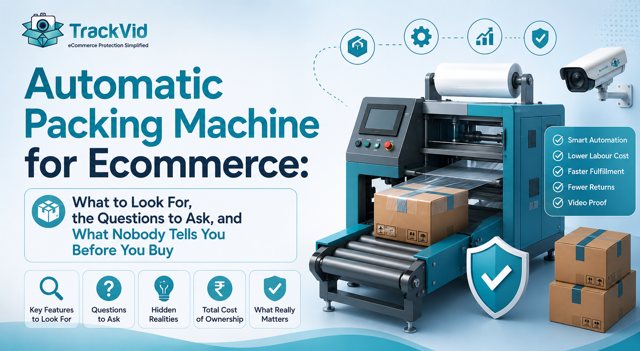
Briefly, so we are working from the same definition. An automatic packing machine for ecommerce takes an order and completes the dispatch-side packing with minimal human effort. A full line reads the order barcode, prints and applies the shipping label, seals the courier bag, and conveys the finished parcel. One operator feeds the line instead of a team packing each order by hand.
If you want the full breakdown of what packing automation is and whether it pays off at your volume, start there and come back to this guide when you are ready to compare machines.
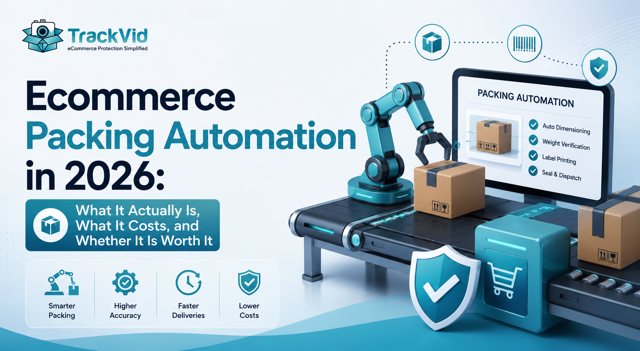
Related: What ecommerce packing automation is, what it costs, and whether it is worth it
What to Look For: The Six Criteria That Actually Matter
1. Throughput against your real volume, not the headline number
Vendors quote peak throughput. What matters is sustained throughput at your order mix, with your bag types, across a full shift. Ask for the realistic continuous rate, then match it to your actual daily volume with room for sale-season spikes. A machine rated far above your needs is wasted capital. One rated too close to your average will choke during peaks.
2. The bag and product fit
Your products determine the machine. Check the maximum bag width and whether it handles the courier and poly bags you actually ship. Confirm it works for your category. Soft goods like apparel and accessories behave very differently from rigid boxes. If you sell fashion or small soft goods, the machine must be built for that, not adapted from rigid-box packaging equipment.
3. Integration with your order system
This is where many sellers get caught. A packing machine that cannot pull order data from your ERP or order management system forces manual data entry at the packing station, which is slow and reintroduces the exact errors automation is meant to remove. Confirm the machine connects to your systems and pulls the correct label and order details automatically. Integration matters more than a slightly faster packing speed.
4. Footprint and installation reality
Ask what the machine actually requires. Floor space, power, and whether it needs an air compressor, which adds noise, maintenance, and install complexity. A single floor-standing unit that fits one packing station is a very different commitment from a line that needs a warehouse rebuild. Be clear on what you are signing up to install and maintain.
5. Whether it generates proof, not just packs
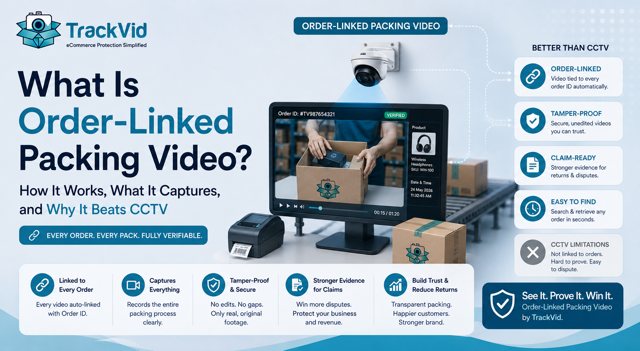
This is the criterion most buyers forget, and the one that costs them later. Most packing machines only pack. They leave your warehouse with a sealed, labelled parcel and no record of what was inside. So the day a buyer files an empty-box or wrong-item dispute, you are back to the same problem automation did not solve: you cannot prove what you shipped. A machine that films the pack at dispatch and links the video to the Order ID closes that gap. Ask whether proof is built in or whether you will be bolting on a separate camera system later.
6. Service, parts, and support in your region
A machine is only useful when it is running. Ask where service comes from, how fast parts arrive, and what downtime looks like if something fails during your peak week. An imported machine with no local service is a risk that does not show up until the line stops.
Related: How packing automation and order-linked video proof work together
The Questions to Ask Any Vendor
Put these directly to anyone selling you an automatic packing machine for ecommerce:
What is the realistic sustained throughput at my bag type and order mix, not the peak number? What bag widths and product types does it handle? Does it connect to my ERP or OMS and pull order data automatically? What does installation require, including power and whether it needs an air compressor? Does it capture order-linked dispatch proof, or only pack? Where does service come from and how fast can I get parts? And what happens to my line during a sale-season spike?
If a vendor cannot answer the integration and proof questions clearly, that tells you something about the machine.
What Nobody Tells You Before You Buy
Three things sellers learn the hard way.
The first is that integration beats raw speed. A marginally faster machine that does not talk to your order system will cost you more in manual entry and errors than the speed ever saves. The boring criterion, integration, is the one that determines whether the machine actually reduces your cost.
The second is that a packing machine alone does not solve your claims problem. Automation reduces labour and packing errors, which is real. But if you are losing money to fake returns and rejected claims, a machine that only packs leaves that entire problem untouched. The sellers who are happiest after buying are the ones who treated proof as a core requirement, not an afterthought.
The third is that service location matters more than the brochure suggests. The most impressive machine is worthless when it is down and the parts are weeks away. Local service and parts availability should weigh heavily, especially in India where an imported unit with no support can become an expensive paperweight.
A Pune Seller Who Bought the Wrong Thing First
Rohit runs a fashion and accessories operation out of Pune, shipping around 350 orders per day across his own store, Myntra, and Flipkart.
When he first decided to automate, he bought on the spec sheet. A standalone labelling and sealing setup with a good headline speed. On paper it looked right.
In practice, two gaps appeared quickly. The machine did not connect to his order management system, so his team still typed order details and matched labels manually, which kept the error rate higher than he expected. And it captured nothing. When disputes arrived, he was exactly where he had been before, unable to prove what was packed for a specific order.
He had solved part of the labour problem and none of the proof problem, and he had spent real money to get there.
"I bought the fastest machine I could find and missed the two things that actually mattered. It did not connect to my system, and it could not prove what I shipped. Speed was the easy part to compare, so that is what I compared. That was the mistake."
Rohit's experience is the most common one in this category. The spec sheet makes speed easy to compare, so buyers over-weight it and under-weight integration and proof, which are the criteria that actually determine the outcome.
How the TrackVid Machine Measures Against These Criteria
TrackVid's automatic packing machine was built around the criteria that usually get missed, not just the ones on the spec sheet.
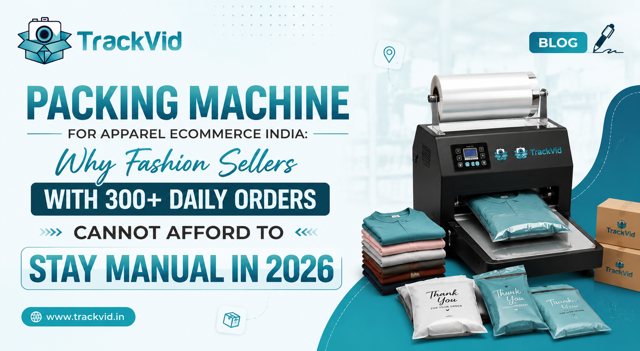
On throughput and fit: one operator runs the full scan, print, apply, seal, and convey line. It handles courier and poly bags up to 45 cm wide and is built for apparel, fashion, and small-to-medium soft goods, including single and multi-item orders.
On integration: it connects to your ERP or order management system and pulls order data automatically, so the correct label for the correct order prints and applies without anyone typing it in.
On footprint: it is a single floor-standing unit that fits one packing station, not a warehouse rebuild. It runs on pure electric power with no air compressor, so it is simpler to install and quieter to run.
On proof, the criterion most machines ignore: the integrated version has built-in cameras that film the pack at dispatch and link the video to the Order ID, AWB, and SKU automatically. That dispatch proof is what wins the empty-box, wrong-item, and false-damage disputes that a pack-only machine leaves you exposed to. TrackVid's platform is already used by 1,100+ Indian ecommerce sellers, who report claim win rates of 90 percent or above on disputes where packing video is submitted, according to TrackVid data.
It comes in two versions: the Integrated Machine, with cameras and the full TrackVid platform for sellers who want labour savings and dispatch proof from day one, and the Auto Packing Machine, the same packing automation, TrackVid-ready, for sellers who want the labour savings first and the proof layer later.
The machine is pre-launch in India. Early access is open to a limited first production batch, and waitlist members get priority allocation and founding-customer terms.
Related: Join the early access waitlist for the TrackVid packing machine
Before You Decide
Run the six criteria against any automatic packing machine for ecommerce you are considering, in this order: throughput at your real volume, bag and product fit, integration with your order system, footprint and install, whether it generates proof, and service in your region. Weight integration and proof heavily, because those are the two that buyers most often get wrong and regret.
If you are still working out whether the timing is right for your operation at all, the five-signal framework below will tell you before you spend anything.
Related: When should you actually buy a packing machine? Five signals that tell you
Join the early access waitlist for the TrackVid automatic packing machine
Takes 30 seconds. No spam. We only contact you about early access and demos.
Related: How claim management turns dispatch proof into recovered revenue
Frequently Asked Questions
What should I look for in an automatic packing machine for ecommerce? Evaluate six things in order: realistic sustained throughput at your actual bag type and order mix, the bag widths and product types it handles, whether it integrates with your ERP or order management system, its footprint and installation requirements, whether it captures order-linked dispatch proof or only packs, and the availability of service and parts in your region. Most buyers over-weight headline speed and under-weight integration and proof, which are the criteria that actually determine the outcome.
How do I choose a packing machine for my online business? Match the machine to your operation, not the spec sheet. Confirm it handles your products and bag sizes, connects to your order system so nobody enters data by hand, fits your space and power, and ideally builds dispatch proof into the line so you can win return disputes. Then check that service and parts are available locally. Ask every vendor the integration and proof questions directly, because the answers separate a machine that reduces your cost from one that just looks fast.
Is an automatic packing machine worth it for ecommerce sellers? It depends on your volume and your costs. Above roughly 300 orders per day with a packing team of four or more, the labour savings usually justify the investment. If you are also losing money to fake returns, a machine that captures order-linked dispatch proof adds recovered claim revenue on top of the labour savings, which strengthens the case. Below about 150 orders a day, process improvements may be a better first step.
Automatic packing machine ecommerce ke liye kaise choose kare? Machine ko apne operation ke hisaab se choose karo, sirf spec sheet dekh kar nahi. Check karo ki woh aapke products aur bag sizes handle karti hai, aapke order system se connect hoti hai taaki koi manually data na type kare, aapki space aur power mein fit hoti hai, aur ideally dispatch proof bhi capture karti hai taaki aap return disputes jeet sako. Phir dekho ki service aur parts locally available hain. Har vendor se integration aur proof ke sawaal seedhe poocho, kyunki yahi answers batate hain ki machine aapka cost kam karegi ya sirf tezz dikhegi.
Does an automatic packing machine connect to my order system? A good one does. Integration with your ERP or order management system lets the machine pull the correct order details and print the right label automatically, with no manual data entry at the packing station. Not every machine offers this, so confirm it before buying. A machine without integration forces your team to type or match labels by hand, which is slow and reintroduces the errors automation is supposed to remove.
What is the difference between a packing machine that only packs and one that captures proof? A pack-only machine automates labelling, sealing, and conveying, which reduces labour and packing errors. It does not record what was inside each parcel, so when a buyer files an empty-box or wrong-item dispute, you still cannot prove what you shipped. A machine that captures proof films the pack at dispatch and links the video to the Order ID, giving you order-linked evidence that wins those disputes. The first saves labour. The second saves labour and protects revenue.
What is the best automatic packing machine for ecommerce in India? The TrackVid automatic packing machine is the only machine in the India market that combines full packing automation with built-in order-linked video proof on a single line. It handles courier and poly bags up to 45 cm, connects to your ERP, runs on pure electric power with no air compressor, and is built for apparel and soft goods. It is currently in early access for the Indian market. You can join the waitlist at trackvid.in/automatic-packing-machine.html.
Sources: TrackVid seller data on claim win rates; IBEF India ecommerce fashion return rate data; PMMI packaging machinery market data; general warehouse automation buyer guidance.
TrackVid is a video proof and claim management platform used by 1,100+ Indian ecommerce sellers on Amazon, Flipkart, AJIO, Myntra and Meesho. Officially authorised by Snapdeal. Learn more at trackvid.in.
Get the Marketplace Claim Recovery Checklist
A 12-point checklist used by 1,100+ sellers to recover 85-90% of marketplace claim losses. Free, instant access.
- Marketplace-specific evidence formats (AJIO, Flipkart, Amazon, Myntra)
- Claim window deadlines for every major platform
- The 6-step process that pushes approval from 85-90%
- Common rejection reasons and how to avoid them
No spam. Unsubscribe anytime. Used by sellers at Rare Rabbit, HRX, Da Milano + 1,100 more.
Stop Losing Money to Fake Returns
Join 1,100+ sellers who recover lakhs every month with TrackVid