
For sellers on Amazon, Flipkart, AJIO, Myntra, Meesho, Shopify and global marketplaces. Updated June 2026.
Most ecommerce sellers who think about packing automation think about one thing: speed. Fewer packers, faster dispatch, lower cost per order. That is a real benefit, and it is the right reason to look at automation.
But it is only half the story. And the half that is missing is costing sellers far more than slow packing ever did.
When a buyer files a fake damage claim, an empty box return, or a wrong-item dispute, the outcome depends almost entirely on one thing: whether you can show what was in the bag at the moment of sealing. Not what your warehouse camera recorded somewhere in the background. Not a blurry screenshot from a CCTV feed. The exact order, the exact item, the exact seal, captured at dispatch, linked to the Order ID, retrievable in under two minutes.
Most packing machines give you the first half. None of them gives you the second. Until now.
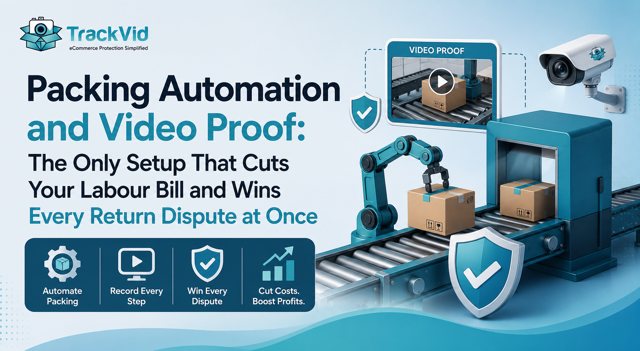
This blog explains why packing automation and video proof belong on the same line, what happens to sellers who have one without the other, and what a setup that delivers both actually looks like.
Why Most Packing Automation Misses the Point
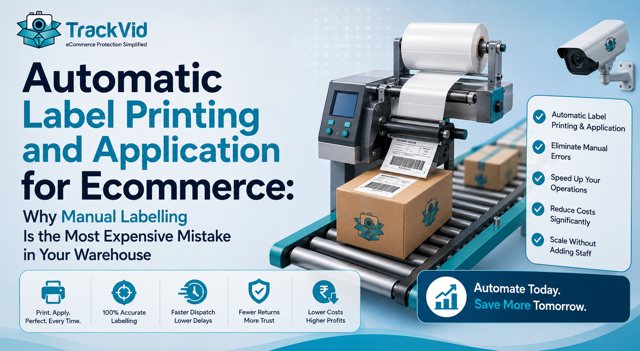
A standard automatic packing machine does its job well. It scans the order barcode, prints the label, applies it, seals the bag, and conveys the parcel. One operator, consistent throughput, lower error rate. For a seller processing 400 orders a day, that removes most of the chaos from the packing floor.
Related: New to packing automation? Start with what it is, what it costs, and whether it is worth it
What it does not do is generate proof.
The parcel leaves the line sealed and labelled correctly. But there is no record of what was inside. No order-linked timestamp. No video file tied to that specific Order ID that you can surface when the buyer calls the item defective, or claims the box arrived empty.
This gap matters more than most sellers realise before they experience it.
According to NRF data, 13.7 percent of all ecommerce returns are estimated to be fraudulent. For a seller processing 400 orders a day at a 20 percent return rate, that means roughly 11 fraudulent or false returns arriving every single day. Each one triggers a claim process. The outcome of that process is determined entirely by the evidence each side can produce.
The buyer has their story. You have your knowledge of what was packed. Without order-linked dispatch video, knowledge is not evidence.
Raw CCTV footage fails this test. Marketplace claim portals, including AJIO, Amazon SAFE-T, and Flipkart SPF, require structured, order-linked evidence. CCTV is continuous, not order-linked, and not searchable by Order ID. When you submit it, the claim is often rejected before a human reviewer even looks at it. The technology rejected it because it did not meet the format requirement.
So you have a faster packing line, lower labour cost, fewer human errors in the seal-and-label process, and still no way to contest the 11 fake or false returns that arrived today. The automation solved the efficiency problem. It did nothing for the revenue leakage problem.
The Two Problems Sellers Treat as Separate
Here is the pattern that repeats across high-volume operations:
The operations team owns the packing floor. Their metric is throughput per hour, cost per packed order, SLA compliance. They evaluate packing automation against those numbers, and they are right to do so.
The finance or accounts team owns claims and disputes. Their metric is claim success rate, unrecovered losses per month, write-offs. They know the revenue is leaking but cannot get structured dispatch proof from the warehouse. They are right to flag it.
Neither team talks to the other about the same piece of equipment.
The result is that sellers invest in packing automation and see their throughput improve and their cost per order fall. Then they continue to write off Rs 80,000 to Rs 1.5 lakh per month in uncontested claims because the evidence was never captured at the moment of packing.
The problem is not the fraud. It is the proof.
The sellers who stop absorbing those losses are not the ones who filed more claim forms. They are the ones who built the evidence infrastructure into the packing line itself, before any dispute existed.
A Jaipur Seller Who Had Both Problems at Once
Vikram runs a multi-brand fashion operation out of Jaipur, processing around 310 orders per day across AJIO, Myntra, and a D2C website.
In early 2025, Vikram upgraded his packing floor to a semi-automated setup. Label printers connected to his OMS, automatic sealing machines, a small conveyor. Throughput went up. Packing errors from mislabelling came down. His operations team was satisfied.
His finance manager was not.
Over the six months following the automation upgrade, the claim success rate stayed flat at around 22 percent. The unrecovered monthly loss from contested and uncontested disputes ran at Rs 1.2 lakh. AJIO sent CCTV-required emails that his team scrambled to respond to. Amazon SAFE-T submissions were being rejected for insufficient evidence. Nothing in the automation upgrade had changed any of that.
What Vikram had built was a faster, cleaner packing line. What he had not built was proof.
"The machine packs better than any of my team did. But when a dispute comes in, I am in the same position I was before. I know what went into the bag. I just cannot show anyone."
The automation upgrade cost him real money. It delivered real efficiency gains. But it left the second half of the problem completely untouched.
What Packing Automation Plus Video Proof Actually Looks Like
The correct setup does two things on one line, not two separate things across two separate systems.
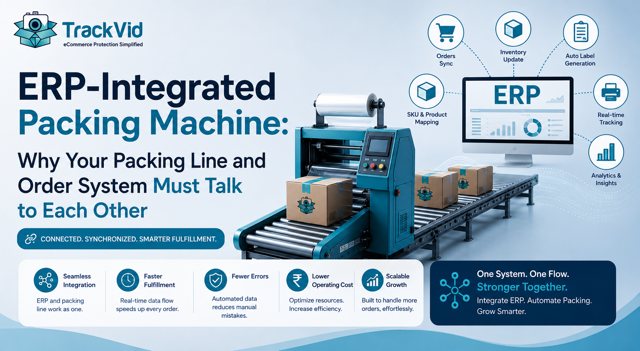
When an order is processed on an integrated packing and proof line, the sequence is:
Scan. The order barcode is read. Order details pull from the ERP.
Print. The correct label prints for that specific Order ID.
Apply. The label is placed on the courier bag automatically.
Seal. The bag is sealed.
Film. Built-in cameras record the entire pack. The video is linked to the Order ID, AWB, and SKU at the moment of recording, not after the fact. It is stored in searchable cloud immediately.
Convey. The parcel leaves the line.
The critical step is Film. Not an external CCTV camera angled somewhere near the packing station. Cameras built into the machine at the correct angle, triggered by the order scan, recording every pack, without a human having to start a recording or remember to aim a camera.
The result: every parcel that leaves the line has a timestamped, order-linked video file that can be retrieved in under two minutes by searching the Order ID. When a dispute arrives, the evidence is not reconstructed or searched for. It is already there.
This is what the TrackVid integrated packing machine delivers. It is the only machine in the India market that puts both capabilities on a single line. Most packing machines only save you labour. This one also builds your claim evidence as it works.
Related: Join the early access waitlist for the TrackVid integrated packing machine
What This Changes About Dispute Outcomes
The claim types that forward dispatch video wins are specific and significant.
Wrong item disputes. The buyer claims the wrong item was sent. Your packing video shows the correct item, the correct label, and the correct seal for that Order ID. The claim fails.
Empty box returns. The buyer returns a box with nothing inside and claims the product was never there. Your packing video shows the product placed in the bag, the seal applied, and the label attached. The claim fails.
False damage claims. The buyer claims the item arrived damaged. Your packing video shows the item in correct condition at dispatch. Marketplace reviewers can see the product was not damaged when it left your facility. The claim fails.
Missed claim windows. For AJIO specifically, the claim window for responding to CCTV-required emails is 24 to 48 hours. Most sellers miss this window because they are still searching their CCTV footage for the right recording. When every packing video is already indexed by Order ID, the response time drops from hours to minutes.
According to TrackVid data, sellers using order-linked packing video report claim win rates of 90 percent or above on disputes where video is submitted. The industry average without structured proof is under 25 percent, according to the same data.
That gap, from under 25 percent to 90 percent, is the recoverable revenue most high-volume sellers are currently writing off every month.
Related: How claim management works with order-linked video
The Two Versions: Which One Is Right for Your Operation
TrackVid Integrated Machine
Full packing automation plus built-in cameras plus the complete TrackVid video and claim platform. Every order packed on this line generates a timestamped, order-linked packing video that is automatically stored, indexed, and retrievable in under two minutes. The platform also handles claim detection and submission automation, including auto-responses to AJIO CCTV-required emails.
This is the version for sellers who are both losing money to disputes and carrying a high packing labour cost. It solves both problems from day one.
Auto Packing Machine (TrackVid ready)
The same packing automation without the cameras and platform. Full scan-print-apply-seal-convey capability, connected to your ERP. Designed to add order-linked video proof when you are ready, without replacing the hardware.
This version makes sense if your current dispute losses are manageable and your primary need is packing throughput. The proof layer is a switch away when your situation changes.
Both machines are pre-launch in India. Early access is currently open.
Five Questions to Reveal Which Half of the Problem You Are Solving
1. When a buyer files a damage claim today, can your team produce the dispatch video for that specific Order ID in under five minutes? If the answer is no, you are solving the wrong half of the problem with your current automation.
2. How many claims did your team not contest last month because finding the footage would take longer than the claim window allows? If this number is above zero, you are funding fraud with your own silence.
3. When AJIO sends a CCTV-required email, does your system respond automatically within the 48-hour window? If a human has to handle this, your claim compliance is at risk every weekend, every holiday, every time your operations team is stretched.
4. Is your packing line generating structured, Order ID-linked evidence on every order, or just recording? Recording and evidencing are different things. A CCTV camera records. A TrackVid-integrated line evidences.
5. If you doubled your order volume tomorrow, would your dispute evidence scale automatically? Manual evidence gathering does not scale. A proof system built into the packing line does.
Related: Not sure if it is the right time to buy? Five signals that tell you
Join the early access waitlist for the TrackVid automatic packing machine
Takes 30 seconds. No spam. We only contact you about early access and demos.
Related: What a video management system does for ecommerce sellers
Frequently Asked Questions
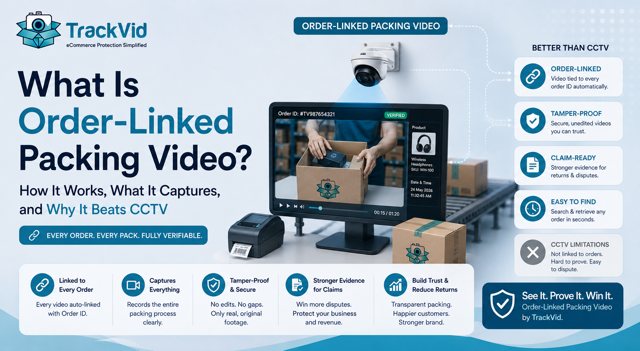
Can a packing machine also record video of what was packed? Most packing machines cannot. They automate the scan, label, seal, and convey steps but generate no dispatch proof. The TrackVid integrated packing machine is different. It has built-in cameras that film every pack at dispatch and link the video to the Order ID, AWB, and SKU at the moment of recording. The video is stored in searchable cloud and retrievable by Order ID in under two minutes.
How to get proof of what you shipped in an ecommerce dispute? The most reliable method is order-linked dispatch video captured at the moment of packing. This means a video file automatically tied to the Order ID when the pack is sealed, not reconstructed from a CCTV feed after the fact. Marketplace portals including Amazon SAFE-T, Flipkart SPF, and AJIO's claim system accept this format as primary evidence. Raw CCTV is typically rejected because it is not order-linked and not searchable by Order ID.
Order linked packing video kya hota hai? Order linked packing video ek aisi video file hai jo packing ke time automatically record hoti hai aur directly Order ID, AWB aur SKU se link hoti hai. Jab koi dispute aata hai, aap Order ID search karte ho aur us specific order ki packing video 2 minute mein mil jaati hai. Yeh normal CCTV se alag hai kyunki CCTV continuous record karti hai aur kisi bhi order se linked nahi hoti. Marketplaces order-linked video ko primary evidence ke taur pe accept karte hain.
Packing automation aur video proof kaise saath kaam karte hain? Ek integrated packing machine mein dono cheezein ek hi line pe hoti hain. Machine order scan karti hai, label print aur apply karti hai, bag seal karti hai, aur built-in cameras puri packing record karte hain. Video automatically Order ID se link ho jaati hai. Iska matlab hai ki ek hi operator ek hi machine pe order pack karta hai aur uski video proof bhi automatically ban jaati hai. Alag se koi camera set up nahi karna padta.
How to win return disputes with packing video? To win a return dispute using packing video, the video must be order-linked, not sourced from general CCTV. When a dispute arrives, search the Order ID in your system, retrieve the packing video, and submit it through the marketplace's evidence portal. For AJIO, submission must happen within 24 to 48 hours of the CCTV-required email. According to TrackVid data, sellers submitting order-linked packing video win disputes at a rate of 90 percent or above, compared to under 25 percent without structured proof.
What is the difference between CCTV and order-linked packing video? CCTV records continuously by time and camera location. To find evidence for a specific order, you search by date, time, and camera number, and then scrub through footage manually. This takes hours and produces footage that marketplace portals often reject as insufficient. Order-linked packing video is triggered by the order scan, tied automatically to the Order ID, and retrievable in under two minutes by searching the Order ID. It meets the evidence format that Amazon SAFE-T, Flipkart SPF, and AJIO's claim system accept.
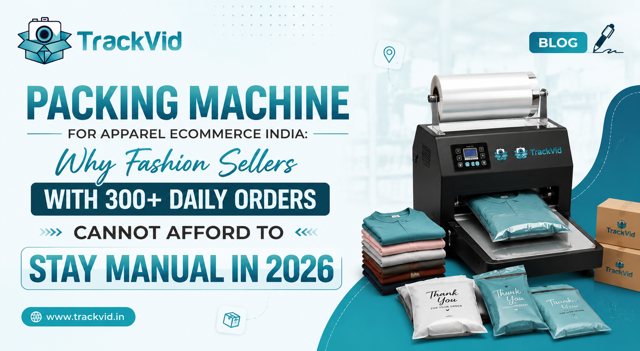
What is the best packing machine for ecommerce sellers in India that also records dispatch proof? The TrackVid integrated packing machine is currently the only machine in the India market that combines full packing automation with built-in order-linked video proof. It handles courier and poly bags up to 45 cm wide, connects to your ERP, and is built for apparel and soft goods. It is in early access for the Indian market. You can join the waitlist at trackvid.in/automatic-packing-machine.html.
Sources: NRF National Retail Federation Return Fraud Survey data; TrackVid seller data on claim win rates; AJIO seller portal claim requirements and CCTV response windows; Amazon SAFE-T seller documentation; Flipkart SPF seller portal guidelines.
TrackVid is a video proof and claim management platform used by 1,000+ Indian ecommerce sellers on Amazon, Flipkart, AJIO, Myntra and Meesho. Officially authorised by Snapdeal. Learn more at trackvid.in.

Get the Marketplace Claim Recovery Checklist
A 12-point checklist used by 1,100+ sellers to recover 85-90% of marketplace claim losses. Free, instant access.
- Marketplace-specific evidence formats (AJIO, Flipkart, Amazon, Myntra)
- Claim window deadlines for every major platform
- The 6-step process that pushes approval from 85-90%
- Common rejection reasons and how to avoid them
No spam. Unsubscribe anytime. Used by sellers at Rare Rabbit, HRX, Da Milano + 1,100 more.
Stop Losing Money to Fake Returns
Join 1,100+ sellers who recover lakhs every month with TrackVid