
For sellers on Amazon, Flipkart, AJIO, Myntra, Meesho, Shopify and global marketplaces. Updated June 2026.
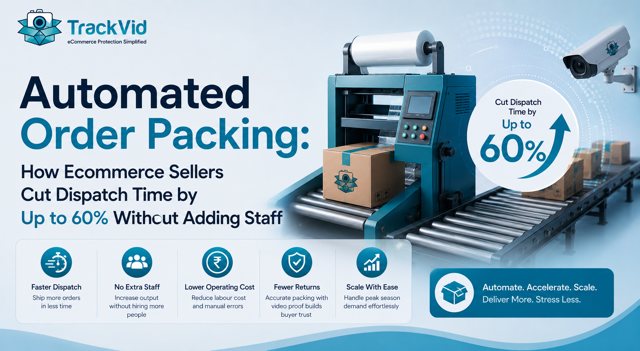
Dispatch time is the metric that quietly caps your growth. It rarely shows up in a dashboard as the problem, but when your packing team cannot get parcels out fast enough, you miss carrier cut-offs, you take SLA penalties, and your marketplace ranking slips. Automated order packing compresses the slowest, most variable part of that timeline, and it does it without adding a single person to the floor.
This guide covers what dispatch time actually is, why manual packing stretches it, and how automation can cut the internal pack-to-handover stage by up to 60 percent, so you hit your cut-offs even as volume climbs.
What Dispatch Time Actually Is, and Why It Decides More Than You Think
Dispatch time is the internal clock from when an order is ready to pack to when the sealed parcel is handed to the carrier. It is not the shipping time. It is the part you control, and it is the part that determines whether you make the cut-off.
That clock matters more than most sellers treat it. Marketplaces set dispatch SLAs, and missing them carries real consequences: penalties, suppressed listings, lost Buy Box eligibility on Amazon, and account health hits on Flipkart and others. Slow dispatch also shows up to the buyer as slow delivery, which drives cancellations and worse reviews. And when your dispatch time is long, a demand spike does not just slow you down, it creates a backlog that spills into the next day and the day after.
So dispatch time is not an operational detail. It is tied directly to penalties, ranking, cancellations, and your ability to grow without the wheels coming off during peak.
Why Manual Packing Stretches Dispatch Time
The pack stage is usually the slowest and most variable part of the internal dispatch clock, and manual packing makes it worse in specific ways.
Per-order handling is slow. A packer picks the label, matches it to the order, applies it, seals the bag, and sets the parcel aside. Every step is manual and every step takes seconds that add up across hundreds of orders.
Flow is inconsistent. Manual output varies by packer, by shift, by fatigue, and by time of day. The afternoon is slower than the morning. Temporary staff during a sale are slower and more error-prone than your trained team. That variability means your dispatch time is not one number, it is a range, and the bad end of the range is where you miss cut-offs.
Backlog compounds. When orders arrive faster than the team can pack, the queue grows. Because manual throughput cannot surge, the backlog does not clear within the day, so it pushes into the next, and your dispatch time quietly degrades across the whole peak period.
The result is a pack-to-handover stage that is slow on a good day and dangerously slow on a busy one.
How Automated Order Packing Compresses the Clock
Automated order packing attacks the exact part of the dispatch timeline that manual packing stretches: the per-order pack stage.
On an automated line, the order is scanned, the correct label is printed and applied, the bag is sealed, and the parcel is conveyed, in one continuous motion with one operator feeding the line. The per-order handling time drops sharply because the manual steps are collapsed into a single automated pass. This is where the up-to-60-percent figure comes from: not the shipping time, but the internal pack-to-handover stage, which automation can compress by half or more depending on your bag type and order mix.
Just as important, the flow becomes consistent. The line does not slow in the afternoon or fumble under sale pressure. Its output at hour six is the same as at hour one, so your dispatch time stops being a range with a dangerous bad end and becomes a stable, predictable number you can plan cut-offs around.
And because throughput is set by feed speed rather than headcount, a demand spike no longer creates a runaway backlog. The line absorbs volume that would have buried a manual team, so the backlog clears within the day instead of spilling into the next.
Related: What ecommerce packing automation is and how the full line works
A Chennai Seller Who Was Missing Cut-Offs
Divya runs a home and lifestyle brand out of Chennai, shipping around 420 orders per day across Amazon, Flipkart, and her own store.
As her volume grew, her dispatch time crept up. On normal days her team just made the carrier cut-off. On busy days they did not. During a festive sale, the backlog from peak day spilled across the next two days, she took SLA penalties on Amazon, and a batch of orders shipped late enough to trigger cancellations.
Her instinct was to hire more packers, but she had already seen that adding people gave her diminishing returns. More packers meant more label printers competing, more coordination, and more variability, not a clean increase in speed. The pack stage was the bottleneck, and throwing bodies at it was not compressing it.
"I kept adding people and my dispatch time barely moved. The packing step itself was the ceiling, and more hands did not make that step faster, it just made the floor more crowded. That is when I understood the problem was the process, not the headcount."
Divya's experience is the one growing sellers hit repeatedly. Past a point, hiring does not reduce dispatch time, because the manual pack step has a speed limit that more people do not raise. Only compressing the step itself does.
The Errors That Secretly Extend Your Dispatch Time
There is a hidden contributor to dispatch time that sellers rarely count: rework.
Every packing error that leaves the warehouse becomes a return that has to be received, inspected, and reshipped, which is a second dispatch cycle for a single order. And errors caught inside the warehouse still cost time to correct on the spot. A high error rate does not just cost money, it inflates your effective dispatch time by forcing you to handle the same order more than once.
Automated order packing reduces this because label printing, application, and sealing become deterministic. The correct label goes on the correct order every time, and the seal is consistent, so the errors that generate re-dispatch cycles are largely removed. Faster packing plus fewer do-overs compounds into a materially shorter effective dispatch time.
How the TrackVid Machine Fits
TrackVid's automatic packing machine is built to compress the pack-to-handover stage that dictates your dispatch time. One operator runs the full scan, print, apply, seal, and convey line, so per-order handling drops and throughput stays consistent whether you are shipping 200 or 600 orders in a day. A demand spike is absorbed by the line rather than turning into a backlog that blows your cut-offs.
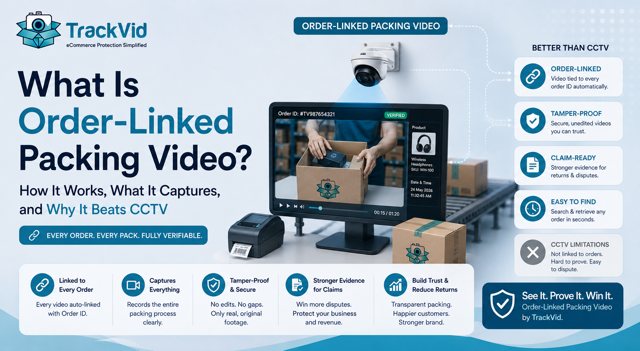
Labelling and sealing are deterministic, so the errors that create re-dispatch cycles are largely removed, which shortens your effective dispatch time further. And on the integrated version, the machine films the pack at dispatch and links the video to the Order ID automatically, so alongside faster dispatch you also get order-linked proof that wins return disputes, without a separate camera setup. TrackVid's platform is already used by 1,100+ Indian ecommerce sellers, who report claim win rates of 90 percent or above on disputes where packing video is submitted, according to TrackVid data.
The machine is pre-launch in India, with early access open to a limited first production batch and priority allocation for waitlist members.
Related: Join the early access waitlist for the TrackVid packing machine
What to Do If Your Dispatch Time Is Slipping
Measure the pack stage specifically. Time how long the pack-to-handover step takes at your busiest hour, not your average, because the busy hour is when you miss cut-offs. If the pack step is your bottleneck and hiring is giving you diminishing returns, that is the signal that the step itself, not your headcount, is the constraint.
Below roughly 150 orders a day, process fixes may be enough: slot fast movers near the station, batch similar orders, remove manual data entry. Above 300 a day with dispatch times that slip on busy days, compressing the pack step with automation is usually the durable fix, because it raises the speed ceiling that more people cannot.
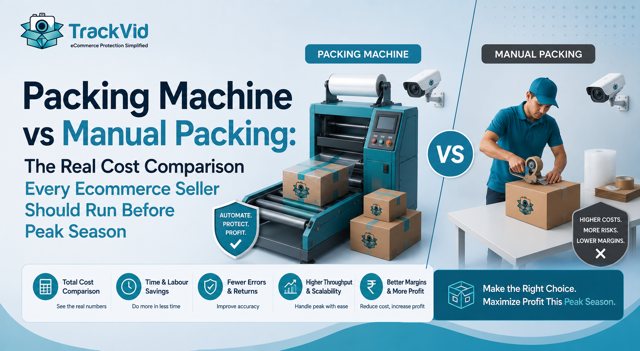
Related: Packing machine vs manual packing, the full cost comparison
Join the early access waitlist for the TrackVid automatic packing machine
Takes 30 seconds. No spam. We only contact you about early access and demos.
Related: How to reduce pick and pack labour cost as you scale
Frequently Asked Questions
How can I pack more orders per hour in ecommerce? Two levers. First, remove wasted motion: slot fast-moving items near the packing station, batch similar orders, and eliminate manual data entry so packers are not typing or hunting for supplies. These lift throughput per person. Second, past a certain volume, compress the pack step itself with automation, where one operator runs a line that scans, labels, seals, and conveys in one pass, raising the per-hour ceiling that adding people cannot.
How do I reduce dispatch time in ecommerce? Focus on the pack-to-handover stage, which is usually the slowest and most variable part of the internal dispatch clock. Reduce per-order handling time and make the flow consistent so it does not slow under pressure. Automated order packing does both, compressing the pack stage by up to 60 percent and holding a steady rate through peak, so you hit carrier cut-offs even on busy days. Also reduce packing errors, because rework forces a second dispatch cycle that inflates your effective dispatch time.
Dispatch time kaise kam kare ecommerce mein? Dispatch time kam karne ke liye pack-to-handover stage pe focus karo, jo internal dispatch clock ka sabse slow aur variable hissa hai. Per-order handling time kam karo aur flow ko consistent banao taaki pressure mein bhi speed na gire. Automated order packing dono karta hai, pack stage ko up to 60 percent tak compress karta hai aur peak mein bhi steady rate rakhta hai, toh aap busy days pe bhi carrier cut-off miss nahi karte. Errors bhi kam karo, kyunki rework ek order ko dobara dispatch karwata hai jo effective dispatch time badha deta hai.
Does adding more packers reduce dispatch time? Up to a point, then it stops working. Beyond a certain volume, more packers bring more coordination, more label printers competing, and more variability, without raising the speed of the pack step itself. The manual pack stage has a ceiling that additional people do not lift. To reduce dispatch time past that ceiling, you have to compress the step, which is what automation does.
What is dispatch time versus delivery time? Dispatch time is the internal clock from an order being ready to pack to the sealed parcel being handed to the carrier. Delivery time is the transit time after handover, which the carrier controls. Dispatch time is the part you own and the part that determines whether you make the marketplace cut-off. Automation targets dispatch time, specifically the pack-to-handover stage within it.
How does faster packing help with marketplace SLAs? Marketplaces set dispatch SLAs, and missing them brings penalties, suppressed listings, and account health damage. A shorter, more predictable dispatch time means you consistently hand parcels to the carrier before the cut-off, even during demand spikes. Automated order packing makes the pack stage both faster and steady, so your SLA compliance holds through peak instead of collapsing when volume rises.
Does automated packing help during sale season specifically? Yes, this is where it matters most. Manual throughput cannot surge, so a sale-season spike creates a backlog that spills across following days and wrecks dispatch times. An automated line absorbs the extra volume at a consistent rate, so the backlog clears within the day. The gap between manual and automated dispatch performance is widest exactly when the stakes are highest.
Sources: TrackVid seller data on claim win rates; IBEF India ecommerce data; marketplace dispatch SLA and account health documentation from Amazon and Flipkart seller portals; general warehouse throughput benchmarks.
TrackVid is a video proof and claim management platform used by 1,100+ Indian ecommerce sellers on Amazon, Flipkart, AJIO, Myntra and Meesho. Officially authorised by Snapdeal. Learn more at trackvid.in.


Get the Marketplace Claim Recovery Checklist
A 12-point checklist used by 1,100+ sellers to recover 85-90% of marketplace claim losses. Free, instant access.
- Marketplace-specific evidence formats (AJIO, Flipkart, Amazon, Myntra)
- Claim window deadlines for every major platform
- The 6-step process that pushes approval from 85-90%
- Common rejection reasons and how to avoid them
No spam. Unsubscribe anytime. Used by sellers at Rare Rabbit, HRX, Da Milano + 1,100 more.
Stop Losing Money to Fake Returns
Join 1,100+ sellers who recover lakhs every month with TrackVid