
For sellers on Amazon, Flipkart, AJIO, Myntra, Meesho, Shopify and global marketplaces. Updated June 2026.
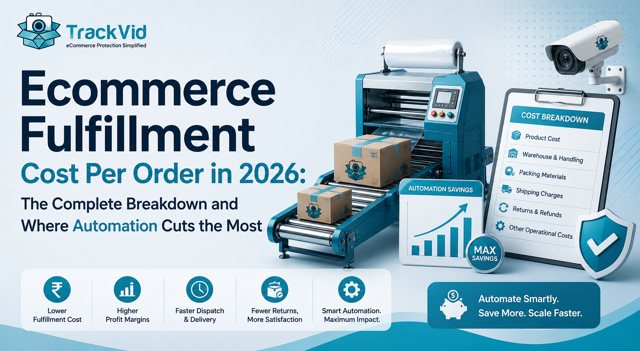
Most sellers cannot tell you their real ecommerce fulfillment cost per order. They know their shipping rate and roughly what they pay their packing team, but the full cost of getting one order from shelf to doorstep is spread across so many lines that the true number stays hidden. And you cannot reduce a cost you have not measured. This is the complete breakdown of ecommerce fulfillment cost per order for 2026, line by line, and an honest account of where automation cuts cost and where it does nothing.
By the end you will know every component of the number, which lines you can actually reduce, and how to calculate your own so you are working from fact instead of a rough guess.
Why This Number Decides Your Margin
Fulfillment cost per order is the total cost of processing and delivering a single order, divided across everything it consumes: storage, picking, packing, materials, shipping, returns, and the losses you absorb along the way.
It matters because it sits directly between your revenue and your profit. When you price a product, discount for a sale, or decide whether a marketplace channel is worth it, this is the number that tells you if the order actually made money. Sellers who do not know it routinely run channels or promotions that lose money on every order without realizing it, because the loss is buried in aggregate figures.
Knowing the per-order number also tells you where to cut. Not every line is reducible, so knowing which ones are is the difference between real savings and wasted effort.
The Complete Breakdown, Line by Line
Here is every component that makes up ecommerce fulfillment cost per order. The rupee ranges are indicative for an Indian apparel or soft-goods seller and will vary by category, location, and volume.
Storage and warehousing. The amortized cost of holding inventory before it sells: rent, racking, utilities, and the staff to manage it. Spread per order, this is usually a smaller line, but it grows if stock moves slowly.
Picking labour. The cost of the human work to locate and retrieve the items for each order. It scales with order volume and catalogue complexity.
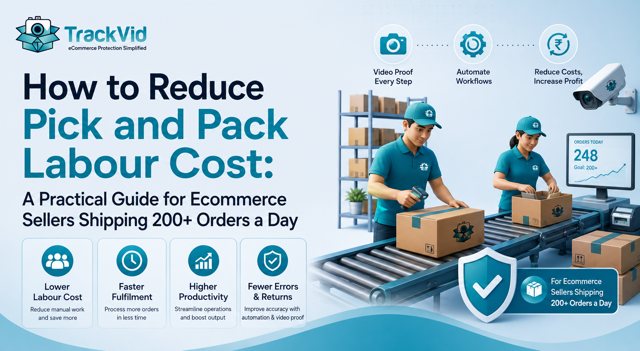
Packing labour. The cost of packing each order: labelling, sealing, and preparing it for dispatch. This is one of the largest controllable lines and the one that rises fastest as you grow, because manual packing adds a packer for every 80 to 100 additional daily orders.
Packaging materials. Courier bags, tape, labels, and any inserts. Often in the range of Rs 15 to Rs 40 per order for soft goods, higher if you use premium packaging.
Shipping and carrier charges. Usually the single largest line, often Rs 40 to Rs 90 or more per order depending on weight, zone, and carrier. Largely set by your carrier contracts and weight, so it is one of the harder lines to compress.
Returns and reverse logistics. The cost of handling returned orders: reverse shipping, inspection, and restocking or write-off. With Indian fashion return rates running at 25 to 35 percent per IBEF data, this line is large and often underestimated, because it is averaged across all orders rather than counted where it lands.
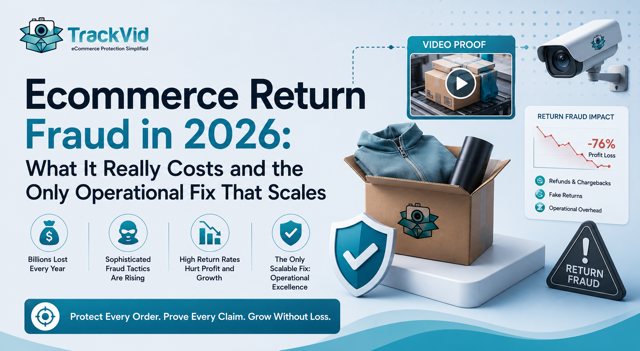
Claim and dispute losses. The refunds and penalties you absorb on fake returns, wrong-item claims, and false damage disputes that you cannot contest. This is the line almost every seller leaves out entirely, because it never appears as a fulfillment cost. It appears as revenue that never arrives.
Overhead and technology. Software, integrations, and the management overhead that supports the whole operation, spread per order.
Add these together and you have your true fulfillment cost per order. For most sellers the first time they do this, the number is higher than they assumed, and two lines are usually the culprits: returns and claim losses.
Which Lines Automation Actually Cuts
Be clear-eyed here, because this is where honest analysis matters. A packing machine does not cut every line. It cuts specific ones, and pretending otherwise would set the wrong expectation.
It does not cut shipping, which is set by your carrier and weight. It does not cut storage or picking directly. If a vendor tells you a packing machine slashes your whole fulfillment cost, be skeptical.
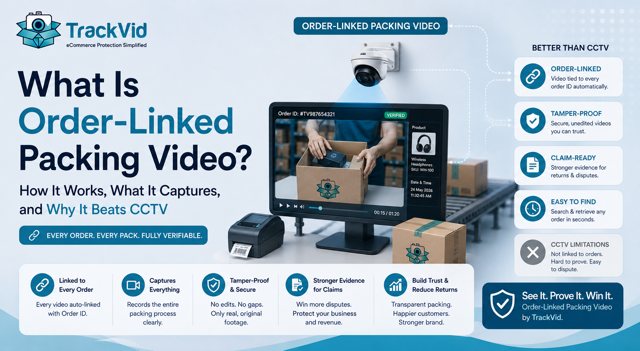
What it does cut is real and often the fastest-growing part of the number. It cuts packing labour, because one operator runs the line instead of a growing team. It cuts the returns caused by packing errors, because deterministic labelling and sealing remove the wrong-label and weak-seal mistakes that trigger a share of returns. And on an integrated machine, it cuts claim losses, because order-linked dispatch proof lets you win the disputes you currently write off.
So automation targets three of the eight lines: packing labour, error-driven returns, and claim losses. Those happen to be among the most reducible lines in the whole breakdown, which is why automation moves the per-order number even though it leaves shipping and storage untouched.
Related: The full pick and pack labour cost breakdown
An Indore Seller Who Ran the Real Number
Ankit runs an apparel and accessories brand out of Indore, shipping around 380 orders per day across his own store, Amazon, and Meesho.
He thought he knew his cost per order. He was counting packaging, shipping, and a rough share of packing wages, and the number looked acceptable. Then he built the full breakdown properly, and two lines he had never counted changed the picture.
The first was returns from packing errors. Once he traced how many returns came from wrong labels and wrong items, and added the reverse shipping, inspection, and re-fulfillment, that line was far larger than he expected. The second was claim losses. He had been absorbing a steady monthly figure in disputes he could not contest, and dividing it across his orders added a real cost per order he had simply never attributed to fulfillment.
"My cost per order was not the number I had been quoting to myself. The packaging and shipping were the easy lines I already knew. The returns from our own packing mistakes and the claims I kept losing were the two lines that were actually eating the margin, and I had never counted either one."
Ankit's realization is the common one. The visible lines are the ones sellers track. The two lines that most inflate the real cost per order, error-driven returns and unrecoverable claims, are the ones that stay invisible until you deliberately count them.
The Two Lines Sellers Always Miss
It is worth isolating the two lines that hide, because they are also the two automation addresses most directly.
Error-driven returns. Every packing error becomes a return that is received, inspected, and reshipped, which is fulfillment cost paid twice on one order. Because it is averaged across all orders, it rarely gets attributed to its cause. Reducing packing errors removes this cost at the source.
Unrecoverable claim losses. Fake returns, wrong-item claims, and false damage disputes that you cannot contest, because manual packing produces no order-linked proof and raw CCTV is rejected by marketplaces. This never appears as a fulfillment line, so it is almost universally excluded, yet it is real money per order. Order-linked dispatch proof turns these from losses into won claims.
Count these two and your real cost per order comes into focus. They are also the reason a packing machine can pay back faster than a wage-only comparison suggests.
Related: The return fraud behind those claim losses, and the fix
How the TrackVid Machine Cuts the Cost Per Order
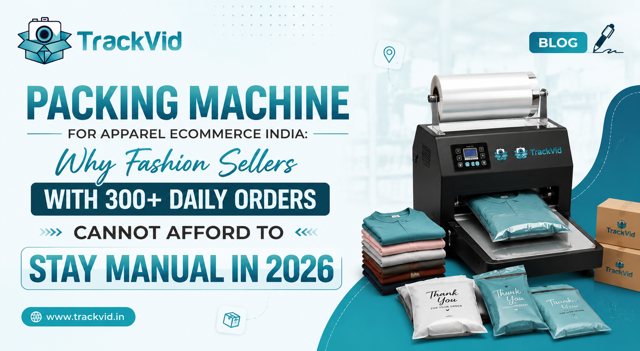
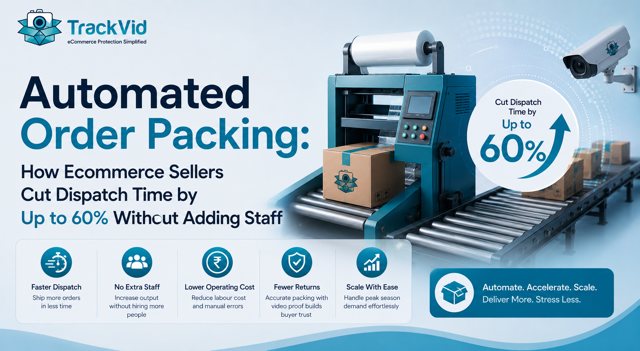
TrackVid's automatic packing machine targets exactly the three reducible lines in your fulfillment cost per order: packing labour, error-driven returns, and claim losses.
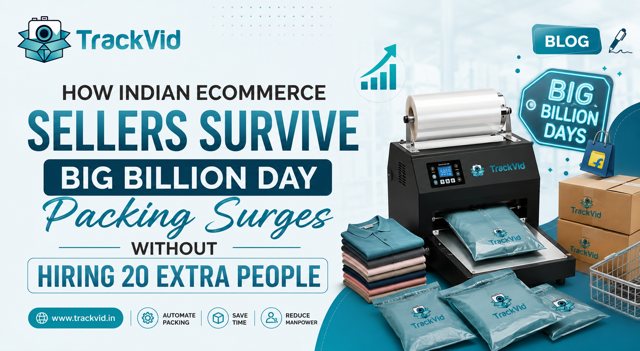
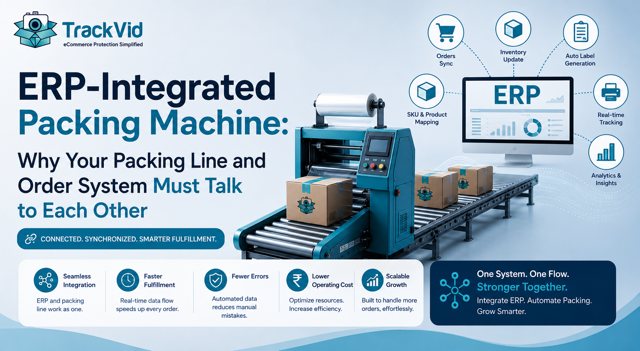
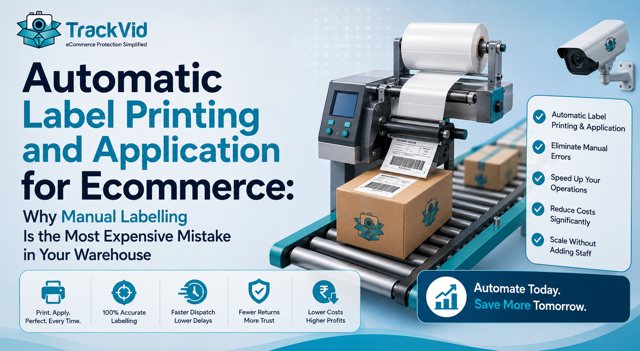
One operator runs the full scan, print, apply, seal, and convey line, so packing labour stops climbing with volume. Labelling and sealing are deterministic, so the errors that drive returns are largely removed, cutting the error-driven returns line. And on the integrated version, built-in cameras film the pack at dispatch and link the video to the Order ID automatically, so you win the disputes that make up your claim-loss line. TrackVid's platform is already used by 1,100+ Indian ecommerce sellers, who report claim win rates of 90 percent or above on disputes where packing video is submitted, according to TrackVid data.
It does not touch your shipping or storage, and it should not claim to. What it does is compress the three lines that are both largest and most reducible, which is where the real per-order savings come from. The machine is pre-launch in India, with early access open to a limited first production batch.
Related: Join the early access waitlist for the TrackVid packing machine
How to Calculate Your Own Cost Per Order
Do it once, properly, and you will never guess again.
Take a full month. Total every fulfillment line for that month: storage share, picking labour, packing labour, packaging materials, shipping, reverse logistics on returns, claim losses and penalties, and fulfillment overhead. Divide by the number of orders shipped that month. That is your true fulfillment cost per order.
Then split each line into reducible and fixed. Shipping and storage are largely fixed. Packing labour, error-driven returns, and claim losses are reducible. Focus your effort on the reducible lines, because that is where savings actually exist, and model what removing most of them would do to the per-order number before you decide on any investment.
Related: Packing machine vs manual packing, the full cost comparison
Join the early access waitlist for the TrackVid automatic packing machine
Takes 30 seconds. No spam. We only contact you about early access and demos.
Related: What ecommerce packing automation is and how it works
Frequently Asked Questions
What is the average fulfillment cost per order in ecommerce? There is no single average, because it depends heavily on category, product weight, shipping zones, and return rate. The more useful approach is to calculate your own by totaling every fulfillment line for a month and dividing by orders shipped. The components are storage, picking, packing, packaging materials, shipping, reverse logistics, claim losses, and overhead. Shipping is usually the largest single line, and returns plus claim losses are the two most often underestimated.
How much does it cost to pack an ecommerce order? Packing cost per order has two parts: labour and materials. Materials like courier bags, tape, and labels often run Rs 15 to Rs 40 for soft goods. Labour depends on your throughput, since manual packing adds a packer for every 80 to 100 additional daily orders. The often-missed part is the cost of packing errors, because every mistake creates a return that is handled and reshipped, which is packing cost paid twice on one order.
Ek order ka fulfillment cost kitna hota hai? Ek order ka fulfillment cost kai lines se milkar banta hai: storage, picking, packing labour, packaging materials, shipping, returns ka reverse logistics, claim losses, aur overhead. Koi ek average number nahi hota kyunki yeh category, weight, aur return rate pe depend karta hai. Sabse accurate tareeka hai ek mahine ki saari lines total karo aur orders se divide karo. Zyada tar sellers do lines miss karte hain: packing errors se aane wale returns, aur woh claims jo prove na kar paane ki wajah se lose ho jaate hain.
How do I calculate fulfillment cost per order? Take one full month. Add every fulfillment line for that month: storage share, picking labour, packing labour, packaging materials, shipping, reverse logistics on returns, claim losses and penalties, and overhead. Divide the total by the number of orders shipped. Then classify each line as fixed or reducible. Shipping and storage are mostly fixed. Packing labour, error-driven returns, and claim losses are reducible, so that is where you focus to lower the number.
Which fulfillment costs can automation actually reduce? A packing machine reduces three lines: packing labour, because one operator replaces a growing team; error-driven returns, because deterministic labelling and sealing remove the mistakes that trigger returns; and claim losses, because order-linked dispatch proof wins disputes you currently write off. It does not reduce shipping, storage, or picking directly. Be wary of any claim that a packing machine cuts your entire fulfillment cost, because it targets specific lines, not all of them.
Why is my real cost per order higher than I think? Because two lines usually go uncounted. Error-driven returns, where your own packing mistakes create returns that get handled and reshipped, are averaged across all orders and rarely traced to their cause. And claim losses from fake returns and false damage disputes never appear as a fulfillment line at all, showing up instead as revenue that never arrives. Count both and your true cost per order comes into focus, usually higher than the figure you had been using.
What is the fastest way to reduce cost per order? Attack the reducible lines, not the fixed ones. Shipping and storage are hard to move. Packing labour, error-driven returns, and claim losses are the lines where savings exist. Reducing packing errors and capturing order-linked proof cut two of them without touching headcount, and automating the packing step cuts the third. Model the effect of removing most of these three before spending on anything, so the decision comes from your own numbers.
Sources: IBEF India ecommerce fashion return rate data; NRF return-fraud research; TrackVid seller data on claim win rates; general ecommerce logistics and warehouse cost benchmarks.
TrackVid is a video proof and claim management platform used by 1,100+ Indian ecommerce sellers on Amazon, Flipkart, AJIO, Myntra and Meesho. Officially authorised by Snapdeal. Learn more at trackvid.in.
Get the Marketplace Claim Recovery Checklist
A 12-point checklist used by 1,100+ sellers to recover 85-90% of marketplace claim losses. Free, instant access.
- Marketplace-specific evidence formats (AJIO, Flipkart, Amazon, Myntra)
- Claim window deadlines for every major platform
- The 6-step process that pushes approval from 85-90%
- Common rejection reasons and how to avoid them
No spam. Unsubscribe anytime. Used by sellers at Rare Rabbit, HRX, Da Milano + 1,100 more.
Stop Losing Money to Fake Returns
Join 1,100+ sellers who recover lakhs every month with TrackVid