
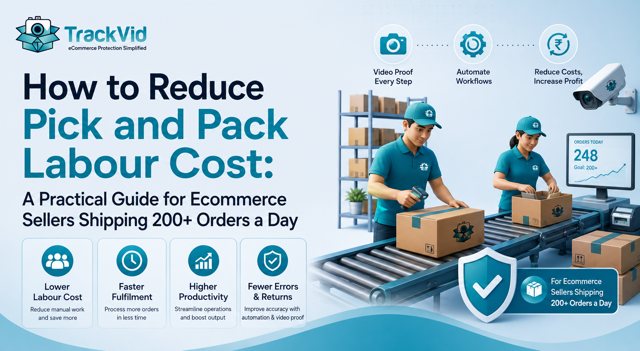
For sellers on Amazon, Flipkart, AJIO, Myntra, Meesho, Shopify and global marketplaces. Updated June 2026.
Pick and pack is the cost that grows fastest as you scale, and the one most sellers measure wrong. They count the salaries on the packing floor and stop there. But the real pick and pack labour cost includes the people you hire, the rework when they make mistakes, and the hours your team loses cleaning up after those mistakes. Reduce only the first and you have barely touched the bill.
This guide breaks down what that cost actually is, why it climbs faster than your revenue, and the specific levers that bring it down, in the order you should pull them.
What Pick and Pack Labour Cost Actually Includes
Pick and pack is the work of taking an order, retrieving the items, and packing them for dispatch. The labour cost of that work is usually the single largest controllable line in fulfilment. Across warehouse operations, staffing is widely cited as more than half of total operating cost, and packing is a major share of that staffing.
Most sellers track only the visible part: the monthly wages of the packing team. That number is real, but it is incomplete. The full pick and pack labour cost has three layers.
The first layer is direct wages. The packers, the supervisors, the shift overlap, the overtime during spikes.
The second layer is rework. Every packing error, a wrong item, a wrong label, a weak seal, creates a return that has to be received, inspected, repackaged, and reshipped. That is labour, and it is labour spent twice on a single order.
The third layer is recovery work. When a buyer files a dispute, someone on your team spends time searching footage, gathering evidence, and responding to the marketplace. At volume, this quietly consumes hours every week.
When sellers say their packing cost is too high, they are usually looking only at layer one. The reductions that actually move the number come from attacking all three.
Why the Cost Climbs Faster Than Your Revenue
Manual packing scales linearly. A trained packer handles roughly 60 to 80 orders per hour depending on category and bag type, which works out to about one additional packer for every 80 to 100 additional orders per day.
That sounds manageable until you map it against growth. At 200 orders a day you need two or three packers. At 500 a day you need five or six, plus a supervisor, plus shift overlap, plus the training cycle for each new hire, plus the cost of the person who quits during your busiest week. Your packing wage bill does not grow in a smooth line. It grows in steps, and each step is harder to staff than the last.
Revenue, meanwhile, does not grow at the same rate as your packing headcount needs. Margins per order tend to compress as you scale and discount to compete. So you reach a point where every additional hundred orders a day adds cost faster than it adds profit, and the packing floor becomes the reason growth stops feeling like progress.
This is the structural problem. Manual pick and pack ties your cost directly to your volume, and there is no version of hiring that breaks that link.
The Levers That Actually Reduce Pick and Pack Labour Cost
Here are the levers in the order you should pull them, from cheapest to most structural.
Lever 1: Fix layout and process first
Before spending on anything, reduce wasted motion. Slot your fastest-moving SKUs closest to the packing station. Batch similar orders so packers are not walking the same route repeatedly. Standardise where labels, bags, and tape live so nobody hunts for supplies. These cost almost nothing and can lift throughput per packer meaningfully.
Lever 2: Reduce errors, because errors are double labour
Every packing error is paid for twice: once to pack it wrong, once to handle the return and repack it. If your error rate is 2 to 3 percent, a meaningful slice of your labour is being spent redoing work. Tightening the label-and-seal step, the most error-prone stage at high volume, removes that rework. This is a labour reduction that does not require cutting a single packer, because you are reclaiming hours already being wasted.
Lever 3: Remove manual data entry
If packers are typing order details or matching pre-printed labels by hand, they are spending time on a task that is both slow and error-prone. Pulling order data automatically from your ERP removes that step entirely and the errors that come with it.
Lever 4: Break the headcount link with automation
The first three levers make your existing team more efficient. They have a ceiling. Past a certain volume, the only way to stop your wage bill climbing with every hundred orders is to stop adding people for every hundred orders.
An automated packing line does exactly that. One operator feeds the line while the machine scans, prints, applies, seals, and conveys. Throughput rises without a proportional rise in headcount. The cost link between volume and labour is broken. That is the structural fix the first three levers cannot deliver.
Related: What ecommerce packing automation is, what it costs, and whether it is worth it
A Bengaluru Seller Who Found the Real Number
Karthik runs a multi-brand apparel operation out of Bengaluru, shipping around 450 orders per day across his own D2C store, Myntra, and Flipkart.
He measured his packing cost the way most sellers do: six people on the packing floor, five packers and a supervisor, a monthly wage line of about Rs 1.2 lakh. That was the number he quoted whenever anyone asked what packing cost him.
Then he actually traced the rest of it. His returns from packing errors, wrong size sent, wrong label, ran at roughly 2.5 percent of orders, and each one consumed receiving, inspection, and reshipping labour. On top of that, his operations lead was spending close to a full day a week assembling evidence for disputes, much of which was rejected anyway because the footage was raw CCTV, not order-linked.
When he added the rework hours and the recovery hours to the visible wage line, his real pick and pack labour cost was materially higher than the six salaries he had been counting.
"I was measuring my packing cost as six salaries. The real number was six salaries plus every hour we lost cleaning up errors and chasing claims we could not prove. Once I saw the full figure, the case for changing how we pack made itself."
Karthik's mistake is the common one. The wage line is the part you can see. The rework and recovery labour is the part that makes the true cost much larger, and the part automation removes alongside the wages.
How Packing Automation Cuts All Three Layers
This is the point most cost comparisons miss. Automation does not just reduce the wage line. It cuts all three layers of packing labour cost at once.
It cuts direct wages because one operator runs the line instead of a five or six person team.
It cuts rework because label printing, label application, and sealing become deterministic. The correct label for the correct order is printed and applied every time, and the bag is sealed consistently. The most common packing errors, the ones that create return-and-repack labour, are removed at the source.
It cuts recovery labour because, on an integrated machine, the dispatch is filmed and linked to the Order ID automatically. When a dispute arrives, the evidence is retrieved by Order ID in seconds instead of your team spending hours searching CCTV. The labour of chasing claims collapses.
You are not just paying fewer salaries. You are reclaiming the hidden hours that the wage line never showed you.
The TrackVid Machine
TrackVid's automatic packing machine is built to remove all three labour layers on a single line. One operator runs the full scan, print, apply, seal, and convey sequence, so your packing capacity stops growing in step with your headcount.
On the integrated version, built-in cameras record the pack at dispatch and link the video to the Order ID, AWB, and SKU. That removes the recovery labour, because the evidence for any dispute already exists and is searchable, not reconstructed by hand. The same forward dispatch video wins the claim types that drive most of your return losses: wrong item, swap, empty box, and false damage.
Most packing machines only reduce your wage line. This one reduces the wage line and the rework and the recovery labour together, which is where your real pick and pack cost actually lives. TrackVid's platform is already used by 1,100+ Indian ecommerce sellers, who report claim win rates of 90 percent or above on disputes where packing video is submitted, according to TrackVid data.
The machine is pre-launch in India. Early access is open to a limited first production batch.
Related: Join the early access waitlist for the TrackVid packing machine
Related: How packing automation and order-linked video proof win every return claim
When Does Automation Make Sense as a Labour Decision
Pull the cheap levers first. Fix layout, reduce errors, remove manual entry. If you are under 150 orders a day, those levers may be all you need.
Automation becomes the right labour decision when two things are true. First, your volume is high enough that you are adding packers in steps and struggling to staff them, typically above 300 orders a day. Second, your total packing labour cost, including rework and recovery, is large enough that removing most of it covers the investment in a reasonable window.
Run your own number the way Karthik did. Add your visible wage line, your rework hours, and your recovery hours. If that full figure is climbing faster than your margin per order, the cheap levers will not hold for long, and the structural fix is the one that pays.
Related: When should you actually buy a packing machine? Five signals that tell you
Join the early access waitlist for the TrackVid automatic packing machine
Takes 30 seconds. No spam. We only contact you about early access and demos.
Related: How claim management works when you have order-linked video
Frequently Asked Questions
How much does pick and pack cost per order? It varies by category, location, and volume, but the labour portion is usually the largest controllable part. The mistake most sellers make is counting only packer wages. The full per-order cost also includes the rework labour from packing errors and the recovery labour from chasing disputes. When you include all three, the real cost per order is meaningfully higher than the wage line alone suggests.
How do I reduce packing staff in ecommerce without slowing dispatch? Start with process. Slot fast-moving items near the packing station, batch similar orders, and remove manual data entry so packers are not typing or hunting for supplies. These lift throughput per person. Past a certain volume, the only way to reduce staff without slowing dispatch is automation, where one operator runs a line that scans, labels, seals, and conveys, so output no longer depends on adding people.
What is pick and pack labour cost? Pick and pack labour cost is the total cost of the human work involved in retrieving and packing orders for dispatch. It has three layers: direct wages of the packing team, rework labour spent redoing orders that were packed incorrectly, and recovery labour spent gathering evidence and responding to marketplace disputes. Reducing only the wages misses the other two layers, which at scale can be just as large.
Pick and pack labour cost kaise kam kare? Pick and pack labour cost kam karne ke liye pehle process theek karo. Fast-moving products ko packing station ke paas rakho, similar orders ko batch karo, aur manual data entry hatao taaki packers ka time bache. Yeh existing team ko efficient banata hai. Lekin ek limit ke baad, jab volume zyada ho jaaye, toh sirf automation hi labour cost ko structurally kam karta hai. Ek operator pure line ko chalata hai jo scan, label, seal aur convey karti hai, toh output badhane ke liye zyada log hire nahi karne padte.
How many packers do I need for 500 orders a day? Manually, roughly five to six packers plus a supervisor, because a trained packer handles about 80 to 100 orders a day reliably across a shift, and you need cover for breaks, absences, and spikes. With an automated packing line, one operator can feed the line for a far higher volume, which is why automation changes the staffing maths at this scale.
Does reducing packing errors actually lower labour cost? Yes, directly. Every packing error is paid for twice, once to pack it wrong and once to receive the return, inspect it, and repack it. If your error rate is 2 to 3 percent, a real slice of your labour is being spent redoing work you already did. Reducing errors, especially at the label and seal stage where most high-volume errors happen, reclaims those hours without cutting a single packer.
What is the best way to reduce fulfilment labour cost at scale? At low volume, process improvements and error reduction are enough. At high volume, the structural answer is automation that breaks the link between order count and headcount. An integrated packing machine reduces all three labour layers at once: fewer wages because one operator runs the line, less rework because labelling and sealing are deterministic, and less recovery labour because dispatch video is captured and linked to the order automatically for disputes.
Sources: NRF National Retail Federation return and return-fraud research; IBEF India ecommerce fashion return rate data; TrackVid seller data on claim win rates; general warehouse operations benchmarks on labour as a share of fulfilment cost.
TrackVid is a video proof and claim management platform used by 1,100+ Indian ecommerce sellers on Amazon, Flipkart, AJIO, Myntra and Meesho. Officially authorised by Snapdeal. Learn more at trackvid.in.


Get the Marketplace Claim Recovery Checklist
A 12-point checklist used by 1,100+ sellers to recover 85-90% of marketplace claim losses. Free, instant access.
- Marketplace-specific evidence formats (AJIO, Flipkart, Amazon, Myntra)
- Claim window deadlines for every major platform
- The 6-step process that pushes approval from 85-90%
- Common rejection reasons and how to avoid them
No spam. Unsubscribe anytime. Used by sellers at Rare Rabbit, HRX, Da Milano + 1,100 more.
Stop Losing Money to Fake Returns
Join 1,100+ sellers who recover lakhs every month with TrackVid