
For sellers on Amazon, Flipkart, AJIO, Myntra, Meesho, Shopify and global marketplaces. Updated June 2026.
The question is never whether to automate packing eventually. At sufficient scale, it is always the right answer. The real question is whether your operation has crossed the threshold where doing it now makes financial sense, and what you are actually giving up every month you wait.
This is not a guide for sellers who have already decided. It is a framework for sellers who are still deciding, and want a set of specific, honest criteria to apply to their own operation rather than a vendor's case study that conveniently justifies the investment every time.
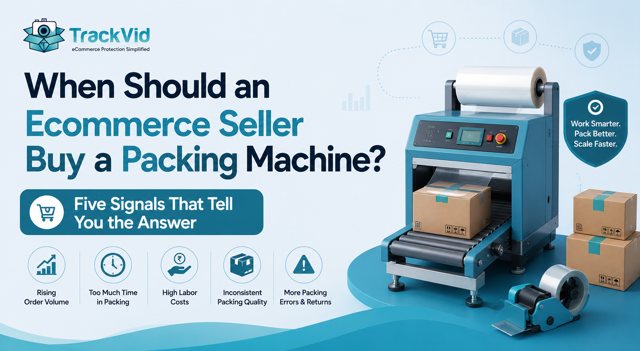
Five signals. If three or more apply to your current situation, the case for buying a packing machine for your ecommerce operation is almost certainly positive. If one or two apply, the financial case exists but is not urgent. If none apply, you are probably not there yet.
Why Most Sellers Get the Timing Wrong
Sellers typically arrive at the packing machine question from one of two directions, and both produce bad timing decisions.
The first direction: volume excitement. Sales are growing. Someone in a trade group mentioned an automated packing line. The operations manager raises it in a review meeting. The decision gets made on momentum rather than on numbers, at a point where the wage savings do not yet cover the investment.
The second direction: crisis. A sale season went badly. Packers quit in peak week. SLA compliance collapsed. The knee-jerk response is automation, but the decision is made in frustration rather than in calculation, which means the problem being solved is the emotional one, not the operational one.
The framework below is designed to bypass both directions. It asks operational questions with specific numerical answers. If you cannot answer the questions with numbers, you are not ready to make the decision yet. Gather the data first, then apply the signals.
Signal One: Your Packing Team Has Become a Growth Cap
Manual packing scales at a predictable rate: roughly one additional trained packer for every 80 to 100 additional orders per day. At 200 orders a day with two packers, the maths works. At 500 orders a day, you are looking at five to six packers, a supervisor, shift overlap, training cycles, and the persistent risk of one person quitting during your busiest week.
The signal to look for is not headcount itself. It is whether hiring is the only lever available to increase throughput.
If you want to pack 20 percent more orders next month and the only way to do it is to hire two more people, your packing team is your growth cap. When throughput is constrained by headcount and headcount is constrained by hiring, scaling your order volume becomes structurally expensive.
An automated packing line breaks this constraint. One operator running the line processes significantly more orders per hour than a manual team of similar size. Increasing output no longer requires a proportional increase in people. That shift changes the economics of growth.
Ask yourself: If your order volume grew by 200 orders per day next month, what would it cost in new wages to absorb that volume? Write the number down. It matters for Signal Five.
Signal Two: Your Packing Error Rate Is Measurable and Meaningful
Packing errors are any event where the wrong outcome leaves your warehouse: wrong label applied, wrong item packed, weak seal that fails in transit, address mislabelled. Each error type has a cost, and that cost is almost always underestimated because it is spread across returns, re-fulfilment, claims, and operational time.
The benchmark to apply: what is your packing error rate as a percentage of orders shipped?
Most manually packed operations running at medium volume run at between 1 and 4 percent error rate, depending on team training, shift fatigue, and whether temporary staff are in use. On 10,000 monthly orders, a 2 percent error rate is 200 error events. If a third of those generate claims and your current claim success rate is under 30 percent, you are absorbing 140 unrecovered error events per month.
Calculate that in rupees. Use your average order value, your return logistics cost, and your re-fulfilment cost. For most apparel sellers, one unrecovered error event costs Rs 400 to Rs 1,200 depending on the product. At 140 events per month, the loss is Rs 56,000 to Rs 1.68 lakh.
Automated packing removes the human error from label printing, label application, and sealing. Not from picking, which is a separate problem. But if your errors are concentrated in the label-and-seal stage, which they typically are at high volume, automation eliminates the category.
Ask yourself: What is your actual packing error rate this month, as a number? If you cannot answer this question, you are absorbing losses you have not measured.
Signal Three: You Are Writing Off Claims You Cannot Contest
This is the signal most sellers underweigh because the cost is invisible. It does not appear as a line item. It appears as revenue that simply never arrives.
When a buyer files a wrong-item dispute, a damage claim, or an empty-box return, you have a claim window to contest it. Amazon SAFE-T gives you 7 days. Flipkart SPF requires response within 48 to 72 hours. AJIO sends CCTV-required emails with a 24 to 48 hour response window. If you miss the window, or if you respond without structured evidence the platform accepts, the claim is lost.
The question is not how many claims you filed. It is how many eligible claims you did not file, or filed without adequate evidence and therefore lost, because your packing process generates no structured dispatch proof.
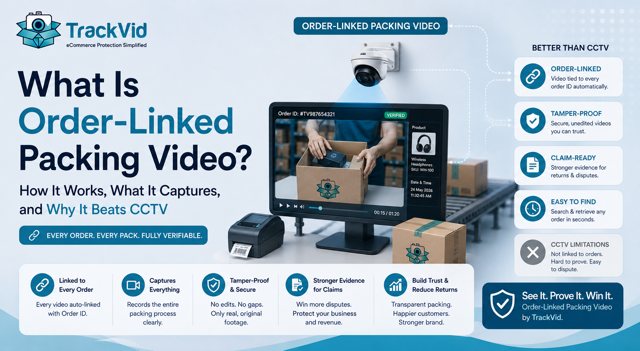
According to TrackVid data, the industry average claim success rate without order-linked packing video is under 25 percent. With order-linked dispatch video, sellers report win rates of 90 percent or above on disputes where the video is submitted. The gap between those two numbers is the revenue your current setup is surrendering every month.
Calculate your uncontested or unwinnable claims for the last three months. Multiply the average claim value by the number of events. That is your monthly proof-gap loss.
If that number is above Rs 40,000 per month, the case for an integrated packing machine that captures order-linked dispatch video is almost certainly positive on the proof recovery alone, before you count the labour savings.
Related: How packing automation and order-linked video proof work together to win every return claim
Ask yourself: How much revenue did you write off last month because you could not prove what was packed and dispatched for a specific order?
A Mumbai Seller's Calculation
Deepak runs a D2C accessories brand out of Mumbai, selling across his own website, Amazon, and Flipkart. He was processing around 260 orders per day when he started evaluating whether to buy a packing machine for his ecommerce operation.
He ran the numbers in three columns.
First column: current monthly wage line for his four-person packing team. Rs 76,000, including one supervisor.
Second column: packing error events per month, calculated from return complaints, re-shipment records, and his own claim logs. He found 180 to 200 error events per month that he could trace directly to label or seal failures. At an average recovery cost of Rs 600 per event, that was Rs 1.08 lakh to Rs 1.2 lakh per month in absorbed costs.
Third column: claims he had not contested or had lost due to insufficient evidence. In three months of records, he identified 47 claim events per month where he either missed the window or submitted and was rejected. Average claim value Rs 1,400. Monthly uncontested loss: approximately Rs 65,800.
"I kept thinking the machine was an operational expense. When I added the second and third columns, it became a revenue recovery decision. I was already spending that money. I was just spending it on losses instead of on a fix."
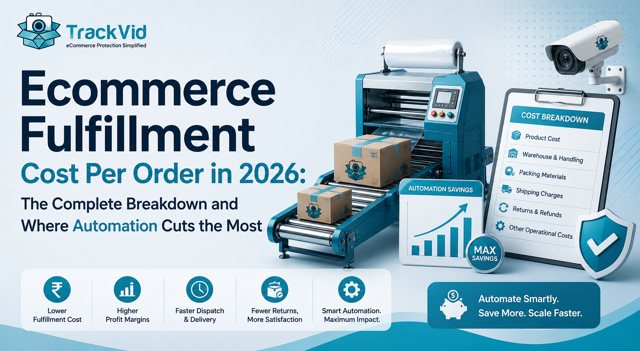
Deepak's total monthly cost from packing inefficiency across all three columns was approximately Rs 2.4 lakh. The wage line was the smallest part of it.
Signal Four: Sale Season Performance Reveals the Real Capacity Ceiling
This is the most diagnostic signal available, and it costs nothing to measure because you already lived through it.
During your last major sale event, Big Billion Day, Myntra EORS, an Amazon sale, or any period where your order volume spiked beyond your normal throughput, what happened to your packing operation?
The indicators to look for:
Did you miss dispatch cut-off times? Did SLA compliance drop? Did you bring in temporary staff, and did those temporary staff generate more errors than your trained team? Did the backlog from peak day spill into the following two or three days? Did you turn off certain sales channels or restrict orders during peak because you could not fulfil them fast enough?
If any of these happened, your packing operation failed its stress test. And sale season is not an anomaly. It is a preview of what your regular throughput will look like in twelve months if your order volume keeps growing at its current rate.
An automated packing line does not get tired in the third shift. It does not make more errors after six hours of high-volume operation. Its throughput is consistent whether you are processing 200 or 600 orders in a day. That consistency is what sale season stress tests reveal your manual team cannot sustain.
Ask yourself: During the last sale event, what was your SLA compliance rate compared to a normal week? Write the percentage drop. That gap is what automation closes.
Signal Five: The Break-Even Calculation Comes Out Positive
This is where the decision becomes concrete. Not in principle, not in operational theory, but in numbers.
The break-even calculation for a packing machine has three components.
Monthly savings from labour reduction. If your current team of five packers costs Rs 1.1 lakh per month and automation reduces that to one operator at Rs 20,000, the monthly wage saving is Rs 90,000. Use your actual numbers.
Monthly savings from error reduction. Take your current packing error rate and calculate the monthly cost using your average recovery cost per event. Conservative estimate: a 70 percent reduction in label and seal errors on automation. Apply that to your current monthly error cost.
Monthly recovery from claim proof. If you are currently writing off Rs 50,000 per month in claims you cannot contest due to lack of dispatch proof, and an integrated machine with order-linked video would allow you to contest 90 percent of those with evidence that wins at 90 percent success rate, your monthly recovery improves by approximately Rs 40,500 per month on that one line item alone.
Add the three monthly savings figures. That is your monthly benefit from automation. The machine investment pays back in the number of months it takes for cumulative monthly benefit to cover the investment.
For most sellers processing 300 or more orders per day with a current packing team of four or more people and a measurable claim write-off, the break-even typically arrives well within the first year.
Ask yourself: Run your actual numbers across these three columns. If the monthly benefit total is positive and meaningful, the financial case is there. If it is marginal, you are probably 3 to 6 months away from the right timing.
How the TrackVid Machine Addresses All Five Signals
The TrackVid automatic packing machine is built specifically to close all five gaps at once, not just the throughput one.
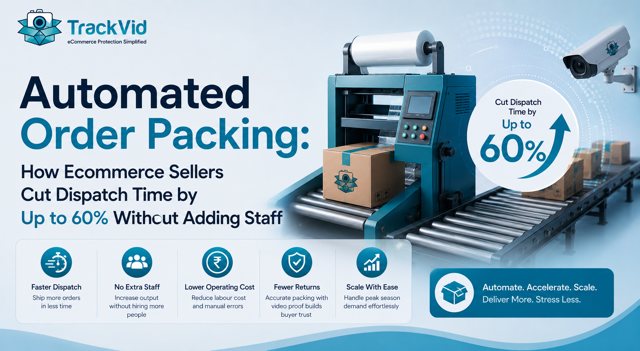
On the throughput signal: one operator runs the full scan-print-apply-seal-convey line. Your packing capacity no longer grows in proportion to your headcount.
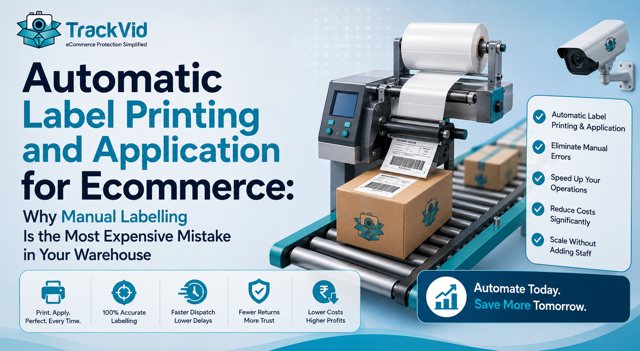
On the error signal: label printing and application are deterministic. The correct label for the correct Order ID is printed and applied every time, removing the manual error category from labelling entirely.
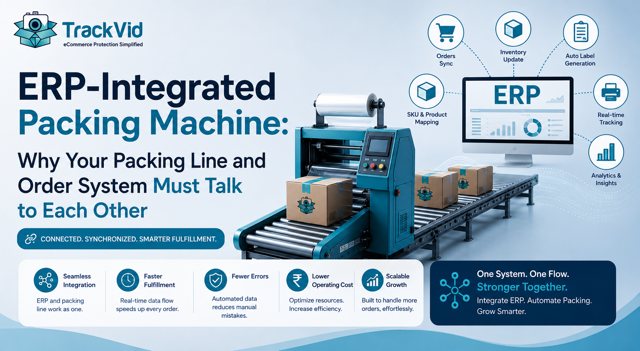
On the claim proof signal: this is where it is different from every other packing machine in the market. The integrated version has built-in cameras that film the pack at dispatch and link the video to the Order ID. When a dispute arrives, the evidence is retrieved by Order ID in under two minutes. The claim window is never missed because the evidence already exists.
On the sale season signal: consistent throughput regardless of volume. No shift fatigue, no temporary staff error spike.
On the break-even signal: calculate yours using the three-column method above. The machine is pre-launch in India. Joining the waitlist now secures priority allocation from the first production batch and early-access terms.
Related: Join the early access waitlist for the TrackVid packing machine
Related: How order-linked packing video wins marketplace disputes
Applying the Five Signals: A Decision Checklist
Go through these five questions with your actual operational data, not estimates.
1. Is hiring the only way to increase your packing throughput right now? If yes: Signal One applies.
2. Can you state your packing error rate as a specific percentage this month? If yes and the rate is above 1.5 percent: Signal Two applies. If you cannot state it as a number: you are absorbing unmeasured losses. Get the number before making any decision.
3. Did you write off any claims last month because you had no dispatch proof? If yes, with a total above Rs 30,000: Signal Three applies.
4. Did your packing operation fail in any measurable way during the last sale event? If yes: Signal Four applies.
5. When you run the three-column break-even calculation, does the monthly benefit exceed zero? If yes: Signal Five applies.
Three or more signals: the case for buying a packing machine for your ecommerce operation is strong. Act on it.
Two signals: the case exists but you may have 3 to 6 months before the timing optimises. Start the evaluation now so you are ready.
One signal or none: not yet. Focus on measuring the data gaps first. You need accurate error rate and claim write-off numbers before this decision can be made properly.
Join the early access waitlist for the TrackVid automatic packing machine
Takes 30 seconds. No spam. We only contact you about early access and demos.
Related: What ecommerce packing automation actually is and what it does
Frequently Asked Questions
When should I buy a packing machine for ecommerce? The clearest signal is when your packing team has become your throughput ceiling, meaning the only way to pack more orders is to hire more people. This typically becomes significant above 250 to 300 orders per day. But volume is not the only factor. Sellers at lower volumes who are writing off significant claim losses due to lack of dispatch proof can also build a strong financial case, because the machine's integrated video proof closes the revenue gap that labour savings alone do not.
How many orders per day justify buying a packing machine? There is no universal threshold, because the ROI calculation includes three components: labour savings, error cost reduction, and claim recovery from dispatch proof. At 300 or more orders per day with a team of four or more packers, the labour savings alone typically make the case within a reasonable payback window. At lower volumes, the calculation depends more heavily on your error rate and your current claim write-off. Run the three-column calculation in this article with your actual numbers before deciding.
Kab lena chahiye packing machine ecommerce ke liye? Packing machine lene ka sahi time tab aata hai jab aapki packing team aapki growth ki limit ban jaaye, matlab zyada orders pack karne ke liye sirf zyada logon ko hire karna padta ho. Yeh usually 250 se 300 orders per day ke upar hota hai. Lekin sirf order volume mat dekho. Agar aap har mahine claims lose kar rahe ho kyunki aapke paas dispatch proof nahi hai, toh woh loss bhi calculation mein aana chahiye. Bahut baar woh loss labour savings se bhi zyada hota hai.
Is a packing machine worth it for ecommerce sellers? It depends entirely on your specific numbers, not on a general answer. Calculate these three monthly figures: what you spend on packing wages today versus with automation; what your packing errors cost you per month; and what you write off in claims you cannot contest due to lack of dispatch proof. If the sum of those monthly savings and recoveries is positive and significant, the machine is worth it. If the numbers are marginal, the timing is not right yet.
What is the difference between buying a packing machine and just hiring more packers? Hiring more packers scales your cost in direct proportion to your volume. Every 100 extra orders per day adds roughly one more packer. A packing machine has a fixed operational cost regardless of whether you pack 200 or 600 orders per day. Beyond the economics, a machine eliminates human error from the label and seal steps, and the TrackVid integrated version also captures order-linked dispatch proof on every order, which a packing team cannot do consistently at scale.
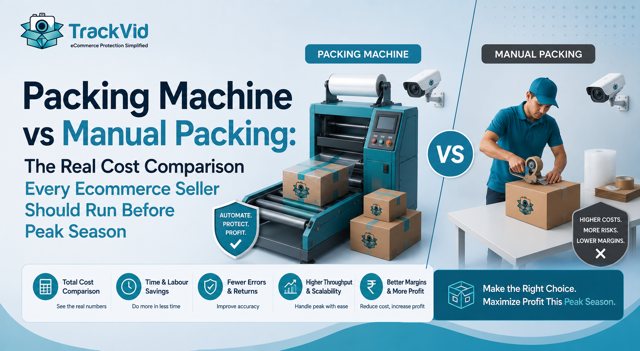
Packing machine vs manual packing: which is better for my ecommerce business? Manual packing is better when your volume is low and flexibility matters more than consistency. Automated packing is better when volume is high, errors are costing you money, and you need consistent throughput across shifts and seasons. The integrated TrackVid machine adds a third advantage manual packing can never match: structured dispatch proof on every order, linked to the Order ID, retrievable in under two minutes when a dispute arrives.
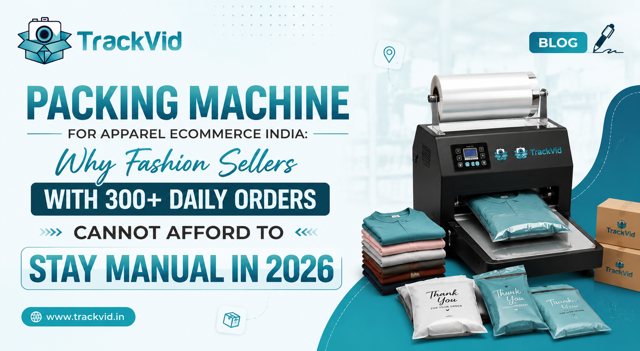
What is the best packing machine for ecommerce in India to buy in 2026? The TrackVid automatic packing machine is the only machine in the India market that combines full packing automation with built-in order-linked video proof on one line. It is built for apparel and soft goods, handles courier and poly bags up to 45 cm wide, and connects to your ERP. It is currently in early access for the Indian market. You can join the waitlist at trackvid.in/automatic-packing-machine.html.
Sources: TrackVid seller data on claim win rates and error cost benchmarks; IBEF India ecommerce return rate data; Amazon SAFE-T claim window documentation; Flipkart SPF seller portal claim requirements; AJIO seller portal CCTV response window guidelines.
TrackVid is a video proof and claim management platform used by 1,000+ Indian ecommerce sellers on Amazon, Flipkart, AJIO, Myntra and Meesho. Officially authorised by Snapdeal. Learn more at trackvid.in.

Get the Marketplace Claim Recovery Checklist
A 12-point checklist used by 1,100+ sellers to recover 85-90% of marketplace claim losses. Free, instant access.
- Marketplace-specific evidence formats (AJIO, Flipkart, Amazon, Myntra)
- Claim window deadlines for every major platform
- The 6-step process that pushes approval from 85-90%
- Common rejection reasons and how to avoid them
No spam. Unsubscribe anytime. Used by sellers at Rare Rabbit, HRX, Da Milano + 1,100 more.
Stop Losing Money to Fake Returns
Join 1,100+ sellers who recover lakhs every month with TrackVid