
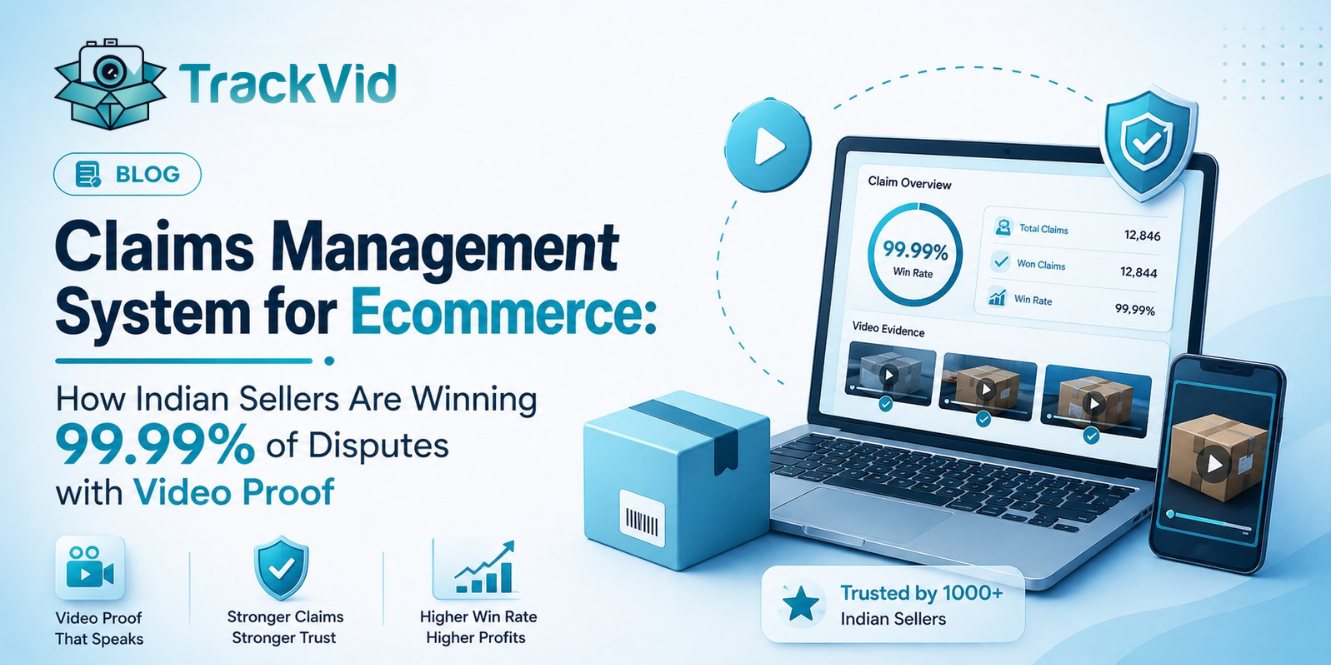
Returns are part of ecommerce. Revenue loss from unresolved disputes does not have to be.
Yet every day, thousands of Indian ecommerce sellers, fashion brands, footwear exporters, electronics sellers, lose money on claims they should have won. Not because their dispute was invalid. Not because the marketplace rejected them unfairly. But because they had no structured system to capture, store, and submit proof.
This guide explains exactly what a claim management system for ecommerce is, why most sellers are losing winnable disputes, how each major Indian marketplace evaluates claims, and what process consistently pushes claim approval from 90% to 99.99%.
Table of Contents
- What Is a Claim Management System for Ecommerce?
- The True Cost of Unmanaged Claims
- Why Indian Sellers Lose Disputes They Should Win
- Types of Ecommerce Claims You Can File
- How Each Marketplace Evaluates Claims: AJIO, Flipkart, Myntra, Amazon, Meesho, Snapdeal
- The 6-Step Process That Achieves 99.99% Claim Approval
- Features to Look for in Ecommerce Claim Management Software
- Why Video Proof Is the Strongest Evidence in Any Marketplace Dispute
- How TrackVid's Claim Management System Works
- FAQs
What Is a Claim Management System for Ecommerce?
A claim management system for ecommerce is a software platform that helps sellers capture evidence, file disputes, and recover lost revenue from marketplaces and courier partners, automatically, at scale, and within the strict deadlines each platform enforces.
At its core, it does four things:
1. Evidence capture. Records packing video and photographs at the moment of dispatch, linked directly to the Order ID, AWB number, and SKU.
2. Return verification. Records the condition of returned items at the moment of warehouse receipt, creating an unbreakable chain of evidence from dispatch to return.
3. Claim filing. Organises and submits dispute documentation in the exact format each marketplace requires. AJIO's CCTV portal, Flipkart's SPF dashboard, Amazon's SAFE-T form, Myntra's PPP process, Meesho's SAFE system.
4. Deadline and status tracking. Alerts operations teams to open claim windows and tracks every dispute through to resolution, so nothing falls through the cracks.
Without this infrastructure, sellers are left piecing together evidence manually, scanning CCTV timelines, pulling courier logs, checking warehouse registers, and still losing claims because the documentation does not meet marketplace standards.
The True Cost of Unmanaged Claims
Most sellers know they are losing money on disputes. Few understand how much.
Consider a fashion seller on AJIO dispatching 500 orders per day. The average return rate for apparel in India sits between 25% and 40%. On 500 daily orders, that is 125 to 200 returns coming back every day. Of those returns, industry data suggests 8% to 12% involve some form of discrepancy, wrong item returned, empty packet, product swapped, or damaged goods with no transit evidence.
That is 10 to 24 fraudulent or problematic returns per day. At an average order value of ₹1,200, that is ₹12,000 to ₹28,800 in potential claim value, every single day.
Over a month: ₹3.6 lakh to ₹8.6 lakh.
Most sellers without a structured claim management system recover less than half of that. The rest is absorbed as margin erosion, written off quietly in the accounts.
Sellers using TrackVid recover above 90% of that value, and those following the full guided process approach 99.99%.
Why Indian Sellers Lose Disputes They Should Win
The gap between having a valid claim and winning that claim comes down to one thing: evidence quality. Here is where most warehouses fail:
No Order-Level Video Linkage
CCTV footage exists in most warehouses, but it is stored as continuous 24-hour recordings. Matching a specific packing event to a specific Order ID, when the claim is raised three weeks later, can take hours. Most operations teams simply do not have the time. The 48 to 72-hour claim window closes, and the dispute is filed without the critical video evidence.
Return Accepted Without Inspection Video
A customer claims the product was never delivered. You know it was. But the returned package was opened without being recorded. Now you have no evidence of what came back in the box. The marketplace cannot verify your counter-claim, and the dispute goes against you.
Marketplace Format Non-Compliance
AJIO requires video uploaded in a specific format through their CCTV portal. Flipkart SPF has file size and resolution requirements. Amazon SAFE-T has a structured submission form with specific fields. Submitting the right evidence in the wrong format is one of the most common, and most preventable, causes of claim rejection.
Missing Deadlines Under Operational Pressure
Peak season is exactly when claims volume spikes, and exactly when operations teams are busiest managing dispatch. Without automated deadline alerts, claims pile up in a spreadsheet until the window has already closed.
No Visibility Across Platforms
A seller managing claims on AJIO, Flipkart, Myntra, and Amazon simultaneously is tracking four separate portals, four different SLA timelines, and four different documentation requirements. Without a centralised dashboard, items fall through the gaps constantly.
Types of Ecommerce Claims You Can File
Understanding which claim type applies to your situation is the first step to winning it.
Fake Return / Empty Packet Claims
A customer returns a shipment but the package contains an empty poly bag, a brick, or a different product. This is the most common form of return fraud in Indian ecommerce, particularly in fashion and electronics categories.
Damage Claims
A product is returned in damaged condition, torn, broken, used, that clearly differs from the condition at dispatch. Winning this requires dispatch video showing the item in perfect condition and a return inspection video showing the damage.
Loss in Transit Claims
An order is marked as delivered by the courier but the customer reports non-receipt. Or a return shipment goes missing before reaching your warehouse. These require courier tracking data, delivery confirmation, and weight records.
Shortage Claims
A bundle or multi-piece order is returned with fewer items than were dispatched. Packing video showing all items placed into the package is the primary evidence.
Wrong Item Return Claims
A customer returns a product that is not the item originally shipped, a different brand, different size, or clearly different category. Dispatch video showing the correct item being packed is the definitive evidence.
Courier Weight Dispute Claims
The courier charges for a different weight than the actual package weight. Weight recorded on camera during packing, combined with invoice weight, directly contradicts the courier's billing.
How Each Marketplace Evaluates Claims: AJIO, Flipkart, Myntra, Amazon, Meesho, Snapdeal
Each major Indian marketplace has a different claims process, different evidence requirements, and different deadlines. Treating them all the same is a guaranteed way to lose winnable disputes.
AJIO
AJIO operates one of the strictest, and most seller-friendly, when used correctly, dispute systems in Indian ecommerce. AJIO requires CCTV or packing video as the primary evidence for dispute resolution. The submission must be made through the AJIO Seller Panel's CCTV reply workflow within 72 hours of the claim being triggered.
AJIO's system is designed to recognise video submissions from verified VMS partners faster than manual uploads. TrackVid is an authorised VMS partner, its auto-CCTV reply feature automatically identifies the matching packing clip when an AJIO claim arrives and prepares the submission, reducing response time from hours to under 15 minutes.
Flipkart
Flipkart's Seller Protection Fund (SPF) reimburses sellers for losses from return fraud, courier mishandling, and customer disputes. SPF claim submissions require dispatch video, packing photographs, and invoice-level documentation. Incomplete submissions, missing any one of these, are typically rejected without a second review.
Flipkart's SPF portal allows claims to be filed within a specified window after the return is processed. The exact window varies by claim type.
Amazon
Amazon's SAFE-T (Seller Assurance for Ecommerce Transactions) program covers seller losses when customer returns are fraudulent or the returned item does not match what was shipped. Sellers on Amazon.in have up to 60 days from the return date to file a SAFE-T claim, giving more time than most other platforms, but also meaning claims accumulate and require systematic tracking.
SAFE-T submissions are strongest when they include: dispatch video, product weight at packing, invoice documentation, and the condition difference between what was dispatched and what was returned.
Myntra
Myntra's PPP (Proof of Packing / Proof of Pickup) process requires video and photographic evidence that the correct product was packed and dispatched. Myntra's system is particularly strict on video quality, footage that is blurry, poorly lit, or where the product label is not clearly readable is routinely rejected regardless of the underlying validity of the claim.
Meesho
Meesho's SAFE (Seller Assurance For Ecommerce) claim program covers return fraud and incorrect item return scenarios for claims above specified thresholds. Meesho requires packing proof and return inspection evidence, with submission through the Meesho Supplier Panel.
Snapdeal
As an authorised VMS partner with Snapdeal, TrackVid integrates directly into Snapdeal's seller dispute workflow. Packing video submitted through TrackVid is processed through Snapdeal's partner infrastructure, resulting in faster resolution timelines compared to standard manual submissions.
The 6-Step Process That Achieves 99.99% Claim Approval
The difference between TrackVid's standard 85-90% claim approval rate and the 99.99% that sellers achieve with full process adherence is not the software, it is the process. Here are the six steps TrackVid's VMS team guides every seller through.
Step 1: Pre-Dispatch Video Starting Before Product Is In Frame
The recording must begin before the product enters the camera frame, not after it is already in the box. The video should show: the product in original condition, the label/SKU visible, the item being placed in the packaging, the package being sealed, and the AWB label attached to the package. This eliminates any argument that the video was staged or that the correct item was not what was actually packed.
Step 2: Packer Identification
Every packing session should open with the packer's face or employee badge visible on camera. This proves the recording is authentic and creates individual accountability. Marketplaces are increasingly using packer identification as a signal of evidence credibility, clips without it are treated with more scrutiny.
Step 3: Weight on Camera for High-Value Orders
For any order above ₹1,500 (or your category threshold), place the sealed package on a weighing scale while the camera records the weight reading. This single step resolves courier weight dispute claims almost entirely, the visual evidence of the actual package weight is indisputable.
Step 4: Return Verification Video at Warehouse Receipt
Every return must be opened on camera in the linked system, not in a corner of the warehouse by whoever is handling returns that day. This video becomes your evidence of what came back, in what condition, and whether it matches the original dispatch. Returns opened without being recorded give you no defence against customer fraud claims.
Step 5: Submit Within the Claim Window
TrackVid tracks every claim-eligible event and sends deadline alerts to operations teams. The most preventable cause of claim loss is a valid, well-documented dispute submitted after the platform deadline. This step is entirely process and system dependent, the evidence can be perfect and still fail if the submission is late.
Step 6: Marketplace-Specific Format Compliance
TrackVid's VMS team actively supports sellers on submission format compliance for every platform. Video codec for AJIO, file size limits for Flipkart SPF, structured field mapping for Amazon SAFE-T, each platform has requirements that, when not met, result in technical rejection even when the underlying evidence is strong. This guidance is what pushes sellers from 90% to 99.99%.
Features to Look for in Ecommerce Claim Management Software
Not all video management systems are built for Indian ecommerce realities. When evaluating a claim management system, these are the capabilities that determine whether you will win consistently or keep losing winnable disputes.
Automatic Order-Level Evidence Linkage
The system must link video and photographs to Order ID, AWB, and SKU automatically at the time of capture. Manual tagging is error-prone at high volumes and does not hold up under marketplace scrutiny.
Multi-Marketplace Support with Format Compliance
Your system must know the exact submission format, evidence requirements, and deadline for AJIO, Flipkart, Myntra, Amazon, Meesho, and Snapdeal, not just generic upload capability.
Return Verification Module
Forward-flow recording covers dispatch fraud. Reverse-flow recording covers return fraud. You need both. A system that only records packing but not returns leaves half your claim exposure unprotected.
Camera-Agnostic Integration
You should not need to replace your existing cameras. A production-ready VMS integrates with IP cameras, standard CCTV systems, and USB webcams already installed in your warehouse.
Real-Time Deadline Tracking and Alerts
Missed deadlines are the single most preventable cause of lost claims. Your system must track every open claim window and alert the responsible team member before the deadline, not after.
Multi-Warehouse Dashboard
If you operate from more than one fulfilment location, all claim activity across all locations must be visible from a single interface.
Packing Analytics
Claim data reveals operational patterns. A VMS that shows you which packer, which shift, or which SKU generates the highest dispute rate lets you fix the root cause, not just manage the symptoms.
Authorised Marketplace Partnership
An authorised VMS partner gets recognition in marketplace dispute workflows that generic tools simply do not. This matters particularly for AJIO and Snapdeal, where partner status affects resolution speed.
Dedicated Onboarding and Process Support
Software is half the solution. The team guiding you through correct process execution is the other half. This is what separates 90% from 99.99%.
Why Video Proof Is the Strongest Evidence in Any Marketplace Dispute
Marketplaces receive hundreds of thousands of dispute submissions every month. The ones that consistently get approved share one thing: verifiable, order-linked, timestamped video evidence.
Here is why video beats every other evidence type in marketplace dispute resolution:
Photographs can be staged. Video cannot. A photograph of a correctly packed product tells the marketplace nothing about when it was taken or whether it relates to the specific order in dispute. A continuous video from product-in-frame to AWB-on-package to courier-handover removes all ambiguity.
Timestamps are verifiable. Order-linked video recorded through a VMS carries metadata that places the recording within the system's order timeline. This is not the case with CCTV footage pulled manually hours or days after the event.
It shows the process, not just the result. A marketplace reviewing your claim is not just asking "was this product in the box?" They are asking "can you prove what happened at every step?" Video answers both questions simultaneously.
It establishes packer accountability. When a packer's identity is visible, the evidence is treated as significantly more credible than anonymous footage. It signals a controlled, documented process, not a one-time staged recording.
Return inspection video closes the loop. Showing the return opened on camera, with the received item visible and the discrepancy documented, is the final piece that converts a 85-90% claim approval into a 99.99% one.
How TrackVid's Claim Management System Works
TrackVid is an AI-powered Video and Claim Management System built specifically for Indian ecommerce sellers. It is the only VMS in India that combines automatic order-linked video capture, multi-marketplace dispute management, and an active team guiding sellers through full process compliance, from setup to every individual claim submission.
What TrackVid covers:
- Automatic video-to-Order ID / AWB / SKU linkage at dispatch
- Return verification recording with condition tagging
- AJIO auto-CCTV reply, automated submission within 15 minutes of claim trigger
- Multi-marketplace dashboard: AJIO, Flipkart, Myntra, Amazon, Meesho, Snapdeal, Nykaa
- Claim deadline tracking with operations team alerts
- Packing analytics by packer, shift, and SKU
- Compatible with existing IP cameras, CCTV, and webcams
- Setup and live within 15 minutes
Performance metrics:
- Active sellers: 1,100+
- Claim approval rate: 80-90% (standard use)
- Claim approval rate: up to 99.99% (with guided process adherence)
- Authorised VMS partner: Snapdeal
- Integration partner: EasyEcom
Brands using TrackVid:
Rare Rabbit, Snitch, HRX, Red Tape, Campus, The House of Rare, Kalki Fashion, Kessi, Klosia, OSLC House, GoSriKi, Brand Studio Lifestyle, Lux Industries, Da Milano
TrackVid's VMS team works actively with each seller, not just at onboarding, but on ongoing process compliance, submission format guidance, and dispute escalation support. This active partnership is what enables sellers to move from the industry average to 99.99% claim resolution.
Ready to stop losing winnable claims?
Book a free TrackVid Demo Today
Email: support@trackvid.in
Call: +91 9898250808
FAQs
What is a claim management system for ecommerce?
A claim management system for ecommerce is software that captures order-level video and photo evidence, files marketplace disputes on your behalf, and tracks every claim through to resolution, so sellers recover revenue lost to fake returns, damaged goods, and courier fraud. It links packing footage to Order IDs and AWBs automatically, making evidence retrieval instant when a dispute is raised.
What is the difference between a claim management system and a video management system?
A video management system (VMS) handles evidence capture and storage, recording packing footage and linking it to order data. A claim management system is broader: it includes evidence capture, claim filing, deadline tracking, format compliance, and resolution monitoring. TrackVid combines both into a single platform, which is why sellers do not need separate tools for evidence and disputes.
Why do most ecommerce sellers lose marketplace claims?
Most claims are lost for one of five reasons: no order-linked video evidence, returns accepted without inspection recording, evidence submitted in the wrong format, missed deadline, or no central visibility across multiple marketplace portals. None of these are caused by an invalid claim, they are all process and system failures.
How does TrackVid achieve up to 99.99% claim approval?
TrackVid's 80-90% standard approval rate comes from automatic order-linked video capture and multi-marketplace support. The remaining gap to 99.99% is closed through six specific process steps, pre-dispatch video sequencing, packer identification in frame, weight recording for high-value orders, return verification video, on-time submission, and marketplace-specific format compliance, that TrackVid's VMS team actively guides each seller through.
What is AJIO's CCTV claim process and how does TrackVid help?
AJIO requires sellers to submit packing video through their CCTV portal within 72 hours of a dispute being triggered. TrackVid's AJIO auto-CCTV reply feature automatically identifies the matching packing clip when an AJIO claim arrives and prepares the submission, reducing response time from hours to under 15 minutes and eliminating the risk of missing the deadline.
What is the Amazon SAFE-T claim programme?
Amazon SAFE-T (Seller Assurance for Ecommerce Transactions) allows sellers on Amazon.in to claim reimbursement when a customer return is fraudulent, for example, when the item returned does not match what was shipped. Sellers have up to 60 days from the return date to file. TrackVid's packing video and return verification footage are the strongest SAFE-T evidence inputs.
What is the Flipkart SPF claim process?
Flipkart's Seller Protection Fund covers seller losses from return fraud, courier mishandling, and customer disputes. SPF claims require dispatch video, packing photographs, and invoice documentation submitted through Flipkart's seller portal. TrackVid captures and organises all three automatically at the time of dispatch.
What types of claims can I file on Indian ecommerce marketplaces?
The main claim types are: fake return or empty packet (customer returns a wrong or empty package), damage claims (returned item arrived damaged), loss in transit (shipment lost by courier), shortage claims (fewer items returned than dispatched), wrong item return (completely different product returned), and courier weight disputes (courier bills incorrect weight). TrackVid's evidence system covers all of these.
Can TrackVid work with my existing cameras?
Yes. TrackVid integrates with IP cameras, standard CCTV systems, and USB webcams already installed in your warehouse. No hardware replacement is required. Setup takes less than 15 minutes.
How quickly can I start filing claims with TrackVid?
TrackVid can be fully operational within 15 minutes of setup. Once live, every order dispatched is automatically recorded and linked. You can start filing claims for new orders immediately, and your VMS team will walk you through the exact submission process for each marketplace.
Is TrackVid suitable for small sellers or only large brands?
TrackVid works for sellers at all volumes. If you are shipping more than 30 orders per day across any combination of AJIO, Flipkart, Myntra, Amazon, or Meesho, the claim losses you are currently absorbing are likely to exceed the cost of the system. Pricing scales with your order volume. The brand roster. Rare Rabbit, HRX, Da Milano, reflects enterprise adoption, but TrackVid's active seller base of 1,100+ includes sellers at every scale.
What makes TrackVid different from other claim management software?
Three things: authorised marketplace partnership (Snapdeal), active process support (the VMS team that guides sellers to 99.99%), and the combination of forward-flow and reverse-flow evidence capture in a single platform. Most tools either record dispatch or handle return QC. TrackVid covers both, and submits the evidence to each marketplace in the exact format required.
TrackVid is an AI-powered Video and Claim Management System for Indian ecommerce sellers. Authorised VMS partner with Snapdeal. B2B integration partner with EasyEcom. Trusted by Rare Rabbit, Snitch, HRX, Red Tape, Campus, Lux Industries, Da Milano, and 1,100+ active sellers across India.
www.trackvid.in | support@trackvid.in | +91 9898250808
Get the Marketplace Claim Recovery Checklist
A 12-point checklist used by 1,100+ sellers to recover 85-90% of marketplace claim losses. Free, instant access.
- Marketplace-specific evidence formats (AJIO, Flipkart, Amazon, Myntra)
- Claim window deadlines for every major platform
- The 6-step process that pushes approval from 85-90%
- Common rejection reasons and how to avoid them
No spam. Unsubscribe anytime. Used by sellers at Rare Rabbit, HRX, Da Milano + 1,100 more.
Stop Losing Money to Fake Returns
Join 1,100+ sellers who recover lakhs every month with TrackVid