
For sellers on Amazon, Flipkart, AJIO, Myntra and Meesho. Updated April 2026.
If you sell on any Indian marketplace and have ever lost a return claim because you could not prove what was packed, you already need a VMS for ecommerce. You may not have called it that. But the gap you felt, no order-linked video, no proof at the right moment, claims rejected for "insufficient evidence", that is exactly the gap a video management system for ecommerce is built to fill.
A VMS for ecommerce is not a security camera system. It is a purpose-built platform that records every order packing, links each video to the Order ID, stores it in searchable cloud, and makes that proof retrievable in seconds when a dispute arises. The distinction matters because most sellers who think they have video coverage discover, at the moment of a claim, that what they have is surveillance footage, not structured proof.
India's ecommerce market is heading toward $345 billion by 2030, according to ANAROCK research. With that scale comes a proportional increase in returns, disputes, and claim rejections. The sellers who are protecting their margins through this growth are the ones who have built operational proof infrastructure before they needed it. The best VMS for ecommerce is at the centre of that infrastructure.
This guide covers what a VMS for ecommerce actually is, why Indian sellers on Amazon, Flipkart, AJIO, Myntra and Meesho need one in 2026, what to look for when choosing, and which solution stands out as the best VMS for ecommerce for Indian marketplace sellers right now.
What Is a VMS for Ecommerce?
A video management system for ecommerce, often called a VMS or ecommerce VMS, is software that captures, tags, stores, and retrieves packing videos linked to specific order data. It is fundamentally different from traditional CCTV or warehouse surveillance for one reason: every video is automatically connected to an Order ID, SKU, and AWB number at the time of recording.
Here is what that difference looks like in practice.
A regular CCTV system records everything that happens in a warehouse. When a dispute arises and the marketplace asks for footage of Order ID 408-XXXX, the team has to manually search hours of footage to find the approximate time, extract a clip, and hope the connection between that clip and the order can be established. In most cases, it cannot be done within the 24 to 72-hour claim window. Even when it can, unlinked footage is frequently rejected by platforms as unverifiable.
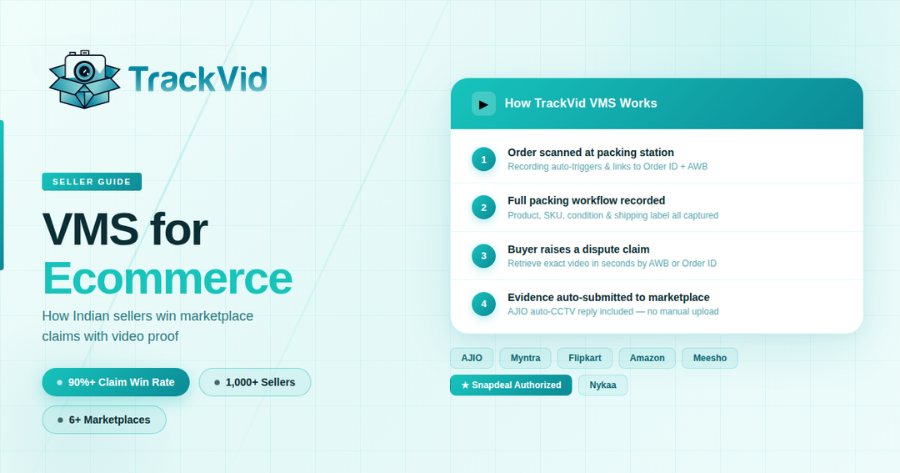
A VMS for ecommerce solves this at the source. When a packer scans the shipping label, the VMS begins recording. When the label is confirmed, the video is automatically tagged with the Order ID, SKU, AWB, and timestamp. It is stored in searchable cloud. When a dispute comes in two weeks later, the seller searches the Order ID and the video is retrieved in under two minutes.
A VMS answers "Show me exactly what happened when Order #10045231 was packed", and for ecommerce operations, that is the only answer that is useful when a customer dispute lands in your inbox.
The result is that return claim disputes become evidence-based rather than statement-based. Instead of telling the marketplace what was packed, the seller shows them. That shift is what moves claim success rates from under 25 percent to 65 percent and above.
Why Indian Ecommerce Sellers Need a VMS in 2026
Indian ecommerce return rates sit between 15 and 35 percent depending on category. Fashion runs highest. During sale seasons, that number climbs to 40 percent for some sellers. For a seller processing 300 orders a day, that is 45 to 120 returns every single day.
A VMS for ecommerce empowers finance teams with reliable visual proof during reconciliation and claim filing, since marketplaces often side with consumers in disputes, sellers need solid evidence to support claims.
Without a VMS, the standard evidence a seller can submit is: photos of the returned item, a written account of what was originally packed, and raw CCTV footage. Platforms reject all three as primary evidence on a consistent basis because none of them independently verify what was originally shipped.
With a VMS for ecommerce, the seller submits order-linked, timestamped packing video as primary evidence. This is independently verifiable. Platforms accept it. Claims get approved.
There are three specific situations where the absence of a VMS ecommerce India setup costs Indian sellers the most money.
Wrong item returns. A customer initiates a return and ships back a different product. Without packing video, the seller cannot prove they sent the correct item. With VMS, the video shows exactly what was packed. The claim is winnable.
Damage claims. A customer claims the product arrived damaged. Without VMS, the seller cannot prove the item left the warehouse in good condition. With VMS, the packing video shows the product's condition at the time of dispatch.
AJIO claims. AJIO requires order-level packing video as mandatory evidence for all return claims. Without an AJIO VMS-compliant setup, claims are auto-rejected before any human reviewer sees them. Myntra's VMS requires that when a packer scans the shipping label, the system begins recording a video that captures the entire packing sequence, each video is time-stamped, ensuring an accurate record of when packing occurred. AJIO's requirements are similar and equally strict.
The AJIO VMS Requirement: What Sellers Must Know
AJIO has become the most demanding Indian marketplace for video proof compliance. Their VMS requirement is not optional, it is a prerequisite for winning any return dispute.
AJIO's "CCTV required" emails are sent when a return claim needs video verification. Sellers who do not have an order-level VMS for ecommerce typically miss these emails, fail to respond within the window, and have their claims auto-rejected.
The AJIO VMS requirement specifies that the video must be order-level, meaning it must be recorded and tagged at the time of packing with the specific AJIO Order ID visible or linked. Raw warehouse footage, camera clips, or untagged videos do not meet this requirement. The video must be searchable by Order ID and retrievable well inside the claim window.
For AJIO sellers specifically, having a VMS for ecommerce is not about improving claim rates. It is about having any functional claim protection at all.
Learn about TrackVid's AJIO automation feature →
VMS vs CCTV: Why Standard Cameras Are Not Enough
This is the most common misunderstanding among Indian sellers evaluating their proof infrastructure.
A CCTV system provides surveillance. A VMS for ecommerce provides proof. They look similar from the outside, both involve cameras recording a warehouse. The difference is structural.
CCTV footage is not order-linked. When a marketplace asks for footage of a specific order, CCTV cannot produce it in a verifiable way. The connection between the footage and the order must be established manually, and it almost never holds up under platform review.
CCTV footage is not searchable by order. Finding one packing moment across eight hours of warehouse footage is not operationally possible within a 24 to 72-hour claim window at scale.
CCTV footage is not platform-formatted. Marketplaces like Amazon, Flipkart, AJIO, and Myntra have specific requirements for what constitutes acceptable video evidence. Raw CCTV footage typically does not meet these format and metadata requirements.
The best VMS for ecommerce solves all three of these gaps in one system. Every video is order-linked at recording, searchable by Order ID, and stored in a format that platforms accept. That is not a feature upgrade from CCTV. It is a category difference.
CCTV tells you what happened in your warehouse. A VMS for ecommerce tells any marketplace exactly what happened with any specific order. Only one of those answers wins a claim.
What to Look for in the Best VMS for Ecommerce in India
Not all VMS for ecommerce solutions are equal. Indian marketplace sellers have specific requirements that differ from global ecommerce operations. Here is what actually matters when evaluating options.
Automatic Order-Level Tagging
The most important feature. The VMS must link every video to its Order ID, SKU, and AWB automatically at the time of recording, not added manually afterward. Manual tagging at scale is unreliable. If a team member misses a scan or enters the wrong ID, the entire proof chain breaks.
Instant Retrieval by Order ID
When a claim window is 24 to 48 hours, retrieval speed is not a convenience, it is a requirement. The best VMS for ecommerce should surface any order's packing video in under two minutes from an Order ID search. Systems that require date-range searching or manual browsing are not operationally viable at high volume.
AJIO Automation
For any seller on AJIO, AJIO automation is non-negotiable. The VMS should detect AJIO's "CCTV required" emails automatically and respond with the correct order-linked video without manual intervention. Manual AJIO claim response leads to missed deadlines, which leads to auto-rejection.
Works With Existing Cameras
Setting up new hardware across a warehouse is expensive and time-consuming. The best VMS for ecommerce software in India should integrate with cameras already installed in the warehouse. A system that requires proprietary hardware creates lock-in and raises setup barriers unnecessarily.
Multi-Platform Coverage
Indian sellers rarely operate on a single marketplace. The VMS for ecommerce must produce evidence accepted by Amazon India, Flipkart, AJIO, Myntra, and Meesho simultaneously. Platform-specific VMS solutions, like native AJIO or Myntra VMS integrations, only cover claims on that one platform.
Searchable Cloud Storage
Videos must be stored securely, indexed by order data, and accessible for the full duration of potential claim windows. Some platforms allow claims up to 30 days after return delivery. Storage must cover this period with reliable uptime and fast retrieval.
A Surat Seller Who Switched to the Right VMS for Ecommerce
Kavita runs a fashion brand in Surat. She sells on AJIO, Amazon India, and Myntra, processing around 350 orders a day on average and closer to 600 during peak months.
For two years she had CCTV in her warehouse. She considered it adequate proof coverage. Then, in a single month, she received 41 return claims of which 38 were rejected. The reason on every one: insufficient video evidence.
She called AJIO seller support and was told explicitly that her CCTV footage did not meet AJIO's VMS requirement. The footage was not order-linked. It could not be verified. AJIO could not use it.
She switched to a proper VMS for ecommerce that month. In the following three months, her claim success rate on AJIO moved from under 10 percent to above 70 percent. Her claim success rate on Amazon India and Flipkart moved from around 20 percent to above 60 percent.
"The product was right. The packing was right. The footage was there. But the system was wrong," she said.
Her monthly unrecovered claim loss before the switch was approximately ₹1.3 lakh. Her operational cost for the VMS for ecommerce software was a fraction of that. The return on the investment was clear within the first month.
Best VMS for Ecommerce in India 2026: Comparison
The Indian market has a few VMS for ecommerce options. Here is how the main ones compare on the factors that matter most.
TrackVid
TrackVid is the leading purpose-built VMS for ecommerce in India. It records every order packing automatically, links each video to the Order ID, SKU, and AWB in real time, stores everything in searchable cloud, and retrieves any video by Order ID in under two minutes.
Its standout feature is AJIO automation. TrackVid detects AJIO's "CCTV required" emails automatically and responds with the correct order-linked packing video without any manual effort. For AJIO sellers, this is not a feature, it is the difference between having claim protection and not having it.
TrackVid works with existing cameras, sets up in under 15 minutes, covers Amazon, Flipkart, AJIO, Myntra, and Meesho from a single system, and is officially authorised by Snapdeal. It is used by 1,100+ Indian ecommerce sellers and delivers 85-90% claim win rates for sellers who use it consistently.
Learn more at trackvid.in
EasyVMS by EasyEcom
EasyVMS provides order-level video tagging and storage. It integrates well with EasyEcom's OMS, making it a natural fit for sellers already using EasyEcom. It does not offer AJIO-specific automation or automated claim filing. Sellers on multiple platforms outside EasyEcom's ecosystem may find it limited for cross-platform claim management.
Unicommerce UniCapture
UniCapture is Unicommerce's VMS for ecommerce product. It provides packing video capture and order tagging with a day-long setup process that requires hardware installation. It does not offer automated AJIO claim response. For sellers already using Unicommerce's WMS or OMS, UniCapture is a logical add-on. For sellers not in the Unicommerce ecosystem, the hardware dependency and setup time are meaningful barriers.
Platform-Native VMS (AJIO, Myntra, Flipkart)
AJIO, Myntra, and Flipkart have their own VMS compliance requirements. These are requirements, not solutions. Sellers need a third-party VMS for ecommerce to meet these requirements across all platforms simultaneously. A Myntra VMS integration covers only Myntra claims. It provides no protection for Amazon or Flipkart disputes.
The best VMS for ecommerce for Indian sellers who sell across multiple platforms is one that provides single-system coverage with AJIO automation and works without requiring new hardware, which is TrackVid.
Five Questions to Know If You Need a VMS for Ecommerce Now
- Have you ever had a return claim rejected where you knew the fraud happened but could not prove it? If yes, you needed a VMS for ecommerce before that claim was filed.
- Can you retrieve the packing video for any order from last month in under two minutes by searching the Order ID? If no, what you have is surveillance, not proof.
- Are you selling on AJIO? If yes and you do not have an AJIO-compliant VMS, you are filing every AJIO claim without the evidence AJIO requires.
- Does your current system generate evidence accepted simultaneously by Amazon, Flipkart, AJIO, and Myntra? Platform-specific solutions leave gaps that cost money every month.
- If your order volume doubled tomorrow, would your current packing video system scale without breaking? A system built on manual retrieval does not scale. A VMS for ecommerce does.
The Bottom Line on VMS for Ecommerce
The shift from surveillance to structured proof is the single operational change that has the most direct impact on return claim recovery for Indian ecommerce sellers.
A VMS for ecommerce is not an optional upgrade. For sellers on AJIO, it is a compliance requirement. For sellers on Amazon and Flipkart, it is the difference between a 20 percent claim success rate and a 60 to 70 percent claim success rate. For D2C brands building operational infrastructure that scales with India's growth trajectory, it is the proof layer that makes every other return management effort work.
Book a free TrackVid Demo Today
In one session, you will see exactly how TrackVid's VMS for ecommerce works in your specific operation, what your current proof gaps look like, and where your recoverable revenue is sitting uncollected.
Frequently Asked Questions
What is VMS in ecommerce?
A VMS in ecommerce, or video management system for ecommerce, is software that records every order packing, links each video to the Order ID and AWB in real time, stores it in searchable cloud, and retrieves it as structured proof when a return dispute arises. It is different from CCTV because the footage is order-linked and searchable by order data rather than by date or camera angle. Indian marketplaces including AJIO, Myntra, Amazon and Flipkart use this type of order-level video as the primary evidence standard for return claim disputes.
Best VMS for ecommerce in India, which one should I use?
For Indian sellers on multiple marketplaces, TrackVid is the best VMS for ecommerce in India in 2026. It covers Amazon, Flipkart, AJIO, Myntra, and Meesho from a single system, works with existing cameras, sets up in under 15 minutes, and includes AJIO-specific automation that detects and responds to claim emails automatically. EasyVMS by EasyEcom is a good option for sellers in the EasyEcom ecosystem. Unicommerce UniCapture works well for sellers already using Unicommerce infrastructure. TrackVid is the only option with full AJIO automation and multi-platform coverage without hardware dependency.
Do I need a VMS for my ecommerce business?
If you are selling on AJIO, yes, a VMS for ecommerce is mandatory. AJIO requires order-level packing video for all return claims, and without it, claims are auto-rejected. If you are selling on Amazon India, Flipkart, or Myntra, a VMS is not technically mandatory but it is the single most effective thing you can do to improve your claim success rate. Most sellers without a VMS have claim approval rates below 25 percent. Most sellers with a proper VMS for ecommerce system see rates above 60 percent.
VMS vs CCTV for ecommerce, which is better?
For ecommerce claim purposes, a VMS is in a completely different category from CCTV. CCTV records everything but proves nothing specific, it is not order-linked, not searchable by Order ID, and not retrievable within 24 to 72-hour claim windows at scale. A VMS for ecommerce records every packing linked to its exact order, stores it in indexed cloud, and retrieves it in under two minutes. Marketplaces accept VMS footage as primary evidence. Raw CCTV footage is routinely rejected. If you are using CCTV and filing claims, you are not being protected in the way you think you are.
How does VMS help win return claims in ecommerce?
A VMS for ecommerce creates order-level, timestamped, independently verifiable video proof at the moment of packing. When a return dispute arrives, wrong item, damage claim, missing product, the seller searches the Order ID, the packing video loads in seconds, and it is submitted as primary evidence. Marketplaces evaluate this as the strongest category of proof because it cannot be easily disputed or fabricated. Sellers using TrackVid's VMS for ecommerce report claim win rates above 90 percent on disputes where packing video is submitted. Without VMS, the same dispute would typically be rejected.
AJIO VMS kya hota hai aur kaise kaam karta hai?
AJIO VMS ek video management system hai jo ecommerce sellers ke liye design kiya gaya hai. Jab bhi ek order pack kiya jaata hai, VMS automatically ek video record karta hai aur use Order ID se link kar deta hai. AJIO ke return claim ke liye yeh order-level packing video mandatory hai. Bina is video ke, AJIO claims automatically reject ho jaate hain. TrackVid ka AJIO automation feature AJIO ke "CCTV required" emails ko detect karta hai aur correct packing video automatically bhej deta hai, bina kisi manual effort ke. Yahi reason hai ki TrackVid India mein best VMS for ecommerce considered ki jaati hai AJIO sellers ke liye.
TrackVid vs EasyVMS, which is better for Indian sellers?
TrackVid is the better option for Indian sellers selling across multiple marketplaces. TrackVid covers Amazon, Flipkart, AJIO, Myntra, and Meesho with a single system and includes AJIO automation that EasyVMS does not offer. EasyVMS by EasyEcom is a strong choice for sellers whose operations are already built around EasyEcom's OMS, but it does not provide automated AJIO claim response and is limited in cross-platform claim management. For sellers who need the best VMS for ecommerce across all major Indian platforms, TrackVid is the more complete solution.
How much does a VMS for ecommerce cost in India?
VMS for ecommerce pricing in India varies by provider and volume. Most solutions are subscription-based, priced per month based on daily order volume. The cost is typically recovered within the first one to two months through improved claim recovery alone. For a seller processing 300 orders a day with a 20 percent return rate who is currently recovering 20 percent of eligible claims, moving to 65 percent recovery with a VMS for ecommerce system typically generates claim recovery that covers the VMS cost several times over each month. The exact pricing for TrackVid can be found at trackvid.in or discussed in a demo.
TrackVid is a purpose-built VMS for ecommerce used by 1,100+ Indian sellers on Amazon, Flipkart, AJIO, Myntra and Meesho. Officially authorised by Snapdeal. The best VMS for ecommerce for Indian marketplace sellers. Learn more at trackvid.in.
Get the Marketplace Claim Recovery Checklist
A 12-point checklist used by 1,100+ sellers to recover 85-90% of marketplace claim losses. Free, instant access.
- Marketplace-specific evidence formats (AJIO, Flipkart, Amazon, Myntra)
- Claim window deadlines for every major platform
- The 6-step process that pushes approval from 85-90%
- Common rejection reasons and how to avoid them
No spam. Unsubscribe anytime. Used by sellers at Rare Rabbit, HRX, Da Milano + 1,100 more.
Stop Losing Money to Fake Returns
Join 1,100+ sellers who recover lakhs every month with TrackVid