
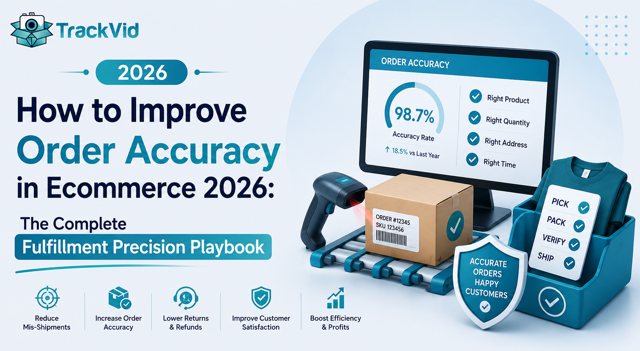
For D2C brand founders, ecommerce operations managers, warehouse teams, and fulfillment leads. Updated August 2026.
Direct Answer
To improve order accuracy in ecommerce, measure your baseline using the formula (error-free orders divided by total orders times 100) with weekly tracking against category benchmark (96-98 percent average, 99+ percent best-in-class), optimize warehouse slotting with ABC placement and golden zone positioning for fast movers, deploy barcode or RF scanning validation at every pick and pack station to catch errors in real time, capture Order ID-linked dispatch video with weight verification as the evidence trail, and run weekly root-cause analysis on every error to prevent recurrence. Brands running this framework move accuracy from 96 percent to 99+ percent within 90 days and eliminate wrong-item dispute losses entirely through defensible dispatch evidence.
The Problem: A 2 Percent Error Rate Feels Small But Compounds Into Meaningful Loss
Most ecommerce fulfillment operations run at 96-98 percent order accuracy, which sounds acceptable until you translate the numbers into daily impact. At 500 orders per day and a 2 percent error rate, you ship approximately 10 wrong parcels every day. Each error triggers return shipping cost, restocking labor, replacement dispatch, customer support time, and potential brand damage. 81 percent of shoppers report they will stop buying after multiple order mistakes, which means the compounding cost extends far beyond the immediate reshipment expense into lifetime value destruction that never appears on any single invoice.
The response most brands try first is to blame individual warehouse staff and demand harder work. This approach fails predictably. Picking errors are almost never a motivation problem; they are a system problem. Bad slotting means pickers travel long distances and confuse similar SKUs. Missing scanning validation means human misreads never get caught. No dispatch evidence means when the customer claims "wrong item," you cannot prove you actually shipped correctly. Adding accountability pressure to a broken system produces stress without accuracy improvement.
The right response is to fix order accuracy as a system through the 5-step framework covered below. Structural fixes at slotting, scanning, verification, evidence capture, and root-cause analysis compound with each other. Brands running the complete framework consistently move from 96-98 percent baseline to 99+ percent best-in-class accuracy within 90 days, cut wrong-item returns 70-85 percent, and eliminate a specific category of loss most brands never measure: fraudulent "wrong item" claims from customers who received the correct product but disputed it anyway.
Across the TrackVid platform of 1,100+ ecommerce sellers, we consistently observe that brands deploying barcode scanning validation combined with Order ID-linked dispatch video evidence experience two accuracy improvements simultaneously. First, the scanning catches real errors at pack station before they ship. Second, the dispatch video defends against fraudulent claims when customers claim "wrong item" on orders that were verifiably packed correctly. Combined effect is why brands running the full stack see order accuracy metrics improve AND dispute-related losses decline in the same 90-day window.
Order accuracy is a system, not a person. Fix the system and the accuracy follows.
What Is Order Accuracy in Ecommerce?
Order accuracy is the percentage of ecommerce orders shipped to customers without any error in what was picked, packed, and delivered relative to what was ordered. It measures the reliability of the entire fulfillment sequence from order receipt to customer delivery.
Order accuracy formula:
Order Accuracy = (Error-Free Orders ÷ Total Orders) × 100
Example: if 5,000 orders shipped in a month and 4,850 arrived correctly with no errors, order accuracy is 97 percent.
What counts as an error:
- Wrong item shipped (SKU mismatch)
- Wrong quantity (fewer or more units than ordered)
- Missing item from multi-item order
- Damaged item that should not have shipped
- Wrong shipping address that could have been caught at pack
- Wrong customization (color, size, engraving)
- Missing accessory or bundled item
Pick accuracy vs order accuracy distinction:
- Pick accuracy measures correctness at the picking stage only (right item pulled from shelf)
- Order accuracy measures the whole fulfillment sequence including picking, packing, labeling, and shipping
A flawless pick can still become an inaccurate order if it ships to the wrong address, gets packed with the wrong quantity, or arrives damaged due to poor packing. Track both metrics side by side; they diagnose different problems.
What Is a Good Order Accuracy Rate?
Understanding benchmark performance tells you where the opportunity sits.
| Performance Tier | Accuracy Rate | Errors per 10,000 Orders |
|---|---|---|
| Warning Level | Below 96% | 400+ errors |
| Industry Average | 96-98% | 200-400 errors |
| Above Average | 98-99% | 100-200 errors |
| Best-in-Class | 99-99.5% | 50-100 errors |
| World-Class (fully automated) | 99.5-99.9% | 10-50 errors |
- Fashion & Apparel: 96-98 percent (size and color complexity)
- Beauty: 97-99 percent (SKU similarity risk)
- Electronics: 97-99 percent (bundled accessories complexity)
- Consumables: 98-99 percent (SKU uniformity helps)
- Books/Media: 99+ percent (barcode-native workflow)
- Multi-SKU bundles: 94-96 percent (highest error rate)
If your accuracy sits at industry average (96-98 percent), a structured improvement program typically moves you to 99+ percent within 60-90 days. Below 96 percent indicates systemic problems that require Steps 1-5 in sequence rather than tactical fixes.
Why Does Order Accuracy Matter Beyond Reshipping Costs?
The direct cost of a wrong shipment is often just 20-30 percent of the total cost. The larger cost is customer trust destruction.
Direct costs:
- Reverse shipping charge (₹100-250 depending on zone)
- Warehouse handling on receipt
- Restocking or write-off labor
- Replacement dispatch cost
- Additional customer support time (15-30 minutes per case)
Indirect costs:
- Customer trust damage (81 percent stop buying after multiple mistakes)
- Negative review probability (35-50 percent of accuracy failures generate 1-2 star reviews)
- Support ticket cascade (customer contacts support 2-4 times during resolution)
- Return processing overhead
- Refund processing if customer opts out rather than accepting replacement
Compound costs:
- Repeat purchase rate destruction (customers experiencing accuracy failures show 45-60 percent lower RPR)
- Referral loss
- Marketplace rating damage (Amazon, Flipkart, Myntra ratings drop with error patterns)
- Competitive positioning loss
The full cost of a single wrong shipment often exceeds ₹1,500-3,000 when compound costs are counted, versus the ₹300-500 direct reshipment cost most operations track. Understanding the full cost is what justifies structural investment in accuracy improvement rather than accepting the "2 percent error rate is fine" mindset.
The 5-Step Framework to Improve Order Accuracy
Step 1: Measure Your Baseline Order Accuracy Correctly
You cannot improve what you cannot measure precisely. Start with clean baseline data.
Measurement setup:
- Weekly tracking of order accuracy rate at the operation level
- Daily tracking during improvement initiatives
- Error categorization by type: wrong SKU, wrong quantity, missing item, damaged, wrong address, wrong customization
- Root cause coding for every error: picking stage, packing stage, labeling stage, shipping stage
- Cost tracking per error using full-cost model
Measurement tools:
- WMS with accuracy tracking (Fishbowl, NetSuite WMS, Shipbob WMS, EasyEcom, Unicommerce)
- Helpdesk categorization of accuracy-related tickets
- Return data cross-referenced against picking data
- Customer complaint categorization
- Warehouse team error self-reporting
Baseline calculation window: measure 90 days of historical data to establish stable baseline. Shorter windows produce noisy numbers that mislead improvement decisions.
Dashboard visibility: publish accuracy metrics weekly to warehouse team, operations leadership, and executive team. Visibility drives accountability, which drives investment in the structural fixes below.
Step 2: Optimize Warehouse Slotting With ABC Placement
Bad slotting is the largest single source of picking errors that scanning cannot fully catch. Confusing layouts produce picker fatigue and SKU confusion.
ABC slotting principles:
- A items (top 20 percent of SKUs, 60-80 percent of order volume): placed in the golden zone (waist to shoulder height), closest to packing stations, along the most-traveled aisle
- B items (next 30 percent of SKUs, 15-25 percent of order volume): medium accessibility, secondary aisles
- C items (bottom 50 percent of SKUs, 5-15 percent of order volume): furthest from packing, upper and lower shelves acceptable
Golden zone insight: picks performed between waist and shoulder height show 30-45 percent lower error rates than picks requiring bending or reaching overhead. Fast-mover placement in golden zone is the single highest-return slotting decision.
SKU differentiation:
- Similar-looking SKUs never adjacent (different sizes, colors, or variants placed with visible separation)
- Color-coded shelf labels for SKUs with common confusion patterns
- Bin dividers for small items to prevent cross-contamination
Pick path optimization:
- Zone picking for small operations
- Batch picking for medium operations
- Wave picking for large operations
Impact: structured slotting typically reduces picking errors 30-45 percent within 30 days and reduces picker travel time 20-30 percent as a bonus.
Step 3: Deploy Barcode or RF Scanning Validation at Every Station
The single most powerful accuracy tool available. Barcode scanning at pick and pack stations catches errors in real time before they ship.
Required scanning infrastructure:
- RF scanner or barcode gun at every picking station
- Pack station scanner with weight verification integration
- Real-time WMS integration validating scanned SKU against order line item
- Error interrupt stopping the pack workflow when scan mismatches order data
- Manager alert on repeated errors from same picker or SKU
Scanning workflow:
- Picker scans SKU as it is pulled from shelf
- WMS validates SKU against order line item
- If mismatch, error prompts picker to re-verify and correct
- Correct pick moves to pack station
- Pack station scans SKU again as final verification
- Weight verification confirms correct SKU by expected weight
- Order ships with confidence
Impact metrics:
- Barcode scanning at picking stage reduces picking errors 60-75 percent
- Pack station verification catches remaining 80-90 percent of picking errors that slipped through
- Weight verification catches quantity errors and wrong-SKU errors when weights differ meaningfully
- Combined stack reduces total shipping errors 85-95 percent versus manual paper-based picking
Cost consideration: entry-level RF scanning infrastructure runs ₹1-3 lakh for a small warehouse and pays back within 60-90 days through avoided error costs.
Legacy paper-based picking should be phased out entirely by any operation above 100 orders per day. The error rate difference (2-3 percent paper versus 0.5-1 percent scanned) alone justifies the technology investment.
Step 4: Capture Order ID-Linked Dispatch Video for Evidence Trail
This is where TrackVid becomes decisive. Even with best-in-class picking and scanning, some category of accuracy dispute survives: customer claims wrong item was received when the correct item was verifiably shipped. Without dispatch evidence, these disputes default against you. With Order ID-linked dispatch video, they resolve in your favor at 85-90 percent win rate.
Dispatch video capture requirements:
- Order ID-linked video at pack station showing the specific product going into the specific parcel
- Weight verification captured in the same frame
- Tamper-evident seal applied and shown on video
- SKU visible during packing so post-dispute review can verify what shipped
- Retrievable in under 2 minutes for support team response to disputes
Legitimate accuracy failure: picker or packer sent wrong item. Dispatch video shows the wrong item being packed, enabling root cause analysis. Refund processed with clear internal accountability.
Fraudulent "wrong item" claim: customer received correct item but disputes it. Dispatch video shows correct item being packed. Dispute defended at 85-90 percent win rate.
Confused customer claim: customer received correct item but genuinely thought it was wrong (variant confusion, size expectation mismatch). Dispatch video enables clear explanation with visual proof, resolving without escalation.
Damage-in-transit claim: customer received damaged item and disputes whether it shipped damaged. Dispatch video shows condition at pack station. Damage liability moves to carrier appropriately.
Marketplace dispute defense: Amazon, Flipkart, Myntra dispute teams receive dispatch evidence proving correct dispatch. Claim approval rates for merchants with dispatch evidence reach 84 percent versus 27 percent for merchants without evidence.
For related dispute defense workflows, see our Fake COD Order Detection Playbook and Customer Risk Scoring Playbook at trackvid.in for the customer profiles most likely to generate fake accuracy disputes.
Step 5: Run Weekly Root-Cause Analysis on Every Error
The final step converts one-time error correction into structural accuracy improvement. Without root-cause discipline, the same errors repeat indefinitely.
Weekly root-cause review workflow:
- List every accuracy error from the previous week
- Categorize by root cause: picker misread SKU, similar SKUs adjacent, missing scan step, weight verification skipped, incorrect order data at input, vendor concealed shortage at receiving, packing team accidentally combined orders
- Identify patterns: same picker producing multiple errors (training issue), same SKU pair producing errors (slotting fix), same pack station producing errors (equipment or process issue), same time-of-day producing errors (staffing or fatigue issue)
- Assign structural fix for each identified pattern
- Track fix implementation and monitor accuracy impact 30-60 days later
Common root causes and structural fixes:
- Similar-SKU adjacency: re-slot to add physical separation
- Fast-mover misplacement: move to golden zone
- Repeated picker errors: additional training or ergonomic assessment
- Time-of-day pattern: shift schedule review, break placement optimization
- Multi-item bundle errors: dedicated bundle pack station with checklist
- Vendor concealed shortage: implement receiving inspection protocol
- Software mapping errors: WMS configuration review
Weekly review cadence: operations lead plus warehouse lead plus support lead review accuracy errors every Monday morning. 30-minute standing meeting. Track quarterly accuracy trend against baseline.
The 30-60 day payback: structural fixes identified through root-cause analysis show measurable accuracy impact within 30 days and full impact within 60 days.
Case Study: D2C Brand, Order Accuracy 96.2% to 99.4% in 90 Days
A men's fashion and accessories D2C brand on the TrackVid platform started 2026 with 96.2 percent order accuracy across 800 daily orders. Their error breakdown: 42 percent wrong SKU (picker error), 24 percent wrong quantity (bundle picking issues), 18 percent wrong size or color variant (similar-SKU confusion), 12 percent missing item, 4 percent other. Monthly accuracy-related cost including compound effects: ₹8.4 lakh.
Days 1-14: Order accuracy audit and measurement infrastructure. Categorized 90 days of historical errors by root cause. Discovered 68 percent of errors concentrated in 12 SKU pairs with adjacent slotting or similar variants. Set up weekly accuracy dashboard visible to warehouse team.
Days 15-30: Slotting optimization. Re-slotted 12 problematic SKU pairs with physical separation. Moved 30 fast-movers into golden zone. Added color-coded shelf labels for common confusion patterns. Deployed bin dividers for small items.
Days 31-60: Barcode scanning validation deployment. RF scanner at every picking station with WMS integration. Pack station scanner with weight verification. Error interrupt workflow preventing mis-picks from moving to pack. Manager alerts on repeated errors.
Days 61-90: Order ID-linked dispatch video via TrackVid deployed on every packing station without workflow changes. Weight verification captured in frame. Tamper-evident seal shown on video. Support team trained to retrieve dispatch evidence in under 2 minutes. Weekly root-cause review discipline established.
Results at day 90:
- Order accuracy rate: 96.2 percent to 99.4 percent (error rate down from 3.8 percent to 0.6 percent)
- Wrong SKU errors: down 82 percent (slotting plus scanning combined)
- Wrong quantity errors: down 71 percent (scanning plus weight verification)
- Similar-SKU variant errors: down 89 percent (slotting fixes)
- Missing item errors: down 78 percent (pack station verification)
- Fraudulent "wrong item" disputes won: 92 percent versus prior 34 percent
- Support tickets from accuracy issues: down 68 percent
- Monthly accuracy-related cost: ₹8.4 lakh to ₹1.7 lakh (down 80 percent)
- Annualized savings: ₹80 lakh
- Customer NPS score: 41 to 58 (up 17 points)
- Repeat purchase rate among accuracy-affected customers: up 34 percent
The single largest contribution came from Step 3 (barcode scanning) plus Step 4 (dispatch evidence) combined, accounting for approximately 70 percent of the total error reduction.
See how dispatch evidence integrates with your existing WMS and pack station workflow to defend against wrong-item disputes. 30 minutes. No commitment.
How Does Barcode Scanning Improve Order Accuracy?
Barcode scanning is the single most impactful accuracy technology available to ecommerce warehouses.
The 4-stage scanning workflow:
Stage 1 - Order release scan. Scanner confirms picker has the correct pick list for the specific order.
Stage 2 - Pick verification scan. Picker scans the SKU as it is pulled from shelf. WMS validates against the order line item. Mismatch triggers immediate correction prompt.
Stage 3 - Pack station verification scan. Second scan at pack station catches any picking-stage errors that slipped through. Redundancy is intentional.
Stage 4 - Shipping label scan. Final scan pairs the correct parcel with the correct shipping label, preventing address swaps between orders.
Impact per stage:
- Stage 2 alone reduces picking errors 60-75 percent versus manual paper-based picking
- Stage 3 catches 80-90 percent of remaining errors
- Stage 4 eliminates address-swap errors almost entirely
- Combined stack achieves 99+ percent accuracy on well-slotted warehouse
Weight verification complement: integrated weight scale at pack station catches quantity errors and wrong-SKU errors when weights differ meaningfully. A single unit of a 400g product weighing 800g at pack indicates likely double-pick.
Common scanning implementation mistakes:
- Scanner deployed at pack only, missing picking-stage catch
- No error interrupt, allowing packers to override scan mismatch
- No weight verification companion
- Insufficient training on scanning discipline
- Legacy paper picking retained "as backup" undermining scanning discipline
For the complete workflow integrating dispatch evidence with scanning validation, see our Post-Purchase Experience Playbook at trackvid.in.
How to Prevent Fraudulent "Wrong Item" Claims
A meaningful percentage of "wrong item" disputes are fraudulent claims from customers who received the correct product but claim otherwise. Distinguishing fraud from legitimate errors requires evidence.
The fraudulent claim pattern:
- Customer receives correct order
- Customer decides to keep the item but wants refund
- Customer claims "wrong item received" via support ticket, marketplace dispute, or chargeback
- Without dispatch evidence, merchant refunds to preserve customer relationship
- Fraud repeats across brands and platforms
Detection through dispatch evidence:
- Video shows the correct item being packed with SKU visible
- Weight verification shows expected weight for the correct SKU
- Tamper-evident seal confirms the parcel was properly sealed at dispatch
- Order ID linkage proves the video corresponds to this specific order
Dispute defense workflow:
- Customer files "wrong item" claim
- Support team retrieves dispatch evidence in under 2 minutes
- Video shared with customer through support channel showing correct dispatch
- Legitimate confusion resolves at first contact
- Fraudulent claims withdraw when evidence is presented
- Marketplace disputes submitted with dispatch evidence attached win at 84 percent rate versus 27 percent without
For pattern-level fraud detection tied to specific customer profiles, see our Customer Risk Scoring Playbook at trackvid.in.
The combined effect: brands with dispatch evidence infrastructure see fraudulent "wrong item" claims drop 60-80 percent within 60 days.
Where TrackVid Fits in Your Order Accuracy Stack
Steps 1-3 need standard warehouse infrastructure (WMS platform like EasyEcom, Unicommerce, Shipbob, NetSuite, Fishbowl; RF scanners; pack station equipment). Step 4 (dispatch evidence layer) and Step 5 (root-cause analysis on wrong-item disputes) are where TrackVid becomes decisive.
TrackVid is a video proof and claim management platform used by 1,100+ ecommerce sellers on Shopify, WooCommerce, Amazon, Flipkart, Myntra, AJIO, Nykaa, Meesho, and Snapdeal. Officially authorized by Snapdeal. Brands using TrackVid include Rare Rabbit, Wrogn, The Indian Garage Co, The Bear House, HRX, Nike, Jordan, Tommy Hilfiger, and Snitch.
For how to improve order accuracy specifically, TrackVid delivers:
- Order ID-linked dispatch video on every packing station without workflow changes. Captures exactly what was packed with weight verification and tamper seal in the same frame. Retrievable in under 2 minutes.
- Wrong-item dispute defense at 85-90 percent win rate versus 40 percent for manual defense without evidence. Eliminates fraudulent "wrong item" claims as a loss category.
- Weight reconciliation between dispatch and return receipt catches empty-box fraud and quantity manipulation that scanning alone misses.
- Support ticket acceleration through instant dispatch evidence retrieval. Wrong-item queries resolve at first contact at 85-90 percent rate versus 55-65 percent without evidence.
- Auto-files claims on marketplaces (Myntra, AJIO, Nykaa, Meesho, Snapdeal) for wrong-item disputes, cutting manual filing from 15-20 minutes to under 30 seconds per claim.
- Warehouse team accountability through video review capability. Root cause analysis on genuine accuracy failures becomes visual rather than speculative.
For related workflows across the operational accuracy stack, see our WISMO Reduction Playbook, Post-Purchase Experience Playbook, Customer Trust Building playbook, and How to Get More Sales From Your Online Store playbook at trackvid.in.
WROGN's pilot data shows the pattern clearly. Across 95,836 tracked orders and 868 claims filed, systematic dispatch evidence combined with scanning validation moved claim approval from 42.3 percent (June) to 60.3 percent (July) within one month, while eliminating fraudulent wrong-item disputes as a loss category across all cohorts.
In a 30-minute call, our team walks through your specific accuracy gaps and dispute exposure, quantifies the annualized savings from dispatch evidence, and shows you exactly how the layer integrates with your existing WMS and pack station workflow. No commitment, no obligation.
5-Question Order Accuracy Audit
1. What is your current order accuracy rate, tracked weekly with error categorization by root cause? If you cannot answer with a specific number, measurement infrastructure is your Step 1 priority.
2. Are your fast-moving SKUs slotted in the golden zone (waist to shoulder height) close to packing stations? Golden zone placement alone reduces picking errors 30-45 percent.
3. Do you have barcode or RF scanning validation at both picking and packing stations with WMS integration and error interrupt? Without scanning at both stations, you are running 60-75 percent higher error rates than best-in-class operations.
4. Do you capture Order ID-linked dispatch video with weight verification at every pack station? Without dispatch evidence, wrong-item disputes default against you at 60 percent rate, and fraudulent claims cannot be distinguished from legitimate errors.
5. Do you run weekly root-cause analysis on every accuracy error? Without root-cause discipline, the same errors repeat indefinitely and structural improvement never compounds.
See exactly where your accuracy gaps sit and how dispatch evidence eliminates wrong-item dispute losses. 30 minutes. No commitment.
Frequently Asked Questions
How to improve order accuracy in ecommerce?
Measure baseline using formula (error-free orders divided by total orders times 100) with weekly tracking, optimize warehouse slotting with ABC placement and golden zone positioning for fast movers, deploy barcode or RF scanning at every pick and pack station, capture Order ID-linked dispatch video with weight verification as evidence trail, and run weekly root-cause analysis on every error. Framework moves accuracy from 96 percent to 99+ percent within 90 days.
What is order accuracy in ecommerce?
Order accuracy is the percentage of ecommerce orders shipped to customers without any error relative to what was ordered. Formula: (Error-Free Orders divided by Total Orders) times 100. Errors include wrong SKU, wrong quantity, missing item, damaged item, wrong address, or wrong customization. Different from pick accuracy (picking stage only); order accuracy covers the whole fulfillment sequence.
What is a good order accuracy rate?
Industry average sits at 96-98 percent (roughly 200-400 errors per 10,000 orders). Best-in-class operations achieve 99-99.5 percent (50-100 errors per 10,000). World-class fully automated operations reach 99.5-99.9 percent. Below 96 percent indicates systemic problems. By category: consumables 98-99 percent, fashion 96-98 percent, multi-SKU bundles 94-96 percent.
What is the order accuracy formula?
Order Accuracy = (Error-Free Orders divided by Total Orders) times 100. Example: if 5,000 orders shipped in a month and 4,850 arrived correctly, order accuracy is 97 percent. Track weekly with error categorization by type and by fulfillment stage (picking, packing, labeling, shipping) to enable root-cause analysis.
How does barcode scanning improve order accuracy?
Barcode scanning reduces picking errors 60-75 percent through a 4-stage workflow: order release scan, pick verification scan (WMS validates against order line item, mismatch triggers correction), pack station verification scan, shipping label scan. Combined with weight verification at pack station, total accuracy reaches 99+ percent versus 96-98 percent manual paper-based baseline.
What is the difference between pick accuracy and order accuracy?
Pick accuracy measures correctness at picking stage only (right item pulled from shelf). Order accuracy measures the whole fulfillment sequence including picking, packing, labeling, and shipping. A flawless pick can still become an inaccurate order if it ships to wrong address, gets packed with wrong quantity, or arrives damaged. Track both metrics side by side.
How to prevent wrong item shipped?
Prevent wrong item shipments through 5 tactics: ABC slotting with visible separation between similar SKUs, barcode scanning at picking stage with WMS validation and error interrupt, second scan verification at pack station, weight verification catching quantity and wrong-SKU errors, Order ID-linked dispatch video capturing what was actually packed. Combined stack reduces wrong-item shipments 80-90 percent within 90 days.
What is the cost of an inaccurate order?
Direct cost per wrong shipment runs ₹300-500 (reverse shipping, warehouse handling, replacement dispatch, support time). Full cost including compound effects runs ₹1,500-3,000 (customer trust damage, negative review probability, repeat purchase destruction, marketplace rating impact, support cascade). 81 percent of shoppers stop buying after multiple mistakes.
How to reduce picking errors in warehouse?
Reduce picking errors through 5 tactics: ABC slotting with fast movers in golden zone (waist to shoulder height), physical separation of similar SKUs with color-coded shelf labels, barcode or RF scanning at picking station with WMS integration, error interrupt preventing mis-picks from moving to pack, weekly root-cause analysis identifying pattern-level fixes. Combined approach reduces picking errors 60-75 percent within 60 days.
Does dispatch evidence improve order accuracy metrics?
Dispatch evidence does not improve the raw accuracy rate (packing correctly is what does that), but it eliminates a specific category of loss most brands never measure: fraudulent "wrong item" claims from customers who received correct products but disputed them. Order ID-linked dispatch video defends wrong-item disputes at 85-90 percent win rate versus 40 percent without evidence.
Sources: ShipBob Order Accuracy Guide 2026, Descartes Finale Order Picking Accuracy Guide 2026, Onramp Funds Order Picking KPI Analysis 2026, GetNimbl Order Picking Accuracy Report 2026, Modula Order Picking Accuracy Best Practices 2026, Optioryx Warehouse Picking Performance 2026, ArgoSoftware Order Picking Accuracy Guide 2026, KPI Depot Order Picking Accuracy Benchmarks 2026, Productiv Warehouse Pick Rate Report 2026, TrackVid platform data across 1,100+ sellers, WROGN pilot data (94,904 videos, 95,836 tracked orders, 868 claims filed)
TrackVid is a video proof and claim management platform used by 1,100+ ecommerce sellers on Shopify, Amazon, eBay, Flipkart, Myntra, AJIO, Nykaa, Meesho, Bol.com, Zalando, MyDeal, PayPal, and Snapdeal. Officially authorized by Snapdeal. Brands trusting TrackVid include Rare Rabbit, Wrogn, The Indian Garage Co, The Bear House, HRX, Nike, Jordan, Tommy Hilfiger, and Snitch. Learn more at trackvid.in.


Get the Marketplace Claim Recovery Checklist
A 12-point checklist used by 1,100+ sellers to recover 85-90% of marketplace claim losses. Free, instant access.
- Marketplace-specific evidence formats (AJIO, Flipkart, Amazon, Myntra)
- Claim window deadlines for every major platform
- The 6-step process that pushes approval from 85-90%
- Common rejection reasons and how to avoid them
No spam. Unsubscribe anytime. Used by sellers at Rare Rabbit, HRX, Da Milano + 1,100 more.
Stop Losing Money to Fake Returns
Join 1,100+ sellers who recover lakhs every month with TrackVid