
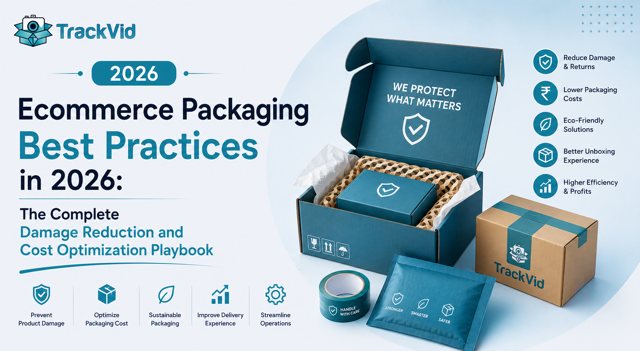
For D2C brand founders, ecommerce operations managers, warehouse teams, and procurement leads. Updated August 2026.
Direct Answer
To implement ecommerce packaging best practices, measure your baseline damage rate and packaging cost per order, right-size packaging to 3-5 SKU sizes covering 85 percent of orders (cuts dimensional weight surcharges 15-30 percent), select materials by product category (corrugated boxes for fragile, poly mailers for soft goods, padded mailers for accessories), deploy tamper-evident sealing (water-activated tape or tear-away strips) that is visible in dispatch video, and capture Order ID-linked dispatch video showing package condition and weight for dispute defense. Brands running this framework cut damage rates 60-75 percent, reduce packaging cost 20-30 percent, and eliminate empty-box return fraud within 90 days.
The Problem: Packaging Is Where Margin Silently Disappears
Ecommerce packaging looks like a small line item on the P&L until you audit it properly. Damage rates across ecommerce categories run 10-15 percent of parcels, with fragile categories crossing 20 percent. Dimensional weight surcharges from oversized packaging add 15-30 percent to shipping cost for the average brand. Empty-box return fraud (customer receives parcel, keeps product, claims empty parcel arrived) drains 2-4 percent of revenue with almost no operational visibility. Sustainable packaging preferences are now a purchase factor for 67 percent of shoppers under 40 (NielsenIQ 2025), which means poor packaging choices actively cost you sales even before considering damage.
The response most brands try first is to buy cheaper packaging materials to protect margin. This approach fails predictably. Cheaper packaging drives higher damage rates. Higher damage rates drive higher return costs. Higher return costs drive higher customer service overhead. Higher service overhead drives lower customer satisfaction. Lower satisfaction drives lower repeat purchase. The cost trade-off flips within 60 days because the damage cascade always exceeds the packaging savings for anything above ultra-low-value products. Cheap packaging is expensive.
The right response is to treat packaging as a system with four connected variables: product protection, carrier cost, brand experience, and sustainability. Optimizing all four simultaneously produces a packaging strategy that reduces damage, lowers shipping cost, builds brand loyalty, and meets consumer sustainability expectations. Brands running structured packaging optimization consistently cut damage rates 60-75 percent, reduce packaging cost 20-30 percent, and lift repeat purchase 15-25 percent from the unboxing experience effect alone.
Across the TrackVid platform of 1,100+ ecommerce sellers, we consistently observe that brands deploying tamper-evident packaging combined with Order ID-linked dispatch video eliminate a specific category of loss most brands never measure: empty-box return fraud. Customers receiving intact tamper-sealed packaging with dispatch video showing seal application cannot credibly claim the parcel arrived empty or tampered. The evidence chain closes the fraud vector entirely. This is a category ecommerce packaging best practices content rarely covers because most content focuses only on damage prevention, missing the post-delivery fraud protection angle where dispatch evidence integration produces the largest measurable ROI.
Packaging is not a cost line. It is the physical embodiment of your brand promise. Design it that way.
What Is Ecommerce Packaging?
Ecommerce packaging is the complete set of materials and design decisions that protect a product from picking through last-mile delivery while representing the brand and meeting operational, cost, and sustainability requirements. It includes primary packaging (product box or bag), secondary packaging (shipping container), void fill (protective material inside container), tamper-evident sealing, and any branded elements (inserts, tissue, ribbons).
The 4 variables ecommerce packaging must balance:
- Product protection: minimize damage in transit through appropriate structural strength, cushioning, and sealing
- Carrier cost: minimize dimensional weight surcharges through right-sizing and material efficiency
- Brand experience: create positive unboxing that drives repeat purchase, social sharing, and word of mouth
- Sustainability: meet consumer preferences and regulatory requirements without compromising the first three
Most brands optimize only one or two of these variables at a time. Optimizing all four simultaneously requires structured packaging strategy rather than tactical purchasing decisions.
The primary packaging types:
- Corrugated boxes (single-wall, double-wall, triple-wall): broadest applicability, best damage protection, higher per-unit cost, higher DIM weight
- Poly mailers (LDPE, recycled LDPE, compostable): lowest per-unit cost, best for soft goods (apparel, small accessories), minimal DIM weight
- Padded mailers (bubble-lined, honeycomb kraft-lined): middle ground for small items needing cushioning
- Rigid mailers (chipboard, corrugated): protection for flat items (photos, documents, small electronics)
- Custom folding cartons: branded high-perceived-value packaging for beauty, jewellery, subscription boxes
Selection depends on product category, order value, damage sensitivity, and brand positioning. Wrong material choice cascades into cost problems that no other optimization can fix.
What Percentage of Ecommerce Parcels Are Damaged?
Damage rate benchmarks tell you where the opportunity sits.
| Category | Average Damage Rate | Best-in-Class | Warning Level |
|---|---|---|---|
| Fashion & Apparel | 3-6% | Under 2% | Above 8% |
| Beauty & Personal Care | 8-12% | Under 5% | Above 15% |
| Electronics | 10-15% | Under 5% | Above 18% |
| Home & Kitchen | 12-18% | Under 6% | Above 22% |
| Jewellery | 5-8% | Under 3% | Above 10% |
| Glassware/Ceramics | 18-25% | Under 8% | Above 30% |
| Fragile Bundled Items | 15-22% | Under 7% | Above 25% |
| Books/Media | 2-4% | Under 1% | Above 6% |
- Direct cost: reverse shipping, restocking labor, replacement dispatch, damaged inventory write-off
- Full cost with compound effects: customer trust damage, negative review probability (40-55 percent of damage claims generate 1-2 star reviews), repeat purchase destruction, marketplace rating impact
- Direct cost typical range: ₹200-500 per damaged parcel
- Full cost typical range: ₹1,000-2,500 per damaged parcel
The compound damage cascade:
- Damaged parcel arrives at customer
- Customer opens dispute or return request (support ticket 1)
- Customer waits for reshipment resolution (frustration compounds)
- Reshipment ships (packaging cost multiplied)
- Second parcel arrives (if intact, resolution completes; if also damaged, retention collapses)
- Customer decides on repeat purchase (roughly 45-60 percent lower probability after damage experience)
If your damage rate sits above category average, structural packaging improvement is your fastest single lever. Below-average brands still benefit from the framework because damage reduction compounds with cost reduction and sustainability improvement simultaneously.
The 5-Step Framework for Ecommerce Packaging Best Practices
Step 1: Audit Your Baseline Damage Rate and Packaging Cost Per Order
You cannot optimize what you cannot measure. Start with clean baseline data across all packaging decisions.
Baseline metrics to track:
- Damage rate by SKU category (weekly tracking)
- Damage rate by carrier (identifies handling problems)
- Packaging cost per order (materials plus labor combined)
- Dimensional weight surcharges (identifies right-sizing opportunity)
- Return-for-damage rate (customer-reported vs actual damage)
- Packaging weight per parcel (affects both DIM and shipping cost)
- Customer complaints citing packaging (unboxing frustration, environmental concern)
Baseline calculation window: 90 days minimum for stable numbers. Track by SKU category and by carrier to isolate variables.
Cost model requirements:
- Include labor time to pack (packing takes 45-90 seconds per order for average operations)
- Include material cost (box plus tape plus void fill plus tamper seal plus insert)
- Include damage cost (full cost including compound effects, not just reshipment)
- Include DIM weight surcharges as separate line item
- Include sustainability signaling cost (branded packaging premium over generic)
The measurement discipline: brands measuring packaging cost monthly typically discover their true fully-loaded cost is 40-80 percent higher than the material cost they track. This gap is where the optimization opportunity lives.
Step 2: Right-Size Packaging to 3-5 SKU Sizes Covering 85 Percent of Orders
Right-sizing is the single highest-return packaging decision available. Oversized packaging costs money in three ways: material waste, DIM weight surcharges, and increased damage risk from product movement inside container.
Right-sizing methodology:
- Analyze 90 days of order data: identify your most common product combinations
- Design packaging around top 8-10 combinations: these typically cover 85 percent of order volume
- Standardize to 3-5 box sizes: small, medium, large, extra-large, and one specialty size for outliers
- Test each size against actual products: ensure minimal void space (product should fit with 10-15 percent void fill maximum)
- Weigh each packaged option: identify DIM weight improvements possible
Impact of right-sizing:
- Dimensional weight surcharges drop 15-30 percent
- Material cost per order drops 10-20 percent
- Damage from internal product movement drops 20-35 percent
- Warehouse storage space required drops 25-40 percent
Common right-sizing mistakes:
- Using one universal "large enough for anything" box (maximum waste)
- Stocking 15-20 packaging sizes (complexity without benefit)
- Choosing box sizes based on convenient supplier options rather than product dimensions
- Not accounting for orientation options (some products pack better rotated)
The 85 percent rule: targeting to cover 85 percent of orders with 3-5 sizes accepts that 15 percent of orders will use non-optimal packaging. This is efficient. Trying to cover 100 percent of orders creates operational complexity that outweighs the marginal cost savings on that final 15 percent.
For related workflows on reducing shipping cost through operational optimization, see our How to Get More Sales From Your Online Store playbook at trackvid.in.
Step 3: Select Materials by Product Category
Material selection is where cost, damage, and sustainability meet. Different categories require materially different approaches.
Fashion and apparel (soft goods):
- Primary: poly mailers (recycled LDPE preferred)
- Alternative: kraft paper mailers for premium positioning
- Void fill: not required for soft goods
- Tamper seal: adhesive strip integrated into mailer
Beauty and personal care (mixed fragility):
- Primary: corrugated boxes with structural void fill
- Void fill: air pillows, kraft crinkle paper, honeycomb kraft
- Tamper seal: water-activated tape or tear-away strip
- Interior protection: individual product bags or wraps for glass items
Electronics accessories:
- Primary: corrugated boxes (single-wall for small, double-wall for larger)
- Void fill: molded pulp inserts (custom for high volume), air pillows
- Tamper seal: water-activated tape (strongest available)
- Anti-static requirements for sensitive electronics
Home and kitchen (heavy or fragile):
- Primary: double-wall corrugated boxes
- Void fill: substantial layers of air pillows, foam-in-place, or molded pulp
- Tamper seal: water-activated tape reinforced at seams
- Corner protectors for oversized items
Jewellery and small luxury:
- Primary: custom folding cartons (branded high-perceived-value)
- Outer: rigid mailer or small corrugated box
- Void fill: cotton, ribbon, or premium tissue paper
- Tamper seal: branded seal with tamper-evident design
Consumables and food:
- Primary: kraft paper mailers or corrugated boxes
- Special: moisture-resistant grades for climate-sensitive items
- Tamper seal: induction seals on inner primary packaging
- Compliance labeling as required by regulation
Sustainability layer across categories:
- Post-consumer waste (PCW) content: 60-100 percent recycled corrugated is now standard
- Compostable mailers: viable for specific verified use cases only
- Reduced-plastic void fill: kraft paper, honeycomb kraft, air pillows with recycled content
- Water-based inks and soy-based inks for printed packaging
- Right-sized packaging is the largest sustainability lever
Critical insight: 67 percent of shoppers under 40 consider sustainability a purchase factor (NielsenIQ 2025), and this is now a purchase driver in mainstream categories. Ignoring sustainability is now a competitive disadvantage, not a neutral position.
Step 4: Deploy Tamper-Evident Sealing Visible in Dispatch Video
Tamper-evident packaging is where physical protection meets fraud defense. The sealing method matters both for physical security and for the evidence trail it creates.
Water-activated tape (strongest option):
- Fiber-reinforced kraft tape activated by water at application
- Creates unified bond with corrugated box that cannot be resealed without visible damage
- Best for: electronics, glassware, premium subscription boxes, high-value items
- Higher upfront cost but strongest fraud deterrent
Tear-away strips (built into box design):
- Fiber-reinforced strip integrated during box manufacturing
- Customer pulls strip to open cleanly; box cannot be resealed without visible damage
- Best for: subscription boxes, premium apparel, gift orders
Resealable strips (poly mailer standard):
- Pressure-sensitive adhesive strip under tear-away flap
- Once opened, cannot be resealed without visible damage
- Best for: apparel poly mailers, small accessory orders
Handle cuffs and shrink bands:
- Seal entire bag or handle by wrapping with adhesive band
- Best for: specific compliance-required packaging (pharmaceutical, food, cosmetic)
Induction seals:
- Heat-sealed foil layer beneath cap or lid
- Standard for liquid consumables, supplements, cosmetics
- Provides internal tamper evidence beyond outer packaging
Video-verifiable seal principle: whatever tamper-evident sealing you choose, it should be clearly visible in Order ID-linked dispatch video captured at pack station. The video showing seal application at dispatch, combined with the seal condition on delivery, creates a defensible evidence chain against empty-box or tampered-parcel fraud claims.
Step 5: Capture Order ID-Linked Dispatch Video for Package Condition Evidence
This is where TrackVid becomes decisive. Physical packaging protects the parcel; dispatch evidence protects you from fraudulent damage or tampering claims after delivery.
Dispatch video capture requirements:
- Order ID-linked video at pack station showing packaging assembly
- Tamper seal visible during application to the parcel
- Weight verification captured in the same frame
- Product condition visible during packing (undamaged at dispatch)
- Retrievable in under 2 minutes for support response to disputes
Damage-in-transit claim: customer receives visibly damaged parcel and disputes whether it shipped that way. Dispatch video shows product condition and packaging integrity at dispatch. Damage liability moves to carrier appropriately, and carrier reimbursement claims file with defensible evidence.
Empty-box fraud claim: customer receives parcel, keeps product, claims empty parcel arrived. Dispatch video shows product being packed with weight verification. Weight reconciliation between dispatch and any return catches empty-box fraud that visual evidence alone could miss.
Tampered-parcel claim: customer claims tamper seal was broken on arrival, product missing. Dispatch video shows tamper seal being applied intact. Seal condition on delivery cross-references against dispatch state.
Wrong-item claim (via packaging error): customer claims wrong product was packed. Dispatch video shows exact product going into exact parcel with SKU visible.
For related workflows on defending disputes across the operational chain, see our How to Improve Order Accuracy playbook, Customer Risk Scoring Playbook, and Fake COD Order Detection Playbook at trackvid.in.
Combined effect: brands with dispatch evidence infrastructure see packaging-related fraud claims drop 60-80 percent within 60 days because the evidence chain closes the fraud vector entirely.
Case Study: D2C Brand, Damage Rate 11% to 3.8% and Packaging Cost Down 22% in 90 Days
A men's fashion and accessories D2C brand on the TrackVid platform started 2026 with an 11 percent damage rate across 1,200 daily orders. Packaging cost per order: ₹42 (materials plus labor combined). Damage-related costs: 4.8 percent of revenue with compound effects. Empty-box return fraud: estimated 1.9 percent of orders based on weight reconciliation trials.
Days 1-14: Packaging audit. Categorized 90 days of damage claims by SKU category and carrier. Discovered 62 percent of damage concentrated in accessories category (over-packaged in oversized boxes) and 24 percent in bundled multi-item orders (insufficient void fill). Analyzed order data for right-sizing opportunity.
Days 15-30: Right-sizing implementation. Reduced packaging SKUs from 11 to 4 sizes covering 87 percent of orders. Redesigned accessory packaging around actual product dimensions. Standardized void fill approach.
Days 31-60: Material upgrade with sustainability signaling. Moved to 80 percent PCW recycled corrugated. Deployed water-activated tape as tamper seal replacing standard packing tape. Added branded insert card in each parcel.
Days 61-90: Dispatch evidence integration via TrackVid on every packing station. Order ID-linked video showing tamper seal application and product condition. Weight verification integrated with WMS.
Results at day 90:
- Damage rate: 11 percent to 3.8 percent (down 65 percent)
- Packaging cost per order: ₹42 to ₹33 (down 22 percent)
- Dimensional weight surcharges: down 28 percent
- Empty-box fraud claims won: 92 percent versus prior 31 percent
- Support tickets from damage or packaging complaints: down 58 percent
- Repeat purchase rate on customers experiencing unboxing: up 18 percent
- Negative reviews citing packaging: down 71 percent
- Total packaging-related loss: 4.8 percent of GMV to 1.9 percent
- Annualized savings: ₹68 lakh across damage reduction, cost optimization, and fraud elimination
The single largest contribution came from Step 2 (right-sizing) plus Step 5 (dispatch evidence) combined, accounting for approximately 65 percent of the total impact.
See how dispatch evidence with tamper-evident packaging eliminates empty-box return fraud from your operation. 30 minutes. No commitment.
Does Sustainable Packaging Affect Sales?
The sustainability question has moved from "nice to have" to "measurable purchase driver" in 2026.
Data on sustainability impact:
- 67 percent of US shoppers under 40 consider sustainability a purchase factor (NielsenIQ 2025)
- Sustainability preference is strongest in beauty, fashion, food, and personal care categories
- Verified claims (PCW content percentage, recyclability certification) carry weight; vague claims trigger skepticism
- Compostable claims specifically face increased scrutiny in 2026 due to widespread greenwashing accusations
PCW content transparency: display specific post-consumer waste percentage on packaging and product pages. "80 percent PCW recycled corrugated" beats "eco-friendly packaging" by 3-4x on customer trust metrics.
Third-party certifications: FSC (Forest Stewardship Council), SFI (Sustainable Forestry Initiative), Cradle to Cradle. Certification badges carry more weight than self-declared claims.
Right-sizing as sustainability: properly sized packaging reduces material use, shipping emissions, and DIM weight all together. This is the largest single sustainability lever available and requires no material change.
End-of-life clarity: clear disposal instructions on packaging. Vague instructions reduce credibility.
What NOT to do:
- Vague "eco-friendly" claims without specifics
- Compostable claims without disposal infrastructure disclosure
- Sustainability messaging on obviously oversized packaging
- Greenwashing that customers can verify through basic research
Sustainability done credibly lifts conversion 5-12 percent in relevant categories and drives repeat purchase 15-25 percent higher on cohorts that value it. Done poorly, it triggers backlash that damages brand credibility permanently.
What Are the Best Packaging Materials for Ecommerce in 2026?
Best material choice depends on your specific product category, order value, and brand positioning.
| Product Type | Primary Choice | Secondary Choice | Avoid |
|---|---|---|---|
| Apparel | Poly mailer (recycled) | Kraft paper mailer | Corrugated box (over-packaging) |
| Beauty | Corrugated plus kraft void fill | Padded mailer | Excessive individual wrapping |
| Electronics | Double-wall corrugated | Rigid mailer (small items) | Poly mailer (insufficient protection) |
| Jewellery | Custom folding carton in rigid mailer | Small corrugated box | Poly mailer (perceived value) |
| Home Goods | Double-wall corrugated | Triple-wall for heavy | Single-wall (damage risk) |
| Books | Rigid mailer | Padded mailer | Corrugated box (over-packaging) |
Where TrackVid Fits in Your Ecommerce Packaging Stack
Steps 1-4 need standard packaging infrastructure (packaging suppliers, right-sizing analysis, tamper-evident sealing, sustainability certifications). Step 5 (dispatch evidence layer) is where TrackVid becomes decisive.
TrackVid is a video proof and claim management platform used by 1,100+ ecommerce sellers on Shopify, WooCommerce, Amazon, Flipkart, Myntra, AJIO, Nykaa, Meesho, and Snapdeal. Officially authorized by Snapdeal. Brands using TrackVid include Rare Rabbit, Wrogn, The Indian Garage Co, The Bear House, HRX, Nike, Jordan, Tommy Hilfiger, and Snitch.
For ecommerce packaging best practices specifically, TrackVid delivers:
- Order ID-linked dispatch video on every packing station without workflow changes. Captures packaging assembly, product condition, tamper seal application, and weight verification in one frame. Retrievable in under 2 minutes.
- Empty-box return fraud elimination. Weight reconciliation between dispatch and return receipt catches customers who accept parcels then claim empty-box arrival. Defended at 85-90 percent win rate versus 30-40 percent without evidence.
- Damage claim defense. Dispatch video shows product condition at dispatch. Damage liability moves to carrier appropriately, and carrier reimbursement claims file with a defensible evidence chain.
- Tampered-parcel claim defense. Dispatch video shows tamper seal being applied intact. Seal condition on delivery cross-references against dispatch state.
- Support ticket acceleration through instant dispatch evidence retrieval. Packaging-related queries resolve at first contact at 85-90 percent rate versus 55-65 percent without evidence.
- Auto-files claims on marketplaces (Myntra, AJIO, Nykaa, Meesho, Snapdeal) for packaging or damage disputes, cutting manual filing to under 30 seconds per claim.
For related workflows across the operational and fraud defense stack, see our How to Improve Order Accuracy playbook, Post-Purchase Experience Playbook, Customer Trust Building playbook, and WISMO Reduction Playbook at trackvid.in.
WROGN's pilot data shows the pattern clearly. Across 95,836 tracked orders and 868 claims filed, systematic dispatch evidence combined with tamper-evident packaging moved claim approval from 42.3 percent (June) to 60.3 percent (July) within one month, while eliminating empty-box return fraud as a loss category across all cohorts.
In a 30-minute call, our team walks through your specific packaging cost and damage exposure, quantifies the annualized savings from dispatch evidence integration, and shows you exactly how the layer integrates with your existing packaging workflow. No commitment, no obligation.
5-Question Ecommerce Packaging Audit
1. What is your current damage rate by SKU category and by carrier? If you cannot answer with specific numbers, measurement infrastructure is your Step 1 priority.
2. How many packaging SKUs do you stock? If above 8, right-sizing to 3-5 sizes covering 85 percent of orders is your fastest cost lever with meaningful damage reduction as a bonus.
3. Are your packaging materials category-appropriate (corrugated for fragile, poly for soft goods, custom cartons for premium)? Wrong material choice cascades into cost problems no other optimization can fix.
4. Do you use tamper-evident sealing visible in dispatch documentation? Without it, empty-box return fraud goes undetected and undefended, draining 1-3 percent of revenue silently.
5. Do you capture Order ID-linked dispatch video showing package condition, tamper seal, and weight? Without dispatch evidence, packaging-related disputes default against you at 60-70 percent rate.
See exactly where your packaging cost and damage gaps sit and how dispatch evidence eliminates empty-box fraud. 30 minutes. No commitment.
Frequently Asked Questions
What are the best ecommerce packaging practices?
Measure baseline damage rate and packaging cost per order, right-size to 3-5 SKU sizes covering 85 percent of orders (cuts DIM weight surcharges 15-30 percent), select materials by product category (corrugated for fragile, poly mailers for soft goods, custom cartons for premium), deploy tamper-evident sealing visible in dispatch video, and capture Order ID-linked dispatch video showing package condition and weight. Framework cuts damage 60-75 percent and packaging cost 20-30 percent.
What percentage of ecommerce parcels are damaged?
Damage rates vary by category. Fashion 3-6 percent baseline, beauty 8-12 percent, electronics 10-15 percent, home and kitchen 12-18 percent, glassware 18-25 percent. Best-in-class operations achieve half or less of category average through structural packaging strategy. Above category warning level indicates systemic packaging problems requiring the 5-step framework.
How to reduce shipping damage in ecommerce?
Reduce shipping damage through 5 tactics: right-size packaging to minimize internal product movement, use category-appropriate materials (double-wall corrugated for fragile, adequate void fill), deploy tamper-evident sealing that protects during handling, standardize packing procedures across team, capture Order ID-linked dispatch video documenting product condition at dispatch. Combined approach cuts damage rates 60-75 percent within 90 days.
What is dimensional weight in ecommerce?
Dimensional weight (DIM weight) is a pricing formula carriers use to charge for parcel volume when it exceeds actual weight. Formula: (length times width times height) divided by DIM factor. Carriers bill on the greater of actual weight or dimensional weight. Oversized packaging with light products triggers DIM weight surcharges that add 15-30 percent to shipping cost. Right-sizing packaging is the fastest way to reduce DIM weight surcharges.
Does sustainable packaging affect sales?
Yes. 67 percent of US shoppers under 40 consider sustainability a purchase factor (NielsenIQ 2025). Verified sustainability claims (specific PCW percentage, third-party certifications like FSC) lift conversion 5-12 percent in relevant categories and drive repeat purchase 15-25 percent higher on cohorts that value it. Vague claims trigger greenwashing skepticism that damages credibility.
What is tamper-evident packaging?
Tamper-evident packaging includes sealing methods that show visible evidence if anyone opens the parcel between dispatch and delivery. Options include water-activated tape (strongest), tear-away strips built into box design, resealable strips on poly mailers, handle cuffs, shrink bands, and induction seals on inner packaging. Combined with dispatch video showing seal application, tamper-evident packaging eliminates empty-box and tampered-parcel fraud claims.
What packaging works best for fashion ecommerce?
Fashion ecommerce works best with recycled poly mailers (LDPE with 50-70 percent PCW content) for standard orders, kraft paper mailers for premium positioning, and small corrugated boxes for delicate items or bundles. Poly mailers deliver lowest per-unit cost, minimal DIM weight, and adequate protection for soft goods. Add tissue paper wrap and branded insert for premium unboxing experience without switching to boxes.
How much does packaging cost per order?
Packaging cost per order runs ₹15-30 for basic poly mailer soft goods, ₹30-60 for standard corrugated box with void fill, ₹60-150 for premium branded custom folding carton. Cost includes materials plus packing labor (45-90 seconds per order). Full cost including damage and fraud impact typically runs 40-80 percent higher than direct material cost.
How to prevent empty-box return fraud?
Prevent empty-box return fraud through 3 tactics: deploy tamper-evident sealing visible in dispatch video (water-activated tape or tear-away strips), capture Order ID-linked dispatch video with weight verification at pack station, implement return weight reconciliation catching weight mismatches between dispatch and return receipt. Combined approach eliminates empty-box fraud as a loss category at 85-90 percent win rate on disputes versus 30-40 percent without evidence.
What are the best packaging materials for ecommerce in 2026?
Corrugated boxes (60-100 percent PCW) for fragile items and bundles, poly mailers (recycled LDPE) for soft goods, padded mailers (kraft-lined preferred over bubble-lined) for small cushioned items, rigid mailers for flat items, custom folding cartons for premium positioning above 500 orders per month. Selection cascade: start with product category default, adjust for order value and brand positioning, optimize sustainability within chosen category.
Sources: EcoEnclose Sustainable Packaging Trends Report 2026, Atomix Logistics Ecommerce Packaging Guide 2026, EcoPackables Tamper Evident Packaging Guide 2026, Brown Packaging Strategic Shifts Report 2026, eFulfillment Service Sustainable Shipping Report 2026, NielsenIQ Consumer Sustainability Study 2025, TrackVid platform data across 1,100+ sellers, WROGN pilot data (94,904 videos, 95,836 tracked orders, 868 claims filed)
TrackVid is a video proof and claim management platform used by 1,100+ ecommerce sellers on Shopify, Amazon, eBay, Flipkart, Myntra, AJIO, Nykaa, Meesho, Bol.com, Zalando, MyDeal, PayPal, and Snapdeal. Officially authorized by Snapdeal. Brands trusting TrackVid include Rare Rabbit, Wrogn, The Indian Garage Co, The Bear House, HRX, Nike, Jordan, Tommy Hilfiger, and Snitch. Learn more at trackvid.in.
Get the Marketplace Claim Recovery Checklist
A 12-point checklist used by 1,100+ sellers to recover 85-90% of marketplace claim losses. Free, instant access.
- Marketplace-specific evidence formats (AJIO, Flipkart, Amazon, Myntra)
- Claim window deadlines for every major platform
- The 6-step process that pushes approval from 85-90%
- Common rejection reasons and how to avoid them
No spam. Unsubscribe anytime. Used by sellers at Rare Rabbit, HRX, Da Milano + 1,100 more.
Stop Losing Money to Fake Returns
Join 1,100+ sellers who recover lakhs every month with TrackVid