
For D2C brand founders, ecommerce operators, and marketplace sellers running cash on delivery. Updated August 2026.
Direct Answer
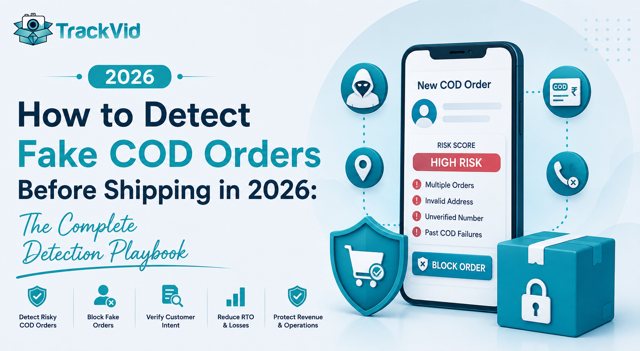
To detect fake COD orders before shipping, score every order at checkout against 8 risk signals (incomplete address, phone-state mismatch, high-RTO pincode, bulk identical SKUs, late-night placement, repeat cancellations, device reuse, name-email mismatch). Orders triggering 3 or more signals get automated WhatsApp confirmation before dispatch. Unresponsive orders auto-cancel within 4 hours. This flag-stacking approach catches over 80 percent of fake COD orders while preserving frictionless checkout for genuine buyers.
The Problem: Fake COD Orders Are Growing Faster Than Detection Systems
Fake COD orders represent 8 to 15 percent of total COD volume for the average D2C brand, with high-risk categories (fashion, beauty, electronics accessories) crossing 20 percent. Every fake order costs approximately ₹100 to ₹250 in stacked losses: forward shipping already dispatched, reverse shipping charged back, repackaging labor, inventory locked for 1 to 2 weeks in reverse leg, and warehouse handling on receipt. A brand shipping 1,000 COD orders daily at 12 percent fake rate absorbs six-figure monthly losses on orders that were never intended to be received.
The response most brands try first is manual review of every COD order. This works at 50 orders per day, fails at 500, and becomes operationally impossible at 5,000. Manual review also introduces friction for genuine customers, damaging conversion rate on the majority who intended to buy.
The right response is automated flag stacking at the point of checkout. Individual signals prove nothing on their own. A late-night order is not fake. A high-RTO pincode is not fake. A name mismatch is not fake. But an order combining 3 or more of these signals is fake 80 percent of the time. Industry analysis consistently shows this pattern across categories, geographies, and price points.
Across the TrackVid platform, which processes packing video across 1,100+ ecommerce sellers, we consistently observe that brands deploying flag-stacking detection combined with WhatsApp pre-dispatch confirmation cut fake COD order rates from 12 percent range to 3 to 5 percent within 90 days. The remaining fake orders that slip through require a different defense: dispatch evidence that protects the seller when a flagged order ships and later disputes.
Fake orders and genuine RTO are two different leaks. Detection logic differs. Fixes differ. Treat them separately.
What Is a Fake COD Order?
A fake COD order is a cash-on-delivery order placed with no genuine intent to accept or pay for the parcel. It differs from a genuine return-to-origin (RTO) event where a real buyer changes their mind or becomes unavailable at delivery.
Categories of fake COD orders:
- Competitor sabotage. Rival brands or affiliates placing large volume orders to inflate your RTO rate, tie up your inventory, and damage your operational metrics.
- Prank orders. Individuals placing orders as jokes, with no intent to receive.
- Serial abusers testing. Fraudsters probing your verification systems to identify weak spots for future exploitation.
- Address fraud rings. Organized groups using fake or borrowed addresses to place orders they never receive.
- Casual browsers with no commitment. Users placing orders during product exploration who then vanish, especially common on mobile browsing during off-hours.
How fake COD differs from genuine RTO:
| Attribute | Fake COD Order | Genuine RTO |
|---|---|---|
| Buyer intent | No intent to receive | Real intent, changes mind or becomes unavailable |
| Best detection point | At checkout | At delivery attempt (NDR stage) |
| Signal source | Order metadata patterns | Customer behavior post-dispatch |
| Prevention strategy | Flag stacking + pre-dispatch verification | NDR management + customer risk scoring |
| Cost to seller | Full RTO cost (₹100-250) | Full RTO cost (₹100-250) |
The 8 Signals of Fake COD Orders
Individual signals prove nothing. Flag stacking is what identifies fake orders reliably. Industry analysis consistently shows orders triggering 3 or more of these signals account for over 80 percent of confirmed fake COD orders.
Signal 1: Incomplete or vague address. "Near bus stand," "next to school," or missing house number, missing landmark, missing pincode. Every incomplete address is a future RTO event waiting to happen.
Signal 2: Phone-state mismatch. The phone number's telecom circle does not match the delivery state. A Delhi phone number ordering to a Kerala address is not automatic fraud, but it is a flag that combines with others.
Signal 3: Name-email mismatch. The name on the order does not match the name pattern of the email (Rajesh Kumar ordering with the email "shopping.deals.99@gmail.com" is a signal). Not fraud alone, but stackable.
Signal 4: Late-night impulse window. Orders placed between 11 PM and 3 AM show roughly double the daytime RTO rate. Combined with other flags, timing amplifies the risk score.
Signal 5: High-RTO pincode. Your own historical data shows this pincode has returned 40 percent or more of past COD orders. Every brand should maintain pincode-level RTO history and score against it.
Signal 6: Bulk identical SKUs. Five units of the same product going COD to one address is either a genuine reseller or a fraud setup. Combined with other flags, it warrants verification before dispatch.
Signal 7: Repeated cancellation history. The same phone number with multiple recent cancellations or refusals across your store is your serial abuser fingerprint. Track this across orders, not just within single orders.
Signal 8: Device or IP reuse across accounts. Multiple orders from the same IP or device fingerprint using different names is a strong sign of single-actor fraud. This signal alone justifies verification even without other flags.
The critical insight: flag stacking beats individual flags every time. Blocking all late-night orders damages genuine customers. Blocking all bulk orders damages resellers. Blocking orders with 3+ combined flags catches fake orders at 80 percent precision while preserving the frictionless experience for genuine buyers.
Why Do People Place Fake COD Orders?
Understanding motive helps calibrate response. Across the TrackVid platform of 1,100+ sellers, we observe the following distribution of fake COD order motives:
The 5 Motive Categories:
- Competitor sabotage (10-15% of fake orders). Rival brands, disgruntled affiliates, or malicious third parties placing bulk orders to inflate your RTO rate, damage marketplace metrics, tie up inventory, and hurt cash flow. Often follows successful marketing campaigns.
- Casual browsers with no commitment (25-35% of fake orders). Users exploring products during idle scrolling who "add to cart" for later consideration but complete checkout without genuine buying intent, especially on mobile.
- Serial abusers testing systems (15-20% of fake orders). Fraudsters probing verification flows to identify weaknesses. These orders often precede systematic fraud campaigns targeting the same brand or category.
- Prank or troll orders (10-15% of fake orders). Friends prank-ordering to each other's addresses, ex-partners sending nuisance orders, or coordinated group actions.
- Address fraud rings (5-10% of fake orders). Organized crime networks using stolen addresses or address-borrowing schemes to place orders for reshipping or intercepting during last-mile delivery.
The remaining balance covers legitimate confusion (duplicate accidental orders, address entry errors that get corrected, genuine changes of mind before shipping).
The critical operational insight: each motive category has a different optimal defense. Competitor sabotage responds to bulk-order flag stacking. Casual browsers respond to WhatsApp confirmation. Serial abusers respond to device fingerprint tracking. Prank orders respond to phone verification. Address fraud rings respond to pincode-level scoring. A single detection layer misses most motives; layered detection catches them all.
The 5-Step Framework to Detect Fake COD Orders Before Shipping
Step 1: Deploy Address and Pincode Quality Scoring at Checkout
The moment a customer submits their address is your first detection opportunity. Every checkout should trigger automated address quality analysis.
Address parsing. Flag incomplete addresses missing pincode, house number, apartment number, or landmark. Reject or require correction before checkout completes for critical missing fields.
Pincode-level RTO history. Maintain your own database of pincode RTO performance across the last 90 to 365 days. Cross-reference every new order against this. Pincodes with 40 percent or higher historical RTO rate get automatic flagging.
City-pincode consistency check. Flag orders where the pincode does not match the entered city. A common data-entry error, but also a common fraud signal.
Landmark quality scoring. Vague landmarks ("near school," "opposite temple") without specific street names or building numbers add to the risk score. Real addresses have specific reference points.
Address deduplication. Multiple recent orders to the same address from different customer accounts flags coordinated fraud. Some fraud rings rotate names but keep the address consistent.
Step 2: Verify Phone Number and Device Signals
Phone-level verification catches a significant share of fake orders that address scoring misses.
Phone OTP verification. SMS or WhatsApp OTP at checkout catches bot-generated phone numbers and validates that the customer controls the number they entered. Failed OTP attempts are your first fraud signal.
Telecom circle vs delivery state matching. Automated check comparing the phone's operator circle against the delivery state. Mismatches add to the risk score.
Phone number reuse tracking. The same phone number appearing across multiple customer accounts with different names is a velocity fraud signal. Track phone-account relationships across your customer base.
Device fingerprint. Multiple orders from the same device using different customer accounts, especially in short time windows, indicates coordinated fake ordering. Modern device fingerprinting tools capture screen resolution, browser configuration, timezone, and installed fonts to create a stable device identifier.
IP address velocity. Multiple orders from the same IP within short windows, especially to different addresses, is a strong signal. Legitimate household use rarely triggers this pattern.
Step 3: Apply Behavioral Signal Detection Through Flag Stacking
This is the operational core of the framework. Build a scoring engine assigning points per triggered signal:
- Incomplete address: 2 points
- Phone-state mismatch: 1 point
- Name-email mismatch: 1 point
- Late-night order (11 PM-3 AM): 1 point
- High-RTO pincode: 3 points
- Bulk identical SKUs: 2 points
- Repeat cancellation history: 4 points
- Device or IP reuse across accounts: 4 points
Score thresholds: 0-3 standard checkout no friction; 4-6 auto-triggered WhatsApp confirmation; 7+ manual review or auto-cancel with polite decline.
Segment calibration. New customers stricter thresholds. Repeat customers with successful history relaxed thresholds. Small brands (under 500 orders/day) can handle manual review at Score 4+. Larger brands need automated confirmation at 4-6 and auto-cancel at 7+ for operational efficiency.
Step 4: Deploy WhatsApp Pre-Dispatch Confirmation as Verification Layer
Every flagged COD order triggers automated confirmation before dispatch.
WhatsApp first (60-70 percent response rate). Auto-send within 15 minutes with order details, COD amount, and one-tap "Yes, confirm" button.
Auto-cancel timer. No confirmation within 2-4 hours = auto-cancel with polite message. Prevents fake orders tying up dispatch while giving genuine customers reasonable time.
SMS backup and IVR for high-value. SMS catches non-responders where WhatsApp fails. IVR call for top 10-15 percent AOV orders that failed automated channels.
Prepaid conversion incentive at confirmation. 3-5 percent prepaid discount converts uncertain customers to committed customers. Prepaid RTO is 4-6 times lower than COD.
WhatsApp confirmation is consistently the single highest-ROI fake order prevention workflow. Brands running it on flagged orders reduce fake shipment rates 65-80 percent within 60 days.
Step 5: Order-Level Dispatch Evidence for Flagged Orders That Ship
Even with rigorous detection, some flagged orders will ship: borderline scores, legitimate customers who look suspicious, high-value returning customers whose behavior changed. When these dispute later, dispatch evidence is your defense.
Every shipped COD order (especially flagged ones) gets Order ID-linked packing video at dispatch, tagged to Order ID, SKU, and tracking. Video shows the product going into the parcel with calibrated weight and tamper-evident seal in the same frame.
Three defensive outcomes when a flagged order ships and disputes:
Wardrobing or empty-box return fraud. Customer files "wrong item" or "empty box" claim. Dispatch video with weight data defeats it.
Fake NDR by courier. Agent marks "customer not available" on a parcel never attempted (documented pattern in COD-heavy markets). Return reconciliation cross-references NDR against GPS attempt data.
Marketplace dispute or chargeback. Complete dispatch evidence wins 84 percent of disputes vs 24 percent for manual submissions.
Across the TrackVid platform, dispatch evidence on flagged COD orders recovers 8-15 percent of what would otherwise be pure fake-order loss.
Case Study: D2C Brand, 12% Fake COD Rate to 3.4% in 90 Days
A men's fashion and accessories D2C brand on the TrackVid platform started 2026 with a 12 percent fake COD order rate. Distribution: 34 percent casual browsers, 22 percent competitor sabotage during viral campaigns, 18 percent serial abusers, 14 percent prank orders, 12 percent address fraud rings.
Days 1-14: Fake order data audit. Identified top 40 high-RTO pincodes representing 51 percent of fake events. Mapped serial patterns (4.1 percent of prior "customers" as pure fake-order actors).
Days 15-30: Deployed 8-signal flag stacking with tiered scoring. Enabled auto WhatsApp confirmation on all orders scoring 4+.
Days 31-60: Layered device fingerprinting and IP velocity tracking. Auto-cancel enabled for scores 7+. Added prepaid conversion incentive at WhatsApp confirmation.
Days 61-90: Layered Order ID-linked dispatch video on flagged orders that shipped. Enabled return reconciliation for fake NDR detection.
Results at day 90:
- Fake COD order rate dropped from 12 percent to 3.4 percent (down 72 percent)
- Competitor sabotage patterns detected and blocked at checkout: 89 percent reduction
- Casual browser fake orders (score 4-6 range): 67 percent auto-cancelled at WhatsApp confirmation
- Serial abusers auto-blocked at checkout: 94 percent reduction within 60 days
- Prepaid share of orders rose from 32 percent to 44 percent (Step 4 conversion impact)
- Recovered dispatch dispute wins on flagged orders that shipped: 84 percent win rate vs prior 27 percent
- Total fake-order-related cost dropped from 3.1 percent of GMV to 0.9 percent
- Net margin improved 2.2 percentage points
The single largest contribution came from Step 3 (flag stacking) plus Step 4 (WhatsApp confirmation) working together, accounting for approximately 70 percent of the total reduction. Step 5 (dispatch evidence) delivered pure recovery on the 3.4 percent that still shipped.
How to Prevent Competitor Sabotage Orders Specifically
Competitor sabotage orders spike during successful marketing campaigns, viral moments, or seasonal sale periods. The 5-step framework applies fully, but three additional tactics work specifically for sabotage detection.
Volume anomaly monitoring. Sudden spike in orders from unusual pincodes, unusual devices, or unusual IP ranges during campaign windows. Automated anomaly detection catches coordinated sabotage before it inflates RTO metrics.
IP range blocking. After confirmed sabotage patterns, block IP ranges associated with the attack. Legitimate customers rarely share IP ranges with sabotage actors.
Timing correlation. Sabotage orders often cluster in narrow time windows (bulk placement within 15-30 minutes). Legitimate campaign response spreads across hours. Time-clustering detection catches sabotage waves.
Brands running these tactics during campaign windows consistently see competitor sabotage patterns detected and blocked within the first hour of an attack, preventing RTO metric damage and inventory lock.
Difference Between Fake Orders and Genuine RTO (Critical Distinction)
Most brands conflate fake orders with genuine RTO. They require completely different defenses.
Fake orders:
- Placed with no intent to receive
- Detected at CHECKOUT (before dispatch)
- Signals in order metadata (address, phone, device, timing)
- Prevention through flag stacking + pre-dispatch verification
- Cost: full RTO cost per parcel that ships
Genuine RTO:
- Placed with real intent, changes mind or becomes unavailable
- Detected at DELIVERY ATTEMPT (post-dispatch)
- Signals in customer behavior post-dispatch (NDR responses, delivery availability)
- Prevention through NDR management + customer risk scoring
- Cost: full RTO cost per parcel
Why this distinction matters:
Treating both as one problem produces flat, ineffective solutions. Treating them as two separate leaks with two separate defenses cuts total RTO-related loss 40 to 55 percent instead of 15 to 20 percent.
Fake order defense operates BEFORE dispatch. Genuine RTO defense operates AFTER dispatch. Brands that build both layers cut structural loss materially. Brands that build only one layer plug half the leak.
For genuine RTO detection and NDR management, see our full RTO Reduction Playbook which covers Steps 3-5 in depth.
Where TrackVid Fits in the Fake COD Detection Stack
Steps 1 through 4 need a checkout intelligence layer (address parsing, phone verification, WhatsApp confirmation platform, scoring engine). Step 5 is where TrackVid becomes decisive.
TrackVid is a video proof and claim management platform used by 1,100+ ecommerce sellers on Shopify, WooCommerce, Amazon, Flipkart, Myntra, AJIO, Nykaa, Meesho, and Snapdeal. Officially authorized by Snapdeal. Brands using TrackVid include Rare Rabbit, Wrogn, The Indian Garage Co, The Bear House, HRX, Nike, Jordan, Tommy Hilfiger, and Snitch.
For fake COD order defense specifically, TrackVid delivers:
- Order ID-linked dispatch video on every packing station without workflow changes. Defends the outcome when flagged orders still ship and later dispute.
- Return reconciliation module scans return delivery logs across major couriers, flagging fake NDR patterns, weight mismatches, and GPS-inconsistent scans.
- Auto-files claims on marketplaces (Myntra, AJIO, Nykaa, Meesho, Snapdeal), cutting manual filing from 15-20 minutes to under 30 seconds. 90 percent plus claim win rate.
- WhatsApp packing video share at dispatch for borderline flagged orders. Trust artifact converting uncertain customers when they see the item being packed.
- Serial fake-order detection backed by per-order video evidence. Risk scoring becomes defensible when backed by dispatch evidence, not just refusal statistics.
- Post-delivery empty-box detection via dispatch weight vs return weight mismatch. Catches fake customers accepting delivery then filing "empty box" fraud.
WROGN's pilot data shows the pattern clearly. Across 95,836 tracked orders and 868 claims filed, systematic dispatch evidence combined with return reconciliation moved claim approval from 42.3 percent (June) to 60.3 percent (July) within a single month.
In a 30-minute call, our team walks through your specific fake order patterns, quantifies your recoverable loss from flagged-order disputes alone, and shows you exactly how dispatch evidence integrates with your existing checkout and shipping stack. No commitment, no obligation.
5-Question Fake COD Detection Audit
1. What percentage of your COD orders currently RTO within the "customer refused" or "customer unavailable" categories? If combined exceeds 40 percent of your RTO events, a meaningful share is likely fake orders, not genuine RTO.
2. Do you have flag stacking deployed at checkout with 6-8 signals? Without multi-signal scoring, you are catching individual signals but missing the 80-percent-precision opportunity from combined signals.
3. For your last 100 COD orders, how many received WhatsApp pre-dispatch confirmation? If below 30 percent, deploy confirmation on flagged orders as fastest single-lever intervention.
4. Do you track pincode-level RTO history and score new orders against it? Without pincode intelligence, you repeat the same losses to the same delivery locations month after month.
5. For flagged COD orders that still ship, do you have Order ID-linked dispatch video for post-delivery dispute defense? Without dispatch evidence, flagged-order disputes default against you.
See exactly where your fake COD order loss is concentrated and what a layered detection system looks like in your specific operation. 30 minutes. No commitment.
Frequently Asked Questions
What is a fake COD order?
A fake COD order is a cash-on-delivery order placed with no genuine intent to accept or pay for the parcel. Categories include competitor sabotage (10-15 percent), casual browsers with no commitment (25-35 percent), serial abusers testing systems (15-20 percent), prank orders (10-15 percent), and address fraud rings (5-10 percent). Each category has different optimal defenses. Combined, fake COD orders represent 8-15 percent of total COD volume for the average D2C brand.
How to identify fake COD orders before shipping?
Fake COD orders are identified through flag stacking against 8 signals at checkout: incomplete address (2 points), phone-state mismatch (1 point), name-email mismatch (1 point), late-night order 11 PM-3 AM (1 point), high-RTO pincode (3 points), bulk identical SKUs (2 points), repeat cancellation history (4 points), device or IP reuse across accounts (4 points). Orders scoring 4-6 get WhatsApp confirmation; orders scoring 7+ get manual review or auto-cancel. This catches over 80 percent of fake COD orders.
Why do people place fake COD orders?
Five primary motives drive fake COD orders. Competitor sabotage (10-15 percent) inflates rival RTO metrics. Casual browsers (25-35 percent) complete checkout without buying intent. Serial abusers (15-20 percent) test verification systems for weaknesses. Prank orders (10-15 percent) are jokes or nuisance actions. Address fraud rings (5-10 percent) place organized fraud orders for reshipping or last-mile interception. Each motive has a different optimal defense; layered detection catches them all.
What are the signs of a fake ecommerce order?
The 8 primary signs: incomplete or vague address, phone number telecom circle mismatched with delivery state, name-email mismatch, order placed 11 PM to 3 AM, high-RTO pincode with 40 percent+ historical returns, bulk identical SKUs to one address, repeat cancellation history on the phone number, multiple orders from same IP or device using different names. No single sign proves fraud, but 3 or more combined signs identify fake orders with over 80 percent precision.
How to prevent competitor sabotage orders?
Competitor sabotage prevention requires three specific tactics beyond the general framework. First, volume anomaly monitoring during marketing campaigns to catch sudden spikes from unusual pincodes, devices, or IP ranges. Second, IP range blocking after confirmed attack patterns. Third, timing correlation detection catching bulk order clusters within 15-30 minute windows (sabotage clusters, legitimate response spreads across hours). Brands running these tactics detect sabotage waves within the first hour of attack.
Does WhatsApp confirmation reduce fake orders?
Yes. WhatsApp pre-dispatch confirmation on flagged orders reduces fake order shipment rates by 65 to 80 percent within 60 days. Auto-send within 15 minutes of placement with one-tap confirm button, escalate to SMS backup for non-responders, auto-cancel after 2-4 hours of no confirmation. WhatsApp confirmation is consistently the single highest-ROI workflow in fake order prevention because it verifies buyer intent without adding friction to genuine customers who confirm quickly.
How to block fake COD customers?
Block fake COD customers through pattern blocking, not individual customer blocking. Blocking a specific customer permanently creates legal complexity. Blocking a specific phone-address-pincode pattern with 3+ RTO events in 90 days is defensible operational risk management. Apply COD unavailability, mandatory prepaid, or manual verification requirements to flagged patterns. Standard customers retain frictionless COD access. This surgical approach cuts fake orders without damaging your genuine customer experience.
What is the difference between fake orders and genuine RTO?
Fake orders are placed with no intent to receive, detected at checkout through metadata signals (address, phone, device, timing), prevented by flag stacking and pre-dispatch verification. Genuine RTO involves real buying intent that fails at delivery attempt, detected through post-dispatch customer behavior, prevented by NDR management and customer risk scoring. Both cost the same per parcel, but require completely different defenses. Brands treating them as one problem plug half the leak; brands treating them as separate leaks cut total loss 40-55 percent.
What are the best fake order detection tools in 2026?
Best fake order detection tools combine three layers. Layer 1: Checkout intelligence platforms with address parsing, phone verification, and device fingerprinting (RapidShyp, Simpl, Gokwik, Salesix). Layer 2: WhatsApp confirmation platforms with auto-cancel timers (AiSensy, Interakt, Wati). Layer 3: Dispatch evidence and return reconciliation for post-shipment defense on flagged orders that ship (TrackVid). The combined stack catches fake orders at 80+ percent precision at checkout AND defends flagged orders that reach dispatch.
How many flags indicate a fake COD order?
Orders triggering 3 or more risk signals from the 8-signal framework indicate fake COD orders at over 80 percent precision. This industry-consistent threshold works across categories, price points, and geographies. Individual flags produce false positives (many legitimate orders trigger one signal), but flag combinations are statistically strong. Build your verification rules around flag combinations rather than individual signals to catch fake orders while preserving genuine customer experience.
Sources: Metaport COD Fraud Detection Analysis 2026, RapidShyp COD Fraud Prevention Guide 2026, Salesix Fake Order Reduction Guide 2026, ShipPrime Fake Orders and COD Fraud Report 2026, GeoFraudShield 12 Types of Shopify Fraud Report 2026, TrackVid platform data across 1,100+ sellers, WROGN pilot data (94,904 videos, 95,836 tracked orders, 868 claims filed)
TrackVid is a video proof and claim management platform used by 1,100+ ecommerce sellers on Shopify, Amazon, eBay, Flipkart, Myntra, AJIO, Nykaa, Meesho, Bol.com, Zalando, MyDeal, PayPal, and Snapdeal. Officially authorized by Snapdeal. Brands trusting TrackVid include Rare Rabbit, Wrogn, The Indian Garage Co, The Bear House, HRX, Nike, Jordan, Tommy Hilfiger, and Snitch. Learn more at trackvid.in.


Get the Marketplace Claim Recovery Checklist
A 12-point checklist used by 1,100+ sellers to recover 85-90% of marketplace claim losses. Free, instant access.
- Marketplace-specific evidence formats (AJIO, Flipkart, Amazon, Myntra)
- Claim window deadlines for every major platform
- The 6-step process that pushes approval from 85-90%
- Common rejection reasons and how to avoid them
No spam. Unsubscribe anytime. Used by sellers at Rare Rabbit, HRX, Da Milano + 1,100 more.
Stop Losing Money to Fake Returns
Join 1,100+ sellers who recover lakhs every month with TrackVid