
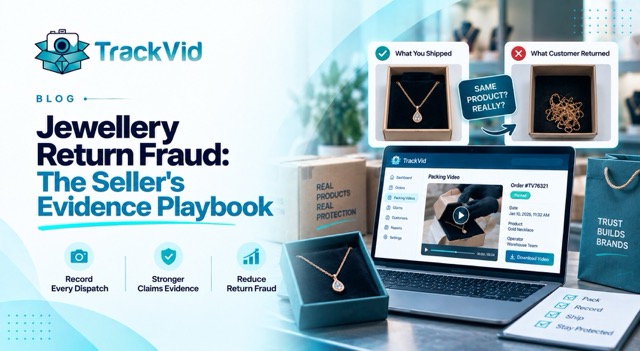
For jewellery sellers worldwide. Updated September 2026.
Direct Answer
Jewellery is the category with the highest return fraud exposure per order of any ecommerce product type, despite having one of the lowest overall return rates at roughly 4 percent. That combination is what makes it uniquely dangerous: the risk sits in the value and substitutability of each individual piece rather than in the frequency of returns. A gold pendant worth several hundred dollars weighs under an ounce and can be substituted for a plated fake inside the same original packaging in under a minute. Most jewellery pieces carry no unique identifier the way a phone carries a serial number or IMEI, so proving that the piece the buyer returned is not the piece you shipped depends entirely on dispatch-side evidence of physical attributes: weight, hallmark stamp, stone specification and setting condition. Six fraud patterns concentrate here: stone substitution, weight fraud on gold and silver pieces sold by weight, counterfeit or purity substitution, empty box or decoy returns, hallmark and certificate manipulation, and false damage claims. What resolves them is order-linked video capture at dispatch showing the piece being weighed, the hallmark visible in the frame, and the stones and setting documented in condition, retrievable when a dispute arrives.
Quick Answer: What Makes Jewellery Different From Other Categories?
Three things, and only one of them is what most sellers think. It is not that jewellery returns are rare, though they are. It is that the value density and substitutability of the products makes each fraudulent return catastrophically more expensive than a return in almost any other category. And it is that jewellery lacks the unique identifiers that make electronics disputes provable, forcing evidence to run on physical attributes that can be substituted rather than on serial numbers that cannot.
Why Jewellery Has the Highest Fraud Exposure Per Order
Category return rate benchmarking puts jewellery at roughly 4 percent when sold through established sellers with strong product imagery, well below apparel at 25 percent, electronics at 11 to 15 percent and even beauty at 4 to 12 percent. Read alone, that number suggests a category with low fraud exposure.
Jewellery return fraud sits at the wrong end of a different measurement entirely: fraud exposure per order.
Three structural factors combine to produce this:
Highest per-unit value in mainstream ecommerce. A single fraudulent return on a fine jewellery piece can exceed the entire month's fraud loss of an apparel or beauty seller processing hundreds of orders. The absolute cost per fraudulent incident is what matters, not the rate at which returns arrive.
Trivially easy physical substitution. A gold pendant worth several hundred dollars weighs under an ounce. Swapping it for a plated fake inside the original packaging takes less than a minute and requires no specialist skill. The same is true for most gemstones, particularly diamonds against convincing simulants, and for silver against silver-plated substitutes.
Absence of unique identifiers on most pieces. Electronics carries a serial number or IMEI at the unit level, which makes swap fraud arguable when captured at dispatch. Most jewellery has no such identifier. Certified diamonds carry a laser-inscribed report number on rare occasions, and some fine pieces have maker's marks or edition numbers, but the great majority of jewellery in commerce is identified only by its physical attributes: weight, purity, stone type, cut and setting. Every one of those attributes can be substituted without changing external appearance.
The combined result is a category where jewellery return fraud attempts are rarer than in apparel or electronics but each successful one costs meaningfully more, and where the evidence needed to contest a dispute is qualitatively different from any other category.
Bring one recent disputed jewellery return and we will walk through what dispatch evidence would have changed the outcome. 15 minutes. No commitment.
What Are the Six Jewellery Return Fraud Patterns?
Six jewellery return fraud patterns dominate. The first three are close to category-exclusive.
1. Stone substitution. The buyer receives a piece set with a genuine stone, extracts and replaces it with a convincing simulant, and returns the piece claiming it arrived with the wrong stone or a lower-grade specification. Diamond substitution with cubic zirconia or moissanite is the most common single form, since the substitutes are widely available, visually close and priced at a small fraction of the original. Gemstone substitution follows the same pattern with glass, synthetics or lower-grade natural stones.
2. Weight fraud on pieces sold by weight. Gold and silver jewellery is frequently priced against actual weight rather than a fixed unit price. A buyer receiving a ten-gram gold chain can return a seven-gram chain of similar visual design claiming that is what arrived. Without a weight recorded against the specific order at dispatch, the substitution is nearly impossible to disprove.
3. Counterfeit or purity substitution. The buyer purchases a genuine hallmarked piece and returns a convincing counterfeit of the same design, or substitutes a lower-purity piece for a higher-purity one where hallmarking is not internationally uniform. Common on established brand jewellery and on gold at the boundary between marked purities.
4. Empty box or decoy returns. Overstated-quantity returns are the fastest-rising fraud pattern retailers report, at 71 percent reporting increases in that specific tactic, followed by empty box returns at 65 percent and decoy or substituted returns at 64 percent, according to NRF 2025 data. Jewellery is disproportionately targeted because a small, high-value item is easy to represent as shipped when it was not, and easy to remove from packaging that is then returned as a decoy.
5. Hallmark or certificate manipulation. The buyer claims the hallmark stamp is missing, illegible or refers to a lower purity than sold, or that the certificate of authenticity was not included in the shipment. Both claims invalidate the authenticity story around the piece and force the seller into a corner without dispatch evidence.
6. False damage claims. The buyer claims the piece arrived scratched, dented, with a damaged setting, a chipped stone or a broken clasp, when it left in perfect condition. A growing share of these claims arrive with photographic evidence that increasingly cannot be assumed to be an honest record of receipt.
How Does Insurance Interact With Jewellery Return Claims?
High-value jewellery shipments interact with insurance and declared value in a way most other categories do not, and this creates a jewellery return fraud defensive angle unique to the category. It is also frequently underused, because the evidence it depends on is rarely captured.
The general shape. Fine jewellery shipments are commonly sent through carriers offering declared-value coverage, and some sellers also carry specialty jewellery insurance for higher-value transit. Where a claim arises, whether against the carrier for loss or damage in transit, against a payment processor for fraud, or against a marketplace for a wrong-item dispute, the evidence admissibility standards for these routes typically require documented proof of what was packed and its condition at dispatch. Without that proof, the claim frequently defaults to the minimum-liability position rather than the declared-value one.
Why the position is usually not used. Enforcing it requires the seller to demonstrate two things: what was actually packed and shipped, and that the piece was in the represented condition when it left. A written packing list against an order number does not meet the bar. A photograph of an outer parcel does not meet it either. What meets the bar is order-linked video of the specific piece being packed, with weight, hallmark and setting visible.
Verify locally before relying on this defense. Carrier terms, marketplace insurance policies and specialty insurance requirements vary significantly by market, by route and by carrier. Confirm the specific evidence requirements for your carriers and any insurance policies you hold directly, rather than assuming they apply as described. What holds in every market is the general principle: declared value only pays if the shipment can be documented.
The practical implication. For a jewellery seller, order-linked dispatch evidence is not only for marketplace claims and payment disputes. It is also what converts a declared-value shipping arrangement from paper protection into an actually-recoverable one.
See dispatch evidence capture running on real jewellery orders, and how the same recording supports marketplace, payment and insurance routes. 15 minutes. No commitment.
What Evidence Resolves a Jewellery Return Fraud Dispute?
The evidence standard for jewellery return fraud is different from any other category in one specific respect: it runs primarily on physical attributes rather than on identifiers, and the attributes need to be visually documented in a way that survives later comparison.
The five things worth capturing at dispatch:
- Weight, on a visible scale reading, tied to the specific order. This is the single highest-value piece of evidence for weight-fraud cases and provides a baseline for stone-substitution claims where a substituted stone typically alters weight measurably.
- The hallmark or purity stamp, legible in the frame, on the specific piece. This is what forecloses the hallmark-manipulation and purity-substitution patterns before they can be claimed.
- The stone specification and setting condition, with the stones visible in their settings and the setting undamaged. Diamond and gemstone disputes depend on this, and video captures aspects of stone appearance (fire, brilliance, scintillation) that still photography does not.
- Certificate, appraisal or authenticity documentation, if included, visibly placed into the package before sealing.
- Order-linked indexing, so all of the above is retrievable by order number on a claim window that may be tighter than a jewellery seller expects.
A note on video versus photography for jewellery specifically. Still photography is meaningfully weaker evidence for this category than for most others. A stationary photograph of a piece cannot document weight, cannot always resolve subtle differences between a genuine and simulant stone, and cannot capture the setting integrity in three dimensions. Video showing the piece being handled, weighed and packed, with the operator's hands and the scale in frame, is a qualitatively different evidence tier and is what marketplaces, payment processors and insurers typically require for full admissibility.
What does not resolve these disputes. A written packing description. A photograph of the outer parcel. General warehouse CCTV footage indexed by time. A weight recorded in a spreadsheet without visual proof tying it to the shipped piece.
Where You File, and How Long You Have
Check the terms for your own market before acting on this section. Claim routes, evidence formats and deadlines are set by each marketplace and each country, and they are revised without notice. Everything else in this guide holds wherever you sell.
Jewellery sellers typically file through one of four routes depending on where and how they sell:
Marketplace claim programs. Each marketplace runs its own protection and dispute mechanism with its own window and evidence format. Windows vary substantially by platform and by market, and jewellery-specific policies within those marketplaces may differ from generic return policies. Confirm the exact window and evidence format for every marketplace you sell on.
Payment and card disputes for direct-to-consumer sales, where the timeline runs from the transaction or dispute notification rather than from the return, and the evidence is submitted to a payment processor.
Carrier and declared-value claims. Distinct from the above and running on their own timeline, typically requiring proof of dispatch condition alongside proof of transit incident. Carrier claim windows are frequently short and process-specific.
Specialty jewellery insurance. Where held, these carriers have their own evidence and reporting requirements, sometimes stricter than any of the above.
The practical rule that holds in every market. Map the shortest window across all four routes and tune capture and retrieval speed to it. The shortest-window channel is where valid claims are lost most often, regardless of country.
How Do You Build a Jewellery Return Fraud Evidence System?
Five steps, applicable in any market.
1. Capture physical attributes at the piece level, not the SKU level. This is the change that matters most in jewellery. Your system needs to record weight, hallmark and stone specification for the specific piece shipped against the specific order, not that a SKU of that model shipped.
2. Capture on every order, not a sample. Jewellery fraud selects for gaps precisely because the per-order value is so high. Sampling fails predictably: the order that becomes a dispute is the one that was not recorded.
3. Trigger capture automatically. Manual capture that depends on a packer remembering to start it will be skipped under volume pressure, and jewellery orders are frequently the ones packers rush through to avoid handling errors.
4. Capture the return side too. Dispatch proof shows what you sent. Return proof shows what came back. Stone substitution and weight fraud claims are resolved by comparing weight and stone appearance between the two, not by either alone.
5. Make retrieval fast enough to matter. Jewellery disputes cross multiple routes with different windows, from marketplace to payment to carrier to insurance. Evidence that exists but cannot be found across all four channels inside the shortest window is functionally the same as no evidence.
Where TrackVid Fits
TrackVid is a video proof and claim management platform used by 1,100+ ecommerce sellers and fulfillment operations.
What applies to jewellery return fraud specifically:
- Order-linked video capture at packing, triggered automatically from the shipping label scan, tied to Order ID, AWB and SKU, which puts weight, hallmark, stones and setting on record for that specific order rather than a generic photograph of a sealed parcel
- Return-side video capture, so a substituted or weight-fraud return can be compared against the sealed-at-dispatch record, which is how stone substitution and weight fraud claims are actually resolved
- Retrieval by order ID in under two minutes, which matters disproportionately for jewellery, where a single dispute may need to be submitted across up to four different routes
- Automated claim filing on supported marketplace channels via robotic process automation operating the seller's own portal access, with filing time reduced from 15 to 20 minutes per claim to under a minute
- Return reconciliation surfacing eligible claims that would otherwise expire unfiled
What to confirm for your specific setup. Supported claim-filing channels vary by marketplace and by market, so confirm coverage for the platforms you sell on rather than assuming it from this guide. The insurance-interaction points described above should also be confirmed against your carrier terms and any specialty policies you hold directly.
Where this does not help. It does not prevent a fraudulent return from being attempted, and it does not authenticate a stone or hallmark that was not authenticated at dispatch. It changes whether a disputed return is provable, which is a different question from whether it can be prevented.
See piece-level capture, weight documentation and hallmark retrieval running on real jewellery orders. 15 minutes. No commitment.
A Note on Watches
Watches sit adjacent to jewellery but face a materially different evidence problem. Fine watches carry serial numbers, movement numbers and often reference numbers stamped on the case, which makes their evidence profile closer to the unit-level identifiability of electronics than to the physical-attribute dependence of jewellery. Weight verification is not usually the operative check, and hallmarking rules do not apply the same way. If your business is primarily watches rather than jewellery, the electronics playbook is closer to your evidence needs than this one, though the value-density and physical-substitution risks remain jewellery-adjacent.
Read Next
- Jewellery Return Fraud for Handmade and Etsy Sellers, the same fraud patterns seen from a handmade and Etsy seller's side, including how Purchase Protection leaves those sellers exposed
- Electronics Return Fraud, sister vertical page on unit-level identifier evidence, closer to the watches playbook
- Beauty Return Fraud, sister vertical page on tamper seal and batch code evidence
- Best Jewellery Selling Platform 2026, platform comparison for jewellery sellers choosing where to sell
- Handmade Jewellery Selling Platforms 2026, the handmade and bespoke sub-vertical view
- Ecommerce Return Statistics 2026, the full category benchmarking data behind the figures here
Frequently Asked Questions
What is jewellery return fraud?
Return fraud targeting jewellery specifically, including stone substitution, weight fraud, counterfeit or purity substitution, empty box and decoy returns, hallmark and certificate manipulation, and false damage claims. It has the highest fraud exposure per order of any ecommerce category despite one of the lowest return rates.
What is stone substitution fraud?
A pattern where the buyer receives a piece set with a genuine stone, extracts and replaces it with a convincing simulant such as cubic zirconia in place of a diamond or glass in place of a gemstone, and returns the piece claiming it arrived with the wrong stone or lower-grade specification.
How do jewellery sellers prove a piece was authentic at dispatch?
With order-linked video captured at packing showing the piece being weighed on a visible scale, the hallmark stamp legible in frame, the stones and setting documented in condition, and any certificate visibly included before sealing. Photographs and written descriptions are substantially weaker.
How do I stop weight fraud on gold returns?
Prevention is difficult once a buyer commits to the scheme. What changes the outcome is order-linked video showing the weight on a scale reading at dispatch, which converts a spreadsheet weight record into visually documented evidence that can be compared against the returned piece.
What evidence wins a jewellery return dispute?
Order-linked video captured at dispatch showing weight on a visible scale, hallmark stamp, stone specification and setting condition, and any documentation included, retrievable by order number. Still photography of the piece alone is a weaker tier and often insufficient for higher-value disputes.
Do I need to document hallmark stamps when packing?
For jewellery sold on the strength of hallmark or stated purity, yes. The hallmark stamp is what forecloses the hallmark-manipulation and purity-substitution patterns before they can be claimed against you, and it needs to be legible in the frame on the specific piece against the specific order.
How does insurance interact with jewellery return claims?
Declared-value shipments and specialty jewellery insurance typically require documented proof of what was packed and its condition at dispatch for the claim to be admissible at the declared value rather than a minimum-liability figure. Confirm the exact evidence requirements with your carriers and any specialty policies.
Why is jewellery return fraud higher-cost than other categories?
Because value density is the highest in mainstream ecommerce, physical substitution is trivially easy on small high-value items, and most jewellery has no unique identifier the way a phone has a serial number. Fraud exposure per order exceeds every other category even though the return rate is one of the lowest.
What is the return rate for jewellery?
Category benchmarking puts jewellery at roughly 4 percent when sold through established sellers with strong product imagery, below apparel at around 25 percent, electronics at 11 to 15 percent and beauty at 4 to 12 percent. The category's problem is not return frequency but the fraud exposure per individual order.
Does the same evidence system apply to watches?
Not exactly. Watches carry serial and movement numbers, which makes their evidence profile closer to electronics unit-level identifiability than to jewellery's physical-attribute dependence. Weight and hallmark checks apply less directly, though value-density and physical-substitution risks remain.
Sources: Branvas 2026 category return-rate research; NRF 2025 return fraud tactic reporting (overstated quantity 71 percent, empty box 65 percent, decoy or substituted 64 percent); TrackVid's own jewellery platform analysis identifying the category as having the highest fraud exposure per order; industry reporting on stone substitution and counterfeit-return patterns; TrackVid platform data across 1,100+ ecommerce sellers
Return fraud rates, category benchmarks, marketplace claim windows and carrier or insurance policies vary by market and change over time. Verify current figures, your marketplace terms, your carrier declared-value policies and any specialty jewellery insurance you hold before relying on this guidance for a specific decision.
TrackVid is a video proof and claim management platform for ecommerce sellers and fulfillment operations, providing order ID-linked evidence capture and automated claim filing on supported channels. Learn more at trackvid.in.
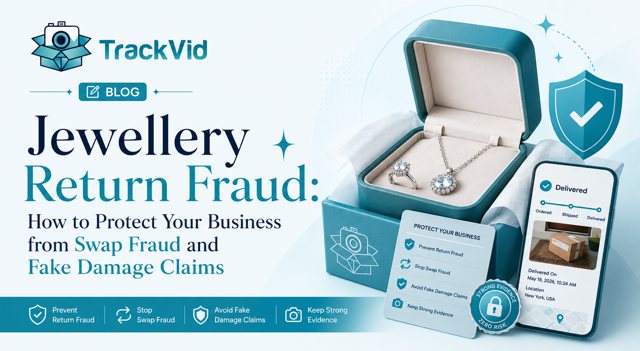

Get the Marketplace Claim Recovery Checklist
A 12-point checklist used by 1,100+ sellers to recover 85-90% of marketplace claim losses. Free, instant access.
- Marketplace-specific evidence formats (AJIO, Flipkart, Amazon, Myntra)
- Claim window deadlines for every major platform
- The 6-step process that pushes approval from 85-90%
- Common rejection reasons and how to avoid them
No spam. Unsubscribe anytime. Used by sellers at Rare Rabbit, HRX, Da Milano + 1,100 more.
Stop Losing Money to Fake Returns
Join 1,100+ sellers who recover lakhs every month with TrackVid