
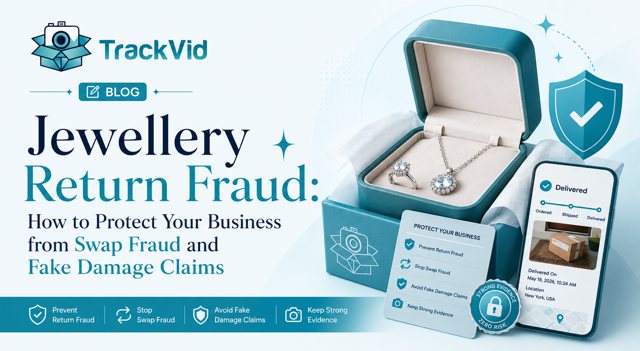
For handmade and independent jewellery sellers on Etsy, Amazon Handmade, eBay, and direct-to-consumer stores. Updated May 2026.
Jewellery return fraud is one of the most financially damaging and hardest-to-contest fraud types for independent sellers. The average Etsy jewellery order sits between $85 and $320. At that price point, a single successful swap fraud incident absorbs a week of materials cost. Across a month of repeat incidents, the losses are enough to threaten the viability of a small jewellery business entirely.
What makes jewellery uniquely vulnerable is not the price point. It is the product itself. A cheap gold-plated piece can look almost identical to real gold in a photograph. A broken stone can be claimed as transit damage when it was intact at dispatch. A different ring in the same style can be returned as "wrong item" when the correct piece was clearly sent. Without documentation that shows the specific item's condition at the moment of packing, a jewellery seller cannot prove any of these claims are false.
Return fraud in the jewellery category is not a customer service problem. It is an evidence problem. And it is solvable.
Why Jewellery Sellers Are Disproportionately Targeted
Return fraud operations, whether individual buyers or organised groups, evaluate their targets based on one criterion: how easy is it to file a claim the seller cannot disprove?
Jewellery sellers meet every requirement for an easy target.
The product is small, portable, and high in value-to-weight ratio. A bespoke gold necklace worth $280 weighs less than an ounce. Swapping it for a cheap substitute during the return process requires no special equipment and leaves no evidence on the packaging.
The product is visually ambiguous in photographs. A listing photo of a sterling silver ring looks almost identical to a white-metal substitute when returned. Without close-up documentation of the specific piece's hallmark, metal characteristics, and stone setting, the comparison between dispatched piece and returned piece cannot be made with certainty.
The seller community has a high tolerance for isolated losses. Most independent jewellery sellers absorb individual dispute losses rather than contest them, because the process feels time-consuming relative to the order value. Professional fraudsters know this. The sellers who do not contest are the ones who keep getting targeted.
And the evidence gap is structural. Listing photographs prove what a jewellery seller generally offers. They do not prove what was in the parcel for order number 4521 specifically. That gap is what every form of jewellery return fraud exploits.
The Four Types of Jewellery Return Fraud
Each operates differently and requires a specific evidence response.
Swap Fraud
Swap fraud is the most costly and most common jewellery return fraud type. The buyer receives the correct piece, keeps it, and returns a substitute: a cheaper version of the same style, a broken piece they owned, an item of similar weight in inferior metal, or in some cases a completely different item altogether.
The returned item arrives in the original packaging, sometimes with the seller's tissue paper and ribbon still intact. The weight may be close enough that initial inspection does not trigger concern. The seller processes the return, issues the refund, and only discovers the fraud later when the returned piece is inspected more carefully or offered for resale.
For handmade and bespoke pieces, swap fraud is particularly damaging because the original item cannot be reproduced identically. A one-of-a-kind piece returned as a mass-produced substitute is a permanent loss.
Evidence requirement: packing video showing the specific piece being packed, its characteristics, condition, and any unique features, is the only evidence that directly proves a swap occurred. When compared against the returned piece, the discrepancy between dispatched and received is independently verifiable.
Fake Damage Claims
A buyer receives the jewellery in perfect condition and files a dispute claiming it arrived damaged: a broken chain, a bent prong, a scratched stone, a missing clasp. On genuine transit damage, this is a legitimate claim. On fabricated damage, the seller has no way to prove the item was undamaged at dispatch without pre-dispatch documentation.
Fake damage claims are particularly effective for jewellery because:
Metal can be bent or scratched by the buyer after receipt with no indication that the damage is recent. Stones can be chipped by normal impact. Clasps can be broken deliberately. None of these condition changes leave evidence of when they occurred. Without a dispatch record showing the item undamaged at the moment of packing, the claim resolves in the buyer's favour by default.
Evidence requirement: packing video showing the piece in pristine condition, with chain intact, settings secure, and all components present, at the moment of packing against the specific Order ID.
Stone Substitution Fraud
Stone substitution is a variant of swap fraud specific to gemstone jewellery. The buyer receives a piece set with genuine stones, removes the stones or replaces them with fakes, and returns the piece claiming "not as described" or "arrived damaged." With lower-end settings, stone removal is straightforward. The returned piece arrives with missing, chipped, or substituted stones.
Unless the seller has documentation showing the stones in place at the time of dispatch, this dispute cannot be won. A product listing photograph shows stones in a sample piece or a studio shot. It does not show the stones in the specific ring from order 4521 on the day it was packed.
Evidence requirement: close-up packing video clearly showing the stones in their settings, their condition, and where applicable their approximate size and colour, at the moment of dispatch.
"Wrong Item" Claims on Bespoke Orders
For custom or bespoke jewellery, "wrong item" claims are among the most frustrating disputes to receive because the seller often has extensive communication with the buyer about the specific design, and the returned piece is clearly not what was made to order.
Despite this, winning the dispute requires evidence beyond communication records. Banks reviewing "wrong item" chargebacks need to see independently verifiable proof of what was dispatched, not proof of what was discussed. A chain of messages about a custom ring design does not prove the correct ring was packed and shipped.
Evidence requirement: packing video showing the finished custom piece before dispatch, ideally showing it alongside any agreed specifications. This is the only evidence that independently answers what was in the parcel.
UK Maker Clare: Three Pieces a Month Gone Before She Understood Why
Clare makes handmade silver and semi-precious stone jewellery from her workshop in Yorkshire, selling through her Etsy shop and a small Shopify store. Her average order value runs around £195. She offers free returns within 14 days on unworn items.
For approximately eight months she had been absorbing what she described as "the occasional bad return." A necklace returned with a broken chain that she was certain was intact when it left. A ring returned as "wrong size" that arrived as a visibly different style to what she had listed. A pair of earrings returned with one stone missing, claimed as "arrived damaged."
Each incident felt isolated. She contested two of the three disputes and lost both, submitting her product listing photos alongside written accounts of what she had packed. The bank sided with the buyer in both cases.
She had not connected the pattern until she tracked her losses over a rolling quarter and found that she was absorbing between two and four fraudulent returns per month, at an average individual loss of £185 per incident. Her quarterly fraud loss was running at approximately £2,000 to £2,800. For a one-person workshop, that represented a significant share of her effective quarterly profit.
When she reviewed the dispute evidence she had submitted in her two contested cases, the problem became clear. Her listing photos showed beautiful, professionally photographed pieces from her collection. They showed what she generally makes. They did not show what she packed for order number 4521 on a specific Thursday in February. The bank had no way to verify that the returned piece differed from what she had dispatched, because she had no documentation of what she had dispatched at the order level.
I had photos of my work everywhere. I did not have a photo of that specific piece going into that specific envelope. That is the gap they were using.
After Clare began recording every packing session with order-linked video, the next disputed return she received was handled differently. She retrieved the packing video for that specific order, which showed the necklace in question, chain intact, stone set, clasp working, being wrapped and placed in the padded envelope against the order slip. She submitted this alongside the return receipt showing a different, cheaper chain had come back.
The dispute resolved in her favour within five days. The buyer did not file a further dispute. That specific return fraud pattern from that account did not recur.
Her monthly jewellery return fraud losses dropped from two to four incidents per month to zero contested losses in the 90 days following.
What Evidence Actually Wins Jewellery Return Disputes
The evidence that wins jewellery disputes is different from the evidence that wins general ecommerce disputes, because jewellery fraud exploits the visual similarity between the dispatched piece and a cheap substitute.
What does not work:
Product listing photos. These show your catalogue, not your specific order. A dispute for order 4521 cannot be won by showing a studio photo of a similar ring. The bank needs evidence of what was in that specific parcel.
Written accounts. "I packed this item myself and it was in perfect condition" is a seller's assertion. It carries no evidentiary weight against a buyer's counter-assertion without independent verification.
General warehouse footage. Time-based CCTV showing packing activity does not link footage to a specific Order ID. It cannot verify which piece was packed in which envelope at which moment.
What works:
Order-linked packing video showing the specific piece at dispatch. The video needs to show the item's actual condition: metal finish, stone settings, chain integrity, clasp function, any unique characteristics. It needs to be linked to the specific Order ID so it can be retrieved and submitted as primary evidence when a dispute arrives.
Supporting documentation: weight confirmation at dispatch for pieces where weight is a meaningful indicator of metal quality, close-up photography of hallmarks for hallmarked pieces, and return receipt documentation noting any discrepancy between what arrived back and what the packing video shows was dispatched.
Together, these create a before-and-after record that is independently verifiable. The claim that the piece arrived damaged or wrong cannot survive comparison with clear footage of its condition at packing.
Related: Chargeback representment: what evidence wins by dispute type →
How Etsy's Purchase Protection Leaves Jewellery Sellers Exposed
Etsy's Purchase Protection Programme for sellers covers certain dispute categories, but its scope is more limited than many sellers realise, particularly after the May 2026 policy update.
For damaged item cases, Etsy's protection supports sellers for their first eligible case and once per calendar year thereafter. A jewellery seller experiencing three fraudulent damage claims in a single quarter is covered for one of them. The other two resolve entirely at the seller's expense and risk.
For "not as described" cases where the item matches the listing, Etsy may provide support. But this protection applies when a buyer disputes accuracy they cannot actually demonstrate. A buyer who returns a different piece altogether and claims wrong item received has introduced a factual dispute that Etsy's protection does not automatically resolve in the seller's favour without evidence.
For chargebacks filed directly through the buyer's bank or card issuer rather than through Etsy's case system, Etsy forwards the seller's evidence to the bank. The outcome depends entirely on what the seller submits. There is no platform intervention beyond that forwarding. The seller wins or loses based on evidence quality alone.
This means that for the majority of jewellery fraud scenarios, a seller operating without order-linked packing video is effectively unprotected. The platform's structural protections apply narrowly and run out quickly. The evidence the seller can produce independently is what determines outcomes.
How TrackVid Provides Jewellery Sellers with Order-Level Dispatch Evidence
The documentation infrastructure that wins jewellery return fraud disputes requires one specific capability: every order needs a video linked to its Order ID that shows the specific piece in its dispatch condition, retrievable in under two minutes when a dispute arrives.
TrackVid provides this infrastructure for ecommerce sellers globally, including jewellery sellers on Etsy, Amazon Handmade, eBay, and Shopify. Every packing session is recorded and linked to the Order ID, SKU, and dispatch reference at the moment of packing. Videos are stored in indexed cloud, searchable by order number. When a return fraud dispute arrives, the seller retrieves the exact packing video for that specific order and submits it as primary evidence.
For jewellery sellers specifically, the video captures exactly what makes jewellery fraud contestable: the specific piece's condition, metal finish, stone settings, hallmarks, and packaging, all visible and linked to the specific order. The comparison between dispatched and returned becomes independently verifiable. Swap fraud, fake damage claims, and stone substitution claims that previously resolved by default in the buyer's favour become disputes the seller can win.
TrackVid works with existing cameras including phone cameras and small workshop setups. It does not require commercial warehouse infrastructure. For a one-person jewellery workshop, the setup takes under 15 minutes.
Book a free TrackVid Demo Today
In one session, you will see what order-linked video documentation looks like for a jewellery dispatch workflow and how it maps to the evidence requirements for the specific dispute types hitting your shop.
Five Questions to Know If Your Current Setup Leaves You Exposed
- When your last disputed return arrived, could you prove at the order level what was packed? Not what you generally make and sell. What was specifically inside the parcel for that order, on that date, in that condition. If the honest answer is no, every future dispute has the same outcome.
- Do you know which of your dispute losses were fraudulent versus genuine? If you cannot distinguish them because you lack dispatch documentation, you are absorbing genuine losses and fraudulent losses equally without any mechanism to contest the latter.
- Have you exhausted your Etsy Purchase Protection for damaged items this calendar year? After the first covered incident per year, every subsequent damage claim is your full loss. A packing video is the only protection that does not run out.
- For bespoke or custom pieces, do you have documentation of the finished piece before it was packed? Communication records of what was agreed are not the same as evidence of what was dispatched. Custom pieces are irreplaceable. The documentation created at dispatch is the only record of what left your workshop.
- If a buyer returned a cheap substitute for your piece, do you have any way to prove the difference? Visual similarity is the swap fraudster's tool. Your listing photo shows your design style. Only packing video of the specific dispatched piece can demonstrate the difference between your work and a substitute.
Frequently Asked Questions
How to protect my jewellery business from return fraud?
Protecting a jewellery business from return fraud requires order-level dispatch documentation: a packing video for every order that shows the specific piece in its dispatch condition, linked to the Order ID and retrievable when a dispute arrives. This is the evidence that wins swap fraud disputes, fake damage claims, and stone substitution cases, because it provides independent verification of what was dispatched that listing photos and written accounts cannot provide. TrackVid automates this documentation for jewellery sellers globally. Combined with return receipt photography documenting what arrives back, it creates a before-and-after record that makes return fraud disputes contestable rather than automatically absorbed.
Customer returned fake jewellery: what can I do?
If a customer has returned a different piece than what you dispatched, file a dispute immediately with your platform or payment processor. The critical evidence you need is packing video of the specific order showing the genuine piece being packed, and documentation of what arrived back. Without packing video of the dispatched piece, this dispute is difficult to win because you cannot independently prove the difference between what you sent and what came back. If you have the footage, submit it alongside your return receipt documentation showing the discrepancy. Merchants with order-linked packing video win the majority of swap fraud disputes where video is submitted, according to TrackVid data. Going forward, start recording every packing session linked to the Order ID.
How to prove jewellery was genuine when shipped?
The most effective proof that jewellery was genuine at dispatch is order-linked packing video recorded at the moment of packing, showing the specific piece's characteristics: metal finish, hallmark if applicable, stone settings, condition, and any unique features. This video needs to be linked to the specific Order ID, not just time-stamped, so it can be retrieved and submitted as evidence for a specific dispute. A listing photo proves what you generally sell. Packing video of order 4521 proves what was in that specific parcel. For high-value pieces, supplement the video with a close-up of the hallmark, a weight reading, and photographs of any unique characteristics that distinguish the genuine piece from a potential substitute.
What evidence wins a jewellery return dispute?
The evidence that wins jewellery return disputes depends on the claim type. For "arrived damaged" claims, order-linked packing video showing the piece in undamaged condition at dispatch is primary evidence. For "wrong item received" claims, packing video showing the correct item being packed against the specific Order ID directly contradicts the claim. For "not as described" claims on handmade pieces, packing video alongside listing screenshots, custom order communications, and return receipt documentation showing what arrived back provides the strongest evidence package. Listing photos alone, written accounts, and general warehouse footage do not win jewellery disputes because they cannot answer the specific question: what was in that parcel for that order?
Etsy jewellery seller return fraud protection: what does Etsy actually cover?
Etsy's Purchase Protection covers sellers for certain dispute types, but with important limits for jewellery sellers specifically. Damaged item cases are covered for the first eligible incident and once per calendar year thereafter. This means a jewellery seller experiencing three fraudulent damage claims in a year is covered for one. After that, each loss is entirely the seller's responsibility. For chargebacks filed through the buyer's bank rather than Etsy's case system, Etsy forwards the seller's evidence to the bank and the outcome depends entirely on evidence quality. Etsy has no power to override the bank's decision. Order-linked packing video is the protection that does not run out and does not depend on platform intervention.
What is swap fraud in jewellery ecommerce?
Jewellery swap fraud occurs when a buyer receives the correct piece, keeps it, and returns a substitute: a cheaper version of the same style, a broken piece from their collection, an inferior metal equivalent, or in some cases a completely unrelated item. The return arrives in the original packaging, which is why initial inspection often misses it. Swap fraud is particularly damaging for jewellery sellers because the product's high value-to-weight ratio makes substitution easy, visual similarity between genuine and fake pieces makes verification difficult without close inspection, and bespoke handmade pieces cannot be reproduced once lost. The only effective evidence for swap fraud disputes is order-linked packing video showing the specific genuine piece being dispatched.
How to stop fake damage claims on handmade jewellery?
Fake damage claims on handmade jewellery cannot be prevented at the policy level because consumer protection frameworks exempt damage claims from most standard return policy restrictions. They are defeated at the evidence level: if you have packing video showing the piece undamaged at dispatch, a damage claim has to survive direct comparison with that footage. Metal that was clearly unblemished in the dispatch video cannot have been damaged in transit without carrier liability entering the dispute. Stone settings that were secure in the footage cannot have arrived loose without a verifiable explanation. Order-linked packing video created at dispatch is the specific evidence that turns fake damage claims from automatic losses into contestable disputes. TrackVid creates this documentation automatically for every order.
Customer claims jewellery arrived damaged: what to do?
When a jewellery buyer claims an item arrived damaged, first request photographic evidence of the alleged damage through your platform's messaging system before initiating a return. This creates a record of what the buyer claims and the timing of the claim. If you have packing video of the specific order showing the piece undamaged, review it immediately and note any differences between the damage described and the piece's condition at dispatch. File a dispute response with your packing video as primary evidence alongside your return inspection documentation when the piece arrives back. If the damage appears inconsistent with transit damage and consistent with deliberate post-receipt damage or a substituted piece, note this specifically in your rebuttal. Going forward, order-linked packing video from dispatch is the documentation that converts this from an unwinnable situation to a winnable one.
Sources: Etsy Purchase Protection for Sellers Policy May 2026, Etsy Seller Community fraud reports 2026, Chargeflow Return Fraud 2026 Research, NRF Return Fraud Survey 2026, Claimlane 2026 Return Research, TrackVid internal seller data, Craftybase Etsy Scams Guide April 2026
TrackVid is a video proof and claim management platform used by 1,100+ ecommerce sellers globally. Officially authorised by Snapdeal. Learn more at trackvid.in.



Get the Marketplace Claim Recovery Checklist
A 12-point checklist used by 1,100+ sellers to recover 85-90% of marketplace claim losses. Free, instant access.
- Marketplace-specific evidence formats (AJIO, Flipkart, Amazon, Myntra)
- Claim window deadlines for every major platform
- The 6-step process that pushes approval from 85-90%
- Common rejection reasons and how to avoid them
No spam. Unsubscribe anytime. Used by sellers at Rare Rabbit, HRX, Da Milano + 1,100 more.
Stop Losing Money to Fake Returns
Join 1,100+ sellers who recover lakhs every month with TrackVid