
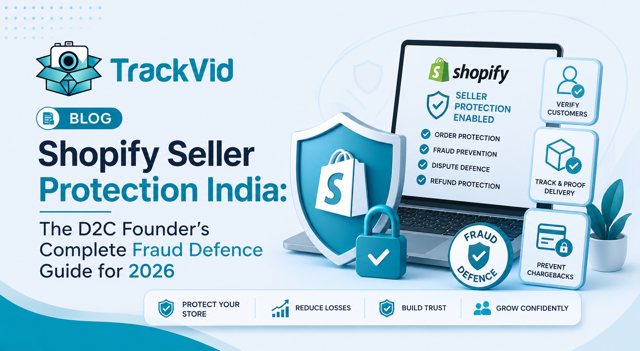
For Indian D2C brand founders and Shopify, WooCommerce, and headless commerce sellers shipping across India. Updated June 2026.
Shopify seller protection in India is fundamentally different from the global Shopify seller protection conversation, and Indian D2C founders applying global advice to their Indian operation are leaving the majority of their fraud losses unrecovered. The global discussion centres on Shopify Protect, 3DS2 authentication, and Stripe's dispute process. None of these are particularly relevant to the Indian D2C reality where COD is 60 to 80 percent of orders, Razorpay or PayU handles most prepaid transactions, and the fraud profile is dominated by COD RTO and post-purchase return fraud rather than card-not-present payment fraud.
India's D2C market crossed Rs 2.5 lakh crore in GMV in 2025 and is projected to grow 30 percent in 2026, according to CODCourierService and HillTeck industry data. Shopify is the dominant platform powering this growth, with the majority of Indian D2C brands above Rs 50 lakh monthly revenue running on Shopify or Shopify Plus. The fraud and dispute losses these brands absorb monthly typically range from Rs 80,000 to over Rs 5 lakh, and the largest share of those losses sits in categories Shopify Protect explicitly does not cover.
The Shopify seller protection India playbook that actually works in 2026 operates across three layers: COD RTO prevention (the highest-volume loss category), Razorpay or PayU chargeback defence (the highest-value individual loss), and return fraud evidence (the largest unrecovered loss). Layer 1 is what most guides cover. Layers 2 and 3 are where most of the money actually lives.
What Indian Shopify Sellers Are Actually Losing Money To
Before any protection layer is implemented, an Indian Shopify founder needs to understand which loss category is draining their margin. Three loss types account for the vast majority of Indian D2C fraud and dispute losses, and each requires a different defence.
Loss Type 1: COD RTO
Cash on Delivery Return to Origin events. The customer placed a COD order, the parcel was dispatched, and the customer refused delivery at the door or could not be located. The parcel returns to the seller's warehouse. The seller absorbs forward shipping, reverse shipping, and zero revenue.
According to CODCourierService 2026 research, COD orders see RTO rates of 20 to 40 percent, three to five times higher than the prepaid RTO rate of under 2 percent. For an Indian Shopify brand with 65 percent COD mix, the math is direct: 25 percent RTO rate translates to roughly 16 percent of total revenue lost to RTO events. Indian D2C brands collectively lose over Rs 8,000 crore annually to RTO.
Loss Type 2: Razorpay and PayU Chargebacks
When an Indian Shopify customer pays via Razorpay, PayU, Cashfree, or Stripe India and later disputes the transaction with their card-issuing bank, the resulting chargeback lands on the seller's account. The seller pays a dispute fee of Rs 750 to Rs 2,500 depending on the gateway and absorbs the transaction value if the dispute is lost.
The chargeback reasons most common on Indian Shopify D2C are not card fraud. They are friendly fraud and post-purchase disputes: "item not as described," "wrong product received," "item not received" (often on confirmed-delivery orders), and "damaged on arrival." According to Chargebacks911 industry data, friendly fraud accounts for 60 to 80 percent of ecommerce chargeback losses globally, and Indian D2C brands report similar or higher percentages because the post-purchase fraud profile in India is particularly active.
Loss Type 3: Return Fraud on Indian Shopify Stores
A customer initiates a return on a Shopify D2C store. The return arrives. The product inside is not what was dispatched. The wrong item is inside the box, the package is empty, the product is broken, or the customer is claiming damage with a manipulated photograph.
Unlike marketplace sellers who can file Flipkart SPF, Amazon SAFE-T, or AJIO CCTV claims to recover fraudulent return losses, Indian Shopify D2C brands have no platform-level protection programme. Every return fraud loss is the founder's direct loss. The only protection available is the seller's own evidence infrastructure and refund policy.
Why Global Shopify Seller Protection Advice Does Not Work for India
Open any global Shopify seller protection guide and the recommendations are clear: enable 3DS2 authentication, install Signifyd or NoFraud for behavioural fraud scoring, configure AVS and CVV matching, enrol in Shopify Protect, and use Ethoca or Verifi for pre-dispute alerts.
This advice is correct for the global market. For India specifically, it addresses a smaller share of the loss problem than most founders realise.
Three reasons explain the gap.
First, Shopify Protect coverage is limited and partial in India. Even where eligible, Shopify Protect covers fraudulent transaction chargebacks where the card was used without the cardholder's knowledge. It explicitly does not cover "item not received" or "item not as described" reason codes, which together account for the majority of Indian D2C chargeback volume. Shopify Payments is also not the dominant gateway in Indian D2C, with Razorpay holding the largest share of Indian Shopify D2C transactions.
Second, COD RTO is not a global problem. International ecommerce is overwhelmingly prepaid. Indian ecommerce, especially in Tier-2 and Tier-3 cities, runs 60 to 80 percent on COD. The single largest loss category for Indian Shopify D2C brands does not exist in the global Shopify protection conversation at all. Tools like 3DS2 and Signifyd that prevent payment fraud cannot prevent a Tier-3 city customer from refusing delivery at the door.
Third, friendly fraud in India operates through Indian payment gateways with their own dispute processes. Razorpay, PayU, and Cashfree run dispute resolution through their own portals, with their own evidence requirements, their own deadlines, and their own chargeback fee structures. Global tools like Chargeflow are not integrated with Indian gateways. An Indian D2C founder evaluating chargeback automation tools finds that the dominant global platforms do not cover the gateways their customers actually use.
The result: a Shopify India founder who implements every globally recommended best practice still has Layer 2 friendly fraud disputes and Layer 3 return fraud losses entirely unaddressed, plus the largest loss category of all: COD RTO completely outside the framework.
Mumbai D2C Founder Karthik: How Layer 1 Tools Missed Rs 2.3 Lakh of Monthly Losses
Karthik runs a men's grooming D2C brand from Mumbai on Shopify Plus, with Razorpay as primary payment gateway and Shiprocket routing courier shipments. Daily order volume approximately 280, average order value Rs 850, COD mix 58 percent.
He had built what he considered a strong fraud protection stack. Razorpay Thirdwatch for COD fraud scoring on incoming orders. NoFraud added to checkout for prepaid transaction screening. 3DS2 enabled for all card transactions above Rs 2,000. OTP confirmation flow via WhatsApp on every COD order. Pincode blocking on the top 12 historically high-RTO pincodes.
His RTO rate had dropped from 31 percent to 24 percent over six months. Payment fraud chargebacks were near zero. He considered his fraud protection complete.
When his accountant flagged that his monthly "shipping and operations losses" line had grown to Rs 4.8 lakh in three of the previous four months, Karthik did a complete loss audit. The breakdown explained the picture.
Genuine RTO logistics losses (Layer 1 territory): Rs 2.5 lakh per month. Reduced from his historical peak of Rs 3.6 lakh through his Layer 1 implementations.
Razorpay chargebacks: Rs 1.4 lakh per month. He was contesting 40 percent of these and winning 18 percent. The win rate was low because his standard evidence package was order confirmation emails, shipping tracking, and a written description of the product. None of this answered the bank's question about what was specifically inside the disputed parcel.
Return fraud losses on Shopify direct orders: Rs 90,000 per month. Customers returning empty boxes, wrong products, or items in worse condition than dispatched. Karthik was absorbing nearly all of these because as a Shopify D2C brand there was no Flipkart SPF or Amazon SAFE-T equivalent to file claims through.
Total monthly loss across all three categories: Rs 4.8 lakh, of which Rs 2.3 lakh sat in Layers 2 and 3 that his fraud stack did not touch.
I had built a fraud protection stack thinking I was protecting my business. What I had actually done was reduce my Layer 1 losses by Rs 1 lakh per month and ignored Rs 2.3 lakh in losses I did not know existed as a separate category.
After Karthik implemented TrackVid at his Mumbai fulfilment centre, every Shopify order was packed with an Order ID-linked video on a calibrated scale, with the AWB, product, and condition visible in frame. Footage was indexed by Order ID and retrievable in under two minutes when a Razorpay chargeback or return dispute arrived.
His Razorpay chargeback win rate on "item not as described" and "wrong product" disputes moved from 18 percent to 74 percent in 60 days. His return fraud loss dropped from Rs 90,000 per month to under Rs 22,000 because every disputed return now had specific dispatch evidence that contradicted the buyer's claim.
His overall monthly fraud and dispute loss dropped from Rs 4.8 lakh to Rs 2.9 lakh within the first quarter. The Layer 1 stack continued working as designed. Layers 2 and 3 finally had a defence.
The Three-Layer Shopify Seller Protection Stack for India
A complete Shopify seller protection setup for an Indian D2C brand operates across three layers simultaneously. Each layer addresses a specific loss category and requires specific tools.
Layer 1: COD RTO Prevention
The highest-volume loss category for Indian Shopify D2C. Tools and tactics include:
Pre-dispatch OTP verification: WhatsApp or SMS OTP confirmation before dispatch on every COD order. Customers who verify intent are seven to ten times less likely to refuse delivery. Reduces fraudulent COD orders by 20 to 30 percent according to Shipway 2026 data.
Address validation at checkout: Google Maps-style autocomplete, PIN code verification against India Post's 19,100+ pincode database, mandatory landmark fields. Eliminates 15 to 20 percent of address-driven RTOs.
COD fraud scoring: Razorpay Thirdwatch, GoKwik, or Pragma assign risk scores to incoming COD orders based on phone number patterns, device fingerprinting, and historical delivery success at the address. High-risk orders auto-converted to prepaid or blocked.
Pincode blocking: Historically high-RTO pincodes disabled for COD or shown only as prepaid options at checkout.
NDR management: Automated re-engagement within 24 hours of a Non-Delivery Report via WhatsApp, recovering 20 to 40 percent of orders that would otherwise return.
COD-to-prepaid incentives: Rs 50 off, free gift, or expedited dispatch as prepaid incentives. Razorpay and Cashfree offer payment links for COD-to-prepaid conversion mid-flow.
Layer 2: Razorpay and PayU Chargeback Defence
The highest-value individual loss category. Indian D2C friendly fraud chargebacks typically range from Rs 1,500 to Rs 8,000 per dispute, plus the gateway dispute fee.
Razorpay dispute portal automation: Razorpay's merchant dashboard provides a dispute interface where evidence is submitted in response to chargeback notifications. The platform allows 7 to 14 days depending on dispute type to respond with compelling evidence.
Order-linked packing video: For "item not as described," "wrong item received," and "item not received on confirmed delivery" disputes, packing video showing the specific product packed for the specific Order ID is primary evidence. This is the evidence category Razorpay's reviewers consistently accept as definitive when properly submitted.
Pre-dispute chargeback alerts: Razorpay and Cashfree offer pre-dispute notification services on some plans, allowing merchants to refund proactively and avoid the chargeback fee. Best used for clearly fraudulent disputes where representment would not win anyway.
Visa CE 3.0 compatibility: For card transactions where Visa is the network, the April 2026 update to Compelling Evidence 3.0 allows merchants to submit packing-level evidence directly to issuing banks via Order Insight before the chargeback is decided. Order-linked packing video is the primary evidence type that activates under CE 3.0.
Layer 3: Return Fraud Evidence
The largest unrecovered loss category for Indian Shopify D2C because no platform-level protection programme exists.
Order-linked packing video: Records every Shopify order being packed with the product, label, AWB, and condition visible in frame, linked to the specific Order ID at the moment of packing. Stored in indexed cloud, retrievable in under two minutes.
Return inspection on camera: Every incoming return opened on camera at the receiving station, with the parcel, return label, and contents documented in sequence. Creates the before-and-after evidence chain that makes return fraud claims contestable.
Refund policy enforcement: Clear written return policy on the Shopify store that requires customers to provide proof of the issue (damaged product photo, evidence of wrong item) before initiating a refund. Combined with packing video, this is the policy framework that allows refusal of fraudulent return refunds.
How Razorpay Chargeback Disputes Actually Work for Indian Shopify D2C
Understanding the specific Razorpay chargeback process helps Indian Shopify founders submit evidence the gateway's reviewers actually accept.
When a Razorpay-processed transaction is disputed by the customer's bank, the dispute appears in the merchant's Razorpay dashboard under the Disputes section. The merchant has a window, typically 7 to 14 days depending on dispute type, to submit evidence and contest the dispute.
Razorpay's review team evaluates the evidence against the dispute reason code provided by the bank. For "item not as described" or "wrong product received" disputes, the review team specifically looks for:
Independent verification of what was dispatched for the specific Order ID. Order confirmation and shipping documentation alone is not sufficient because it does not prove product condition at dispatch. Carrier tracking with delivery confirmation, GPS, and timestamp where applicable. Photographic or video evidence of the product at dispatch matching the listing description. Prior customer history with the merchant where applicable, particularly for chargebacks from accounts with prior undisputed transactions.
The evidence type that consistently wins these disputes is order-linked packing video showing the specific product packed for the disputed Order ID. Razorpay's dispute reviewers can verify the video matches the disputed transaction and evaluate whether the dispatched product matched the listing. This is the evidence that directly answers the bank's question, which no other documentation type can do at the order level.
Related: How to reduce RTO in ecommerce India
How TrackVid Powers Indian Shopify Seller Protection
TrackVid (trackvid.in) provides order-linked packing video documentation specifically built for Indian D2C operations on Shopify, WooCommerce, and headless commerce stores. Every packing session is recorded with the product, label, AWB, and condition visible in frame, linked to the specific Order ID at the moment of packing. Evidence is indexed by Order ID and stored in searchable cloud, retrievable in under two minutes when any dispute arrives.
For Indian Shopify D2C specifically, TrackVid covers three of the most important Layer 2 and Layer 3 use cases simultaneously.
Razorpay and PayU chargeback evidence: When a chargeback arrives in the gateway dashboard, the corresponding packing video is retrieved by Order ID and submitted via the gateway's dispute portal with compelling evidence formatting. Sellers using TrackVid for Razorpay disputes report win rate improvements from under 20 percent to 65 to 75 percent on product disputes.
Return fraud documentation: For Shopify direct orders where no platform protection exists, packing video plus return inspection video creates the before-and-after evidence chain that establishes the seller's position. Return fraud losses drop significantly because fraudulent claims can be refused with documented evidence.
Cross-platform coverage: Indian Shopify D2C brands selling on Amazon India, Flipkart, AJIO, Meesho, Myntra, and Snapdeal alongside their Shopify store get unified evidence infrastructure across every channel. The same packing video that wins a Razorpay chargeback also wins a Flipkart SPF claim, an Amazon SAFE-T dispute, and an AJIO CCTV-required response.
TrackVid is officially authorised by Snapdeal, the only claim management system in India with that designation. Works with existing warehouse cameras. Setup under 15 minutes. Used by 1,100+ Indian ecommerce sellers including major Shopify D2C brands.
Schedule a free demo at trackvid.in/book-demo.html
Five Questions to Audit Your Shopify India Fraud Exposure
1. What percentage of your monthly fraud and dispute losses sit in COD RTO versus chargebacks versus return fraud?
Most Indian Shopify D2C founders do not know this breakdown. The split typically surprises founders who assumed RTO was the entire problem when chargebacks and return fraud together often exceed it.
2. When a Razorpay or PayU chargeback arrives, what evidence are you currently submitting?
If the answer is order confirmation emails, tracking, and a written description, you are submitting evidence that does not answer the bank's question about product condition. Your win rate is likely under 20 percent.
3. For your last five Shopify return fraud incidents, did you have order-linked packing video for the specific disputed Order ID?
If the answer is no, those returns were absorbed as losses with no defence available. Going forward, every return fraud incident is contestable with dispatch documentation.
4. Are you tracking Razorpay or PayU dispute windows automatically?
The window is 7 to 14 days from chargeback notification. Manual tracking during sale seasons misses approximately 25 to 35 percent of eligible disputes, all of which become permanent losses.
5. Does your Layer 1 stack actually address Layers 2 and 3, or just COD RTO?
3DS2, AVS, Signifyd, and Shopify Protect prevent payment fraud and reduce COD RTO. None address friendly fraud chargebacks or return fraud on confirmed-delivery orders. Adding more Layer 1 tools will not reduce Layer 2 or 3 losses.
Frequently Asked Questions
Shopify India pe seller protection kaise kare?
Shopify India pe seller protection teen layers mein kaam karta hai. Layer 1: COD RTO prevention with OTP verification, address validation, Razorpay Thirdwatch ya GoKwik se fraud scoring, aur NDR management 24 ghante mein. Layer 2: Razorpay aur PayU chargeback defence with order-linked packing video evidence jab chargeback aata hai. Layer 3: return fraud documentation with packing video aur return inspection video har Shopify direct order ke liye, kyunki Indian Shopify D2C ke liye Flipkart SPF ya Amazon SAFE-T jaisi platform protection nahi hoti. Indian D2C brands jo teeno layers run karte hain wo monthly fraud loss ko 50 to 60 percent tak reduce kar sakte hain. TrackVid Layer 2 aur Layer 3 ke liye order-linked packing video provide karta hai.
Razorpay chargeback dispute kaise win kare India mein?
Razorpay chargeback dispute jeetne ke liye specific dispute reason code ke according evidence submit karna padta hai. "Item not as described" ya "wrong product received" disputes ke liye order-linked packing video primary evidence hoti hai jo specific Order ID ke liye sahi product pack hote dikhati hai. Razorpay dashboard mein Disputes section se respond karo within 7 to 14 din. Order confirmation aur tracking submit karna sufficient nahi hai kyunki yeh product condition prove nahi karta. TrackVid ke saath packing video automatically retrieve hoti hai disputed Order ID ke liye, aur submit ho jaati hai compelling evidence format mein. Win rate 18 percent se 70 percent tak improve hoti hai.
Indian D2C brand fraud se kaise bachayein?
Indian D2C brand ko fraud se bachane ke liye teen specific things zaroori hain. Pehla, COD orders pe OTP confirmation aur fraud scoring (Razorpay Thirdwatch, GoKwik). Doosra, Razorpay aur PayU chargebacks ke liye order-linked packing video evidence har dispatch ka. Teesra, return fraud ke liye dispatch packing video aur return inspection video jo before-and-after chain banata hai. India mein D2C brands jo sirf Layer 1 (COD prevention) implement karte hain wo Layer 2 (chargebacks) aur Layer 3 (return fraud) ke losses ignore kar dete hain, jo combined zyada ho sakte hain. Complete protection ke liye teeno layers chahiye.
Shopify pe RTO aur return fraud kaise rokein?
RTO aur return fraud do alag problems hain Indian Shopify D2C ke liye. RTO prevention ke liye OTP confirmation, address validation, COD fraud scoring, NDR management, aur COD-to-prepaid incentives use karo. Return fraud prevention possible nahi hai 100 percent, lekin recovery possible hai with order-linked packing video evidence. Har Shopify order ka packing video record karo with product, AWB, aur condition visible. Returns ko camera pe open karo at receiving station. Yeh before-and-after evidence chain banata hai jo fraudulent return refunds ko refuse karne ki capability deta hai. TrackVid both ke liye infrastructure provide karta hai.
How to protect Shopify store India from fraud?
Protecting a Shopify store in India from fraud requires a three-layer stack. Layer 1: COD RTO prevention through OTP verification, address validation, fraud scoring (Razorpay Thirdwatch, GoKwik, Pragma), pincode blocking, NDR management, and COD-to-prepaid incentives. Layer 2: Razorpay or PayU chargeback defence with order-linked packing video as primary evidence for friendly fraud disputes. Layer 3: return fraud evidence with dispatch packing video and return inspection video for Shopify direct orders where no platform protection exists. Global Shopify protection advice (3DS2, Signifyd, Shopify Protect) addresses payment fraud but not COD RTO, friendly fraud chargebacks, or return fraud, which together account for the majority of Indian D2C losses.
Does Shopify protect Indian D2C brands from chargebacks?
Shopify Protect provides limited coverage for fraudulent transactions where the card was used without the cardholder's knowledge, but explicitly does not cover "item not received," "item not as described," or "wrong product received" reason codes. For Indian D2C brands, the majority of chargebacks fall into these excluded categories because friendly fraud accounts for 60 to 80 percent of chargeback volume per Chargebacks911 industry data. Most Indian Shopify D2C also uses Razorpay, PayU, or Cashfree rather than Shopify Payments, putting them outside the Shopify Protect framework entirely. Indian D2C brands need separate Layer 2 evidence infrastructure (order-linked packing video) to win the chargebacks Shopify Protect does not cover.
PayU chargeback dispute kaise file kare?
PayU chargeback dispute file karne ke liye PayU merchant dashboard mein Disputes section khol kar specific chargeback pe respond karo. Evidence mein order-linked packing video submit karo specific Order ID ke liye, alongside carrier tracking with delivery confirmation, aur listing screenshot. PayU ka dispute window typically 7 to 10 days hota hai chargeback notification se. Manual tracking miss karta hai windows during high volume periods, isliye automated tracking better hai. Without packing video, written assertion alone Indian payment gateways pe under 25 percent win rate deta hai. Order ID-linked packing video Razorpay, PayU, aur Cashfree teeno pe consistently 65 to 75 percent win rate produce karta hai.
India mein D2C return fraud kya hai?
India mein D2C return fraud tab hota hai jab customer Shopify ya D2C brand store se order karta hai, return initiate karta hai, lekin return mein wrong product, empty box, ya purposely damaged item bhejta hai keeping genuine product. Indian D2C brands ke liye yeh particularly painful hai kyunki marketplace sellers jaise Flipkart SPF, Amazon SAFE-T, ya AJIO CCTV claim protection programmes available nahi hote. Every return fraud loss direct loss hota hai founder ka. Protection sirf seller's own evidence aur refund policy se possible hai. Order-linked packing video at dispatch + return inspection video at receiving = before-and-after evidence chain jo fraudulent return refunds refuse karne ki basis banata hai. TrackVid yeh infrastructure provide karta hai Indian D2C brands ke liye.
Sources: Razorpay merchant dispute policy 2026, PayU India dispute documentation, CODCourierService RTO Ecommerce India Guide 2026, HillTeck D2C India RTO Guide April 2026, Shopify Protect policy 2026, Chargebacks911 Chargeback Field Report 2026, Eshopbox India D2C Shipping Report 2026, TrackVid internal seller data.
TrackVid is a video proof and claim management platform used by 1,100+ Indian ecommerce sellers across Shopify, Amazon India, Flipkart, AJIO, Myntra, Meesho and Snapdeal. Officially authorised by Snapdeal. Learn more at trackvid.in.
Get the Marketplace Claim Recovery Checklist
A 12-point checklist used by 1,100+ sellers to recover 85-90% of marketplace claim losses. Free, instant access.
- Marketplace-specific evidence formats (AJIO, Flipkart, Amazon, Myntra)
- Claim window deadlines for every major platform
- The 6-step process that pushes approval from 85-90%
- Common rejection reasons and how to avoid them
No spam. Unsubscribe anytime. Used by sellers at Rare Rabbit, HRX, Da Milano + 1,100 more.
Stop Losing Money to Fake Returns
Join 1,100+ sellers who recover lakhs every month with TrackVid