
For sellers on Amazon, Flipkart, AJIO, Myntra and Meesho. Updated June 2026.
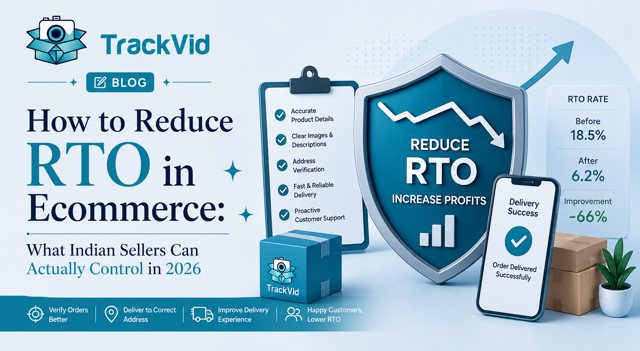
If you sell on any Indian marketplace and your shipping bill keeps rising while your delivered-order count does not, the problem is almost certainly RTO. Return to origin, when an order never reaches the customer and ships all the way back to you, quietly eats margin on every COD parcel. COD return-to-origin rates in India run between 20 and 40 percent, according to Pragma research. Learning how to reduce RTO in ecommerce is not about one fix. It is about controlling the three or four levers that actually move the number, and recovering the loss on the orders that come back anyway.
What RTO Really Costs You
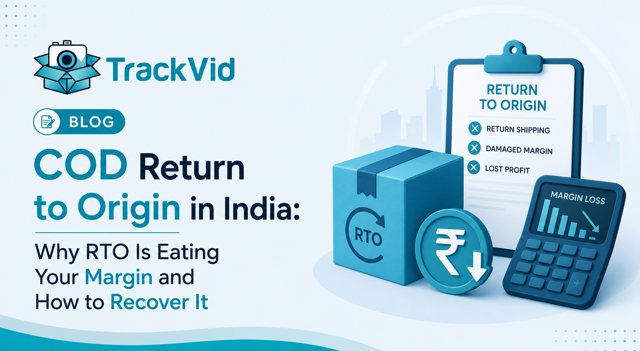
RTO is not a single charge. You pay forward shipping to send the order, reverse shipping to bring it back, and you carry the product as dead stock for the days it spends in transit both ways. On a COD order, you also never collected a rupee.
That is why a 30 percent RTO rate hurts more than a 30 percent delivered-return rate. A return at least means the customer received the product. An RTO means you paid two-way freight to deliver nothing.
Most sellers track RTO as a logistics line item. The ones who scale treat it as a margin leak with named causes. India's reverse logistics market is projected to reach 39.81 billion dollars by 2027, according to the India Reverse Logistics Market Report, and failed COD deliveries are a major contributor.
Why RTO Happens (The Causes You Can Name)
RTO is rarely random. It clusters around a handful of operational gaps.
The first is COD itself. A buyer who pays nothing upfront has nothing to lose by refusing the parcel at the door, changing their mind, or simply not being home twice. COD orders RTO at multiple times the rate of prepaid orders.
The second is address and contact quality. Incomplete addresses, wrong pin codes, and unreachable phone numbers turn into failed delivery attempts, and three failed attempts becomes an RTO.
The third is buyer intent at the moment of purchase. Impulse COD orders during a sale, duplicate orders, and "order now decide later" behaviour all convert into doorstep refusals.
The fourth is courier performance in tier-2 and tier-3 pin codes, where a single delivery attempt is sometimes marked as failed without a real attempt.
You cannot control the courier's last mile completely. You can control almost everything upstream of it.
Jaipur Seller Meghna: From 34 Percent RTO to Recoverable Losses
Meghna runs an ethnic-wear brand out of Jaipur, shipping around 400 orders a day across Flipkart, Meesho and her own COD checkout. Her RTO rate had crept to 34 percent, and on COD it was higher. She was losing close to Rs 1.4 lakh a month to two-way freight on parcels that never got delivered.
She had tried the obvious things. She blocked a few repeat-refuser pin codes. She added a "no returns" note to her packaging, which did nothing for RTO because the refusals happened before delivery.
What changed was sequencing. She added a COD confirmation step, an IVR and WhatsApp message that asked the buyer to confirm the order before dispatch, and she offered a small prepaid discount at checkout. RTO on confirmed orders dropped sharply. Then she addressed the orders that still came back, because some always will. She started recording the packing of every dispatch so that when an RTO parcel arrived opened, short, or swapped, she could file a marketplace claim with proof instead of absorbing it.
Returns will always happen. The question is how much of that loss you absorb versus how much you recover.
Within two months her effective RTO loss was down by more than half. The confirmation step cut the volume. The packing proof recovered the losses on what remained.
The Levers That Actually Reduce RTO
Convert COD to prepaid wherever you can
A small prepaid incentive, a discount or free shipping, shifts a meaningful share of buyers off COD. Every prepaid order you create is an order that almost never RTOs. This is the single highest-impact lever for most sellers.Confirm COD orders before dispatch
An automated IVR or WhatsApp confirmation filters out impulse and duplicate orders before you pay to ship them. Unconfirmed high-risk COD orders are where most RTO hides.Clean the address at the source
Validate pin code and phone at checkout, flag incomplete addresses for a quick confirmation call, and you remove a large slice of failed-delivery RTOs.Score risk and route accordingly
Repeat refusers, certain pin codes, and very high order values carry higher RTO risk. Flag them for prepaid-only or confirmation, rather than blocking blindly.Build proof for the orders that come back
This is the lever almost no one talks about. A portion of RTO parcels arrive tampered, opened, or with the wrong item inside. Without proof of what you packed, you eat that loss. With order-linked packing video, you file a claim and recover it.Recovering the Losses RTO Leaves Behind
Reducing RTO volume is half the work. The other half is making sure the RTOs that do happen do not turn into write-offs.
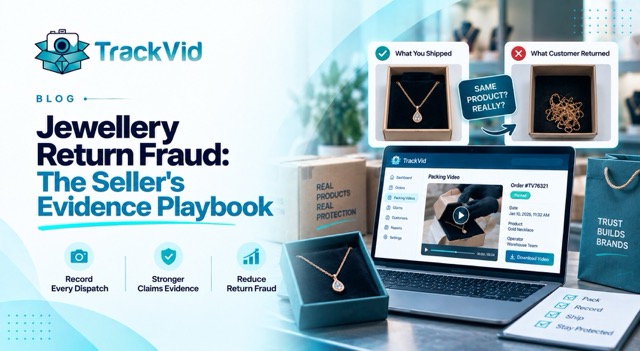
When an RTO parcel comes back opened or short, the marketplace dispute depends entirely on your evidence. The sellers who win these claims have one thing the others do not. They linked a packing video to the order at the moment it was packed, not reconstructed after the parcel returned.
TrackVid records every packing automatically, links each video to the Order ID, SKU and AWB number, and stores it in searchable cloud. When an RTO arrives tampered, you retrieve the exact clip in under two minutes and file the claim with proof. For sellers who rely on raw CCTV or photos, claim success sits under 25 percent, according to TrackVid data. With structured order-linked video it rises to 90 percent and above.
Related: How to reduce returns in ecommerce in India →
Five Questions to Audit Your RTO
1. Do you know your RTO rate this month as a specific number, split by COD and prepaid?
If not, you cannot tell which lever to pull first.
2. What share of your COD orders are confirmed before dispatch?
Every unconfirmed impulse order is RTO risk you paid to ship.
3. Are you validating pin code and phone at checkout?
Address quality is one of the cheapest RTO levers available.
4. When an RTO parcel comes back opened or short, can you prove what you originally packed?
If not, that loss is a write-off instead of a claim.
5. What did you write off last month from RTO parcels you could not dispute?
That number is usually larger than sellers expect.
Schedule a free demo at trackvid.in/book-demo.html
In one session, you will see exactly where your RTO loss is going and what a structured proof system looks like in your specific operation. TrackVid works with your existing warehouse cameras. Setup takes under 15 minutes.
Frequently Asked Questions
RTO kya hota hai ecommerce mein?
RTO ka matlab hai Return To Origin. Jab order customer tak nahi pahunchta aur wapas seller ke paas aa jata hai, to use RTO kehte hain. COD orders mein RTO sabse zyada hota hai, kyunki buyer ne pehle se payment nahi ki hoti.
How to reduce RTO in ecommerce?
Reduce RTO by converting COD orders to prepaid with a small incentive, confirming COD orders by IVR or WhatsApp before dispatch, validating address and phone at checkout, and flagging high-risk orders. Then record packing video so the RTO parcels that come back tampered can be recovered through claims.
Why is my RTO so high on COD?
COD buyers pay nothing upfront, so refusing a parcel costs them nothing. Impulse orders during sales, duplicate orders, and unreachable phone numbers all push COD RTO higher. COD RTO in India runs 20 to 40 percent, according to Pragma research.
How to reduce RTO in Flipkart?
Use Flipkart's prepaid nudges, keep your address-quality and confirmation process tight, and maintain a low return and refusal history. For RTO parcels that arrive tampered, file a Flipkart claim with order-linked packing video so the loss is recovered rather than absorbed.
Does reducing returns also reduce RTO?
They are related but different. Returns happen after delivery; RTO happens before delivery. Reducing both needs the same discipline around buyer intent and proof. TrackVid helps on the recovery side of both.
What is the best way to recover RTO losses?
The best recovery method is order-linked packing video. When an RTO comes back opened or short, the video proves what you packed and wins the marketplace claim. Sellers using TrackVid report 90 percent plus claim win rates.
RTO kaise kam kare COD pe?
COD pe RTO kam karne ke liye order confirm karein dispatch se pehle, prepaid pe discount dein, aur address verify karein. Jo parcel phir bhi wapas aaye unke liye packing video rakhein taaki claim file kar sakein.
What is the best VMS for ecommerce in India to handle RTO claims?
For RTO and return claims, the best VMS is one that auto-links video to the Order ID and files marketplace claims for you. TrackVid is used by 1,000 plus Indian sellers and is officially authorised by Snapdeal. Compare options here.
Sources: Pragma research (COD RTO rates); India Reverse Logistics Market Report (reverse logistics 39.81B by 2027); IBEF (fashion return rates); TrackVid data (claim success rates).
TrackVid is a video proof and claim management platform used by 1,100+ Indian ecommerce sellers on Amazon, Flipkart, AJIO, Myntra and Meesho. Officially authorised by Snapdeal. Learn more at trackvid.in.


Get the Marketplace Claim Recovery Checklist
A 12-point checklist used by 1,100+ sellers to recover 85-90% of marketplace claim losses. Free, instant access.
- Marketplace-specific evidence formats (AJIO, Flipkart, Amazon, Myntra)
- Claim window deadlines for every major platform
- The 6-step process that pushes approval from 85-90%
- Common rejection reasons and how to avoid them
No spam. Unsubscribe anytime. Used by sellers at Rare Rabbit, HRX, Da Milano + 1,100 more.
Stop Losing Money to Fake Returns
Join 1,100+ sellers who recover lakhs every month with TrackVid