

For sellers on Amazon, Flipkart, AJIO, Myntra and Meesho. Updated July 2026.
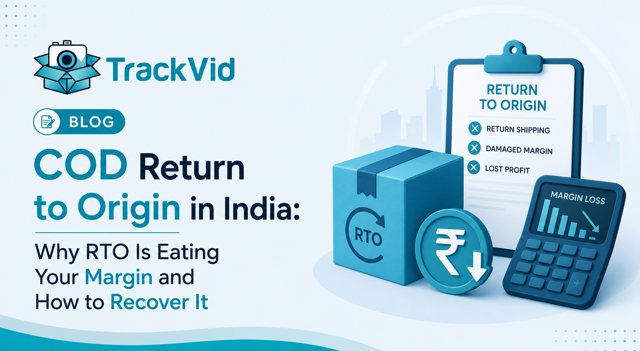
RTO in ecommerce is when an order never reaches the customer and travels back to you, usually because a cash-on-delivery buyer refused it or the address failed. India's average RTO rate is about 23 percent, according to GoKwik's analysis across more than 180 million shoppers, and Indian D2C brands collectively lose over Rs 8,000 crore a year to it. The loss is brutal because you pay forward and reverse shipping and recover nothing, and the product often comes back damaged or swapped.
RTO is not the same as a return. A return happens after delivery. RTO happens when delivery fails, which means you eat the full logistics cost with zero sale to show for it. For COD-heavy categories, it is the single largest silent drain on margin.
Why RTO in Ecommerce Is So High in India
RTO in ecommerce is driven by how India actually shops, and cash on delivery sits at the centre of it. COD still makes up 60 to 70 percent of orders in India, according to GoKwik data, and COD orders behave very differently from prepaid ones.
Prepaid orders barely fail. Their RTO sits under 2 percent. COD orders are a different story, with nearly 26 percent returning as RTO and fashion, footwear, and general merchandise touching 40 percent. The buyer has no money committed, so refusing at the door costs them nothing.
The RTO problem is really a commitment problem. When a buyer has paid nothing, the friction of saying no at delivery is zero.
Three forces stack on top of COD. The first is impulse ordering, where a buyer places an order and cools off before it arrives. The second is address and contact failure, where an incomplete address or unreachable phone means the courier cannot deliver. The third is order fraud, where fake COD orders placed by bots, competitors, or serial refusers are never meant to be accepted at all.
Each failed delivery carries a cost that most sellers underestimate. You pay to ship it out, pay to ship it back, and often receive a unit that can no longer be sold as new. India's reverse logistics market alone is projected to reach 39.81 billion dollars by 2027, according to the India Reverse Logistics Market Report, and RTO is a large slice of that.
The Half of RTO No One Talks About: What Comes Back in the Box
Reducing RTO gets all the attention. The packages that still come back get almost none, and that is where a second loss hides.
When an RTO parcel returns to your warehouse, most sellers assume the product inside is fine and restock it. Often it is not. The parcel was handled through two courier legs, and in COD categories it is a known target for swap and tampering, where the sealed box that returns does not contain the unit that left.
This is the exact gap that turns an operational loss into an unrecoverable one. You cannot file a claim on a tampered RTO parcel if you cannot prove what you packed. Without order-linked proof from packing, the RTO write-off and the fraud loss merge into one number you never question.
Returns will always happen. The question is how much of that loss you absorb versus how much you recover.
Jaipur Seller Meghna: Cutting RTO Losses and Recovering Rs 90,000 a Month
Meghna runs an apparel brand out of Jaipur, shipping around 300 orders a day, mostly COD across marketplaces and her own D2C store. Her RTO rate was sitting near the category average, and it was quietly eating her best months.
Her first fix was the obvious one. She added phone-based order confirmation for COD, flagged repeat-refuser numbers, and pushed prepaid with a small discount at checkout. Address validation caught incomplete pincodes before dispatch. Over a quarter, her RTO rate came down meaningfully, in line with the 15 to 25 percent reduction that address and verification steps typically deliver.
The problem she had not seen was the second loss. When RTO parcels came back, some were lighter than they should have been. A few had a cheaper garment inside. Her team had been restocking them without checking, because checking every returned parcel by hand was impossible at 300 orders a day.
Once every order was recorded at packing and linked to its Order ID, the picture changed. When a suspicious RTO came back, her team searched the Order ID, pulled the packing video, and could prove exactly what had shipped. That proof turned unrecoverable write-offs into claims she could actually file and win, recovering close to Rs 90,000 a month she had been absorbing silently.
"I spent a year trying to stop RTO," Meghna said. "The bigger leak was the RTO parcels I took back on faith without ever proving what was inside them."
Her RTO rate mattered. What mattered more was that she stopped losing twice on the same order.
How to Reduce RTO in Ecommerce
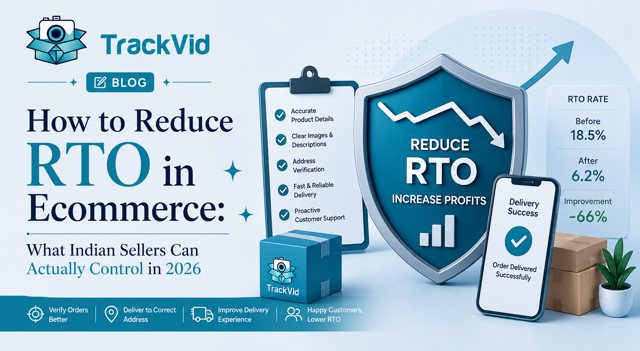
RTO in ecommerce comes down before delivery and gets contained after it. Both halves matter. Work through these in order.
- Verify COD orders before dispatch. Send an OTP or a confirmation call for COD orders. This step alone can cut fraudulent and impulse orders by 20 to 30 percent, according to industry data.
- Validate the address at checkout. AI address validation flags incomplete addresses and high-failure pincodes and can reduce address-related RTO by 15 to 25 percent.
- Push prepaid with a small nudge. A modest discount or cashback for advance payment moves buyers off COD, and prepaid RTO sits under 2 percent.
- Flag serial refusers. Track phone numbers and addresses with repeated refusals and route them to prepaid only.
- Set delivery expectations clearly. Accurate delivery timelines and proactive tracking updates reduce the buyer cool-off that drives door refusals.
- Prove what you packed on every order. For the RTO parcels that still come back, order-linked packing video is what lets you catch tampering and recover the loss instead of restocking a swapped unit.
The first five steps shrink how many parcels come back. The sixth decides how much you lose on the ones that do.
Where TrackVid Fits Into RTO
TrackVid does not reduce your RTO rate, and it should not claim to. Address validation, COD verification, and prepaid incentives do that. What TrackVid (trackvid.in) protects is the second loss, the one that hits when an RTO parcel comes back tampered and you have no way to prove what left your warehouse.
TrackVid records every packing automatically and links each video to its Order ID, SKU, and AWB at the moment of packing. When an RTO parcel returns lighter or wrong, your team searches the Order ID and has the packing video in under two minutes, ready as primary evidence for a marketplace claim. The RTO you cannot prevent still deserves proof, because a tampered parcel with proof is a claim, and without proof it is a write-off.
The system works with your existing warehouse cameras, stores every video in searchable cloud, and is used by more than 1,100 Indian ecommerce sellers across Amazon, Flipkart, AJIO, Myntra, and Meesho. It is a recovery system for the losses that survive your RTO reduction efforts.
Related: How to reduce returns in ecommerce, what Indian sellers actually need to know
Five Questions to Check Your Real RTO Cost
1. Do you know your RTO rate this month as a specific number, split by COD and prepaid?
If not, you cannot see which channel is bleeding.
2. When an RTO parcel comes back, does anyone verify the unit inside before restocking?
Restocking on faith is how swapped parcels re-enter your inventory.
3. Can you retrieve the packing video for any RTO order in under two minutes?
If not, tampered parcels become silent write-offs.
4. What share of your COD orders are verified before dispatch?
Unverified COD is where impulse and fraud RTO concentrate.
5. Do you count the reverse-shipping and lost-unit cost of RTO, or only the missed sale?
The full cost is usually double what sellers assume.
Stop Losing Twice on the Same Order
Schedule a free demo at trackvid.in/book-demo.html
In one session, you will see exactly where your recoverable revenue is going and what a structured proof system looks like in your specific operation. TrackVid works with your existing warehouse cameras. Setup takes under 15 minutes.
Related: How to recover revenue from ecommerce returns
Frequently Asked Questions
Rto in ecommerce meaning
RTO in ecommerce means return to origin, when an order fails to reach the customer and is sent back to the seller. It usually happens because a cash-on-delivery buyer refuses the parcel at the door or the delivery address fails. The seller pays both forward and reverse shipping and recovers no sale, which makes RTO one of the most expensive losses in Indian ecommerce.
How to reduce rto in ecommerce india
Verify COD orders with an OTP or confirmation call, validate addresses at checkout, and nudge buyers toward prepaid with a small discount. These steps can cut RTO meaningfully, since prepaid RTO stays under 2 percent while COD RTO can touch 40 percent, according to GoKwik data. For the parcels that still come back, keep order-linked packing video so a tampered RTO becomes a recoverable claim.
Rto kya hota hai ecommerce
RTO ka matlab hai return to origin, yaani order customer tak nahi pahuncha aur wapas seller ke paas aa gaya. India me ye zyada tar COD orders me hota hai jab buyer parcel refuse kar deta hai. Iska cost double hota hai kyunki forward aur reverse dono shipping seller ko bharni padti hai, aur kai baar parcel me product swap ho kar wapas aata hai.
Cod rto kaise kam kare
COD RTO kam karne ke liye har COD order ko dispatch se pehle OTP ya call se verify karo, address checkout par validate karo, aur prepaid par chhoti si discount do. Prepaid orders ka RTO 2 percent se kam hota hai jabki COD ka 26 se 40 percent tak jaata hai. Jo parcel phir bhi wapas aaye, uska packing video TrackVid me linked ho to tampering pakad kar loss recover ho sakta hai.
Why is my rto rate so high?
A high RTO rate almost always traces back to unverified COD orders, incomplete addresses, and impulse buyers who cool off before delivery. COD makes up 60 to 70 percent of Indian orders and behaves very differently from prepaid, which is why COD-heavy fashion and footwear can hit 40 percent RTO. Verification, address validation, and prepaid nudges are the fastest levers.
Does reducing RTO also stop return fraud?
No, they are two separate losses. Reducing RTO lowers how many parcels come back, but it does not protect the parcels that still return tampered or swapped. To recover those, you need order-linked packing proof, because a swapped RTO parcel without proof is written off while the same parcel with proof becomes a claim you can win.
How much does RTO cost Indian sellers?
Indian D2C brands collectively lose over Rs 8,000 crore a year to RTO, according to GoKwik, and India's reverse logistics market is projected to reach 39.81 billion dollars by 2027. Per order, the cost includes forward shipping, reverse shipping, and often a unit that can no longer be sold as new, which is why the true RTO cost is usually about double what sellers first assume.
What is the best way to protect against RTO losses in India?
Combine prevention and proof. Cut RTO volume with COD verification, address validation, and prepaid incentives, then protect the returning parcels with order-linked packing video so tampering becomes recoverable. TrackVid provides that proof layer for more than 1,100 Indian sellers, working with existing cameras and setting up in under 15 minutes.
Sources: GoKwik RTO and COD data, India Reverse Logistics Market Report, industry verification and address-validation data, TrackVid seller data.
TrackVid is a video proof and claim management platform used by 1,100+ Indian ecommerce sellers on Amazon, Flipkart, AJIO, Myntra and Meesho. Officially authorised by Snapdeal. Learn more at trackvid.in.
Get the Marketplace Claim Recovery Checklist
A 12-point checklist used by 1,100+ sellers to recover 85-90% of marketplace claim losses. Free, instant access.
- Marketplace-specific evidence formats (AJIO, Flipkart, Amazon, Myntra)
- Claim window deadlines for every major platform
- The 6-step process that pushes approval from 85-90%
- Common rejection reasons and how to avoid them
No spam. Unsubscribe anytime. Used by sellers at Rare Rabbit, HRX, Da Milano + 1,100 more.
Stop Losing Money to Fake Returns
Join 1,100+ sellers who recover lakhs every month with TrackVid