
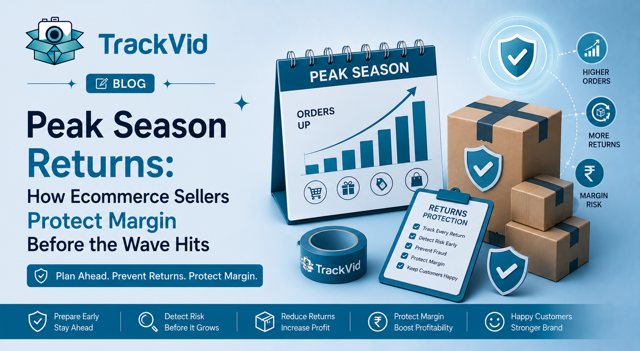
For ecommerce and D2C sellers preparing for the busiest, highest-return season of the year. Updated July 2026.
Peak season returns are the returns that arrive after your biggest sales window, and they do more damage than the volume alone suggests. Returns spike, fraud spikes faster, and dispute windows get missed under the load. Return abuse surged 64 percent between January 2024 and May 2025, according to Signifyd 2026 data, and festive-period return rates can reach 40 percent. The season that makes your revenue is also the season that quietly takes the most of it back.
The mistake most operators make is treating peak season returns as a volume problem to survive. It is a margin problem to plan for. The orders you win in November are decided in the returns and disputes you process through December and January.
Why Peak Season Returns Hit Margin Harder
Peak season returns compound three pressures at once, and each one makes the others worse. Volume rises, so every process runs closer to its limit. Fraud rises, because high volume is exactly when bad actors hide. Time compresses, because dispute and claim windows do not extend just because your queue got longer.
Volume is the visible part. A big sale event can double or triple order flow, and returns follow four to six weeks later, landing right when teams are stretched thin. Processing a single return already costs 20 to 65 percent of the item's value, according to NRF and Shopify data, so a returns spike is a direct margin event. A single high-volume week in November can keep costing you well into January, long after the revenue has been booked and the sale has been celebrated. That gap, between when you earn the money and when you quietly lose part of it back, is exactly what makes peak season margin so hard to protect.
Fraud is the hidden part. Friendly fraud, where a customer disputes a legitimate charge, now accounts for around 36 percent of ecommerce fraud, and 45 percent of consumers admit to some form of return policy abuse, according to Riskified 2026. A small group does most of the damage, with serial returners making up 5 to 10 percent of buyers while driving 30 to 40 percent of returns, according to Claimlane 2026.
Peak season is when abuse is cheapest to commit and hardest to catch. The queue is long, the staff is tired, and a fraudulent return looks identical to an honest one until someone checks.
The third pressure is time. Chargeback and marketplace dispute windows are fixed. When return volume triples, the manual work of pulling evidence for each dispute does not, so windows get missed and winnable claims are lost by default rather than on the merits.
The Return Behaviours That Spike When Volume Peaks
Peak season returns are not one problem. They are three behaviours that all rise at once, and each needs a different response.
The first is bracketing, where a shopper orders the same item in several sizes or colours intending to keep one and return the rest. It is now common behaviour rather than an edge case, and it inflates return volume without any bad intent. Bracketing is expensive but honest, and the fix is policy and sizing accuracy, not proof.
The second is wardrobing, where a buyer wears an item once, a party dress or a pair of shoes for an event, then returns it as unworn. Wardrobing spikes hardest around holidays and peak occasions for obvious reasons, and nearly half of retailers report being hit by it. During peak the volume makes each case harder to inspect. Here proof matters, because a worn item returned as new is a condition dispute you can only win if you can show what left your warehouse.
The third is outright return fraud, including empty-box returns, swapped items, and claims of a parcel never arriving while the buyer holds the product. This is where friendly fraud lives, accounting for around 36 percent of ecommerce fraud. During peak, a fraudulent return is nearly invisible in a queue of thousands, which is exactly why organised abusers time it for the busiest weeks.
The three behaviours share one defence, which is evidence of what shipped. Bracketing needs better policy, but wardrobing and fraud are won or lost on whether you can prove the condition and contents of the order that went out.
That distinction changes how you prepare. You cannot inspect your way out of peak season fraud by hand, because the volume that makes the season profitable is the same volume that makes manual checking impossible. The sellers who hold margin do not check harder. They make sure every order carried proof before it shipped, so the check is already done.
The Story Every Operator Recognises: Winning the Claim You Could Not Prove
Consider a D2C footwear and apparel brand running on Shopify and Amazon, shipping around 500 orders a day at normal volume and roughly double that through a peak event. Call the operations lead Daniel.
Through the peak, sales looked excellent. The problem showed up six weeks later. Returns and disputes arrived in a wave, and a meaningful share were not honest. Boxes came back with worn items, with a different pair inside, or with a dispute filed claiming the order never arrived at all.
Daniel's team fought each one with what they had, which was order confirmations, delivery tracking, and photos taken at the returns desk. They lost most of the disputes. Delivery tracking proved the parcel moved, not what was inside it, and a photo taken at the desk could not prove the condition at dispatch. The brand absorbed the refunds, the return shipping, and the lost units, and the losses stacked up to a five-figure USD hit for the season.
The fix was not fighting harder. It was changing the evidence. Once every order was recorded at packing and linked to its order number at the moment it was packed, the team stopped reconstructing the story after each dispute and started attaching proof that already existed. Through the next peak, dispute win rates climbed sharply, and the season that used to leak margin held it.
"We were not losing to fraud," Daniel said. "We were losing to the fact that we could never prove what we actually shipped."
The problem is not the fraud. It is the proof.
How to Prepare for Peak Season Returns
Peak season returns are won by decisions made before the season, not during it. Work through these while the queue is still short.
- Forecast the returns wave, not just the sales spike. Expect returns to land four to six weeks after the peak and staff for that window, not the sales week.
- Tighten your return policy honestly. Clear condition requirements and return windows reduce wardrobing and bracketing without punishing genuine buyers.
- Flag serial returners early. A small group drives a large share of returns, so identify repeat abusers before peak and adjust their options.
- Build proof into packing now. Order-linked packing video captured before the season means every disputed order already has evidence when the window opens.
- Automate evidence retrieval. Manual clip-hunting collapses under peak volume, so make every order's proof searchable in seconds.
- Track dispute win rate as a number. If you cannot see it, you cannot defend it, and peak season is when it drops fastest.
The pattern is consistent. The seller who prepares evidence before peak recovers margin that the seller who reacts during peak writes off.
Where TrackVid Fits Into Peak Season
The operators who hold margin through peak season are not fighting disputes better. They walk into every dispute with proof that already exists.
TrackVid (trackvid.in) is a video proof and claim management platform that records every packing automatically and links each video to its order number, SKU, and tracking ID at the moment of packing. When a return or dispute lands during the post-peak wave, the team searches the order and has the packing video in under two minutes, ready as primary evidence for a marketplace claim or a chargeback representment.
That is what makes proof scale when volume does not. The evidence is captured before the dispute, not reconstructed after it, so a tripling of return volume does not triple the work of defending each claim. TrackVid works with existing warehouse cameras, stores every video in searchable cloud, and is used by more than 1,100+ ecommerce sellers.
Related: How to win a chargeback dispute as an ecommerce seller in 2026
Five Questions to Check Your Peak Season Readiness
1. Can you retrieve any order's packing video in under two minutes during your busiest week?
If not, peak volume will bury your evidence when you need it most.
2. Do you know your dispute win rate as a specific number?
If you cannot measure it, you cannot protect it through peak.
3. Are you staffing for the returns wave four to six weeks out, or only the sales spike?
Returns arrive after the celebration, when everyone has moved on.
4. When a chargeback claims the item was wrong, can you prove what shipped for that order?
Delivery tracking answers the wrong question in a condition dispute.
5. If order volume doubled next peak, would your evidence process still hold?
Manual proof breaks under load. Order-linked proof does not.
Go Into Peak Season With Your Proof Already Built
Schedule a free demo at trackvid.in/book-demo.html
In one session, you will see exactly where your recoverable revenue is going and what a structured proof system looks like in your specific operation. TrackVid works with your existing warehouse cameras. Setup takes under 15 minutes.
Related: Ecommerce return statistics 2026, the global data every seller needs to know
Frequently Asked Questions
How to prepare for peak season returns
Prepare before the season, not during it. Forecast the returns wave for four to six weeks after your sales peak, tighten condition and window rules in your return policy, flag serial returners early, and build order-linked packing proof into every order now. That way every disputed order already has evidence when the window opens, instead of being reconstructed under pressure.
Why do returns spike during peak season?
Higher order volume produces proportionally more returns, and impulse buying during sale events increases the share that come back. Return abuse rises alongside it, having surged 64 percent between January 2024 and May 2025, according to Signifyd 2026. The combination of volume and abuse is why peak season returns damage margin more than the raw numbers suggest.
Peak season return fraud how to stop
You cannot stop every fraudulent return, but you can make each one recoverable. Capture order-linked packing video so a swapped or worn return can be proven, flag serial returners who drive a disproportionate share of abuse, and keep dispute evidence searchable so windows are never missed. TrackVid provides that proof layer so peak season return fraud becomes a claim you can win rather than a write-off.
How much do peak season returns cost?
Each return costs 20 to 65 percent of the item's value to process, according to NRF and Shopify data, before counting the refund and lost unit. During peak, that cost multiplies with volume and is worsened by fraud, since friendly fraud makes up around 36 percent of ecommerce fraud and 45 percent of consumers admit some return abuse, according to Riskified 2026. The true seasonal cost is the processing, the refunds, and the disputes lost for lack of proof combined.
Best way to handle holiday returns ecommerce
Handle holiday returns as a margin plan rather than a volume scramble. Staff for the delayed returns wave, set clear return terms up front, and make sure every order carries proof of what shipped so disputes are winnable. Operators who prepare evidence before the season recover margin that reactive sellers write off.
What is friendly fraud during peak season?
Friendly fraud is when a genuine customer disputes a legitimate charge, claiming the item never arrived or was not as described, to keep both the product and the refund. It accounts for around 36 percent of ecommerce fraud and rises during peak when dispute volume hides it. Order-linked packing proof is the strongest defence, because it shows exactly what shipped for the disputed order.
Do delivery tracking and receipts win return disputes?
Usually not for condition or wrong-item disputes. Delivery tracking proves a parcel moved and a receipt proves what was ordered, but neither proves what was inside the box at dispatch. Order-linked packing video is the evidence that answers the actual question, which is what the seller shipped for that specific order.
What is the best system to protect margin during peak season?
The best system records every packing automatically, links each video to the order at the moment of packing, and keeps it searchable so evidence retrieval does not collapse under peak volume. TrackVid does this for more than 1,100+ ecommerce sellers, working with existing cameras and setting up in under 15 minutes, so disputes stay winnable when volume triples.
Sources: NRF and Shopify return-cost data, Signifyd State of Commerce 2026, Riskified 2026, Claimlane 2026, TrackVid seller data.
TrackVid is a video proof and claim management platform used by 1,100+ ecommerce sellers on Amazon, Flipkart, AJIO, Myntra and Meesho. Officially authorised by Snapdeal. Learn more at trackvid.in.
Get the Marketplace Claim Recovery Checklist
A 12-point checklist used by 1,100+ sellers to recover 85-90% of marketplace claim losses. Free, instant access.
- Marketplace-specific evidence formats (AJIO, Flipkart, Amazon, Myntra)
- Claim window deadlines for every major platform
- The 6-step process that pushes approval from 85-90%
- Common rejection reasons and how to avoid them
No spam. Unsubscribe anytime. Used by sellers at Rare Rabbit, HRX, Da Milano + 1,100 more.
Stop Losing Money to Fake Returns
Join 1,100+ sellers who recover lakhs every month with TrackVid