
For sellers on Amazon, Shopify, Walmart and global marketplaces. Updated July 2026.
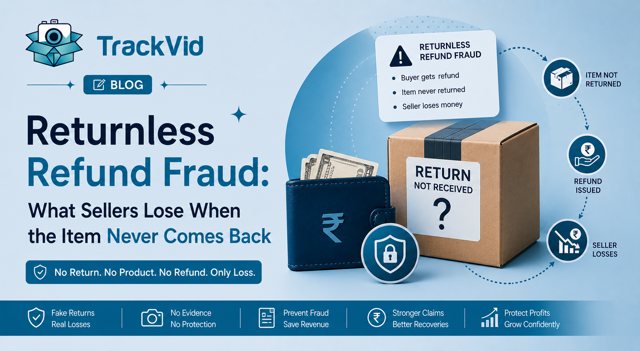
Returnless refund fraud happens when a customer receives a refund and keeps the product, because the platform decided the item was not worth shipping back. The policy is called a returnless or "keep it" refund, and it was designed to save money on low-value returns. For sellers, it has quietly become one of the easiest fraud vectors to exploit, because there is no returned item to inspect and no proof that anything was ever wrong.
The trend is accelerating. Amazon announced in January 2026 that it would expand returnless refunds to third-party sellers using its fulfillment services globally, particularly for purchases under 75 dollars in the US, and Walmart and Target have rolled out similar keep-it options, according to reporting from ConsumerAffairs and Shopify's returns research. More returnless refunds means more transactions where the seller pays and never sees the goods again.
Set against a return fraud problem that already costs retailers more than 103 billion dollars a year, according to the NRF, returnless refund fraud is not a small edge case. It is a growing hole in the middle of the returns process.
How Returnless Refund Fraud Actually Works
A returnless refund removes the one control sellers relied on: the physical return. Once that is gone, three abuse patterns take over.
The first is the false-fault claim. A customer reports an item as damaged, defective, or not as described, knowing that a low-value order will trigger an automatic keep-it refund with no return required. They keep a working product and get their money back.
The second is repeat exploitation. A small group of buyers learns which price points and categories auto-approve returnless refunds and files the same claim across multiple orders. Serial returners already drive a disproportionate share of returns, with 5 to 10 percent of buyers responsible for 30 to 40 percent of returns, according to Claimlane 2026.
The third is organised abuse. There is now a documented layer of refund fraud as a service, where operators sell scripts and instructions for triggering refunds without returning goods, promoted on social and messaging platforms. This turns a policy convenience into a repeatable playbook.
A returnless refund assumes the customer is honest. Fraudsters read that same policy as an invitation.
Why Sellers Cannot Contest What They Cannot Prove
The reason returnless refund fraud is hard to fight is structural. Every other return leaves evidence behind in the returned parcel. A returnless refund leaves nothing.
When there is no item to inspect, the dispute becomes the customer's claim against the seller's memory. The customer says the item arrived damaged. The seller has an order record and a shipping label, but nothing that shows the actual condition of that specific unit when it left the warehouse. Platforms default to the customer, and the refund stands.
This is the same evidence gap that sinks friendly fraud and chargeback disputes. Around 45 percent of consumers admit to some form of return policy abuse, according to Riskified 2026, and apparel abuse rose 13 percent year on year, according to Signifyd's State of Commerce 2026. The behaviour is common precisely because it is rarely contested with proof.
For D2C brands the damage compounds. A returnless refund on a 40 dollar order is not just 40 dollars. It is the product cost, the original shipping, the payment processing, and the lost margin, with no recovered inventory to offset any of it.
The problem is not the fraud. It is the proof.
A D2C Operator's Story: The Refund Line That Kept Growing
A mid-sized D2C accessories brand selling on its own Shopify store and on Amazon ran roughly 500 orders a day across the US and UK. Returns were normal. What was not normal was a refund line that kept climbing even as return shipments stayed flat.
The operations lead traced it to returnless refunds. Buyers were reporting items as defective, triggering keep-it refunds under the low-value threshold, and no product was coming back. In one quarter, the brand issued around 12,000 dollars in returnless refunds it had no way to contest, because it had no record of each item's condition at dispatch.
The team first tried tightening the return policy language and adding photo requirements at claim time. It did nothing, because a photo taken by the buyer after delivery proves nothing about how the item shipped. They were still arguing condition with no evidence of their own.
The change was recording order-linked packing video for every order, so each unit's condition at dispatch was documented before any claim existed. When a customer next reported a returnless-eligible item as defective, the brand had a clip showing the item sealed and intact under that order number. It used that proof to contest the claim and to challenge the pattern with the marketplace.
Within two quarters, its contest rate on returnless and disputed refunds rose sharply, and the uncontested refund line stopped growing.
In the operator's words: "We were not losing to returns. We were losing to the fact that we could never prove our side."
How to Limit Returnless Refund Fraud
You cannot opt out of every keep-it policy, and you should not want to, because returnless refunds genuinely reduce cost on honest low-value returns. The goal is to keep the convenience while closing the fraud gap.
Document condition at dispatch, not at dispute
The only evidence that survives a returnless refund is proof captured before the order shipped. Order-linked packing video shows the exact item, sealed and correct, tied to the order number. It is the one record the buyer cannot dispute after the fact.
Track returnless refunds as their own metric
Separate returnless refunds from standard returns in your reporting. If the line grows while return shipments stay flat, you are looking at abuse, not demand.
Flag repeat claimants
Identify buyers filing multiple returnless or defective claims. Serial abusers are a small group with an outsized cost, and pattern evidence plus condition proof is what lets you challenge them with the platform.
Use proof to contest, not just to record
Evidence only helps if you use it. When a returnless refund looks fraudulent, submit your order-linked packing video as part of the dispute or chargeback representment rather than absorbing the loss by default.
What a Returnless Refund Actually Costs
The sticker loss on a returnless refund is the order value. The real loss is larger, because nothing comes back to offset it.
On a standard return, the seller at least recovers the inventory and can resell it. On a returnless refund the item is gone, so the loss stacks: the product cost, the original outbound shipping, the payment processing fee, and the full margin, with no recovered unit and no resale. A 40 dollar order can carry a true cost well above 40 dollars once every line is counted.
The exposure scales with policy, not with demand. Amazon expanded returnless refunds to third-party sellers in January 2026, particularly for orders under 75 dollars in the US, according to ConsumerAffairs and Shopify research, so more of a seller's low-value catalogue now sits inside the auto-refund threshold. Walmart and Target run comparable keep-it options. Every widening of that threshold widens the fraud surface.
The categories most exposed are predictable: low unit cost, high resale value, and easy to claim as defective. Consumer electronics accessories, beauty, and fast fashion see the most returnless refund fraud, because the refund is quick, the item is worth keeping, and the seller has no returned unit to inspect. Layer in that 45 percent of consumers admit to some return policy abuse, according to Riskified 2026, and the pattern is not an edge case. It is a standing cost that grows every quarter it goes unmeasured.
There is also a bridge to chargebacks. A buyer who learns that a keep-it claim works will often escalate to a bank dispute on higher-value orders, where the seller again needs proof of what shipped. The same order-linked evidence that answers a returnless refund answers a chargeback representment, which is why sellers treat both as one proof problem rather than two.
Where TrackVid Fits
The sellers who lose the least to returnless refund fraud have built one thing: a record of every order's condition at the moment it shipped, before any claim exists.
TrackVid (trackvid.in) records every packing automatically and links each video to the order ID, SKU, and tracking number. When a returnless refund or a chargeback is filed, the seller retrieves the packing clip in seconds and uses it as primary evidence that the correct item shipped in good condition. There is no returned parcel to inspect, so this dispatch-side proof is the only proof that exists.
This is what separates recording from evidence. A general camera feed cannot be tied to one order after the fact. TrackVid links the video to the order at packing, so the proof is ready the moment a returnless refund is challenged. Sellers who move from no structured proof to order-linked video report dispute and claim success rising from under 25 percent to 90 percent and above, according to TrackVid data.
It works with existing cameras and takes under 15 minutes to set up. Related: How to recover revenue from ecommerce returns and Related: How sellers stop FTID fraud
Five Questions to Test Your Returnless Refund Exposure
1. Do you track returnless refunds separately from standard returns, or are they hidden inside one refund number?
2. For any shipped order, can you show the item's condition at dispatch, or only the customer's claim after delivery?
3. Is your returnless refund line growing while your return shipment volume stays flat?
4. Do you have a way to flag buyers filing repeat defective or keep-it claims?
5. When a returnless refund looks fraudulent, do you contest it with evidence, or refund by default?
If the honest answer to most of these is no, the exposure is not small. It is compounding with every keep-it refund the platform grants.
Schedule a free demo at trackvid.in/book-demo.html
In one session, you will see exactly where your recoverable revenue is going and what a structured proof system looks like in your specific operation. TrackVid works with your existing cameras. Setup takes under 15 minutes.
Frequently Asked Questions
What is returnless refund fraud
Returnless refund fraud is when a customer gets a refund and keeps the product because the platform did not require a return. Fraudsters report low-value items as damaged or defective to trigger automatic keep-it refunds, then keep a working product for free. With no returned item to inspect, sellers cannot contest it without proof of the item's condition at dispatch.
How do fraudsters abuse returnless refunds
They target the price points and categories that auto-approve keep-it refunds, file false damage or not-as-described claims, and repeat the pattern across multiple orders. A small group drives most of it, with 5 to 10 percent of buyers responsible for 30 to 40 percent of returns, according to Claimlane 2026. There is also an organised refund-fraud-as-a-service layer selling scripts for it.
Can you get scammed with returnless refunds as a seller
Yes. Because no item comes back, a returnless refund removes the seller's ability to inspect and disprove a false claim. Around 45 percent of consumers admit to some return policy abuse, according to Riskified 2026. Sellers who record order-linked packing video can still contest these claims by proving the item shipped correctly.
How to prevent returnless refund fraud
You cannot block every keep-it policy, so the practical defence is proof and monitoring. Document each order's condition at dispatch with order-linked packing video, track returnless refunds as a separate metric, flag repeat claimants, and contest suspicious refunds with evidence instead of absorbing them. Platforms like TrackVid capture this dispatch-side proof automatically.
Returnless refund vs return fraud, what is the difference
Return fraud is a broad category covering swaps, wardrobing, and empty-box returns where an item is sent back. Returnless refund fraud is a specific subset where no item is returned at all, because the platform granted a keep-it refund. The returnless version is harder to contest, since there is no returned parcel to inspect, which makes dispatch-side proof the only evidence available.
Amazon returnless refund seller loss, how big is it
The loss is the full order value with no recovered inventory: product cost, shipping, and processing combined. Amazon expanded returnless refunds to third-party sellers in January 2026, especially for orders under 75 dollars in the US, according to ConsumerAffairs and Shopify research, which widens exposure. Return fraud overall already costs retailers more than 103 billion dollars a year, according to the NRF.
Is a proof system worth it for returnless refunds
For any seller with meaningful returnless refund volume, yes. The only evidence that survives a keep-it refund is proof captured before the item shipped. Order-linked packing video, used by 1,100+ sellers through TrackVid, moves dispute and claim success from under 25 percent to 90 percent and above, according to TrackVid data, which turns an uncontestable loss into a recoverable one.
Sources: NRF; Signifyd State of Commerce 2026; Riskified 2026; Claimlane 2026; ConsumerAffairs (Amazon keep-it returnless refunds, 2025-2026); Shopify returns research; TrackVid data.
TrackVid is a video proof and claim management platform used by 1,100+ ecommerce sellers on Amazon, Shopify, Walmart, Flipkart, AJIO, Myntra and Meesho. Officially authorised by Snapdeal. Learn more at trackvid.in.
Get the Marketplace Claim Recovery Checklist
A 12-point checklist used by 1,100+ sellers to recover 85-90% of marketplace claim losses. Free, instant access.
- Marketplace-specific evidence formats (AJIO, Flipkart, Amazon, Myntra)
- Claim window deadlines for every major platform
- The 6-step process that pushes approval from 85-90%
- Common rejection reasons and how to avoid them
No spam. Unsubscribe anytime. Used by sellers at Rare Rabbit, HRX, Da Milano + 1,100 more.
Stop Losing Money to Fake Returns
Join 1,100+ sellers who recover lakhs every month with TrackVid