
For ecommerce and D2C sellers shipping across Shopify, Amazon, eBay and global marketplaces. Updated June 2026.
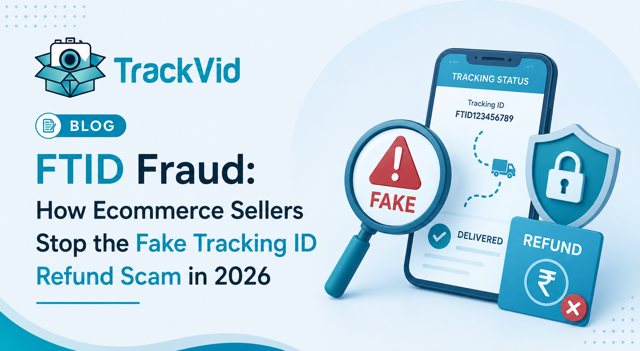
FTID fraud is a return scam where a buyer gets a refund using a fake tracking ID while keeping the product. FTID stands for Fake Tracking ID. The fraudster ships an empty or junk-filled package using a real tracking number that belongs to a different shipment, so the carrier scan looks valid and the refund is auto-approved before anyone opens the box. According to industry estimates reported by return-fraud vendors, FTID fraud may cost retailers up to 18 billion dollars a year. It sits inside a global return fraud problem the NRF puts at roughly 103 billion dollars annually.
The scam works because most refund systems trust the scan, not the contents.
How FTID Fraud Actually Works
The mechanics are simple, which is why FTID fraud scales so well across stores.
A buyer requests a return and gets a prepaid label. Instead of sending back the item, they attach or reference a tracking number from a different package, often a cheap, lightweight item shipped to a nearby ZIP code, or a number from a parcel that has already been delivered and cleared the carrier system.
The carrier scans that unrelated package as "in transit" or "delivered." The seller's automated refund logic sees a valid scan against the return and issues the money. The real product never comes back. By the time a warehouse worker opens the actual package, if one arrives at all, the refund is long gone.
FTID fraud does not break the system. It exploits the one assumption the system is built on: that a tracking scan means the right item is inside.
Why FTID Fraud Is Growing in 2026
Three forces are pushing FTID fraud up, and all of them are getting stronger.
Return volume keeps rising, and high volume hides individual fraud. According to Signifyd 2026 data, return abuse surged 64 percent between January 2024 and May 2025, which gives fraudsters cover inside a flood of legitimate returns.
Policy abuse is now mainstream behaviour. According to Riskified 2026, 45 percent of consumers admit to some form of return policy abuse, and friendly fraud accounts for around 36 percent of all ecommerce fraud.
A small group does most of the damage. According to Claimlane 2026, serial returners, roughly 5 to 10 percent of buyers, drive 30 to 40 percent of returns. These are the buyers most likely to learn and repeat methods like FTID.
Related: Ecommerce return statistics 2026 →
A US Operator Story: 30,000 Dollars a Month Walking Out the Door
Daniel runs fulfilment for a mid-sized apparel and accessories D2C brand in Austin, shipping around 600 orders a day across Shopify and a marketplace storefront. Returns were budgeted. The leakage was not.
His refund flow was efficient and, it turned out, exploitable. When a return tracking number showed a carrier scan, his system auto-approved the refund to keep customer satisfaction scores high. For months the numbers looked normal.
Then a pattern surfaced in the data. A cluster of customers were returning high-value sneakers and jackets, every one showing a clean delivery scan, but the warehouse kept logging empty or wrong-weight packages against those same orders days later. The refunds had already been paid. Daniel was losing close to 30,000 dollars a month to returns that were never really returned.
He had delivery scans. He had order records. What he did not have was proof of what left his warehouse, linked to each order, that he could put in front of a payment processor during a dispute.
The problem is not the fraud. It is the proof.
He moved to order-linked packing video and changed his refund rule so high-value returns required an inspection match before payout. The next FTID attempt was caught at representment. He pulled the packing video for the order, showed the genuine item sealed and shipped, and matched it against the empty package the warehouse received. The dispute was won, and the pattern of repeat offenders dropped off once refunds stopped being automatic.
We were paying people to keep our product. The day we could show what we actually shipped, the game changed.
How to Detect and Stop FTID Fraud
You cannot stop a buyer from faking a tracking ID. You can stop the refund from going out unverified and win the dispute when it does.
1. Break the auto-refund-on-scan rule for high-value items
Do not release refunds on a carrier scan alone for orders above a value threshold. Require an inspection match first. The scan is the exact thing FTID exploits.2. Match weight and contents at receiving
Compare the received package weight against the expected item weight. A returned jacket that weighs 80 grams is a flag before anyone opens it.3. Record order-linked proof of what you shipped
Capture a packing video tied to the order, SKU and shipment ID at the moment of packing, so you can prove the genuine item left in good condition.4. Build a dispute pack, not an argument
When you challenge a refund or chargeback, submit the packing proof plus the receiving evidence as a matched pair. Processors respond to evidence that shows both ends.5. Flag and gate repeat offenders
Track refund behaviour by customer. The serial 5 to 10 percent driving most returns, per Claimlane 2026, should not get frictionless refunds.Related: How to win a chargeback dispute as an ecommerce seller →
Where TrackVid Fits
Sellers who beat FTID fraud share one capability. They can prove what they shipped, order by order, before the refund is requested.
TrackVid records every packing automatically and links each video to the order, SKU and shipment number at the moment of packing, then stores it in searchable cloud. When an FTID refund or chargeback appears, you retrieve the exact packing video in minutes and submit it as primary evidence that the genuine item was sealed and shipped. Combined with weight and contents checks at receiving, that turns an auto-approved loss into a winnable dispute.
It works with your existing cameras and takes under 15 minutes to set up. The same proof layer works whether you sell on Shopify, Amazon, eBay or your own storefront.
Five Questions to Check Your FTID Exposure
1. Do you auto-refund on a carrier scan without inspecting the item?
That single rule is what FTID fraud is built to exploit.
2. Can you prove what you shipped for a specific order in under two minutes?
If not, every dispute starts with you on the back foot.
3. Do you check returned package weight against expected item weight?
Mismatches catch empty and junk-filled returns before refund.
4. Do you track refund behaviour by customer?
A handful of repeat offenders drive most of the loss.
5. When you fight a refund, do you submit matched proof of both ends?
Shipping proof plus receiving proof wins disputes that arguments lose.
Schedule a free demo at trackvid.in/book-demo.html
In one session, you will see exactly where your recoverable revenue is going and what a structured proof system looks like in your specific operation.
Frequently Asked Questions
What is FTID fraud?
FTID fraud, or Fake Tracking ID fraud, is a return scam where a buyer gets a refund using a tracking number that belongs to a different package, while keeping the original item. The carrier scan looks valid, so automated refund systems pay out before anyone inspects the return. Industry estimates put the cost to retailers at up to 18 billion dollars a year.
How do I detect fake tracking ID returns?
Stop auto-refunding on a carrier scan for high-value orders, and compare the returned package weight against the expected item weight at receiving. A correct tracking scan paired with a wrong-weight or empty package is the clearest FTID signal. Order-linked packing proof then confirms what you actually shipped.
A buyer returned an empty package and got refunded. Can I recover the money?
Yes, if you can prove the genuine item shipped. Challenge the refund or chargeback and submit a matched pair of evidence: the packing proof showing the correct item sealed at your warehouse, and the receiving record showing the empty package. According to NRF data, return fraud is a 103 billion dollar global problem, and proof is what separates recovered losses from written-off ones.
How do I prove a return was empty?
Document receiving with weight checks and condition photos, and pair that with order-linked packing video showing the genuine item leaving your warehouse. The contrast between what you shipped and what came back is the proof. TrackVid links each packing video to the order so this pairing is fast.
How is FTID fraud different from a normal chargeback?
A normal chargeback disputes whether a charge was valid. FTID fraud specifically fakes the return leg so an automated refund is approved without the item coming back. Both are won the same way, with proof of what you shipped, which is why a packing-proof system covers both.
What is the best way to stop return fraud in ecommerce?
Remove the assumption that a scan equals a returned item. Require inspection for high-value returns, check weight and contents, and keep order-linked proof of every shipment. TrackVid is used by over 1,000 sellers to capture that proof automatically and win disputes across Shopify, Amazon, eBay and marketplace storefronts.
Sources: NRF, Signifyd 2026, Riskified 2026, Claimlane 2026, return-fraud industry estimates (FTID cost), TrackVid data.
TrackVid is a video proof and claim management platform used by 1,100+ ecommerce sellers to prevent fake returns and win marketplace and payment disputes. Learn more at trackvid.in.

Get the Marketplace Claim Recovery Checklist
A 12-point checklist used by 1,100+ sellers to recover 85-90% of marketplace claim losses. Free, instant access.
- Marketplace-specific evidence formats (AJIO, Flipkart, Amazon, Myntra)
- Claim window deadlines for every major platform
- The 6-step process that pushes approval from 85-90%
- Common rejection reasons and how to avoid them
No spam. Unsubscribe anytime. Used by sellers at Rare Rabbit, HRX, Da Milano + 1,100 more.
Stop Losing Money to Fake Returns
Join 1,100+ sellers who recover lakhs every month with TrackVid