
For sellers on Amazon, Flipkart, AJIO, Myntra and Meesho. Updated June 2026.
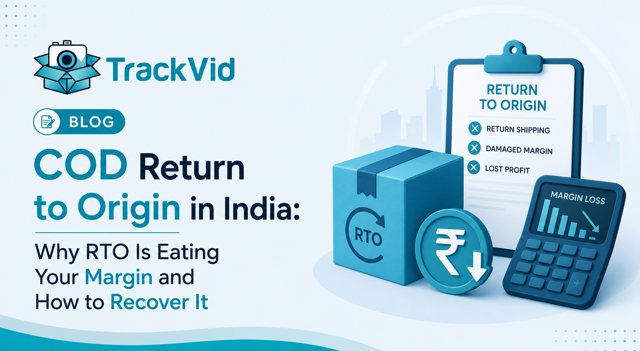
COD return to origin is the silent leak in most Indian ecommerce operations. Return to origin, or RTO, is when a shipped order comes back unsold because the buyer refused it, was unreachable, or the address failed. On cash-on-delivery orders it is brutal: nearly 26 percent of COD shipments come back as RTO, against under 2 percent for prepaid, according to GoKwik 2026 data. You pay forward shipping, reverse shipping, and handling, and you collect nothing.
For a COD-heavy seller, RTO is not an edge case. It is a structural cost that shows up as healthy top-line revenue and quietly missing margin at the bottom.
Why COD Return to Origin Is So High in India
RTO concentrates on COD for reasons that are operational, not mysterious.
There is no commitment at checkout. A prepaid buyer has paid and wants the product. A COD buyer can change their mind at the door at zero cost, so impulse orders, duplicate orders, and "I will decide when it arrives" orders all convert into refusals.
Addresses and reachability fail. Wrong pin codes, unreachable phone numbers, and missed delivery attempts push orders back to origin before the buyer ever sees them. Typical RTO in India runs 20 to 30 percent depending on region, product type, and courier reliability, according to industry reporting, and unoptimized operations see 30 to 50 percent.
Then there is the cost per event. Processing a single return costs between 20 and 65 percent of the item's value once you add return freight, restocking, quality check, re-labelling, and lost selling days, according to NRF and Shopify data. A store running 30 percent RTO can lose a double-digit share of total revenue to RTO alone.
RTO does not show up as a refund line. It shows up as revenue that was never really yours.
The Disputes Hiding Inside RTO
RTO is mostly a logistics and intent problem, but a slice of it is a proof problem, and that slice is where sellers lose real money.
When an RTO parcel comes back, it does not always come back intact. Some return opened, with the product swapped, damaged, or missing, and the buyer or the return leg gets blamed depending on who can prove what. On marketplace COD returns, buyers also file "wrong item" or "damaged on arrival" claims on orders that were refused or returned, and the seller is left proving the order left correct and sealed.
This is the same evidence gap that sinks marketplace claims. The seller knows the right item was dispatched in good condition. Without proof linked to the Order ID and AWB, that knowledge is worth nothing in a dispute.
Returns will always happen. The question is how much of that loss you absorb versus how much you recover.
Jaipur Seller Meghna: Finding the Recoverable Half
Meghna runs an apparel label out of Jaipur, shipping around 300 orders a day, the majority COD across Flipkart, Meesho, and her own D2C store. Her RTO sat near the category norm, and she had made peace with it as the price of selling COD.
What she had not made peace with was the second loss stacked on top. A meaningful share of her RTO parcels came back tampered, with a worn or swapped garment inside, or triggered a buyer claim of "wrong item received" on an order that never even completed delivery. Her monthly write-off from these disputed and tampered RTOs ran around Rs 90,000.
She first assumed it was unavoidable. She tightened address confirmation and added a COD verification call, which helped the refusal rate but did nothing for the tampered-return and false-claim losses. Those needed proof, not prevention.
Recording every order at packing changed the second number. When a returned parcel came back with the wrong garment, or a buyer claimed a damaged item on a refused order, Meghna pulled the packing clip for that Order ID and showed exactly what was sealed and shipped. The disputes she used to lose by default, she started winning.
I could not stop every RTO. But I stopped paying twice for the same order.
Her refusal-side RTO improved with verification, and the disputed-RTO write-off dropped sharply once proof entered the picture.
Related: How to reduce returns in ecommerce in India →
What Sellers Try on COD Return to Origin
Address and phone verification. Worth doing, and it cuts the refusal rate, but it does nothing for parcels that come back tampered or for false post-RTO claims.
Penalising COD with fees or removing it. This shrinks RTO and also shrinks orders, because COD still drives a large share of Indian ecommerce demand.
Blaming the courier. Couriers own transit and delivery attempts. They do not own what was inside a sealed box or what a buyer claims after refusal.
CCTV at the warehouse. It records by time and camera, not by Order ID, so retrieving the one clip for a disputed RTO is slow and the footage is rarely accepted as order-specific proof.
The prevention tools address the refusal half of COD return to origin. The recovery half needs evidence.
Where TrackVid Fits
The sellers who stop bleeding on the recovery half of RTO have built proof into packing instead of reconstructing it after a dispute.
TrackVid records every order being packed and links each video to the Order ID, SKU, and AWB at the moment it is packed. When an RTO parcel returns tampered, or a buyer files a wrong-item or damaged claim on a refused COD order, the seller retrieves the exact packing clip in under two minutes and submits it as primary evidence to the marketplace.
TrackVid is a recovery and proof system, not just a recording tool. It does not stop a buyer from refusing a COD order, and it is honest about that. What it does is make sure that every disputed and tampered RTO, the part of your COD return to origin loss that is actually recoverable, is backed by proof a marketplace accepts. It works with existing cameras and sets up in under 15 minutes.
Five Questions to Audit Your COD RTO Loss
1. Do you know your COD RTO rate and your prepaid RTO rate as two separate numbers? If not, you cannot see where the loss concentrates.
2. When an RTO parcel comes back tampered, can you prove what you originally packed for that Order ID? If not, you absorb the loss.
3. How many "wrong item" or "damaged" claims arrive on orders that were refused or returned? These are recoverable with proof.
4. Can your team find the packing video for a disputed RTO in under two minutes? Slow retrieval means missed claim windows.
5. Do you treat RTO as one number, or do you separate the refusal loss you can prevent from the dispute loss you can recover? Most sellers blur the two and recover neither.
Schedule a free demo at trackvid.in/book-demo.html
In one session, you will see exactly where your recoverable revenue is going and what a structured proof system looks like in your specific operation.
Frequently Asked Questions
What is RTO in ecommerce?
RTO stands for return to origin. It means a shipped order comes back to the seller without being delivered, usually because the buyer refused it, was unreachable, or the address failed. On COD orders RTO is far higher than on prepaid, near 26 percent versus under 2 percent, according to GoKwik 2026 data.
Why is my COD RTO so high?
COD buyers have no financial commitment at checkout, so impulse and duplicate orders convert into refusals, and address or reachability failures push parcels back before delivery. Typical India RTO runs 20 to 30 percent, and unoptimized operations hit 30 to 50 percent, according to industry reporting. Verification cuts refusals, while proof recovers disputed returns.
COD return to origin kya hota hai?
COD return to origin ka matlab hai ki aapka bheja hua order bina deliver hue wapas aa jaata hai, kyunki customer ne refuse kar diya, phone nahi utha, ya address galat tha. COD orders me ye bahut zyada hota hai, lagbhag 26 percent, GoKwik 2026 ke data ke hisaab se. Tampered RTO aur galat claims se bachne ke liye packing video proof kaam aata hai.
Is RTO a loss for the seller?
Yes. On an RTO you pay forward shipping, reverse shipping, and handling and collect no revenue, and processing one return costs 20 to 65 percent of item value, according to NRF and Shopify data. The loss grows when the parcel returns tampered or triggers a false claim, which is the part proof can recover.
RTO kaise kam kare?
Address aur phone verification, COD confirmation call, aur saaf product listings se refusal wala RTO kam hota hai. Lekin tampered returns aur galat claims ke liye prevention kaafi nahi, proof chahiye. TrackVid har order ki packing video Order ID se link karke rakhta hai, taaki dispute me aap sabit kar sako kya bheja gaya tha.
What is the best way to handle COD returns in India?
Split the problem in two. Reduce refusals with verification, and recover disputed and tampered returns with order-linked proof. The best system records every packing automatically and retrieves any clip by Order ID in seconds. TrackVid does this and is used by 1,100+ Indian sellers across Amazon, Flipkart, AJIO, Myntra and Meesho.
Sources: GoKwik 2026 (COD RTO rates), Pragma research (COD RTO range), NRF and Shopify (return processing cost), India Reverse Logistics Market Report (reverse logistics size), TrackVid data (claim recovery).
TrackVid is a video proof and claim management platform used by 1,100+ Indian ecommerce sellers on Amazon, Flipkart, AJIO, Myntra and Meesho. Officially authorised by Snapdeal. Learn more at trackvid.in.


Get the Marketplace Claim Recovery Checklist
A 12-point checklist used by 1,100+ sellers to recover 85-90% of marketplace claim losses. Free, instant access.
- Marketplace-specific evidence formats (AJIO, Flipkart, Amazon, Myntra)
- Claim window deadlines for every major platform
- The 6-step process that pushes approval from 85-90%
- Common rejection reasons and how to avoid them
No spam. Unsubscribe anytime. Used by sellers at Rare Rabbit, HRX, Da Milano + 1,100 more.
Stop Losing Money to Fake Returns
Join 1,100+ sellers who recover lakhs every month with TrackVid