
For new and growing Indian ecommerce sellers on Amazon, Flipkart, AJIO, Meesho, Myntra, Snapdeal and Shopify. Updated June 2026.
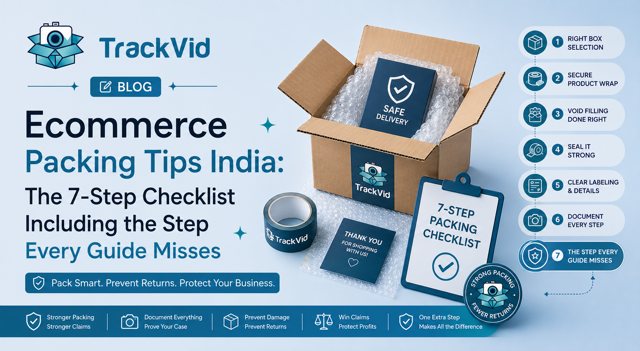
Ecommerce packing tips for Indian sellers usually cover six things: choose the right box, use bubble wrap, seal with quality tape, apply the shipping label correctly, label fragile items, and weigh accurately. These are correct. They are also incomplete in a way that costs Indian sellers lakhs every month.
The step almost every guide leaves out is the one that protects you when something goes wrong: recording the packing session on video, linked to the specific Order ID. This single addition to your packing process is the difference between absorbing fraudulent return losses and recovering them through marketplace claims. It is also the step that turns standard ecommerce packing into a process that wins claims on Amazon SAFE-T, Flipkart SPF, AJIO CCTV-required emails, Myntra PPP, and Meesho WFR disputes consistently.
This guide covers all seven steps. The first six are the standard packing fundamentals every Indian seller needs to follow. The seventh, and the one we will spend the most time on, is the evidence step that most guides forget exists.
Why Indian Ecommerce Packing Is Different
Indian ecommerce operates on tighter margins, higher RTO rates (20 to 40 percent on COD), and longer transit distances than most global markets. Marketplace claim processes are also more demanding: Flipkart SPF requires dispatch video, AJIO sends CCTV-required emails with a 48 hour window, Myntra PPP requires Order ID-linked video, and Amazon SAFE-T in 2026 requires detailed dispatch documentation. Without evidence built into your packing process from day one, every dispute becomes uncontestable.
Your packing process is your evidence infrastructure. Treat it that way.
The Complete 7-Step Ecommerce Packing Checklist for India
Step 1: Choose the Right Box for the Product
The single biggest cause of weight discrepancy disputes in Indian ecommerce is oversized packaging. A 250 gram product in a 30 x 25 x 20 cm box gets billed at 3 kg volumetric weight, not 250 grams actual weight.
Standardise on three to four box sizes that fit your product range:
- Small (15 x 10 x 5 cm) for accessories and small items
- Medium (25 x 18 x 10 cm) for clothing and mid-sized products
- Large (35 x 25 x 15 cm) for combo orders and bulkier items
- XL (45 x 30 x 20 cm) for footwear and larger products
For polybag-shippable items like clothing, use the smallest polybag that fits without stretching. Polybags expand in transit, increasing volumetric weight at the destination hub. A snug polybag at dispatch is the cheapest packaging decision you can make.
Step 2: Record the Packing Session on Video, Linked to the Order ID
This is the step most guides leave out. It is also the step that determines whether you recover fraudulent return losses or absorb them.
Every Indian marketplace claim process requires Order ID-linked dispatch evidence. Flipkart SPF rejects claims without compliant VMS footage. AJIO auto-rejects claims without specific Order ID-linked packing video. Myntra PPP requires video with the AWB and product clearly visible. Amazon SAFE-T's 2026 stricter documentation requirements specifically require dispatch verification.
A standard CCTV camera recording the warehouse does not produce this evidence. Time-based CCTV footage cannot be matched to a specific Order ID, which is the requirement every Indian marketplace claim process enforces.
The packing video that wins claims has four characteristics:
The camera is positioned to show the product, the shipping label (with AWB visible), and the packing station clearly. Recording starts at the moment the shipping label is scanned, automatically. The video is tagged to the Order ID, SKU, and AWB at the moment of recording, not added later. Footage is stored in indexed cloud searchable by Order ID, retrievable in under two minutes when a dispute arrives.
This sounds complex. With existing warehouse cameras and a packing video automation system like TrackVid, setup takes under 15 minutes. Every order from that point forward has dispatch evidence automatically.
Step 3: Use the Right Internal Protection
Internal protection should match the product. Hard goods (electronics, footwear) need one full layer of bubble wrap. Fragile items (glass, ceramics, jewellery) need two layers plus corner protection. Soft goods (clothing) need polybag protection inside the box. Liquid products need sealed polybag with absorbent material if leakage risk exists. Indian transit involves multiple sorting-hub handling, so internal protection is not optional. Damage claims cost more than the bubble wrap would have.
Step 4: Seal With Tamper-Proof Tape
Standard transparent tape is not sufficient for Indian ecommerce. Tamper-proof tape, sometimes called security tape, shows visible damage if the parcel is opened in transit. This matters for two reasons.
First, tamper-proof seals deter pilferage in transit. The seal makes any opening attempt visible to the buyer and the courier, increasing accountability through the delivery chain.
Second, tamper-proof seal evidence helps win claims. If a buyer claims the parcel arrived with the wrong product, the intact tamper-proof seal at delivery is evidence that the parcel was not tampered with in transit. Combined with the packing video showing what was inside, this is a strong evidence chain.
Use printed branded tamper-proof tape if your volume justifies it. Plain tamper-evident tape is also widely available through Indian packaging suppliers.
Step 5: Apply the AWB Label Correctly
The AWB label must be applied to a flat surface, fully visible, and not obscured by tape. Common mistakes that cause scanning failures or routing issues: folding the label across two surfaces, applying tape over the barcode, smudged labels, and old labels on reused boxes. For multi-piece orders, every parcel needs its own AWB label with the Order ID visible. Multi-piece orders are the most common shortage claim category on Indian marketplaces.
Step 6: Weigh on a Calibrated Scale
Weight discrepancy is a Rs 3,500 crore annual problem for Indian ecommerce. Use a calibrated digital scale (Rs 500 to Rs 1,000), accurate to 10 grams, and weigh every parcel before booking. Position the scale visible to the packing camera (Step 2) and record the actual reading without rounding. A 0.48 kg parcel declared as 0.5 kg costs 20 grams of overcharge every time.
For volumetric weight: Length x Breadth x Height (in cm) / 5000 = volumetric weight in kg. Indian couriers bill the higher of actual or volumetric weight.
Step 7: Document the Final Sealed Parcel
The final step before the parcel leaves your warehouse is documenting the sealed, labelled, ready-to-dispatch parcel.
The packing video from Step 2 should capture this final state: the sealed parcel with tamper-proof tape visible, the AWB label clear and unobstructed, the weight reading on the calibrated scale visible, and the Order ID identifiable either on the label or in the metadata.
This final-state documentation is what marketplace claim reviewers look for as the dispatch evidence. It confirms the parcel was in dispatch-ready condition when it left your facility, with the correct product inside (shown earlier in the video) and the correct AWB applied.
If you ship through Shiprocket, Delhivery, Bluedart, Xpressbees, or any major Indian courier, this same documentation also wins weight discrepancy disputes when couriers bill incorrectly.
Surat Seller Anjali: How One Process Change Recovered Rs 48,000 Monthly
Anjali sells women's kurtas from Surat on Amazon India, Flipkart, and Meesho. Daily volume approximately 220 orders. Her packing process was standard: polybag, bubble wrap for the neck, shipping label, digital scale, regular tape.
Her claim approval rate on Amazon SAFE-T and Flipkart SPF was under 18 percent. When she audited three months of rejections, every one cited "insufficient evidence" or "evidence does not match disputed order." Her photographs were generic, her CCTV was not Order ID-linked, her written descriptions were not accepted as primary evidence.
I was packing 220 orders a day correctly. I just had no way to prove I was packing them correctly when something went wrong.
Anjali added two changes: a calibrated scale visible at the packing station, and packing video linked to Order ID through TrackVid. Setup took 15 minutes with her existing warehouse camera. Her Amazon SAFE-T approval rate moved from 18 to the 80-90 percent range in 60 days. Flipkart SPF moved from 12 to over 80 percent. Monthly claim recovery improved by Rs 48,000 in the first quarter. Her packing time per order increased by approximately 15 seconds, the cheapest insurance she had ever bought.
How TrackVid Fits Into Your Indian Ecommerce Packing Process
TrackVid (trackvid.in) provides Order ID-linked packing video automation for Indian ecommerce sellers. It works with your existing warehouse cameras, with no additional hardware required.
The setup is straightforward. Position your existing camera to show the packing station, the product, the AWB label, and the calibrated scale. TrackVid's system automatically starts recording when the shipping label is scanned, tags the video to the Order ID, SKU, and AWB, and stores the footage in indexed cloud searchable by Order ID.
When a return dispute arrives on Amazon SAFE-T, Flipkart SPF, AJIO's CCTV-required email, Myntra PPP, or Meesho WFR, the packing video for the specific disputed order is retrieved in under two minutes and submitted as primary evidence. For AJIO specifically, TrackVid detects the CCTV-required email automatically and responds within the 48 hour window without manual intervention.
TrackVid is officially authorised by Snapdeal, the only claim management system in India with that designation. Used by 1,100+ Indian ecommerce sellers across Amazon, Flipkart, AJIO, Myntra, Meesho, and Snapdeal. Setup under 15 minutes.
Schedule a free demo at trackvid.in/book-demo.html
Frequently Asked Questions
Ecommerce packing kaise kare India mein?
Ecommerce packing India mein 7 steps follow karo: sahi box size choose karo, packing video record karo Order ID se linked, internal protection use karo product type ke according, tamper-proof tape se seal karo, AWB label sahi apply karo, calibrated scale pe weigh karo, aur final sealed parcel document karo. Step 2 (packing video) wo step hai jo zyada tar guides miss karte hain, lekin yeh wahi step hai jo Flipkart SPF, Amazon SAFE-T, AJIO, Myntra aur Meesho disputes jeetane ke liye sabse important hai.
Order packing process kya hota hai?
Order packing process mein product ko safely pack karna, sahi label apply karna, aur dispatch evidence create karna shaamil hai. Process mein internal protection (bubble wrap, polybag), tamper-proof sealing, AWB labelling, accurate weighing, aur Order ID-linked packing video documentation hota hai. Zyada tar Indian sellers Step 2 (packing video) skip kar dete hain. Yeh wahi step hai jo marketplace return disputes jeetne ki capability deta hai.
Sahi packing material kaun sa hota hai?
Packing material product type ke according: clothing ke liye polybag plus thin bubble wrap, electronics aur footwear ke liye corrugated box with bubble wrap, fragile items ke liye double bubble wrap plus corner protection, liquid products ke liye sealed polybag inside box. Sabhi parcels ke liye tamper-proof tape recommended hai (transparent tape ke jagah) kyunki seal pilferage rokta hai aur claims mein evidence banta hai. Box size hamesha smallest choose karo jo product mein fit aaye, kyunki bada box volumetric weight badhata hai aur shipping cost extra lagti hai.
Packing video kaise record kare ecommerce ke liye?
Automated system zaroori hai jo har order ko Order ID se link kare; manual recording 100+ orders per day pe practical nahi hoti. Best approach: existing warehouse camera ko packing station pe position karo (product, AWB label, calibrated scale clearly visible). TrackVid jaise systems automatically recording start karte hain jab shipping label scan hota hai, video Order ID, SKU, aur AWB se tag ho jaati hai, aur cloud mein indexed storage hoti hai. Specific Order ID ki video do minute mein retrieve ho jaati hai. Setup 15 minute mein hota hai existing cameras ke saath.
How to pack fragile items for Indian ecommerce?
Fragile items need layered protection because Indian parcels are handled multiple times across sorting hubs. Use a box one size larger than the product, wrap in two layers of bubble wrap plus corner protection (foam or extra padding), place in centre with at least 2 cm of cushioning on all sides, and apply "Fragile" labels on two sides. Most importantly, record a packing video showing the product in undamaged condition at dispatch, linked to the Order ID. This is the evidence that wins damage claims when buyers report fragile items arrived broken.
Amazon Flipkart ke liye packing rules kya hain?
Amazon Easy Ship ke liye packaging product ko transit ke through protect kare with AWB label clearly visible. Flipkart Smart Fulfilment ke liye box quality, label placement, aur weight accuracy strict hain. 2026 mein dono platforms ke documentation requirements zyada strict hue hain: Amazon SAFE-T ke liye product condition images aur dispatch verification chahiye, Flipkart SPF ke liye VMS compliance mandatory hai (Order ID-linked packing video). Bina compliant packing video ke, dono platforms pe return disputes lose hote hain regardless of underlying validity. TrackVid dono ki specific requirements automatically format karta hai.
Sources: Amazon India Easy Ship Seller Documentation 2026, Flipkart Smart Fulfilment Packaging Guidelines, AJIO Seller Portal Documentation, Myntra PPP Compliance Standards, Eshopbox India Shipping Report 2026, CODCourierService RTO India Guide 2026, TrackVid internal seller data.
TrackVid is a video proof and claim management platform used by 1,100+ Indian ecommerce sellers on Amazon, Flipkart, AJIO, Myntra, Meesho and Snapdeal. Officially authorised by Snapdeal. Learn more at trackvid.in.

Get the Marketplace Claim Recovery Checklist
A 12-point checklist used by 1,100+ sellers to recover 85-90% of marketplace claim losses. Free, instant access.
- Marketplace-specific evidence formats (AJIO, Flipkart, Amazon, Myntra)
- Claim window deadlines for every major platform
- The 6-step process that pushes approval from 85-90%
- Common rejection reasons and how to avoid them
No spam. Unsubscribe anytime. Used by sellers at Rare Rabbit, HRX, Da Milano + 1,100 more.
Stop Losing Money to Fake Returns
Join 1,100+ sellers who recover lakhs every month with TrackVid