
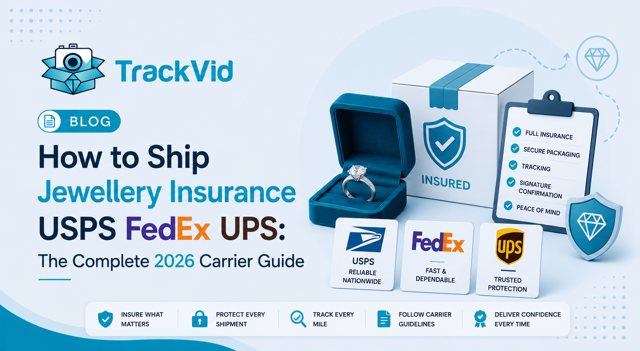
For sellers on Etsy, Amazon Handmade, Shopify and global marketplaces. Updated June 2026.
How to ship jewellery insurance USPS FedEx UPS is the single most consequential operational question most independent jewellers get wrong before they ship their first high-value piece. According to Parcel International 2026 data, approximately 40 percent of denied claims with major carriers like UPS are caused by documentation failures alone, not by fraudulent claims or carrier errors. Sellers pay for what they think is coverage, ship the piece, and discover only after a loss event that their $5,000 piece was capped at $1,000 by default. The gap between what carriers appear to cover and what they actually pay out is where most jewellery shipping losses live.
The carrier rules are documented, the coverage tiers are stable in 2026, and the correct configuration for a $500 piece is different from the configuration for a $50,000 piece. This blog covers how to ship jewellery insurance USPS FedEx UPS at every value tier, what each carrier actually covers, where third-party insurance fills the gap, and the dispatch evidence layer that closes claims cleanly.
Why Jewellery Shipping Is Structurally Different From Everything Else
Jewellery is the highest-value-per-gram product most ecommerce operators will ever ship, and the carrier tariffs know it. Three factors make the shipping stack different from apparel or electronics.
Default liability caps are lower for jewellery specifically. UPS caps liability at $1,000 for gold, silver, platinum, or "gems or industrial diamonds" regardless of declared value, absent an explicit High-Value Goods (HVG) agreement, per Section 3.6.2 of the UPS Tariff. FedEx normally caps jewellery at $1,000 maximum liability without their Declared Value Advantage programme. USPS Priority Mail caps at $5,000 unless Registered Mail is used.
Declared value is not insurance. FedEx Service Guide language is explicit: "WE DO NOT PROVIDE INSURANCE COVERAGE OF ANY KIND." What carriers sell is a contractual cap on maximum liability. If they can prove packaging was inadequate, the shipment fell under an excluded category, or the item was not properly declared, the payout is zero.
Documentation requirements are stricter for jewellery claims. Signature-on-delivery, direct handoff at pickup, adult signature above certain thresholds, serialised inventory, and specific packaging standards apply to jewellery in ways they do not to standard shipments. Missing any one requirement invalidates the claim.
The sellers who ship jewellery profitably do three things right at once: pick the correct carrier tier for each value band, add third-party insurance where carrier caps are insufficient, and maintain dispatch documentation that survives a claim investigation.
The sellers who win claims consistently are not fighting harder after the dispute. They are building their evidence before it happens.
Portland Etsy Jeweller Claire: $6,200 in Monthly Losses Traced to Carrier Mismatch
Claire runs a fine jewellery Etsy shop plus Shopify direct from Portland, Oregon. 14K and 18K gold pieces set with lab-grown diamonds. Daily volume approximately 40 orders. Average order value $850, with roughly 15 percent of orders above $3,000.
For 22 months she had been shipping FedEx Ground domestic and UPS Ground for larger pieces, adding declared value coverage up to the carrier maximum on each shipment. She had a persistent $6,200 monthly loss across missing shipments, damaged pieces, and lost disputes.
Her audit revealed the carrier tier mismatch. Six pieces over the previous quarter had shipped via FedEx Ground with declared value above $2,000. FedEx Ground caps declared value at $2,000 regardless of what she paid, so on a $3,400 piece she recovered $2,000 maximum on the one that arrived damaged. Nine pieces had shipped via UPS without an HVG contract, so the default $1,000 cap applied even where she had declared $4,500. Two shipments were rejected on packaging grounds because the outer box had "JEWELRY" written by a staff member on the return label section.
She rebuilt her shipping stack over 30 days: USPS Priority Mail with $1,200 declared value for pieces $200-$1,000, USPS Registered Mail for pieces $1,000-$5,000, Secursus third-party insurance for pieces above $5,000 via FedEx Priority Overnight, discreet unbranded outer packaging on every shipment, signature-on-delivery above $500, adult signature above $2,000.
Her monthly loss rate dropped from $6,200 to $1,400 in the first quarter. TrackVid dispatch documentation, added in month two, then handled residual disputed-delivery events, recovering another $900 per month.
The Complete Carrier Comparison for 2026
Understanding what each carrier actually covers, what it excludes, and where third-party insurance fills the gap is the foundation of shipping jewellery profitably. Every value band has a correct answer.
USPS Priority Mail and Ground Advantage
Includes automatic $100 insurance, with additional coverage up to $5,000 per shipment. USPS Ground Advantage similarly includes $100 automatic. Additional coverage cost starts at $2.80. Best for pieces $200-$1,000, transit 2-4 business days. Signature confirmation added separately ($4.15 per USPS Notice 123 2026). Not suitable above $1,200 for jewellery.
USPS Registered Mail
The only USPS option covering up to $50,000. Every handoff between USPS employees is logged and signed. Sealed containers, dedicated transit, physical chain of custody. Discontinued for international shipments effective January 1, 2026.
Cost: $19.70 base plus $2.40 per $100 of declared value above the first $100 per USPS Notice 123. A $10,000 item runs $257.30 above postage. Transit 2-10 business days domestically. Best for pieces $1,000-$50,000 where transit speed is not critical.
FedEx Express Services
FedEx Priority Overnight, Standard Overnight, and 2Day allow declared value up to $50,000 for most goods domestically. FedEx Ground caps declared value at $2,000 regardless of amount paid. FedEx normally caps jewellery shipments at $1,000 without their Declared Value Advantage programme. Best for pieces where speed matters and a DVA relationship is in place.
FedEx Declared Value Advantage (DVA)
Available only to contractual customers shipping jewellery 2-3 times weekly. Allows declared values up to $100,000 domestically and $25,000 to select international destinations on jewellery, watches, pearls, precious and semi-precious stones, gold, silver, and platinum. Coins and gold bars excluded. Requires documented direct signature policy, serialised inventory practices, and specific packaging standards. Not available for one-time shipments.
UPS With High-Value Goods (HVG) Contract
UPS default caps precious metals and loose gemstones at $1,000, regardless of declared value. UPS allows declared value up to $50,000 with account approval for most goods but requires an explicit HVG agreement for jewellery. Parcel Pro is UPS's specialist high-value shipping partner. Best for merchants with a negotiated HVG contract or using Parcel Pro.
Third-Party Insurance (Secursus, Parcel Pro, Shipsurance)
Third-party jewellery insurers cover shipments the carrier's declared value cannot. Secursus typical cost 0.6-1 percent of declared value. Parcel Pro serves UPS jewellery shipments primarily. Shipsurance covers up to $10,000 on Priority Mail. Key advantage: claims processed independently of the carrier investigation, typical Secursus resolution 72 hours from submission versus 60-90 days for carrier declared value claims.
Quick Reference: Carrier by Value Band
Under $500: USPS Priority Mail with signature confirmation. $500-$1,200: USPS Priority Mail with $1,200 declared value or Shipsurance for the difference. $1,200-$5,000: USPS Registered Mail or FedEx Priority Overnight with Secursus. $5,000-$25,000: USPS Registered Mail or FedEx DVA if contractually available, otherwise FedEx Priority Overnight with Secursus. $25,000-$100,000: FedEx DVA, UPS HVG with Parcel Pro, or specialised jewellery courier like Malca-Amit or Ferrari Logistics.
Packing, Labelling and Signature Rules That Actually Matter
Five handling rules determine whether a claim survives a carrier investigation.
Discreet unbranded outer packaging. Never write "JEWELRY," "GOLD," or brand names on outer packaging. Use abbreviated business names or LLC identifiers only. Per Secursus 2026, discreet packaging drops theft-in-transit rates by 60-80 percent.
Double-box method. Small rigid inner box with the piece secured, nested inside a larger outer box with void-fill. Seal seams with strong packing tape. Required by FedEx DVA and UPS HVG programmes.
Signature on delivery. Below $500 optional. $500-$2,000 standard signature required. Above $2,000 adult signature (21+) where the carrier offers it. USPS Signature Required is $4.15 as of 2026.
Direct handoff at pickup, not drop box. Every carrier's most common loss point is unsupervised drop-off. High-value shipments go to a staffed counter with receipt.
Chain-of-custody documentation. Serialised inventory (SKU or piece number matched to Order ID and AWB), packing video showing the piece packed and sealed with tamper-evident tape, and delivery signature. Missing any of these five elements is a common claim denial reason.
Related: How the packing video evidence layer wins jewellery disputes across every platform
How TrackVid Adds the Dispatch Evidence Layer
TrackVid (trackvid.in) provides Order ID-linked packing video documentation for jewellery merchants globally. Every packing session records the specific piece, the tamper-evident seal, weight on calibrated scale, and shipping label, tagged automatically to the Order ID at packing.
Carrier insurance and third-party jewellery insurance cover the loss when a piece goes missing or arrives damaged. What they do not automatically cover is disputed delivery outcomes: buyer claims non-receipt, buyer claims wrong piece received, buyer claims different piece than shown in listing. These disputes are decided on dispatch documentation, not carrier tracking alone.
For merchants shipping via any carrier configuration, the Order ID-linked packing video is retrieved in under two minutes when a dispute arrives and submitted as primary evidence through Etsy dispute resolution, Amazon A-to-Z Guarantee, Shopify Payments dispute portal, Stripe representment, PayPal dispute resolution, or platform equivalent. Merchants report dispute win rate improvements from under 25 percent to 70-85 percent within 60 days.
TrackVid works with existing warehouse cameras. Setup under 30 minutes. Used by 1,000+ ecommerce sellers globally including fine jewellery brands, Etsy sellers, and D2C jewellery stores.
Five Questions to Audit Your Jewellery Shipping Setup Today
1. For your last 10 shipments above $2,000, was each shipped on a carrier service where declared value is not capped below the piece value? A $3,000 piece on FedEx Ground pays $2,000 maximum regardless of what you declared.
2. Do shipments above $500 have signature confirmation, and above $2,000 have adult signature? Missing signature is a common claim denial reason.
3. Is outer packaging discreet with no jewellery-related terms visible? A branded return label doubles or triples theft rates per Secursus field data.
4. Do you have Order ID-linked dispatch documentation retrievable in under five minutes for any shipment in the last 60 days? Manual retrieval fails under claim deadline pressure.
5. If a $5,000 shipment goes missing today, can you file the carrier claim and third-party insurance claim in parallel within their windows? Missing either is a permanent loss.
TrackVid works with your existing warehouse cameras. Setup takes under 30 minutes.
Schedule a free demo at trackvid.in/book-demo.html
In one session, you will see exactly where your recoverable revenue is going and what a structured proof system looks like in your specific jewellery shipping operation.
Frequently Asked Questions
How to ship jewellery safely 2026?
Shipping jewellery safely requires four elements running together: correct carrier tier for the value band, third-party insurance where carrier caps are insufficient, discreet unbranded outer packaging with double-box method, and Order ID-linked dispatch documentation. Under $500 use USPS Priority Mail with signature. $1,000-$5,000 use USPS Registered Mail or FedEx Priority Overnight with Secursus. Above $5,000 use USPS Registered Mail up to $50,000, FedEx DVA up to $100,000, or specialised jewellery courier. Adult signature required above $2,000. Never label parcels with jewellery-related terms externally.
What is the best carrier for shipping jewellery?
The best carrier depends on the value band. USPS Priority Mail for pieces $200-$1,200 domestically. USPS Registered Mail for pieces $1,000-$50,000 where transit speed is not critical, offering physical chain-of-custody at every handoff. FedEx Priority Overnight with a DVA contract for high-volume merchants shipping $2,000-$100,000 pieces. UPS with a negotiated HVG contract or via Parcel Pro for existing UPS merchants. For $25,000+ pieces, specialised jewellery couriers like Malca-Amit or Ferrari Logistics.
How much does USPS Registered Mail cost for jewellery?
USPS Registered Mail costs $19.70 base fee plus $2.40 per $100 of declared value above the first $100, per USPS Notice 123 (2026 schedule). A $1,000 piece costs approximately $41.30 above postage. A $10,000 piece costs $257.30 above postage. A $50,000 piece (the maximum Registered Mail covers) costs approximately $1,219.70 above postage. Transit is 2 to 10 business days domestically. Registered Mail was discontinued for international shipments effective January 1, 2026, so international jewellery above $1,000 requires FedEx Priority International or a specialised jewellery courier with third-party insurance.
Does FedEx cover jewellery losses?
FedEx's default liability caps jewellery shipments at $1,000 maximum regardless of declared value, per FedEx High-Value Jewellery documentation. Beyond that, FedEx offers the Declared Value Advantage (DVA) programme covering up to $100,000 domestically and $25,000 to select international destinations. DVA is only available to contractual customers shipping jewellery 2-3 times per week and requires documented direct signature policy, serialised inventory practices, and specific packaging standards. One-time or occasional jewellery shipments are not eligible for DVA and are limited to the $1,000 default liability. Third-party insurance through Secursus or Parcel International fills the gap for merchants without DVA.
How to insure jewellery for shipping?
Insuring jewellery happens at two layers. Layer 1: carrier declared value (USPS Priority Mail up to $5,000, USPS Registered Mail up to $50,000, FedEx DVA up to $100,000, UPS HVG up to negotiated contract limits). Layer 2: third-party insurance (Secursus, Parcel Pro, Shipsurance) where carrier caps are insufficient. Secursus typical cost 0.6-1 percent of declared value. Third-party claims typically resolve in 72 hours versus 60-90 days for carrier claims. Always match insurance to full replacement value, not wholesale cost.
Best way to ship expensive jewellery online?
The best way combines four decisions. First, match carrier to value band: USPS Registered Mail for $1,000-$50,000 domestic, FedEx Priority Overnight with DVA or Secursus for speed-sensitive shipments up to $100,000, specialised jewellery courier above $50,000. Second, discreet unbranded outer packaging with double-box method. Third, signature on delivery (adult signature above $2,000). Fourth, Order ID-linked dispatch documentation including packing video, calibrated scale weight, and tamper-evident seal image. TrackVid provides the dispatch documentation layer that closes claims when carrier tracking alone is not sufficient.
Can I ship gold jewellery with USPS?
USPS accepts gold jewellery and does not explicitly restrict precious metals. USPS Priority Mail includes $100 automatic insurance with additional coverage available. USPS Registered Mail covers up to $50,000 with physical chain-of-custody at every handoff, making it the most secure USPS option for gold. Registered Mail runs $19.70 base plus $2.40 per $100 above the first $100. Signature confirmation ($4.15 as of 2026) is strongly recommended above $500. Discreet outer packaging with no gold or jewellery-related terms is critical.
How to prevent jewellery theft in transit?
Four practices. First, discreet unbranded outer packaging with no jewellery, gold, silver, or brand terms externally visible (drops theft rates 60-80 percent per Secursus 2026). Second, direct handoff at a staffed carrier counter, never drop-box. Third, signature on delivery with adult signature above $2,000. Fourth, chain-of-custody documentation via Order ID-linked packing video, serialised inventory, and tamper-evident seal. Registered Mail is the only USPS service with physical logging at every employee handoff.
Sources: USPS Notice 123 (2026 rate schedule), USPS Registered Mail policy 2026, FedEx Service Guide Declared Value Advantage 2026, FedEx High-Value Jewellery form documentation, UPS Tariff/Terms and Conditions of Service Section 3.6.2, UPS Parcel Pro service documentation, Secursus 2026 shipping insurance guide, Parcel International shipping insurance 2026 comprehensive guide, ShippingEasy Shipsurance documentation, ClickPost jewellery shipping guide 2026, TrackVid internal seller data
TrackVid is a video proof and claim management platform used by 1,000+ ecommerce sellers globally on Etsy, Amazon, Shopify and major marketplaces. Officially authorised by Snapdeal. Learn more at trackvid.in.


Get the Marketplace Claim Recovery Checklist
A 12-point checklist used by 1,100+ sellers to recover 85-90% of marketplace claim losses. Free, instant access.
- Marketplace-specific evidence formats (AJIO, Flipkart, Amazon, Myntra)
- Claim window deadlines for every major platform
- The 6-step process that pushes approval from 85-90%
- Common rejection reasons and how to avoid them
No spam. Unsubscribe anytime. Used by sellers at Rare Rabbit, HRX, Da Milano + 1,100 more.
Stop Losing Money to Fake Returns
Join 1,100+ sellers who recover lakhs every month with TrackVid