
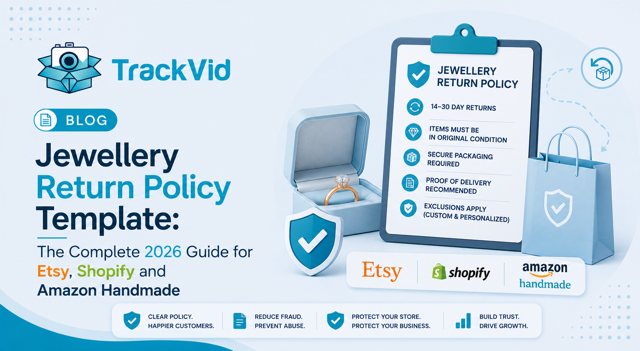
For sellers on Etsy, Amazon Handmade, Shopify and global marketplaces. Updated June 2026.
A jewellery return policy template that actually protects the seller has three components: commercial terms (return window, refund method, restocking fee), fraud protection clauses (non-returnable items, condition requirements, evidence verification), and the enforcement layer (dispatch documentation, return inspection protocol, dispute evidence). Most templates online cover only the first component, which is why so many sellers get burned by policies that read well but do nothing when a fraudulent return arrives.
According to Corso 2026 data, 82 percent of consumers cite return policy in their purchase decision, but jewellery has one of the highest return-fraud exposure rates in ecommerce because policies without evidence infrastructure are functionally unenforceable. Signifyd research shows 24 percent of consumers admit returning a different item than purchased. A policy leaving out condition verification, hallmark integrity, and packing video reference will be interpreted by every platform dispute team in the buyer's favour.
This blog provides three jewellery return policy template variants, specific clauses for Etsy, Shopify, and Amazon Handmade, and the enforcement infrastructure that turns a written policy into an actual protection system.
The Three Policy Stances and Their Trade-Offs
Every jewellery return policy sits on a spectrum from restrictive to permissive. Each stance has specific conversion effects and fraud exposure.
Restrictive: no returns with narrow exceptions. Best for personalised, custom, and one-of-a-kind pieces. Conversion 15-25 percent lower than moderate policies per Corso 2026. Fraud exposure minimal on legitimate no-return orders, though "not as described" disputes still route through platform buyer protection regardless of policy.
Moderate: 14-day return window with condition requirements and specific exclusions. Best fit for most independent fine jewellery sellers. Baseline conversion. Fraud exposure manageable with evidence infrastructure, unmanageable without.
Permissive: 30-day flexible returns. Best for brand-building phase, high-volume moderately-priced pieces, and sellers with strong fraud infrastructure. Conversion 10-15 percent uplift versus moderate. Fraud exposure high without full documentation.
The strategic answer for most independent jewellery sellers: moderate policy with strong fraud protection clauses plus the evidence infrastructure that makes clauses enforceable.
A return policy without evidence infrastructure is a suggestion. A return policy with evidence infrastructure is protection.
Manchester D2C Jeweller Sophie: How a Permissive Policy Cost £4,800 Per Month
Sophie runs a D2C fine jewellery brand from Manchester, UK, on Shopify direct plus Etsy plus a small Amazon Handmade catalogue, shipping across UK, EU, and US. Daily volume approximately 35 orders. Average order value £520.
For 20 months she ran a "30-day free returns, no questions asked" policy modelled on a fast-fashion brand. Return rate climbed from 12 percent at launch to 34 percent by month 20. Her audit revealed the pattern: buyers ordering three or four pieces, keeping one, returning the rest as "not right." Roughly 40 percent of returned pieces arrived with signs of wear (skin oils on stones, minor scratches on soft gold, altered link tension on chains).
Monthly loss profile: £4,800 across unusable returns, refurbishment costs, restocking labour, and disputes she lost on returns she suspected but could not prove. The permissive policy unlocked 10-15 percent higher conversion but the loss rate overwhelmed the margin gain.
She rebuilt the policy over two weeks. 14-day return window from delivery date. "Original condition with hallmark intact, no signs of wear" clause added. Personalised, engraved, and resized pieces non-returnable. Buyer covers return shipping via insured courier. £15 restocking fee. All returns subject to condition verification against dispatch documentation.
Her return rate dropped from 34 to 16 percent in two months. Monthly loss dropped from £4,800 to £600. TrackVid dispatch packing video, added at month one, then handled the dispute cases on the 16 percent that still came through, winning 78 percent of "not as described" chargebacks she had previously lost at 22 percent.
Template 1: Restrictive Jewellery Return Policy Template
Best for personalised, custom, engraved, resized, one-of-a-kind, or bespoke pieces. Also suits estate and vintage jewellery.
Sample text:
All sales are final. Due to the personalised, custom, or one-of-a-kind nature of our jewellery, we do not accept returns or exchanges. Exceptions are considered only for pieces that arrive damaged in transit or that differ from the listing description in a material way. In these cases, please contact us within 3 days of delivery with photographs and a description of the issue. All damage or discrepancy claims are subject to verification against dispatch documentation before resolution.
Refunds for verified damage or listing discrepancies are processed to the original payment method within 5 business days of confirmed resolution. Return shipping for verified issues is covered by us via insured courier with signature confirmation.
Personalised, engraved, resized, or made-to-order pieces are not eligible for return or exchange under any circumstances.
Note: Restrictive policies still route through platform buyer protection. The language reduces frivolous returns but does not override Etsy dispute resolution, Amazon A-to-Z Guarantee, or Shopify Payments chargebacks. Evidence infrastructure remains essential.
Template 2: Moderate Jewellery Return Policy Template (Recommended)
Best for most independent fine jewellery sellers on Etsy, Shopify, and Amazon Handmade. Balances conversion with defensibility.
Sample text:
Returns are accepted within 14 days of delivery, subject to the conditions below. To be eligible, pieces must be:
- In original unworn condition with no signs of wear, damage, or alteration
- Returned in original packaging with all documentation (certificate, care card, box)
- Hallmark intact and clearly visible
- Not personalised, engraved, resized, or altered from the original listing
To initiate a return, contact us within 14 days with your Order ID. Return shipping is the buyer's responsibility via insured courier with signature confirmation and tracking. USPS Registered Mail for US returns and Royal Mail Special Delivery for UK returns recommended. Uninsured returns not accepted. A £15 (or $20 / €18) restocking fee applies to eligible returns.
Refunds are processed within 5 business days of return receipt and successful condition verification against dispatch documentation. Returns that fail verification (signs of wear, damaged hallmark, altered condition, missing packaging, or piece mismatch) are returned to the buyer at buyer expense with no refund issued.
The following items are final sale and not returnable: personalised or engraved pieces, resized rings, made-to-order pieces, and sale items marked "final sale."
Template 3: Permissive Jewellery Return Policy Template
Best for sellers with strong dispatch infrastructure already deployed. Higher conversion at higher loss rate.
Sample text:
Returns are accepted within 30 days of delivery for any reason. To be eligible, pieces must be in original condition with hallmark intact and all original packaging included. Personalised, engraved, and resized pieces are non-returnable.
Return shipping is covered by us for pieces above $100. Buyers below $100 cover return shipping. All returns must use insured courier with tracking and signature confirmation. Uninsured returns are accepted at buyer risk.
Refunds are processed within 5 business days of return receipt and condition verification against dispatch documentation. Any indication of wear, damage, hallmark alteration, or piece mismatch is documented before final decision. Disputed cases are resolved with reference to full dispatch and return inspection video.
Non-returnable items: personalised or engraved pieces, resized rings, and any piece marked "final sale."
Deploy this only if the full evidence infrastructure (dispatch packing video, return inspection protocol, gemological verification for high-value pieces) is in place. Without it, return abuse rates commonly exceed 25 percent.
The Fraud Protection Clauses Every Jewellery Return Policy Needs
Four clauses must be present regardless of policy stance or the policy has no defensive value.
Clause 1: Condition on return. "In original unworn condition with no signs of wear, damage, or alteration." Without it, platforms process refunds on visibly worn pieces by default.
Clause 2: Hallmark integrity. "Hallmark intact and clearly visible." Hallmark damage or removal is a red flag for potential swap fraud and legitimately voids return eligibility.
Clause 3: Non-returnable specifications. "Personalised, engraved, resized, or made-to-order pieces are not eligible for return." Etsy, Shopify, and Amazon all recognise personalised jewellery as legitimately non-returnable.
Clause 4: Condition verification against dispatch documentation. "Returns are subject to condition verification against dispatch documentation before refund processing." Converts the written policy into a functional protection system by explicitly reserving the right to inspect against evidence.
Platform-Specific Adjustments
Etsy, Shopify, and Amazon Handmade each impose specific overrides that your policy needs to reflect.
Etsy
Etsy requires sellers to display a shop-level return policy on every listing. Etsy Purchase Protection Program may cover buyers even for items marked "non-returnable" under certain circumstances. Sellers can mark "personalised" or "made-to-order" pieces as non-returnable per listing. Restocking fees permitted with clear disclosure.
Shopify (Direct D2C)
Shopify direct sellers set their own policy with full flexibility, but payment processor rules (Shopify Payments, Stripe, PayPal) override policy on chargebacks. The policy protects against opportunistic returns but does not shield from chargebacks decided at the payment gateway level. Evidence infrastructure is essential for chargeback defence.
Amazon Handmade
Amazon Handmade defaults to Amazon's return policy structure (30-day window on most categories). Sellers can request category-specific exceptions for personalised jewellery. Amazon A-to-Z Guarantee overrides individual seller policies in most dispute cases. Align your policy with Amazon's structure to avoid conflict.
Related: The complete carrier guide for shipping jewellery insurance USPS FedEx UPS
How TrackVid Powers the Enforcement Layer
TrackVid (trackvid.in) provides Order ID-linked packing video documentation for jewellery merchants globally. For return policy enforcement specifically, TrackVid provides the dispatch documentation that Clause 4 relies on.
Every packing session records the piece, hallmark on close-up, certificate visible in frame, calibrated scale reading, original packaging, and tamper-evident seal. Tagged to Order ID at packing. Retrievable in under two minutes when a return arrives.
When condition verification runs against a return, the dispatch video shows the piece in original condition. Comparison with return inspection video determines whether the piece qualifies for refund or fails verification. For platform disputes on Etsy, Shopify Payments, Stripe, PayPal, or Amazon A-to-Z, the dispatch plus return-receipt video wins buyer-protection cases at 75-85 percent.
TrackVid works with existing cameras. Setup under 30 minutes. Used by 1,000+ ecommerce sellers globally.
Five Questions Before Publishing Your Jewellery Return Policy
1. Does your policy specify a return window (7, 14, 21, or 30 days) with a specific eligibility start date? Ambiguity loses disputes.
2. Does your policy list specific non-returnable items with concrete examples? Vague "custom pieces" language is unenforceable.
3. Does your policy state condition requirements including "no signs of wear," "hallmark intact," and "original packaging"? Missing any condition clause invalidates rejection.
4. Does your policy reserve the right to condition verification against dispatch documentation before refund? Without this clause, verification cannot legally hold a refund.
5. Do you have dispatch documentation infrastructure retrievable in under five minutes for any Order ID from the last 60 days? A policy without infrastructure is a suggestion.
TrackVid works with your existing warehouse cameras. Setup takes under 30 minutes.
Schedule a free demo at trackvid.in/book-demo.html
In one session, you will see exactly where your recoverable revenue is going and what a structured proof system looks like in your specific jewellery operation.
Frequently Asked Questions
What should a jewellery return policy include?
Six specific components. First, return window (typically 7, 14, or 30 days from delivery). Second, condition requirements ("original unworn condition with no signs of wear or alteration"). Third, hallmark integrity requirement. Fourth, original packaging and documentation requirement. Fifth, list of non-returnable items with specific examples (personalised, engraved, resized, custom, made-to-order, sale items). Sixth, verification clause reserving the right to condition verification against dispatch documentation before refund. Optional: restocking fee ($15-$25 range), buyer-covered insured return shipping.
Can I have a no-return policy for jewellery?
Yes, particularly for personalised, engraved, resized, custom, made-to-order, or one-of-a-kind pieces. Etsy, Shopify, and Amazon Handmade recognise these as legitimately non-returnable. However, no-return policies do not override platform buyer protection. Etsy Purchase Protection Program, Amazon A-to-Z Guarantee, Shopify Payments dispute resolution, Stripe representment, and PayPal buyer protection can still process buyer-favoured refunds on "final sale" items in cases of documented damage, listing discrepancy, or non-receipt. Evidence infrastructure remains essential.
How long should my jewellery return window be?
The recommended window is 14 days for most independent sellers. Shorter (7 days) works for personalised or restrictive policies. Longer (30 days) works for brand-building or sellers with strong dispatch infrastructure. Per Corso 2026, 82 percent of consumers cite return policy in purchase decision, and 30-day windows show 10-15 percent conversion uplift versus 14-day. However, permissive policies without evidence infrastructure show return abuse rates commonly exceeding 25 percent, erasing the conversion gain. 14 days with a strong evidence layer is the sweet spot.
Should I charge a restocking fee on jewellery returns?
Yes, $15-$25 or £15 equivalent is standard for eligible returns. Covers inspection labour, refurbishment where required, hallmark re-inspection, and re-listing overhead. Must be clearly disclosed in the return policy and at checkout. Etsy, Shopify, and Amazon all permit restocking fees with disclosure. Fees above $25 or 10 percent of item value can trigger disputes on grounds of unreasonableness. Sale items should be non-returnable rather than restocking-fee eligible.
What makes a return policy legally binding?
A jewellery return policy becomes legally binding when clearly displayed to the buyer before purchase and the buyer completes the transaction. Displaying in a shop-wide statement, on every listing, at checkout, and on order confirmation email creates the strongest binding. Etsy, Shopify, and Amazon Handmade automatically present policies during checkout. However, "legally binding" does not mean "enforceable in dispute." Platform buyer protection systems have their own dispute logic that overrides individual seller policies in many cases. The policy sets ground rules, but the evidence infrastructure determines dispute outcomes.
How do I write a return policy for Etsy jewellery?
Use Etsy's shop-level policy settings and configure per-listing exceptions for personalised pieces. Include: 14-day return window from delivery, condition requirements (original unworn, hallmark intact, original packaging), specific non-returnable categories (personalised, engraved, resized, custom), buyer-covered return shipping via insured courier, $20 restocking fee, and condition verification clause against dispatch documentation. Etsy Purchase Protection Program can override policy in specific circumstances, so evidence infrastructure remains essential. Configure "made to order" and "personalised" flags per listing.
Best return policy for fine jewellery online?
The best return policy for fine jewellery online is the moderate policy: 14-day return window with strict condition requirements plus specific non-returnable categories plus condition verification clause plus evidence infrastructure. Structure: 14 days from delivery, original unworn condition with hallmark intact, original packaging required, personalised/engraved/resized pieces non-returnable, buyer covers insured return shipping, $15-$25 restocking fee, condition verification against dispatch documentation. Deploy with Order ID-linked packing video and return inspection protocol. Balances conversion (14-day window signals safety) with defensibility (strict conditions plus evidence layer) across Etsy, Shopify, and Amazon Handmade.
Jewellery return policy for custom pieces?
Custom, personalised, engraved, resized, and made-to-order pieces should be marked non-returnable. Sample language: "Personalised, engraved, resized, and made-to-order pieces are final sale and not eligible for return or exchange under any circumstances." Etsy, Shopify, and Amazon Handmade recognise these categories as legitimately non-returnable. Exceptions for damage in transit or listing discrepancy handle through the damage protocol, not the return process. For custom pieces above $2,000, add a signed order confirmation step before production to document buyer approval of specifications.
Sources: Corso Post-Purchase Resource Center Jewellery Returns Guide 2026, Signifyd State of Fraud and Returns Report 2025, NRF Retail Returns Landscape Report 2026, Etsy Seller Policy Documentation 2026, Amazon Handmade Category Policies 2026, Shopify Payments Dispute Resolution Guide 2026, ClickPost Jewellery Shipping and Returns Guide, TrackVid internal seller data
TrackVid is a video proof and claim management platform used by 1,000+ ecommerce sellers globally on Etsy, Amazon, Shopify and major marketplaces. Officially authorised by Snapdeal. Learn more at trackvid.in.



Get the Marketplace Claim Recovery Checklist
A 12-point checklist used by 1,100+ sellers to recover 85-90% of marketplace claim losses. Free, instant access.
- Marketplace-specific evidence formats (AJIO, Flipkart, Amazon, Myntra)
- Claim window deadlines for every major platform
- The 6-step process that pushes approval from 85-90%
- Common rejection reasons and how to avoid them
No spam. Unsubscribe anytime. Used by sellers at Rare Rabbit, HRX, Da Milano + 1,100 more.
Stop Losing Money to Fake Returns
Join 1,100+ sellers who recover lakhs every month with TrackVid