
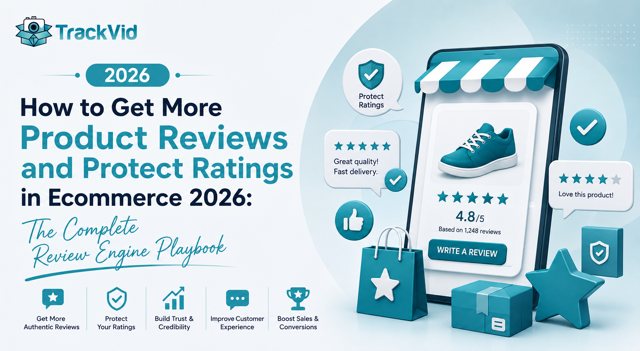
For D2C brand founders, ecommerce growth managers, and marketplace sellers protecting brand credibility. Updated August 2026.
Direct Answer
To get more product reviews, deploy multichannel automated review requests (email + SMS + WhatsApp) timed to your product-specific sweet spot (7-14 days post-delivery for most categories), incentivize photo and video reviews specifically with small rewards like loyalty points or store credit, use single-tap submission with product name in subject line, respond to every review positive and negative within 48 hours, and detect fake reviews systematically through pattern analysis with a dispute workflow for competitor sabotage. This framework lifts review submission rate from organic 1-3 percent to 15-30 percent, produces the 5+ review threshold that increases purchase likelihood 270 percent (Spiegel Research), and protects ratings in the trust-critical 4.2-4.7 star range.
The Problem: Most Stores Wait for Reviews and Get 1 to 3 Percent Submission
The average ecommerce store waits for reviews to arrive organically and gets a submission rate of 1 to 3 percent. Stores that actively request reviews at the right time on the right channel see 15 to 30 percent submission rates. That is a 5-10x difference in review generation on the same customer base, driven entirely by request timing and channel discipline, not by product quality.
The response most brands try first is to send a generic post-purchase email asking "How was your order?" This approach fails predictably. Open rates on generic subject lines run under 20 percent. Click-through rates run under 3 percent. The customer scanning their inbox sees no reason to invest 3-5 minutes in a review submission workflow that offers nothing back. Meanwhile, the product page sits at 2 or 3 reviews (below the 5-review threshold that drives 270 percent purchase likelihood per Spiegel Research), and conversion suffers.
The right response is a structured review engine that combines multichannel automated requests, category-specific timing, incentivized photo and video submission, active response protocols, and fake review defense. Each element compounds with the others. Brands running the complete engine consistently move from 3 percent submission rates to 15-25 percent submission rates within 60 days, generate the review depth that drives AI Overview citation on Google, and protect their ratings in the trust-critical 4.2-4.7 star range against both quality-driven declines and competitor sabotage.
Across the TrackVid platform of 1,100+ ecommerce sellers, we consistently observe that brands deploying multichannel review request infrastructure combined with dispatch evidence at first purchase generate 5-10x more reviews within 90 days than brands using single-channel email requests. The dispatch evidence effect matters here for a specific reason: customers who receive WhatsApp packing video share at dispatch develop first-purchase satisfaction anchored in operational trust, which translates directly into higher positive review rates and higher photo submission rates when the review request eventually arrives.
Reviews are not something you collect. They are something you engineer. Design the engine or accept the 3 percent baseline.
Why Do Customers Not Leave Reviews?
Understanding why the default state is silence is the prerequisite to fixing it. Customer non-review behavior comes from four primary sources.
Source 1: Timing mismatch. Review request arrives before the customer has meaningfully used the product, or arrives weeks after the product experience has faded from memory. The window of engaged attention closes within 7-21 days depending on product category.
Source 2: Friction overload. Review request requires clicking through multiple pages, creating an account, uploading photos through complex interfaces. Every additional friction point drops submission rate 10-20 percent.
Source 3: No reward or reason. Generic "we'd appreciate your feedback" asks nothing more than the customer's time and offers nothing back. Customers rationally skip requests that ask a lot and provide nothing.
Source 4: Single-channel dependency. Review request goes to email only. Customer never opens email. Customer would have responded to WhatsApp or SMS but was never asked through those channels. Single-channel review programs cap at 3-5 percent submission regardless of quality.
The fix for each source is structural, not persuasive. Better timing beats better copy. Reduced friction beats stronger incentive. Multichannel beats single-channel every time.
What Is a Good Product Review Rate for Ecommerce?
Understanding benchmark performance tells you where the opportunity sits.
Review submission rate benchmarks (2026):
- Organic (no automated requests): 1-3 percent of customers submit
- Email-only prompted: 5-10 percent submission
- Multichannel prompted (email + SMS + WhatsApp): 15-30 percent submission
- Best-in-class (multichannel + incentive + timing optimization): 25-40 percent submission
- Photo/video review submission with incentive: 5-15 percent of total reviews
- Video review submission with incentive: 2-8 percent of total reviews
Review depth benchmarks per product:
- Below 5 reviews: below the 270 percent conversion threshold (Spiegel Research)
- 5-20 reviews: conversion lift kicking in, but still trust-fragile
- 20+ reviews: meaningful trust signal, AI Overviews start citing
- 100+ reviews: review count itself becomes a trust signal
- 500+ reviews: category authority level
Rating benchmarks:
- Below 3.5 stars: structural quality problem, brand damage compounding
- 3.5-4.0 stars: below average, active protection required
- 4.2-4.7 stars: trust sweet spot (Spiegel Research finding)
- 4.8-5.0 stars: appears suspicious in 2026, may reduce conversion
If your product review rate sits at 1-3 percent (organic default), your fastest revenue lever is deploying the framework below. Moving to 15-25 percent submission with photo and video content generates the review depth that drives conversion, AI Overview citations, and marketplace ranking simultaneously.
The 5-Step Framework to Get More Product Reviews and Protect Ratings
Step 1: Deploy Multichannel Review Request Infrastructure
Single-channel review programs cap at 3-5 percent submission. Multichannel programs achieve 15-30 percent through channel-appropriate messaging that reaches customers where they respond.
Required channel infrastructure:
- Email (baseline): subject line includes product name (40-50 percent open rate versus under 20 percent for generic "How was your order?")
- SMS (backup and urgent): short-form request with direct submission link, 90 percent plus open rate
- WhatsApp (highest ROI in 2026): interactive request with one-tap star rating and photo upload directly in chat, 90 percent plus open rate and 45-60 percent action rate
- QR code on packaging insert: customer scans on unboxing, arrives at review submission page pre-populated with order details
- App push notification (for brands with mobile apps): targeted post-delivery notification
Channel orchestration strategy:
- Initial request via WhatsApp (highest response probability)
- Email follow-up at 3 days if no WhatsApp response
- SMS reminder at 7 days for still-unresponsive customers
- Final email nudge at 10-14 days with slight incentive escalation
Multi-channel review platforms (WiserReview, Yotpo, Judge.me, Loox, Stamped) handle this orchestration. Native email service providers (Klaviyo, Omnisend) can run email-only workflows but miss the multichannel lift.
Step 2: Time Review Requests to Category-Specific Sweet Spots
Review timing is the single highest-lever variable in review generation. Wrong timing kills the request even if channel and messaging are perfect.
Category-specific optimal timing (days after delivery):
- Consumables (supplements, food, pet): 5-10 days (customer has meaningful usage experience)
- Beauty & Personal Care: 10-14 days (initial effects visible)
- Fashion & Apparel: 7-14 days (customer has worn or tried the item)
- Footwear: 14-21 days (break-in period matters)
- Electronics Accessories: 7-14 days (initial usage complete)
- Home & Kitchen: 14-30 days (integration into daily use)
- Jewellery: 14-30 days (worn on multiple occasions)
- Video reviews specifically: 7-14 days post-delivery for most categories
Timing failure modes:
- Too early (0-3 days post-delivery): customer has not meaningfully experienced the product, review reflects packaging rather than product
- Too late (30+ days post-delivery): product experience has faded from memory, no engagement moment to lever
- Wrong day of week: review requests sent Sunday evening perform 25-40 percent worse than Wednesday morning
Response rate optimization within timing:
- Send reminder at 5-7 days after initial request if no response (recovers 30-50 percent additional submissions)
- Second reminder at 10-14 days with small incentive escalation
- Stop after third touchpoint to prevent unsubscribe damage
For the complete post-purchase communication framework that intersects with review timing, see our Post-Purchase Experience Playbook at trackvid.in.
Step 3: Incentivize Photo and Video Reviews Specifically
Photo and video reviews drive disproportionate conversion impact. Video reviews convert 80 percent higher than text-only reviews. Photo reviews generate 2x more engagement than text reviews. Yet customers rarely add photos or videos without explicit prompting and modest incentive.
Incentive structure that works:
- Text review only: modest thank-you (loyalty points, small store credit)
- Photo review: meaningful reward (5-10 percent discount on next order, larger loyalty point bonus)
- Video review: larger reward (10-15 percent discount, free product on next order, or gift with purchase)
Incentive design principles:
- Small enough to not feel transactional. Larger incentives (20 percent plus) risk feeling like paid reviews and damage authenticity signals.
- Discount on next order beats cash incentives. Discount ties incentive to future purchase, extending customer relationship.
- Loyalty points work best for repeat categories. Consumables and beauty benefit from points accumulation.
- Legal disclosure required. FTC (US), CCPA, and equivalent regulations require incentive disclosure. "We may offer a discount for reviews" language is standard.
Photo and video submission mechanics:
- Single-tap submission from mobile. WhatsApp integration allows customer to snap photo and reply within chat.
- Pre-populated review form with order details already filled to reduce customer effort
- Clear guidance on what makes a good photo review: "Show the product in use or your favorite feature"
- Video length guidance: 15-30 seconds is the ecommerce sweet spot; longer feels like production
The unboxing prompt loop: Customer receives parcel with QR code on packaging insert, scans code, submits photo of unboxing directly, review appears on product page, future prospects see the real customer experience while researching. This is compounding social proof that requires initial infrastructure investment but generates ongoing UGC at zero marginal cost per review.
Step 4: Respond to Every Review to Protect Ratings and Build Trust
Response is where ratings get protected and relationships get built. Silent brands lose reviews and lose trust; responsive brands accumulate both.
Response protocol requirements:
- 48-hour response SLA on all reviews (positive and negative)
- Personalized responses referencing specific review content, not templated "Thank you for your review!"
- Solution-oriented on negative reviews offering specific resolution paths
- Public follow-through when problems get resolved offline
Response templates by review type:
Positive review (4-5 stars) response:
- Acknowledge specific detail from the review
- Reinforce brand value proposition
- Invite continued relationship (mention loyalty program, subscription option)
- Length: 2-3 sentences
Constructive review (3 stars) response:
- Acknowledge the specific concern
- Explain what happened if you have insight
- Offer resolution or improvement path
- Ask for opportunity to make it right
- Length: 3-5 sentences
Negative review (1-2 stars) response:
- Genuine apology for the experience
- Take responsibility for what went wrong
- Provide specific resolution path with direct contact
- Follow up publicly once resolved offline
- Length: 4-6 sentences
What NOT to do:
- Do not argue with negative reviewers publicly
- Do not use legal threat language
- Do not delete negative reviews (Google penalizes review suppression)
- Do not respond defensively even if the review is unfair
- Do not use bot-generated response templates that read as inauthentic
The response quality signal matters as much as the response itself. Prospects reading reviews notice how the brand handles criticism, and responsive brand behavior on negative reviews often converts prospects more than the 4-5 star reviews do.
Step 5: Detect and Dispute Fake Reviews Systematically
Fake reviews from competitors (negative reviews to damage your rating) and from paid sources are increasingly common. Ratings protection requires active detection and dispute infrastructure.
Fake review detection signals:
- Volume anomaly: sudden spike in negative reviews within short time window (competitor sabotage indicator)
- Language patterns: reviews using nearly identical phrasing across accounts (bot or coordinated activity)
- Reviewer history: accounts with no other reviews or reviews only for competitor products
- Verified Purchaser mismatch: review from customer without corresponding order record
- Photo reuse: same photo appearing across multiple reviews on your site or other sites (reverse image search)
- Timing anomaly: review appearing before delivery date (impossible for genuine reviewer)
- Geographic patterns: clusters of reviews from unusual locations for your customer base
Fake review defense workflow:
On your own store: dispute fake reviews with your review platform (Yotpo, Judge.me, Loox all have dispute workflows). Provide evidence (verified purchaser mismatch, language pattern analysis, timing anomaly). Legitimate platforms remove verified fake reviews within 48-72 hours.
On marketplaces (Amazon, Flipkart, Myntra, AJIO): file review dispute through marketplace seller portal. Marketplaces require documented evidence: order record for allegedly non-buyer reviewers, dispatch proof for "wrong item" complaints, language pattern documentation for coordinated attacks.
For customer risk scoring that intersects with fake review detection, see our Customer Risk Scoring Playbook at trackvid.in. For dispatch evidence that defends against "wrong item" fake reviews, TrackVid's Order ID-linked packing video provides the marketplace-required proof to remove fake negative reviews within 24-48 hours.
Proactive rating protection tactics:
- Volume dilution: accelerating genuine review generation dilutes the impact of any individual fake review
- Response documentation: responding to suspected fake reviews with polite offer of resolution demonstrates good faith to future readers
- Cross-platform monitoring: check for coordinated fake review campaigns across your store, marketplaces, and third-party review sites simultaneously
- Competitor watch: monitor competitor reviews for similar patterns
Case Study: D2C Brand, Review Rate 3% to 16% and Rating 4.1 to 4.6 in 90 Days
A men's fashion and accessories D2C brand on the TrackVid platform started 2026 with a 3 percent organic review rate, average product rating of 4.1 stars (below the 4.2-4.7 trust sweet spot), and 12 percent of products with fewer than 5 reviews (below the 270 percent purchase likelihood threshold). Their review infrastructure: standard post-purchase email, no photo incentive, no negative review response protocol, no fake review defense.
Days 1-14: Review engine audit. Analyzed submission rate by cohort, timing distribution of existing reviews, photo submission rate (2 percent), rating distribution, and product-level review depth. Identified 40 products with fewer than 5 reviews as priority for accelerated collection.
Days 15-30: Deployed multichannel review request infrastructure. WhatsApp integration for initial request. Email backup at day 3. SMS reminder at day 7. Product name in email subject line (open rate jumped from 18 to 47 percent). Fashion-specific timing (day 10 for most categories, day 14 for footwear).
Days 31-60: Photo and video review incentive program. 5 percent discount on next order for photo reviews. 10 percent discount for video reviews. QR code on packaging insert linking to pre-populated review submission form. Response protocol activated with 48-hour SLA on all reviews.
Days 61-90: Fake review detection and dispute workflow. Identified 22 fake reviews on marketplace (competitor sabotage indicators). Filed disputes with dispatch evidence from TrackVid; 19 removed within 72 hours. Deployed proactive volume dilution to further protect ratings.
Results at day 90:
- Overall review submission rate: 3 percent to 16 percent (up 433 percent)
- Photo review submission rate: 2 percent to 11 percent of total reviews
- Video review submission rate: 0 percent to 4 percent of total reviews
- Products with 20+ reviews: 8 percent to 47 percent of catalog
- Products with fewer than 5 reviews: 12 percent to 2 percent
- Average product rating: 4.1 to 4.6 (into trust sweet spot)
- Fake reviews successfully disputed and removed: 19 of 22 identified
- Review response rate: 15 percent (mostly negative) to 100 percent within 48 hours
- Conversion rate impact from review depth: up 34 percent (products crossing 5+ review threshold)
- Return rate on reviewed products: down 18 percent (accurate expectations)
The single largest contribution came from Step 1 (multichannel infrastructure) plus Step 2 (category-specific timing) combined, accounting for approximately 65 percent of the submission rate lift. Step 3 (photo/video incentive) drove the UGC quality that pushed rating from 4.1 to 4.6. Step 5 (fake review defense) protected the rating during a targeted competitor sabotage campaign in month 2.
See how dispatch evidence integrates with fake review defense to protect your ratings from competitor sabotage. 30 minutes. No commitment.
How Do You Respond to Negative Reviews Without Damaging Your Brand?
Negative reviews are inevitable. How you respond determines whether they damage your brand or reinforce your credibility with future prospects.
The 5-part negative review response framework:
Part 1: Genuine acknowledgment. "We're sorry this experience did not meet the standard you expected." Not defensive, not templated, not deflecting.
Part 2: Specific reference to the review content. "You mentioned the [specific issue]. That is not how our product should perform." Shows you actually read the review.
Part 3: Take responsibility where appropriate. "This is on us and we should have caught this before it reached you." Public accountability builds trust with future readers.
Part 4: Provide specific resolution path with direct contact. "Please reach out to [specific person] at [email or WhatsApp] and we will make this right." Concrete resolution, not vague promises.
Part 5: Follow up publicly once resolved. "Just closing the loop for anyone reading: we sent the replacement and issued a partial refund. Thanks for giving us the chance to fix it."
The critical insight: future prospects read negative reviews more carefully than positive reviews because they are looking for real problems. A brand that responds professionally, takes responsibility, and follows through on resolution converts prospects better than a brand with no negative reviews at all. Absence of negative reviews looks suspicious in 2026; well-handled negative reviews look credible.
Where Does TrackVid Fit in Your Review Engine and Rating Protection Stack?
Steps 1-4 need standard review platform infrastructure (WiserReview, Yotpo, Judge.me, Loox, Stamped, Bazaarvoice) plus multichannel automation (Klaviyo, AiSensy, Interakt). Step 5 (fake review defense) and the underlying trust foundation are where TrackVid becomes decisive.
TrackVid is a video proof and claim management platform used by 1,100+ ecommerce sellers on Shopify, WooCommerce, Amazon, Flipkart, Myntra, AJIO, Nykaa, Meesho, and Snapdeal. Officially authorized by Snapdeal. Brands using TrackVid include Rare Rabbit, Wrogn, The Indian Garage Co, The Bear House, HRX, Nike, Jordan, Tommy Hilfiger, and Snitch.
For how to get more product reviews and protect ratings specifically, TrackVid delivers:
- Order ID-linked dispatch video on every packing station without workflow changes. First-purchase trust foundation that seeds positive review probability. Customers who see WhatsApp packing video share develop higher first-purchase satisfaction and submit reviews at 30-45 percent higher rates than customers receiving standard tracking only.
- Dispatch evidence for fake review disputes on marketplaces. Order ID-linked video and weight verification provide marketplace-required proof to remove fake "wrong item" or "empty box" reviews within 24-48 hours. 90 percent plus dispute win rate for marketplace fake review removal.
- WhatsApp packing video share at dispatch. Customers receiving dispatch evidence often mention it in subsequent reviews, generating unique review content that drives future conversions.
- Post-delivery empty-box detection via dispatch weight vs return weight mismatch. Catches fraudulent claims that would otherwise become fake negative reviews about non-existent product problems.
- Return reconciliation cross-references NDR and return events against dispatch evidence to prevent fake NDR-driven customer frustration that manifests as negative reviews.
- Auto-files claims on marketplaces (Myntra, AJIO, Nykaa, Meesho, Snapdeal) for review disputes, cutting manual filing to under 30 seconds per claim.
For related workflows on the trust foundation that seeds positive reviews, see our How to Build Customer Trust in an Online Store playbook at trackvid.in. For the retention framework that generates reviewer relationships, see the How to Increase Repeat Purchase Rate playbook at trackvid.in. For the complete post-purchase workflow that integrates with review timing, see the Post-Purchase Experience Playbook at trackvid.in.
WROGN's pilot data shows the pattern clearly. Across 95,836 tracked orders and 868 claims filed, systematic dispatch evidence combined with post-purchase communication moved claim approval from 42.3 percent (June) to 60.3 percent (July) within one month, while lifting review generation rates across all cohorts using WhatsApp packing video share.
In a 30-minute call, our team walks through your specific review generation gaps, quantifies the rating protection opportunity from fake review disputes, and shows you exactly how dispatch evidence integrates with your existing review platform. No commitment, no obligation.
5-Question Review Engine Audit
1. What is your current review submission rate? If below 10 percent, single-channel dependency or generic email subject lines are your fastest single lever for improvement.
2. What percentage of your products have fewer than 5 reviews? Any product below the 5-review threshold is missing the 270 percent purchase likelihood lift (Spiegel Research) that only kicks in above 5 reviews.
3. What is the median timing of your review requests relative to delivery date? Requests before day 3 or after day 30 miss the engagement window; category-specific 7-21 day timing is optimal.
4. What percentage of your reviews are photo or video reviews? Below 8 percent indicates missing UGC incentive infrastructure that would drive both conversion and AI Overview citations.
5. Do you have a fake review detection and dispute workflow with dispatch evidence backing? Without this, competitor sabotage and paid fake reviews compound over time and eventually push your rating below the 4.2-4.7 trust sweet spot.
See exactly where your review engine leaks are and how dispatch evidence protects your ratings from fake review campaigns. 30 minutes. No commitment.
Frequently Asked Questions
How to get more product reviews for ecommerce?
Deploy multichannel automated review requests (email + SMS + WhatsApp) timed to your product-specific sweet spot (7-14 days post-delivery for most categories), include product name in email subject line (lifts open rate from under 20 percent to 40-50 percent), incentivize photo and video reviews with small rewards, use single-tap submission mechanics, and send reminder at 5-7 days for non-responders. Framework lifts submission rate from 1-3 percent organic to 15-30 percent.
What is a good review rate for ecommerce?
Organic (no automated requests) sits at 1-3 percent submission rate. Email-only prompted reaches 5-10 percent. Multichannel prompted (email + SMS + WhatsApp) achieves 15-30 percent. Best-in-class with incentives and timing optimization reaches 25-40 percent. Photo review submission with incentive: 5-15 percent of total reviews. Video review submission: 2-8 percent of total reviews.
When is the best time to send a review request?
Best timing varies by category: consumables 5-10 days post-delivery, beauty 10-14 days, fashion 7-14 days, footwear 14-21 days, electronics 7-14 days, home and kitchen 14-30 days, jewellery 14-30 days. Video reviews specifically perform best 7-14 days post-delivery across categories. Send reminder 5-7 days after initial request for 30-50 percent additional submission recovery.
How to get more photo reviews?
Incentivize photo reviews specifically with meaningful rewards (5-10 percent discount on next order, larger loyalty point bonus). Provide single-tap submission from mobile through WhatsApp integration. Include clear guidance ("Show the product in use or your favorite feature"). Deploy QR code on packaging insert for unboxing capture. Pre-populate review form with order details to reduce effort.
How to get more video reviews?
Video reviews convert 80 percent higher than text but require larger incentive to generate. Offer 10-15 percent discount, free product on next order, or gift with purchase. Provide 15-30 second video length guidance. Enable direct submission from WhatsApp. Keep authenticity front and center: informal customer video outperforms polished brand video on trust metrics. Target 2-8 percent of total reviews as video.
How to respond to negative reviews?
Use the 5-part framework: genuine acknowledgment, specific reference to review content, take responsibility, provide specific resolution path with direct contact, follow up publicly once resolved. Respond within 48 hours. Do not argue, threaten, or delete. Prospects read negative reviews more carefully than positive; well-handled negative reviews build credibility that converts better than absence of negative reviews.
Can you legally incentivize reviews?
Yes, with proper disclosure. FTC (US), CCPA, and equivalent regulations require disclosure that a review may have been incentivized. Standard language: "We may offer a discount for reviews." Small incentives (loyalty points, store credit, 5-10 percent discount on next order) are legally acceptable. Larger incentives risk feeling transactional and damaging authenticity signals. Never require positive reviews for reward eligibility.
How to detect fake reviews on ecommerce?
Detect fake reviews through pattern analysis: volume anomaly (sudden negative review spike), language patterns (identical phrasing across accounts), reviewer history (accounts with no other reviews), verified purchaser mismatch, photo reuse (reverse image search), timing anomaly (review before delivery), geographic clustering unusual for your customer base. Dispute with review platform providing evidence; legitimate platforms remove verified fake reviews within 48-72 hours.
Why do customers not leave reviews?
Four primary reasons: timing mismatch (request too early or too late), friction overload (multi-step submission process), no reward or reason (generic ask offers nothing back), and single-channel dependency (email-only misses WhatsApp and SMS responders). Fix is structural, not persuasive: better timing beats better copy, reduced friction beats stronger incentive, multichannel beats single-channel every time.
Does dispatch evidence increase review generation?
Yes. Customers who receive WhatsApp packing video share at dispatch develop first-purchase satisfaction anchored in operational trust, which translates to 30-45 percent higher review submission rates than customers receiving standard tracking only. Dispatch evidence also provides marketplace-required proof to remove fake reviews within 24-48 hours, protecting overall rating from competitor sabotage.
Sources: Spiegel Research Center Product Reviews Impact Study, Bazaarvoice Consumer Behavior Report 2026, PowerReviews UGC Research 2026, WiserReview Ecommerce Review Strategy 2026, Judge.me Review Platform Analysis 2026, Yotpo Review Generation Guide 2026, Baymard Institute Product Page Audit 2026, Nielsen Norman Group Online Trust Research 2026, Digital Applied Product Review Collection Program 2026, 82dash Video Reviews for Ecommerce 2026, TrackVid platform data across 1,100+ sellers, WROGN pilot data (94,904 videos, 95,836 tracked orders, 868 claims filed)
TrackVid is a video proof and claim management platform used by 1,100+ ecommerce sellers on Shopify, Amazon, eBay, Flipkart, Myntra, AJIO, Nykaa, Meesho, Bol.com, Zalando, MyDeal, PayPal, and Snapdeal. Officially authorized by Snapdeal. Brands trusting TrackVid include Rare Rabbit, Wrogn, The Indian Garage Co, The Bear House, HRX, Nike, Jordan, Tommy Hilfiger, and Snitch. Learn more at trackvid.in.

Get the Marketplace Claim Recovery Checklist
A 12-point checklist used by 1,100+ sellers to recover 85-90% of marketplace claim losses. Free, instant access.
- Marketplace-specific evidence formats (AJIO, Flipkart, Amazon, Myntra)
- Claim window deadlines for every major platform
- The 6-step process that pushes approval from 85-90%
- Common rejection reasons and how to avoid them
No spam. Unsubscribe anytime. Used by sellers at Rare Rabbit, HRX, Da Milano + 1,100 more.
Stop Losing Money to Fake Returns
Join 1,100+ sellers who recover lakhs every month with TrackVid