
For D2C brand founders, ecommerce growth managers, retention leads, and CX teams. Updated August 2026.
Direct Answer
To improve post-purchase experience in ecommerce, structure the customer journey after checkout into 5 stages with automated multichannel communication. Send order confirmation within 60 seconds via WhatsApp, email, and SMS. Deliver dispatch notification with tracking link and dispatch evidence (packing video share) within 2 hours of shipment. Provide proactive in-transit updates at every major shipment event. Confirm delivery with unboxing prompt and review request. Trigger post-delivery behavioral loop at day 7 (review), day 14 (upsell), and day 60 (win-back). Brands running this framework lift repeat purchase rate 40 to 60 percent within 90 days.
The Problem: 70 Percent of the Customer Experience Happens After Checkout, and Most Brands Ignore It
The post-purchase phase shapes 70 percent of the total customer experience, yet most ecommerce brands allocate almost nothing to it beyond a standard confirmation email and a carrier tracking link. Meanwhile, 65 percent of ecommerce revenue comes from repeat customers, 86 percent of customers say post-purchase experience determines whether they buy from the same brand again (Narvar), and customers with strong post-purchase experiences spend 140 percent more over time (Accenture). The gap between what post-purchase drives and what brands invest in it is where retention is won or lost.
The response most brands try first is to layer more acquisition spend on top of a broken retention funnel. This fails predictably. Meta CPMs are up 15 percent year over year. Google Ads costs keep climbing. Customer acquisition costs have climbed sharply, with typical CACs rising 25 to 40 percent year over year across most verticals. Acquiring new customers to replace ones lost to poor post-purchase experience is the most expensive growth strategy available. Every dollar spent on acquisition without post-purchase infrastructure is a dollar spent filling a leaky bucket.
The right response is to treat post-purchase experience ecommerce operations as a first-class growth channel with the same rigor applied to acquisition. Structured touchpoints. Automated workflows. Multichannel communication. Measured retention metrics. The brands winning in 2026 have shifted from acquisition-first to retention-first economics because retention is the only math that works at current CAC levels.
Across the TrackVid platform, which processes packing video across 1,100+ ecommerce sellers, we consistently observe that brands deploying structured post-purchase workflows combined with WhatsApp dispatch evidence share lift repeat purchase rates 40 to 60 percent within 90 days. The critical insight most brands miss is that dispatch itself is a post-purchase touchpoint, not just a logistics event. The moment the customer receives proof of exactly what shipped with weight verification and tamper-evident seal is the trust anchor that reduces buyer's remorse and increases repurchase probability.
Post-purchase experience is not customer service. It is a growth channel. Instrument it that way.
What Is Post-Purchase Experience in Ecommerce?
Post-purchase experience is the complete customer journey after checkout, spanning order confirmation through repeat purchase or churn. It includes every touchpoint the customer has with the brand between clicking "place order" and either returning to buy again or lapsing.
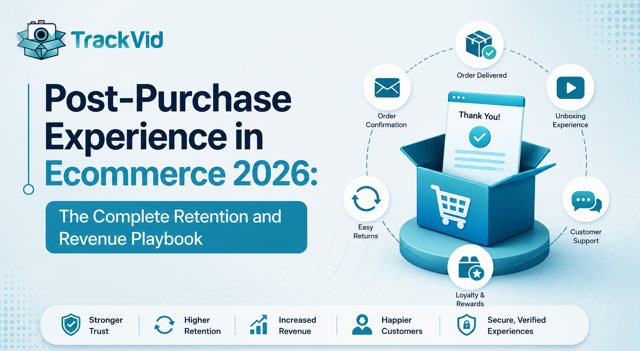
The 7 critical post purchase experience ecommerce touchpoints are:
- Order confirmation (within 60 seconds of checkout)
- Dispatch notification (with tracking link and dispatch evidence)
- In-transit updates (proactive alerts at major shipment events)
- Delivery ETA communication (day-before or day-of expected delivery)
- Delivery confirmation (with unboxing prompt)
- Post-delivery follow-up (thank you, care instructions, review request)
- Retention triggers (upsell at day 14, win-back at day 60)
Each touchpoint has an optimal channel, optimal timing, and optimal content. Applying email-only communication across all 7 touchpoints achieves 20 percent open rates and 3 percent action rates. Applying multichannel communication (WhatsApp + email + SMS orchestrated by trigger) achieves 90 percent open rates on WhatsApp touchpoints and 40 to 60 percent action rates on high-intent moments.
Post-purchase experience is not customer service. Customer service is reactive: it responds to problems. Post-purchase experience is proactive: it anticipates the customer's information needs at every stage and delivers them before the customer has to ask.
Why Does Post-Purchase Experience Matter for Ecommerce Growth?
The economics have shifted decisively toward retention. Understanding why explains everything about how the discipline should be resourced.
The retention math that changed the industry:
- Repeat customers spend 67 percent more than first-time buyers (Bain & Company)
- A 5 percent increase in retention boosts profits 25 to 95 percent (Harvard Business Review)
- Loyal customers convert at 60 to 70 percent versus 5 to 20 percent for new prospects
- Customer lifetime value grows 3 to 5x for brands with strong post-purchase infrastructure
The acquisition cost pressure driving the shift:
- Average customer acquisition cost across ecommerce climbing 25 to 40 percent year over year
- Meta CPMs up 15 percent year over year in 2026
- Google Ads costs continue climbing across every vertical
- Organic reach on social platforms continues declining
The gap most brands fail to close:
- 56 percent of customers report disappointment with their post-purchase experience (Accenture)
- Only 17 percent feel businesses actually care about what happens after they buy
- Most brands invest less than 5 percent of marketing budget in post-purchase touchpoints
- The gap between what post-purchase drives (retention, repeat purchase, LTV) and what brands invest in it (nearly nothing) is the largest addressable inefficiency in ecommerce today
The brands winning in 2026 have moved retention infrastructure investment from "nice-to-have" to "table stakes." Post-purchase experience ecommerce operations receive the same executive attention, budget allocation, and metric rigor previously reserved for acquisition. This is not a philosophical shift; it is a mathematical one driven by the collapse of unit economics on acquisition-first strategies.
The 5-Step Framework to Build Post-Purchase Experience in Ecommerce
Step 1: Send Order Confirmation Within 60 Seconds Across Multiple Channels
The first 60 seconds after checkout is the highest-attention window in the customer relationship. The customer just committed to a purchase and is actively waiting for confirmation. Failing to deliver in this window creates immediate post-purchase dissonance and increases refund request probability.
Channel strategy:
- Email (baseline): Full order details, itemized breakdown, expected delivery window, invoice, contact information
- WhatsApp (primary): Short thank-you message, order number, tracking placeholder, one-tap support option
- SMS (backup): Concise confirmation with order number and expected delivery date
Content requirements:
- Order number prominently visible
- Itemized product list with images
- Expected delivery date range
- Shipping address confirmation (helps customer catch errors early)
- Payment confirmation for prepaid orders
- COD amount confirmation for COD orders
- Clear contact information for questions
Timing: Automated trigger on order placement. WhatsApp confirmation within 30 seconds. Email within 60 seconds. SMS within 90 seconds. Delay beyond these thresholds triggers the anxiety response most brands never measure.
Critical rule: confirmation is not marketing. Do not embed upsell offers or promotional content in the order confirmation. Save those for post-delivery. Confirmation is a trust and information delivery task; contaminating it with promotion damages the trust signal.
Step 2: Deliver Dispatch Notification With Tracking Link and Proof of Shipment
Dispatch is the second-highest attention window. The customer receives confirmation that the order is now physically in motion, which converts the abstract "I bought something" into concrete "my item is coming."
What most brands send: "Your order has shipped. Track here." (bare minimum, misses the retention opportunity)
What high-retention brands send:
- Dispatch notification with tracking link on branded tracking page (not carrier default page)
- Dispatch evidence via WhatsApp packing video share showing the exact product being packed with weight verification and tamper seal
- Expected delivery window with confidence indicator (typically 2 to 4 days out)
- What to do if any issue arises with one-tap support access
Why dispatch evidence changes everything: The WhatsApp packing video share is the single most differentiated post-purchase touchpoint available in 2026. It transforms dispatch from a logistics event into a trust artifact. Customers who see their exact item being packed with proper handling reduce buyer's remorse rate 35 to 55 percent. On high-AOV orders (fashion above 2,000 rupees, electronics above 5,000 rupees), the trust artifact effect is even stronger. This is a post-purchase touchpoint traditional tracking platforms cannot deliver because they only handle carrier data, not dispatch operations data.
For deeper context on how dispatch evidence integrates with claim defense and RTO reduction workflows, see the complete RTO Reduction Playbook at trackvid.in.
Timing: Automated trigger on shipment status change. WhatsApp within 30 minutes of dispatch. Email within 2 hours. Tracking link goes live immediately.
Step 3: Provide Proactive In-Transit Updates to Reduce WISMO Queries
WISMO ("Where Is My Order?") queries represent 30 to 45 percent of all ecommerce support tickets. Every WISMO ticket costs support team time and signals a post-purchase experience failure. Proactive updates eliminate the majority of WISMO queries before they get raised.
In-transit trigger events requiring proactive notification:
- Shipment picked up by carrier
- Shipment arrived at sorting hub
- Shipment departed sorting hub for destination city
- Shipment out for delivery (day-of notification)
- Delivery attempt failed (if applicable)
Channel by trigger:
- Sorting hub events: email (low urgency, informational)
- Out-for-delivery: WhatsApp + SMS (high urgency, action-triggering)
- Delivery attempt failed: WhatsApp within 15 minutes (recovery workflow)
Content strategy for in-transit updates:
- Location and status of parcel
- Updated ETA if changed
- What to expect next
- Contact information for concerns
Target reduction: structured proactive updates cut WISMO queries 40 to 60 percent within 60 days. This alone justifies the entire post-purchase infrastructure investment through support cost reduction. Brands that want to prevent WISMO at the root layer should also see our Customer Risk Scoring Playbook at trackvid.in for identifying high-anxiety customer segments requiring extra communication.
Step 4: Confirm Delivery With Unboxing Prompt and Review Request Setup
Delivery confirmation is the moment of truth. The customer has the product in hand. This touchpoint sets the trajectory for everything that follows: repurchase, review, referral, or return.
Delivery confirmation workflow:
- Automated WhatsApp within 30 minutes of delivery confirmation from carrier
- Message content: "Your order has arrived. We hope you love it. Any issues? Reply here for instant help."
- Include unboxing prompt: "Share your unboxing on Instagram tagging @yourbrand for a chance to be featured"
- Set up review request queue for day 7 delivery
Why day-of unboxing prompt matters: The moment after delivery is when customer emotional peak intersects with sharing behavior. Prompting an unboxing share at this window captures user-generated content that costs nothing and outperforms paid social 4 to 7 times on engagement metrics.
Return protection layer: for customers who received the parcel and file "empty box" or "wrong item" claims within 24 hours of delivery, Order ID-linked dispatch evidence defeats fraudulent claims at 85-90 percent win rate. See the complete Fake COD Order Detection Playbook at trackvid.in for the checkout-side prevention layer.
Timing: WhatsApp delivery confirmation within 30 minutes of carrier delivery scan. Unboxing prompt embedded in same message. Review request scheduled for day 7.
Step 5: Trigger Post-Delivery Behavioral Loop for Retention and Revenue
The final step converts one-time buyers into repeat customers through structured behavioral automation.
The 4-touchpoint behavioral loop:
Day 3: Care instructions and satisfaction check
- Email with product care instructions, styling tips, or usage guides
- WhatsApp check-in: "How is [product] working out?"
- Purpose: catch dissatisfaction early, generate positive engagement
Day 7: Review request
- Email with one-click review link
- WhatsApp request for photo review with incentive (small discount on next order)
- SMS backup for non-openers
- Purpose: capture review while product experience is fresh
Day 14: Cross-sell or upsell
- Email with complementary product recommendations based on purchase history
- WhatsApp offer for related items with time-limited discount
- Purpose: convert post-purchase momentum into a second purchase
Day 60: Win-back trigger
- Email with "we miss you" message and re-engagement offer
- WhatsApp reminder with returning-customer discount
- Purpose: catch customers before they lapse permanently
Personalization requirements:
- Reference the specific product purchased, not generic messaging
- Use customer name and purchase context
- Time-of-day optimization (send in customer's local timezone at high-response windows)
- Segment by purchase value tier (VIP customers get different messaging than first-time buyers)
Target outcomes: Structured post purchase experience ecommerce behavioral loops lift repeat purchase rate 40 to 60 percent within 90 days. Review generation rates rise from 2 to 3 percent (organic) to 10 to 15 percent (prompted). Customer lifetime value grows 2 to 4x for cohorts running through the full behavioral loop.
Case Study: D2C Brand, Repeat Purchase Rate 24% to 41% in 90 Days
A men's fashion and accessories D2C brand on the TrackVid platform started 2026 with basic post-purchase infrastructure: order confirmation email, carrier tracking link, no proactive updates, no behavioral loop. Their metrics: 24 percent repeat purchase rate within 90 days, 3 percent review generation rate, 38 percent of support tickets were WISMO queries, average customer lifetime value at ₹2,400 across the base.
Days 1-14: Post-purchase touchpoint audit. Mapped current customer journey against the 7 critical touchpoints. Identified gaps at every stage: no WhatsApp confirmation, no dispatch evidence share, no proactive in-transit updates, no delivery unboxing prompt, no behavioral loop.
Days 15-30: Deployed multichannel order confirmation (WhatsApp + email + SMS) within 60-second window. Enabled branded tracking page with dispatch evidence integration. Set up WhatsApp packing video share on all orders above 1,500 rupees.
Days 31-60: Layered proactive in-transit updates at every major shipment event. Enabled delivery confirmation workflow with unboxing prompt. Set up day 7 review request queue.
Days 61-90: Activated full behavioral loop: day 3 care instructions, day 7 review request, day 14 upsell, day 60 win-back. Set up segmented messaging by AOV tier and purchase category.
Results at day 90:
- Repeat purchase rate: 24 percent to 41 percent (up 71 percent)
- Review generation: 3 percent to 14 percent (up 367 percent)
- WISMO queries: 38 percent of support to 18 percent (down 53 percent)
- Buyer's remorse-driven cancellations: down 42 percent
- Average customer lifetime value: ₹2,400 to ₹3,850 (up 60 percent)
- NPS score: 32 to 54 (up 22 points)
- Return rate (dispatch evidence effect): 26 percent to 21 percent (down 19 percent)
- Support ticket volume overall: down 34 percent
The single largest contribution came from Step 2 (dispatch evidence share via WhatsApp packing video) plus Step 5 (behavioral loop) combined, accounting for approximately 65 percent of the total lift. The dispatch evidence share alone drove the return rate reduction and buyer's remorse reduction; the behavioral loop drove the repeat purchase rate and LTV gains.
See how WhatsApp packing video share transforms your post-purchase experience and lifts repeat purchase rates. 30 minutes. No commitment.
What Are the Best Channels for Post-Purchase Communication?
Channel choice determines whether your post purchase experience ecommerce workflow actually reaches the customer. The 2026 channel hierarchy has shifted decisively.
WhatsApp (highest ROI for post-purchase):
- Open rates: 90 percent plus (within 3 minutes typical)
- Click-through rates: 45 to 60 percent
- Best for: order confirmation, dispatch notification, delivery alerts, NDR recovery, review requests
- Cost: modest per-message fee via WhatsApp Business API
- Response rate: 40 to 60 percent for one-tap action prompts
Email (baseline, still essential):
- Open rates: 20 to 30 percent (typical ecommerce)
- Click-through rates: 2 to 5 percent
- Best for: detailed order confirmations, care instructions, review requests, upsell campaigns, receipts
- Cost: extremely low per message
- Response rate: low but volume compensates
SMS (backup and urgent):
- Open rates: 90 percent plus (matches WhatsApp)
- Click-through rates: 15 to 25 percent
- Best for: out-for-delivery alerts, urgent notifications, WhatsApp fallback
- Cost: moderate per message
- Response rate: 8 to 15 percent
Push notifications (app users only):
- Open rates: 40 to 60 percent
- Best for: brands with active mobile apps
- Limitation: only reaches app-installed customers
Channel combination strategy: deploy WhatsApp as primary, email as detailed backup, SMS as urgent-only fallback. This orchestration achieves 90 percent open rates on high-intent touchpoints while retaining email's cost advantage for informational content.
Critical insight: Do not choose one channel. Deploy them in an orchestration engine that triggers each based on message type and customer preference. Single-channel post-purchase in 2026 is outdated and demonstrably underperforms.
How Do You Reduce Buyer's Remorse After Purchase?
Buyer's remorse peaks in the window between order placement and delivery. Customers second-guess the purchase, look at competitor pricing, worry about product fit or quality, and sometimes cancel before dispatch. Reducing buyer's remorse is a core post purchase experience ecommerce discipline that converts wobbly orders into completed sales.
5 tactics that reduce buyer's remorse:
Tactic 1: Immediate order confirmation (within 60 seconds). Silence after checkout amplifies anxiety. Multichannel confirmation within 60 seconds signals professionalism and reduces first-hour remorse.
Tactic 2: Dispatch evidence share via WhatsApp. The single most powerful buyer's remorse killer. Video proof of the actual product being packed with weight verification transforms abstract worry into concrete reassurance. Reduces remorse-driven cancellations 35 to 55 percent.
Tactic 3: Proactive delivery ETA communication. Uncertainty about "when will it arrive?" is the second-largest remorse trigger. Day-before delivery ETA notifications reduce anxiety at the highest-remorse window.
Tactic 4: Care instructions and use context (day 3). Reinforces the value of the purchase after delivery. Customers who receive care instructions rate satisfaction 15 to 25 percent higher than those who do not.
Tactic 5: Easy support access at every touchpoint. Every message includes one-tap access to WhatsApp support. Knowing support is available (whether they use it or not) reduces remorse across all touchpoints.
Brands running the full anti-remorse stack see cancellation rates drop 30 to 50 percent within 60 days.
Where TrackVid Fits in Your Post-Purchase Experience Stack
Steps 1, 3, 4, and 5 need a post-purchase communication platform (LateShipment, AfterShip, Klaviyo Customer Hub, Zineps, or your existing ESP with WhatsApp integration). Step 2 (dispatch evidence share) is where TrackVid becomes the differentiator no other platform can replicate.
TrackVid is a video proof and claim management platform used by 1,100+ ecommerce sellers on Shopify, WooCommerce, Amazon, Flipkart, Myntra, AJIO, Nykaa, Meesho, and Snapdeal. Officially authorized by Snapdeal. Brands using TrackVid include Rare Rabbit, Wrogn, The Indian Garage Co, The Bear House, HRX, Nike, Jordan, Tommy Hilfiger, and Snitch.
For post-purchase experience ecommerce operations specifically, TrackVid delivers:
- Order ID-linked dispatch video on every packing station without workflow changes. Ties every video to Order ID, SKU, and tracking reference. Retrievable in under 2 minutes.
- WhatsApp packing video share at dispatch. The unique post-purchase touchpoint no traditional tracking platform can offer. Trust artifact that reduces buyer's remorse 35 to 55 percent and builds repeat purchase probability.
- Dispatch weight and seal verification captured in-frame. Provides objective proof of what shipped, useful in both post-purchase trust building and post-delivery dispute defense.
- Order ID-linked support acceleration. When customers raise WISMO or "wrong item" queries post-delivery, support team retrieves dispatch evidence in under 2 minutes to resolve inquiries with authority.
- Post-delivery empty-box detection via dispatch weight vs return weight mismatch. Catches fraudulent claims from customers filing "empty box" after delivery acceptance.
- Cross-platform integration with major shipping platforms (Shiprocket, Shipway, Shipmozo, EasyEcom) and post-purchase communication platforms.
For related workflows on defending disputes from bad customers, see our Customer Risk Scoring Playbook at trackvid.in. For NDR recovery workflow that integrates with post-purchase delivery communication, see the NDR Management Ecommerce Playbook at trackvid.in.
WROGN's pilot data shows the pattern clearly. Across 95,836 tracked orders and 868 claims filed, systematic dispatch evidence combined with post-purchase communication moved claim approval from 42.3 percent (June) to 60.3 percent (July) within one month while lifting repeat purchase metrics across all cohorts using the WhatsApp packing video share.
In a 30-minute call, our team walks through your specific post-purchase gaps, quantifies your recoverable retention loss from missing touchpoints, and shows you exactly how WhatsApp packing video share integrates with your existing post-purchase communication stack. No commitment, no obligation.
5-Question Post-Purchase Experience Audit
1. Do you send order confirmation across at least 2 channels within 60 seconds of checkout? If email-only, you are missing the WhatsApp trust window and generating buyer's remorse in the first hour.
2. Does your dispatch notification include actual dispatch evidence (packing video, weight verification) or just a carrier tracking link? Without dispatch evidence, dispatch is a logistics event, not a trust artifact.
3. What percentage of your support tickets are WISMO queries? If above 25 percent, your in-transit communication is failing and proactive updates would materially reduce support burden.
4. Do you have a structured behavioral loop after delivery (day 3, day 7, day 14, day 60)? Without it, first-time buyers become one-time buyers at 70 to 80 percent rate.
5. Do you segment post-purchase messaging by AOV tier or purchase category? Generic post-purchase workflows underperform segmented workflows by 40 to 60 percent on retention metrics.
See exactly where your post-purchase gaps are and how dispatch evidence integrates with your existing communication stack. 30 minutes. No commitment.
Frequently Asked Questions
What is post-purchase experience in ecommerce?
Post-purchase experience is the complete customer journey after checkout, spanning order confirmation through repeat purchase or churn. It includes 7 critical touchpoints: order confirmation, dispatch notification, in-transit updates, delivery ETA communication, delivery confirmation, post-delivery follow-up, and retention triggers. It shapes 70 percent of total customer experience yet most brands invest less than 5 percent of marketing budget in it.
How to improve post-purchase experience in ecommerce?
Improve post-purchase experience through the 5-step framework: send order confirmation within 60 seconds across WhatsApp, email, and SMS; deliver dispatch notification with tracking link and dispatch evidence (packing video share); provide proactive in-transit updates at every major event; confirm delivery with unboxing prompt and review request setup; trigger post-delivery behavioral loop at day 3, day 7, day 14, and day 60. This framework lifts repeat purchase rate 40 to 60 percent within 90 days.
Why does post-purchase experience matter for ecommerce?
Post-purchase experience matters because 65 percent of ecommerce revenue comes from repeat customers, 86 percent of customers say post-purchase determines repurchase (Narvar), and customers with strong post-purchase experiences spend 140 percent more over time (Accenture). Rising acquisition costs (Meta CPMs up 15 percent year over year, Google Ads costs climbing across every vertical) have made retention the only viable growth strategy. Post-purchase is the primary retention driver.
What are the 7 post-purchase touchpoints?
The 7 critical touchpoints: order confirmation (within 60 seconds), dispatch notification (with tracking and evidence), in-transit updates (proactive at major events), delivery ETA communication (day-before or day-of), delivery confirmation (with unboxing prompt), post-delivery follow-up (thank you, care, review request), retention triggers (upsell at day 14, win-back at day 60). Each touchpoint has an optimal channel, timing, and content type.
How to reduce buyer's remorse after purchase?
Reduce buyer's remorse through 5 tactics: immediate order confirmation within 60 seconds across multichannel, dispatch evidence share via WhatsApp packing video (the single most powerful remorse killer), proactive delivery ETA communication, care instructions and use context at day 3, and easy support access at every touchpoint. Brands running the full anti-remorse stack see cancellation rates drop 30 to 50 percent within 60 days.
What is a good post-purchase workflow?
A good post-purchase workflow orchestrates multichannel communication (WhatsApp primary, email baseline, SMS urgent-only) across 5 stages: order confirmation, dispatch with evidence, in-transit updates, delivery confirmation with unboxing prompt, and behavioral loop at day 3, 7, 14, and 60. Personalized by AOV tier and purchase category. Automated but not generic. Measurable against repeat purchase rate, review generation, WISMO reduction, and CLV metrics.
How to build post-purchase automation?
Build post-purchase automation using multichannel orchestration platforms. Trigger events from ecommerce platform (Shopify, WooCommerce). Route via WhatsApp Business API for high-intent touchpoints. Backup via email SMTP for detailed content. Escalate to SMS for urgent-only cases. Timing logic: instant confirmation, 30-minute dispatch alert, day-of delivery ETA, day 3 care check, day 7 review request, day 14 upsell, day 60 win-back. Integrate dispatch evidence share (WhatsApp packing video) at dispatch trigger for unique differentiator.
What are the best post-purchase apps in 2026?
Best post-purchase apps combine three layers. Layer 1: Communication and tracking (AfterShip, LateShipment, Klaviyo Customer Hub, Narvar, Outvio). Layer 2: WhatsApp automation (AiSensy, Interakt, Wati). Layer 3: Dispatch evidence and unique post-purchase differentiator (TrackVid). The combined stack achieves 90 percent open rates on high-intent touchpoints, 40 to 60 percent repeat purchase lift, and material WISMO reduction versus single-tool approaches.
How does WhatsApp improve post-purchase experience?
WhatsApp improves post-purchase experience through 90 percent plus open rates (versus 20 to 30 percent for email), 45 to 60 percent click-through rates, and 40 to 60 percent response rates on one-tap action prompts. Best used for order confirmation, dispatch notification (especially with packing video share), delivery alerts, NDR recovery, and review requests. WhatsApp Business API integration triggers automated messages on ecommerce platform events at modest per-message cost.
Does dispatch video improve post-purchase experience?
Yes. Dispatch video shared via WhatsApp at dispatch is the single most differentiated post-purchase touchpoint available in 2026. It transforms dispatch from a logistics event into a trust artifact. Customers who see their exact item being packed with proper handling reduce buyer's remorse 35 to 55 percent and increase repeat purchase probability. Traditional tracking platforms cannot replicate this because they handle only carrier data, not dispatch operations data.
Sources: Narvar Post-Purchase Report 2026, Accenture Customer Experience Study 2026, Bain & Company Retention Analysis 2026, Harvard Business Review Retention Economics 2026, Loop Returns Global Ecommerce Retention Report 2026, LateShipment Post-Purchase Guide 2026, Zineps Post-Purchase Loyalty Report 2026, TrackVid platform data across 1,100+ sellers, WROGN pilot data (94,904 videos, 95,836 tracked orders, 868 claims filed)
TrackVid is a video proof and claim management platform used by 1,100+ ecommerce sellers on Shopify, Amazon, eBay, Flipkart, Myntra, AJIO, Nykaa, Meesho, Bol.com, Zalando, MyDeal, PayPal, and Snapdeal. Officially authorized by Snapdeal. Brands trusting TrackVid include Rare Rabbit, Wrogn, The Indian Garage Co, The Bear House, HRX, Nike, Jordan, Tommy Hilfiger, and Snitch. Learn more at trackvid.in.
Get the Marketplace Claim Recovery Checklist
A 12-point checklist used by 1,100+ sellers to recover 85-90% of marketplace claim losses. Free, instant access.
- Marketplace-specific evidence formats (AJIO, Flipkart, Amazon, Myntra)
- Claim window deadlines for every major platform
- The 6-step process that pushes approval from 85-90%
- Common rejection reasons and how to avoid them
No spam. Unsubscribe anytime. Used by sellers at Rare Rabbit, HRX, Da Milano + 1,100 more.
Stop Losing Money to Fake Returns
Join 1,100+ sellers who recover lakhs every month with TrackVid