
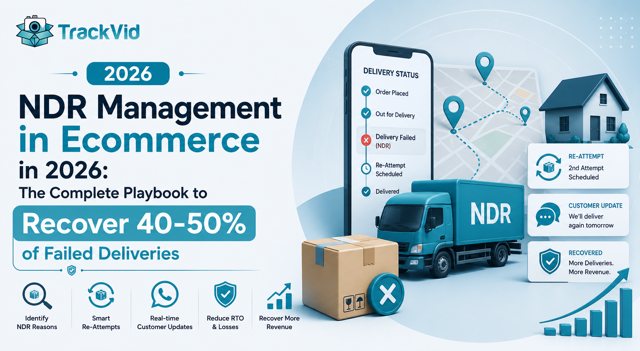
For D2C brand founders, ecommerce operators, logistics teams, and customer support leads. Updated August 2026.
Direct Answer
To manage NDR in ecommerce, categorize every failed delivery by reason code within 4 hours (customer unavailable, wrong address, COD refusal, other), auto-trigger tailored recovery workflows per code (WhatsApp reschedule for unavailable, address correction for wrong address, prepaid conversion for COD refusal), enforce maximum 3 delivery attempts, and reconcile against GPS scan data to detect fake NDR events courier agents mark on parcels never actually attempted. Structured NDR management converts 40 to 50 percent of failed attempts into successful deliveries before they become RTO.
The Problem: NDR Is Where RTO Is Prevented, and Most Brands Miss the Window
Non-Delivery Report (NDR) is the courier event where a delivery attempt fails. NDR management ecommerce operations become critical when NDRs consume 15 to 30 percent of dispatched orders in COD-heavy markets. Left unmanaged, 60 to 80 percent of NDRs convert to RTO (Return to Origin), locking in forward shipping paid, reverse shipping charged back, and 1 to 2 weeks of inventory tied up in the reverse leg. The all-in cost per NDR-turned-RTO parcel runs ₹100 to ₹250, before counting the lost sale itself.
The response most brands try first is to blame the customer, blame the courier, or accept NDRs as unavoidable operational drag. All three responses lose money. NDRs are not unavoidable. Industry data consistently shows 40 to 50 percent of NDR orders can be recovered with a same-day, structured follow-up workflow. The recovery window is 24 to 48 hours from the failed attempt, after which the courier initiates the second or third attempt or begins the RTO leg.
The problem is not NDR frequency. The problem is NDR response time and workflow structure. Brands that treat NDR management ecommerce as a Tier 1 operational discipline (measured recovery rate, structured workflows, defined SLAs) convert failed attempts into revenue. Brands that treat NDR as a support ticket to review "when we get to it" convert NDRs into RTO writes-offs at 70 to 80 percent rate.
Across the TrackVid platform of 1,100+ ecommerce sellers, we consistently observe that brands deploying automated 4-hour NDR triage combined with GPS-based fake NDR detection recover 42 to 55 percent of previously written-off NDR volume. A meaningful share of this recovery comes from a category most brands never measure: fake "customer not available" scans that courier agents mark on parcels they never actually attempted, driven by route completion metrics that reward failed-attempt volume over successful-delivery volume.
NDR is not a lost order. It is an order waiting for the right response inside a 24-hour window.
What Is NDR in Ecommerce?
NDR stands for Non-Delivery Report. It is the courier's record when a delivery attempt fails, flagging the specific reason so the seller can act before the parcel enters the RTO leg.
NDR is different from RTO. NDR is the failed attempt event. RTO is the physical return of the undelivered parcel to the seller warehouse. NDR is a recovery opportunity. RTO is a locked-in loss.
NDR is different from a return. A return is a delivered order the customer sends back afterward. An NDR is an undelivered order where delivery failed at attempt.
For the full framework on preventing RTO after NDR conversion, see our complete RTO Reduction Playbook at trackvid.in.
The NDR-to-RTO progression:
- Courier attempts delivery
- Attempt fails for a specific reason (customer unavailable, wrong address, COD refusal)
- Courier raises NDR record and returns parcel to hub
- Second and third attempts scheduled per courier policy
- If all attempts fail, parcel enters RTO leg and returns to seller warehouse
The critical operational window sits between step 3 and step 4: typically 24 to 48 hours where the seller can intervene with customer contact, address correction, or reschedule to convert the failed attempt into a successful delivery. Miss this window and the parcel moves to RTO.
What Are the Common NDR Reason Codes?
Every courier system uses reason codes on NDR records. The codes differ across couriers, but the categories collapse into 5 primary reasons.
Customer Not Available (25-35% of NDRs). The delivery agent attempted delivery but no one was at the address. Legitimate reasons: customer at work, customer traveling, insufficient advance notice. Fraudulent reasons: courier agent marked NDR without actual attempt (see fake NDR detection below).
Wrong Address (15-25% of NDRs). Address is incomplete, unreachable, or does not exist. Missing pincode, unclear landmark, apartment number wrong. Some couriers list this as "insufficient address" or "address not deliverable."
COD Refusal (30-40% of NDRs on COD orders). Customer opened door but refused to accept the parcel. Change of mind, no cash available, product no longer wanted, price found cheaper elsewhere.
Customer Rescheduled (5-10% of NDRs). Customer answered the call and requested delivery on a different date or to a different address.
Other Operational Reasons (5-15% of NDRs). Weather delay, courier hub processing issue, agent unavailable, area not serviceable during the attempt window.
For customer-side signals that predict which customers will refuse COD deliveries or cause repeat NDRs, see our Customer Risk Scoring Playbook at trackvid.in.
Each reason code requires a different recovery tactic. Applying WhatsApp reschedule to a "wrong address" NDR wastes effort. Applying address correction to a "COD refusal" NDR wastes the customer's time. Reason code triage is Step 1 of every effective workflow.
How to Build NDR Management Ecommerce Framework in 5 Steps
Step 1: Categorize Every NDR by Reason Code Within 4 Hours
The 24 to 48 hour recovery window closes fast. Most brands lose it because NDR data sits unreviewed until the next business day. By the time someone looks at Tuesday's NDRs on Wednesday morning, Tuesday's parcels are already on their second attempt or in the RTO leg.
Automated NDR data ingestion. Set up API-based or webhook-based ingestion from every courier partner (Delhivery, XpressBees, Shiprocket, Shipway, Amazon Shipping, Ecom Express, DTDC, Blue Dart) into a central NDR queue. Manual courier portal check-ins scale to 100 NDRs per day, then break.
Reason code categorization. Every NDR gets tagged with the courier's stated reason code. Codes normalize into the 5 primary categories: customer unavailable, wrong address, COD refusal, customer rescheduled, other operational.
4-hour SLA on triage. Every NDR gets categorized and routed to a recovery workflow within 4 hours of courier reporting it. Above 4 hours, recovery rates drop from 45 percent territory to 25 percent territory. Above 24 hours, recovery becomes marginal.
Prioritization by order value. High-value orders (top 15 to 20 percent by AOV) get manual review layered on top of automated workflow. Standard orders flow entirely through automation.
Step 2: Deploy Automated Recovery Workflows Per Reason Code
Each NDR reason code triggers a specific recovery flow. Applying the wrong flow burns the recovery window.
Customer Not Available workflow:
- WhatsApp message within 15 minutes: "Your delivery attempt failed. Reply with a preferred re-delivery time or reschedule for tomorrow."
- SMS backup for non-WhatsApp responders within 30 minutes
- IVR call for high-value orders within 2 hours
- Auto-reschedule delivery for the next day if no customer response
- Escalate to human callback if no response after 4 hours
Wrong Address workflow:
- WhatsApp message within 15 minutes with the recorded address and correction link
- SMS backup with address confirmation option
- IVR call for high-value orders
- If corrected address received, update courier and retry
- If no correction within 6 hours, escalate to customer support call
COD Refusal workflow:
- WhatsApp message within 15 minutes: "We noticed your delivery was refused. Would you like to reschedule with a prepaid discount?"
- Prepaid conversion incentive (3 to 5 percent discount) as the primary conversion lever
- IVR call with retention offer for high-value orders
- If no response within 4 hours, one final callback attempt
- Do not force retry on refused orders; wasted attempts damage courier relationships
Customer Rescheduled workflow:
- Confirm new date via WhatsApp within 15 minutes
- Update courier system with new preferred delivery date
- Send day-before reminder to customer
- Monitor the rescheduled attempt
Other Operational workflow:
- Automatic retry scheduling (weather delays typically resolve within 24 hours)
- Reroute to alternative courier partner if courier hub issue persists
- Communicate delay to customer proactively via WhatsApp
Target recovery rate: 40 to 50 percent of NDRs converted to successful delivery through structured workflows. Best-in-class brands reach 55 to 65 percent.
Step 3: Enforce Maximum Delivery Attempts
Endless delivery retries compound cost without improving conversion. Set operational limits.
Maximum 3 total delivery attempts per parcel across the courier network. After 3 failed attempts, one of two actions:
- Push for prepaid conversion with retention offer (COD refusal cases)
- Initiate reverse pickup and RTO leg (all other cases)
Attempt-by-attempt success rates typically follow:
- Attempt 1: 82 to 88 percent success (baseline)
- Attempt 2 (post-NDR workflow): 55 to 65 percent success
- Attempt 3 (final): 35 to 45 percent success
- Beyond 3 attempts: below 20 percent success
Attempts beyond 3 rarely pay for themselves. Better to accept the RTO or push aggressively for prepaid conversion than to waste courier capacity on low-probability retries.
Step 4: Detect Fake NDR Events With GPS and Return Reconciliation
This is the step most brands never implement, and it accounts for 8 to 15 percent of preventable NDR loss.
Courier delivery agents are sometimes incentivized on delivery volume and route completion, not delivery success. A minority of agents mark "customer not available" scans on parcels they never actually attempted, because the failed attempt still counts toward their route completion metrics. This pattern is documented across major couriers globally in COD-heavy markets. For the checkout-side detection of fake orders that later become fake NDR patterns, see our Fake COD Order Detection Playbook at trackvid.in.
Fake NDR detection signals:
- GPS location mismatch. NDR marked with GPS scan more than 500 meters from the delivery address indicates the attempt likely did not happen at the location claimed.
- Time-of-day anomalies. NDRs marked between 11 PM and 6 AM in residential areas are highly suspicious; legitimate delivery attempts happen during standard delivery hours.
- Hub-level clustering. Multiple NDRs from the same delivery hub within a short time window suggest a single agent bulk-marking fake attempts.
- Repeat NDR pattern per address. The same customer address getting NDR-marked repeatedly across different orders, especially when the customer confirms availability, indicates courier-side fraud.
- Weight mismatch on return. RTO parcel weight differs from dispatch weight, indicating tampering or wrong parcel being returned.
Reconciliation workflow:
- Match every NDR-flagged order against GPS scan data (where courier APIs provide it)
- Cross-reference against dispatch evidence (packing video, weight, tamper seal)
- Flag suspicious NDRs for investigation
- File automated claims against the courier for confirmed fake attempts
- Track courier-level fake NDR rates and reduce shipment allocation to high-fake-rate carriers
Across the TrackVid platform, sellers deploying return reconciliation recover 8 to 15 percent of previously unrecoverable NDR loss because a meaningful share of NDRs were fake events sellers never had visibility into.
Step 5: Track Recovery Metrics and Optimize Continuously
NDR management improves only when it is measured. Set specific metrics and review them weekly.
Core NDR management ecommerce metrics:
- NDR rate: NDRs / dispatched orders (target: below 15 percent in COD-heavy markets)
- NDR recovery rate: NDRs converted to delivery / total NDRs (target: 40 to 50 percent)
- NDR-to-RTO conversion: NDRs becoming RTO / total NDRs (target: below 50 percent)
- Recovery response time: median time from NDR raised to recovery workflow triggered (target: below 4 hours)
- Courier-level fake NDR rate: confirmed fake NDRs per courier / total NDRs per courier (target: below 2 percent)
- Prepaid conversion rate at NDR: COD refusals converted to prepaid / total COD refusal NDRs (target: 20 to 30 percent)
Weekly review cadence: operations lead reviews NDR metrics with logistics and support teams every Monday. Anomalies (fake NDR spikes, courier-level pattern shifts, workflow failures) get addressed within the week.
Courier scorecard integration. NDR performance feeds into courier-partner scorecards. High-NDR-rate couriers with high fake-NDR rates lose shipment volume allocation. This creates the accountability structure that reduces both legitimate and fraudulent NDR events at the network level.
NDR Management Ecommerce Case Study: 15% Recovery to 48% in 90 Days
A men's fashion and accessories D2C brand on the TrackVid platform started 2026 with a 22 percent NDR rate on their COD orders. Their NDR recovery rate sat at 15 percent (only 15 out of every 100 NDRs converted to successful delivery), meaning 85 percent of NDRs became RTO events. Monthly NDR-related loss represented 6.8 percent of gross revenue.
Days 1 to 14: NDR data audit. Set up API ingestion from 4 courier partners into central queue. Categorized 90 days of historical NDRs by reason code: 34 percent customer unavailable, 28 percent COD refusal, 22 percent wrong address, 9 percent customer rescheduled, 7 percent other operational.
Days 15 to 30: Deployed automated recovery workflows per reason code. WhatsApp integration for customer unavailable and wrong address flows. Prepaid conversion offer at 4 percent discount for COD refusal flows. 4-hour SLA on triage enforced through automation.
Days 31 to 60: GPS-based fake NDR detection activated. Identified one courier partner with 8 percent fake NDR rate (versus 1 to 2 percent industry benchmark). Reduced shipment allocation to that courier by 60 percent while filing recovery claims on documented fake attempts.
Days 61 to 90: Integrated dispatch evidence layer for post-RTO empty-box detection on parcels that returned. Set up weekly NDR scorecard review with logistics and support teams. Tuned workflow trigger thresholds based on response rate data.
Results at day 90:
- NDR recovery rate: 15 percent to 48 percent (3.2x improvement)
- NDR-to-RTO conversion: 85 percent to 52 percent
- Customer unavailable NDRs recovered: 62 percent
- Wrong address NDRs recovered: 71 percent (address correction workflow highly effective)
- COD refusal converted to prepaid: 24 percent
- Fake NDR events identified and claims filed: 380 in 90 days (₹64,600 recovered)
- Prepaid share of orders rose from 34 percent to 46 percent
- Overall NDR-related loss dropped from 6.8 percent of GMV to 3.1 percent
- Net margin improvement: +3.7 percentage points
The single largest contribution came from Step 2 (reason-code-matched recovery workflows) plus Step 4 (fake NDR detection) combined. Step 2 delivered baseline recovery; Step 4 delivered the previously invisible loss category most brands never recover.
See how return reconciliation surfaces the fake NDR events costing your brand today. 30 minutes. No commitment.
How Do You Convert COD Refusal NDRs to Prepaid Orders?
COD refusal is the highest-volume NDR category on COD-heavy stores and the hardest to recover through traditional workflow. Standard reschedule messaging fails on customers who genuinely changed their mind or found the product cheaper elsewhere. The tactic that works is prepaid conversion incentive at the NDR touchpoint.
The conversion sequence:
- WhatsApp message within 15 minutes of NDR: "We noticed your COD delivery was declined. If you'd like to reconsider, we can offer a 4 percent prepaid discount on immediate payment."
- Include prepaid payment link (UPI, card, wallet options)
- SMS backup for non-WhatsApp responders
- IVR call with retention offer for high-value orders
Conversion rates by segment:
- New customers on first COD order: 12 to 18 percent convert to prepaid
- Repeat customers with prior successful orders: 25 to 35 percent convert to prepaid
- High-AOV orders with human callback: 35 to 45 percent convert to prepaid
Overall COD-refusal-to-prepaid conversion: 20 to 30 percent across typical brands, representing pure revenue recovery from orders that would otherwise become RTO writes-offs.
Beyond direct conversion, the offer signals to genuinely uncertain customers that the merchant is willing to accommodate, which sometimes converts to a successful COD delivery on a rescheduled attempt.
How to Detect Fake NDR Attempts Specifically
Fake NDR events are the invisible margin killer. Courier agents mark "customer not available" or similar codes on parcels they never actually attempted, driven by route completion incentives that reward failed attempts as much as successful deliveries.
Specific detection tactics:
GPS scan verification. Modern courier APIs provide GPS coordinates of each scan event. Cross-reference the NDR scan location against the delivery address. Distances above 500 meters raise the fake NDR flag. Distances above 2 kilometers are near-certain fake events.
Time-of-attempt validation. Legitimate residential delivery attempts happen between 8 AM and 8 PM in most markets. NDRs scanned at 2 AM, 4 AM, or during declared courier hub closure hours are procedurally suspicious.
Customer-side confirmation cross-check. WhatsApp the customer immediately on NDR: "Our courier reports attempted delivery at 3:15 PM today. Did you receive a call or see the courier?" Genuine unavailability confirms the courier's account. "No one came, no one called" confirms fake NDR.
Hub-level fake NDR clustering. Aggregate NDR data by originating delivery hub. Hubs with fake NDR rates above 5 percent (versus 1 to 2 percent benchmark) are systemic problems requiring courier partner escalation.
Weight and seal reconciliation. For parcels that do eventually deliver or RTO after multiple NDR cycles, compare dispatch weight and seal status against received weight and seal status. Tampering or substitution during the NDR cycle indicates deeper courier-side problems.
Recovery claim workflow. For confirmed fake NDR events, file claims against the courier partner citing the specific evidence: GPS mismatch, customer confirmation of no attempt, hub-level pattern data. Recoveries typically process at 60 to 75 percent success rate when documented properly.
Where Does TrackVid Fit in Your NDR Management Ecommerce Stack?
Steps 1 through 3 (categorization, automated workflows, attempt limits) need a shipping platform integration layer (Shiprocket, Shipway, Shipmozo, Vamaship, EasyEcom). Step 4 (fake NDR detection) and Step 5 (dispatch evidence reconciliation) are where TrackVid becomes decisive.
TrackVid is a video proof and claim management platform used by 1,100+ ecommerce sellers on Shopify, WooCommerce, Amazon, Flipkart, Myntra, AJIO, Nykaa, Meesho, and Snapdeal. Officially authorized by Snapdeal. Brands using TrackVid include Rare Rabbit, Wrogn, The Indian Garage Co, The Bear House, HRX, Nike, Jordan, Tommy Hilfiger, and Snitch.
For NDR management specifically, TrackVid delivers:
- Order ID-linked dispatch video on every packing station without workflow changes. When an NDR-cycled parcel eventually delivers or RTOs with damage or substitution claims, dispatch evidence defeats the claim.
- Return reconciliation module scans return delivery logs across major couriers and cross-references NDR events against GPS scan data, dispatch evidence, and hub-level patterns. Identifies fake NDR events systematically instead of ad-hoc.
- Auto-files recovery claims against couriers for confirmed fake NDR attempts, cutting manual filing from 15 to 20 minutes to under 30 seconds per claim. 90 percent plus claim win rate across the platform.
- Weight reconciliation between dispatch and RTO parcel receipt catches tampering during NDR cycles that traditional tracking misses.
- Hub-level fake NDR analytics aggregate courier partner data to surface systemic problems, informing courier scorecard decisions and shipment allocation.
- Customer-side WhatsApp packing video share at dispatch establishes customer trust that reduces COD refusal rates at delivery attempt, preventing NDRs upstream.
WROGN's pilot data shows the pattern clearly. Across 95,836 tracked orders and 868 claims filed, systematic dispatch evidence combined with return reconciliation moved claim approval from 42.3 percent (June) to 60.3 percent (July) within one month. Fake NDR recovery represents a meaningful share of this uplift.
In a 30-minute call, our team walks through your specific NDR reason distribution, quantifies your recoverable loss from fake NDR events, and shows you exactly how return reconciliation integrates with your existing shipping platform. No commitment, no obligation.
5-Question NDR Management Audit
1. What is your current NDR recovery rate? If below 30 percent, your workflow structure or response time is failing. Best-in-class brands recover 40 to 50 percent.
2. What is your median response time from NDR raised to recovery workflow triggered? Above 4 hours means you routinely miss the recovery window on the majority of NDRs.
3. Are your NDR recovery workflows differentiated by reason code, or do you apply the same reschedule flow to every NDR? Undifferentiated workflows waste effort on wrong-address NDRs and burn customer trust on COD refusal NDRs.
4. Do you cross-check NDR events against GPS scan data? Without this, fake NDR events go undetected and 8 to 15 percent of your NDR loss is unrecoverable.
5. Do you have a courier partner scorecard that includes fake NDR rate as a performance metric? Without accountability, courier-level fake NDR rates never improve.
See exactly where your NDR recovery gaps are and what a systematic detection and reconciliation system looks like in your specific operation. 30 minutes. No commitment.
Frequently Asked Questions
What is NDR in ecommerce?
NDR stands for Non-Delivery Report. It is the courier's record when a delivery attempt fails, flagging the specific reason so the seller can act before the parcel enters the RTO leg. NDR is different from RTO: NDR is the failed attempt event with a 24-48 hour recovery window, RTO is the physical return of the undelivered parcel to the seller warehouse.
What is the difference between NDR and RTO?
NDR (Non-Delivery Report) is the courier event where a delivery attempt fails, raising a record with the reason. RTO (Return to Origin) is the physical return of an undelivered parcel to the seller warehouse after all delivery attempts are exhausted. NDR is a recovery opportunity with a 24-48 hour window. RTO is a locked-in loss. Most brands ignore NDRs and only see the problem after RTO.
How to reduce NDR in ecommerce with NDR management ecommerce workflows?
Reduce NDR through five actions: categorize every NDR by reason code within 4 hours, deploy automated recovery workflows differentiated by reason code (WhatsApp reschedule for unavailable, address correction for wrong address, prepaid conversion for COD refusal), enforce maximum 3 delivery attempts, detect fake NDR events with GPS reconciliation, and track courier-level metrics with scorecards. Structured NDR management converts 40 to 50 percent of failed attempts into successful deliveries.
What is the 24-hour NDR window?
The 24-hour NDR window is the operational period after a courier raises an NDR during which the seller can intervene before the courier schedules the second attempt or begins the RTO leg. During this window, the seller can contact the customer via WhatsApp, SMS, or IVR, correct address issues, offer prepaid conversion on COD refusals, or reschedule delivery. Miss the window and the parcel moves to the second attempt or RTO with dropping recovery probability.
How to detect fake NDR attempts?
Detect fake NDR attempts through GPS scan verification (NDRs scanned more than 500 meters from delivery address indicate probable fake events), time-of-day anomalies (NDRs scanned between 11 PM and 6 AM in residential areas), customer-side confirmation cross-check via immediate WhatsApp message, hub-level fake NDR clustering aggregating patterns per delivery hub, and weight and seal reconciliation for parcels that eventually deliver or RTO. Systematic detection recovers 8 to 15 percent of previously invisible NDR loss.
What are common NDR reason codes?
Common NDR reason codes across couriers collapse into 5 primary categories: Customer Not Available (25-35 percent of NDRs), Wrong Address (15-25 percent), COD Refusal (30-40 percent on COD orders), Customer Rescheduled (5-10 percent), and Other Operational reasons like weather or hub processing (5-15 percent). Each reason code requires a different recovery tactic; applying the wrong workflow burns the recovery window.
How to convert NDR to successful delivery?
Convert NDR to successful delivery through reason-code-matched workflows within 4 hours of NDR event. Customer Not Available NDRs recover 55-65 percent through WhatsApp reschedule and IVR follow-up. Wrong Address NDRs recover 65-75 percent through address correction workflows. COD Refusal NDRs recover 20-30 percent through prepaid conversion incentives. Customer Rescheduled NDRs recover 85-90 percent through simple confirmation flows. Combined structured approach reaches 40-50 percent overall recovery.
What is a good NDR recovery rate?
A good NDR recovery rate depends on category mix. Overall best-in-class benchmark sits at 45 to 55 percent of NDRs converted to successful delivery. By reason code: customer unavailable 55-65 percent, wrong address 65-75 percent, COD refusal 20-30 percent, customer rescheduled 85-90 percent. Recovery rates below 30 percent indicate workflow or response-time failures. Recovery rates above 60 percent indicate best-in-class NDR management discipline.
What are the best NDR management tools in 2026?
Best NDR management tools combine three layers. Layer 1: Shipping platforms with automated NDR ingestion and workflow triggers (Shiprocket, Shipway, Shipmozo, Vamaship, EasyEcom). Layer 2: WhatsApp automation platforms for recovery messaging (AiSensy, Interakt, Wati). Layer 3: Dispatch evidence and return reconciliation for fake NDR detection and post-delivery dispute defense (TrackVid). The combined stack achieves 45-55 percent NDR recovery versus 15-25 percent for single-tool approaches.
How long does it take to improve NDR management?
NDR management improvement operates on a 90-day timeline for structural gains. Weeks 1-2: NDR data audit, reason code categorization baseline, courier API integration. Weeks 3-4: automated workflow deployment per reason code with 4-hour SLA. Weeks 5-8: GPS-based fake NDR detection and courier scorecard implementation. Weeks 9-12: dispatch evidence integration for post-cycle dispute defense. Brands running the full framework see NDR recovery rates rise from 15-20 percent to 45-55 percent by day 90.
Sources: Shipmozo NDR Management Analysis 2026, Shipway RTO Reduction Report 2026, ZenDMS NDR Management Guide 2026, ShipPrime NDR Recovery Report 2026, TrackVid platform data across 1,100+ sellers, WROGN pilot data (94,904 videos, 95,836 tracked orders, 868 claims filed)
TrackVid is a video proof and claim management platform used by 1,100+ ecommerce sellers on Shopify, Amazon, eBay, Flipkart, Myntra, AJIO, Nykaa, Meesho, Bol.com, Zalando, MyDeal, PayPal, and Snapdeal. Officially authorized by Snapdeal. Brands trusting TrackVid include Rare Rabbit, Wrogn, The Indian Garage Co, The Bear House, HRX, Nike, Jordan, Tommy Hilfiger, and Snitch. Learn more at trackvid.in.
Get the Marketplace Claim Recovery Checklist
A 12-point checklist used by 1,100+ sellers to recover 85-90% of marketplace claim losses. Free, instant access.
- Marketplace-specific evidence formats (AJIO, Flipkart, Amazon, Myntra)
- Claim window deadlines for every major platform
- The 6-step process that pushes approval from 85-90%
- Common rejection reasons and how to avoid them
No spam. Unsubscribe anytime. Used by sellers at Rare Rabbit, HRX, Da Milano + 1,100 more.
Stop Losing Money to Fake Returns
Join 1,100+ sellers who recover lakhs every month with TrackVid