
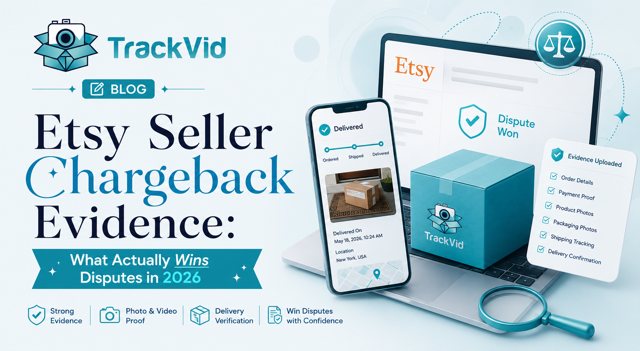
For handmade, vintage, and independent sellers on Etsy globally. Updated May 2026.
Etsy seller chargeback evidence is the single variable that determines whether you recover your money or absorb the loss. Etsy Payments acts as the intermediary between your shop and the buyer's bank, forwarding whatever evidence you submit within the response window directly to the issuing bank for review. The bank decides the outcome. Etsy does not override that decision. Your evidence is the entirety of your case.
Etsy seller win rates on chargebacks hover at 20 to 30 percent overall, according to 2026 data. That number understates what is achievable. Sellers who submit the right evidence for the specific dispute type they are facing win at significantly higher rates. Sellers who submit the wrong evidence, or submit nothing at all, lose regardless of how legitimate their case is.
Etsy chargebacks are not decided by who is right. They are decided by who has better evidence.
How Etsy Chargebacks Actually Work in 2026
Understanding the mechanics matters because it explains why the evidence you submit is the only lever you control.
When a buyer disputes a transaction, they have two routes. They can open a case through Etsy's internal case system, or they can file a chargeback directly with their card issuer. These are separate processes with different timelines and different outcomes.
For cases opened through Etsy, the platform evaluates the dispute and decides whether to invoke its Purchase Protection Programme. If the transaction qualifies, Etsy may absorb the cost of the refund up to $250. If it does not qualify, or if the amount exceeds $250, the seller is responsible for resolution.
For chargebacks filed directly with the buyer's bank, the process bypasses Etsy's internal system entirely. Etsy Payments receives the chargeback notification from the card network, notifies the seller through the Seller Dashboard, and gives the seller a response window of 10 to 20 days. The seller submits evidence. Etsy forwards that evidence package to the issuing bank. The bank decides. Etsy has no power to override or influence that decision beyond forwarding what the seller provides.
The May 2026 policy update made seller responsibility for proof explicit. Etsy now emphasises that sellers need tracking, messages, and photos as baseline documentation. For jewellery and handmade goods specifically, where product condition disputes dominate, baseline documentation is often insufficient. The question the bank is asking goes beyond "did this ship" to "was this item what was ordered and in the condition described."
A high chargeback rate also has consequences beyond individual losses. Sellers with excessive chargebacks risk Star Seller demotion, account suspension in serious cases, and in extreme cases, removal from Etsy Payments entirely.
Why Most Etsy Sellers Keep Losing Chargebacks
The most common reason Etsy sellers lose chargebacks despite submitting evidence is reason code mismatch: submitting evidence that answers the wrong question for the dispute type they are facing.
There are three primary chargeback types on Etsy, and each requires different primary evidence.
Item Not Received (INR). The buyer claims the item never arrived. The bank's question: was it shipped and delivered? Primary evidence: carrier tracking with delivery confirmation to the buyer's Etsy address. For orders above $250, signature confirmation significantly strengthens the case. This is the dispute type where tracking evidence is sufficient.
Item Not as Described (NAD). The buyer claims the item did not match what was listed. The bank's question: did the specific item dispatched match the listing description? This is where most Etsy sellers lose. They submit their listing photos and product description. These prove what the seller generally offers. They do not prove what was in the parcel for the specific disputed order. The bank cannot verify the specific dispatch from general listing evidence.
Unauthorised Transaction. The buyer claims they did not authorise the purchase. The bank's question: did the account holder initiate this transaction? Primary evidence: device fingerprint match, billing address match, prior purchase history from the same account and card.
The sellers who consistently win Etsy chargebacks are not those who submit more evidence. They are those who submit the specific evidence that answers the specific question the bank is asking for their dispute type.
For INR disputes, the evidence is clear and most sellers have it. For NAD disputes, the majority of sellers are missing the primary evidence type that actually answers the bank's question. That gap is where most Etsy chargeback losses live, particularly for jewellery and handmade goods where product condition is the core of almost every dispute.
Berlin Seller Anna: From 11 Percent to 69 Percent Win Rate on the Same Disputes
Anna makes and sells porcelain and enamel jewellery from her studio in Berlin, listing on Etsy and her own Shopify store. Her pieces are distinctive, hand-finished, and priced between €85 and €240. She dispatches approximately 45 to 60 orders per week depending on season.
For almost two years, chargebacks were Anna's most consistent operational frustration. She received them irregularly, typically three to six per quarter, almost always on her higher-value pieces. She filed responses to every one. She submitted her listing photos, her product descriptions, her order confirmation, and her shipping tracking. Her win rate was 11 percent.
She had assumed this was simply how Etsy chargebacks worked for small sellers. The bank sides with the buyer. There is not much a small seller can do.
When she looked at the reason codes on her lost disputes, the pattern was clear. Over 70 percent of her chargebacks cited "item not as described." Not item not received. Not unauthorised transaction. Specifically, the item did not match the description or photos.
For every one of those disputes, Anna had submitted her Etsy listing. Her listing showed her jewellery beautifully photographed. It showed exactly what she makes and how she describes it. What it could not show was what was in the parcel for the specific order in question.
The bank was not asking whether her listings were accurate. The bank was asking whether the specific piece dispatched for that order matched the description. Her listing answered the first question. Nobody had answered the second.
Anna's pieces are handmade. Each one is slightly different. A buyer claiming "not as described" on a handmade piece has identified an ambiguity that product photography and written descriptions cannot definitively resolve at the order level, because the photographs are of her collection generally, not of the individual piece for order 6219.
My shop has hundreds of photos. Not one of them showed the piece I packed the day that order shipped. That is the gap.
After Anna began recording every packing session and linking each video to the Order ID, the next batch of NAD chargebacks she received was different. For each dispute, she retrieved the packing video showing the specific piece being wrapped and placed in its box: the colours correct, the finish matching the listing, the enamel undamaged, the findings secure. She submitted this alongside her listing.
Her win rate on NAD chargebacks moved from 11 percent to 69 percent within two billing cycles. The disputes she still lost were cases where tracking evidence was the primary issue rather than product condition.
The Right Etsy Seller Chargeback Evidence by Dispute Type
Here is the correct evidence structure for each major Etsy chargeback type, with specific guidance for jewellery and handmade sellers.
Item Not Received: Evidence Checklist
Primary evidence required: carrier tracking showing delivery to the buyer's Etsy address with date and time stamp.
Strengthening evidence: GPS delivery confirmation, signature confirmation for orders above $250, prior Etsy message thread where the buyer acknowledged dispatch or tracking.
For jewellery sellers specifically: if the buyer's claim includes "package arrived empty" language alongside the INR claim, carrier tracking alone is insufficient. You need packing video showing the item being placed inside the packaging. An empty-package INR claim shifts the dispute from delivery to contents, and only dispatch documentation answers that question.
What loses: tracking that shows "delivered" without GPS confirmation on high-value orders. Unverified delivery to a building reception without individual confirmation for orders above $150.
Item Not as Described: Evidence Checklist
Primary evidence required: order-linked packing video showing the specific dispatched item in the condition and configuration matching the listing, against the specific Order ID.
Supporting evidence: listing screenshots from the time of purchase, any custom order communications where the buyer confirmed the specification, return receipt documentation if the buyer has initiated a return.
For jewellery sellers specifically: packing video needs to show the piece clearly at dispatch. For handmade pieces, capture the specific details that distinguish the piece: enamel colours, stone settings, metal finish, findings type, any markings. These are the characteristics a NAD claim will dispute. Your video needs to show them before the piece leaves your hands.
What loses: listing photos without order-level packing evidence. This is the most common and most preventable Etsy chargeback loss. The listing shows your collection. The bank needs to see the specific order.
Unauthorised Transaction: Evidence Checklist
Primary evidence required: delivery confirmation to the buyer's registered address, billing address match at transaction, device fingerprint consistency if available through Etsy Payments data.
Supporting evidence: prior order history from the same account showing the buyer has shopped with you before, any post-purchase communication from the buyer acknowledging the order.
For jewellery sellers: unauthorised transaction claims on jewellery orders are often second-attempt fraud after a NAD claim was not filed. If you have prior successful orders from the same account, submit that history. Banks treat established buyer-seller relationships differently from first-transaction disputes.
What Etsy's Purchase Protection Actually Covers for Sellers
Understanding the limits of Etsy's Purchase Protection is essential because many sellers assume they are covered for dispute categories where they are not.
Etsy's Purchase Protection for sellers covers the following, subject to eligibility criteria: orders where the buyer did not receive the package due to loss in transit, orders where the item arrived more than seven days after the estimated delivery date, orders where the item arrived damaged, and orders where the item matches the listing but the buyer disputes accuracy.
The critical limits that affect jewellery sellers:
Damaged item cases are covered for the first eligible incident per calendar year per seller. After that single annual use, all subsequent damage claims are entirely the seller's responsibility. A jewellery seller receiving four fraudulent damage claims in a year is covered for one of them.
The $250 cap. Etsy's protection covers up to $250 including shipping and taxes. Jewellery orders regularly exceed this threshold. Any chargeback above $250 is fully the seller's responsibility regardless of platform protection.
Eligibility requirements must be met. To qualify, the seller must have used Etsy Payments, shipped to the address on the Etsy order, provided valid tracking, and shipped within their stated processing times. Missing any requirement disqualifies the transaction from protection.
For chargebacks filed directly through the buyer's bank, which bypass Etsy's case system entirely, Etsy does not provide protection. The seller's submitted evidence is forwarded to the bank and that is the extent of Etsy's involvement.
The practical implication for jewellery sellers: for the majority of chargebacks above $250, and for all chargebacks after the first annual damaged-item protection is used, the seller's own evidence is the only protection. Packing video is the evidence that makes that protection functional rather than absent.
Related: How to protect your jewellery business from return fraud and swap fraud →
How Packing Video Specifically Changes Etsy Chargeback Outcomes for Jewellery Sellers
The connection between packing video and Etsy chargeback wins is specific to the dispute type that affects jewellery sellers most: Item Not as Described.
For every NAD chargeback, the bank is asking: did the specific item in the parcel match the description and photos on the listing? Listing evidence answers part of this. It shows what the seller offers. Packing video for the specific order answers the whole thing. It shows what the seller dispatched for that particular transaction.
For handmade jewellery, this distinction is more significant than for mass-produced items because each piece is slightly different. The listing photo is a sample or a studio shot. The actual piece dispatched may differ in minor ways that are entirely consistent with handmade production but which a buyer can exploit in a dispute as "not as described." Without packing video of the specific piece, the seller cannot demonstrate that the dispatched piece matched the listing at the item level.
Packing video also closes the empty-package claim gap that affects higher-value jewellery orders. A buyer claiming a box arrived empty has made a claim that delivery confirmation cannot disprove. Footage of the piece being placed inside the packaging and sealed directly addresses this claim.
The practical result: sellers using order-linked packing video on Etsy NAD disputes report win rates of 65 to 75 percent compared to the platform average of 20 to 30 percent, according to TrackVid data. The improvement is concentrated in the dispute type, NAD, that accounts for the majority of jewellery seller chargeback losses.
How to Submit Etsy Chargeback Evidence Effectively
The submission process matters as much as the evidence content. Banks reviewing Etsy chargeback submissions are processing high volumes. A clearly organised, labelled submission is evaluated faster and more favourably than an identical set of documents submitted without structure.
Step 1: Identify the reason code before gathering evidence. Check the chargeback notification in your Etsy Seller Dashboard for the dispute category. Do not start gathering evidence until you know whether you are responding to INR, NAD, or unauthorised transaction. Each requires a different primary evidence type.
Step 2: Retrieve the order-level packing video first. If you have order-linked packing video for the disputed order, retrieve it immediately. This is your primary evidence for NAD and empty-package INR disputes. Everything else supports this.
Step 3: Structure your rebuttal letter to the reason code. Two paragraphs maximum. Lead with a direct statement: "This chargeback is filed under Item Not as Described. The enclosed packing video for Order [ID] demonstrates that the item dispatched matches the listing description." Map each document to its specific purpose. Do not narrate the order history. Answer the bank's specific question.
Step 4: Organise the evidence package in reference order. Label each document clearly. Every document in your package should be referenced in your rebuttal letter. Unlabelled documents are often ignored in automated bank reviews.
Step 5: Submit before your deadline with time to spare. The Etsy response window is 10 to 20 days depending on the card network. Missing the deadline loses the case regardless of evidence quality. Do not wait until the final days.
TrackVid provides order-linked packing video documentation for Etsy sellers globally. Every packing session is recorded and linked to the Order ID at the moment of packing. Videos are stored in indexed cloud, retrievable by order number in under two minutes. When an Etsy chargeback arrives, the packing video for that specific order is retrieved and submitted as primary evidence within the response window.
For jewellery sellers on Etsy, TrackVid closes the evidence gap that accounts for the majority of preventable chargeback losses: the missing order-level documentation of what was dispatched for a specific order. TrackVid works with existing cameras including phone cameras for small workshop setups. Setup takes under 15 minutes.
Book a free TrackVid Demo Today
Five Questions to Know Where Your Etsy Chargeback Losses Are Coming From
- What reason code appears on the majority of your lost Etsy chargebacks? If more than half cite "item not as described," your losses are concentrated in the dispute category where listing photos fail as primary evidence. Order-linked packing video is the specific fix.
- What primary evidence are you currently submitting for NAD disputes? If the answer is listing photos and product descriptions, you are submitting evidence that answers whether your listings are accurate, not whether the specific dispatched item matched them. These are different questions and the second one determines the outcome.
- Have you exhausted your single annual Etsy Purchase Protection for damaged items? Once used, every subsequent damage claim is entirely your responsibility. For a jewellery seller, this protection realistically covers one incident. Packing video is the protection that does not run out.
- Are any of your recent chargebacks above $250? Above $250, Etsy's protection does not apply regardless of eligibility. Your submitted evidence is the entirety of your defence.
- Can you retrieve the packing video for any specific historical order in under two minutes? If the answer requires searching through phone camera rolls or asking your own memory, you do not have indexed documentation. You have footage that cannot be actioned within a 10 to 20 day response window under dispute pressure.
Frequently Asked Questions
What evidence do I need to win an Etsy chargeback?
The evidence needed depends entirely on the chargeback reason code. For Item Not Received disputes, carrier tracking with delivery confirmation to the buyer's Etsy address is primary. For Item Not as Described disputes, order-linked packing video showing the specific dispatched item is the highest-impact evidence, because listing photos prove your general catalogue, not what was in the specific order. For Unauthorised Transaction disputes, delivery confirmation, billing address match, and prior purchase history from the same account are primary. According to TrackVid data, Etsy sellers who submit order-linked packing video for NAD disputes win at 65 to 75 percent, compared to the platform average of 20 to 30 percent using standard documentation.
How to fight a not as described claim on Etsy?
To fight a "not as described" claim on Etsy, you need evidence of what was dispatched for the specific disputed order, not just evidence of what your listings generally show. Order-linked packing video showing the item in its dispatch condition is the primary evidence. Submit it alongside your listing screenshots and a brief rebuttal letter stating specifically that the packing video for the disputed Order ID demonstrates the item matched the listing. For handmade jewellery, capture the specific details in the video: finish, settings, colours, any unique characteristics. Without order-level dispatch evidence, NAD claims default in the buyer's favour because listing photos answer the wrong question.
Etsy chargeback seller lost: what to do?
If you have lost an Etsy chargeback, check whether an appeal option is available in your Seller Dashboard. For cases processed through Etsy's system, there may be a limited window to provide additional evidence. For chargebacks processed through the card issuer, the decision is typically final. Going forward, the most important change is implementing order-linked packing video documentation before the next dispute arrives. Every chargeback you receive for which you have packing video of the specific order will be on fundamentally stronger evidence ground than every chargeback you are currently losing. TrackVid sets this up in under 15 minutes.
Does packing video help win Etsy disputes?
Yes, significantly, for Item Not as Described and empty-package Item Not Received disputes. For NAD disputes, packing video showing the specific dispatched item is the primary evidence the bank needs to evaluate the claim. Listing photos prove what a seller generally offers. Packing video of a specific order proves what was dispatched for that transaction. For jewellery sellers, this distinction is particularly important because each handmade piece is slightly different from the listing photo. Sellers using order-linked packing video for Etsy NAD disputes report win rates of 65 to 75 percent, compared to the 20 to 30 percent platform average.
What is Etsy seller chargeback protection and what does it cover?
Etsy's Purchase Protection for sellers covers specific eligible dispute types up to $250 per transaction including shipping and taxes. It covers lost-in-transit INR cases, late delivery over seven days, the first damaged-item case per calendar year, and NAD cases where the item matches the listing. Critical limits: the damaged-item protection applies once per year per seller. All subsequent damage claims are the seller's full responsibility. Orders above $250 are not covered regardless of eligibility. Chargebacks filed through the buyer's bank rather than Etsy's case system are not covered. Etsy forwards the seller's evidence to the bank, and the bank decides. For the majority of jewellery chargebacks, particularly those above $250 or after the annual protection is used, the seller's submitted evidence is the only protection.
Etsy Purchase Protection seller once per year limit: how does it work?
Etsy's Purchase Protection covers damaged-item cases for sellers once per calendar year. From January to December, each seller gets one covered damaged-item dispute. After that first incident, all subsequent "arrived damaged" claims are entirely the seller's financial responsibility. For jewellery sellers who may receive multiple damage claims per year, this means the majority of claims fall outside Etsy's coverage. The protection is not cumulative and does not carry over between years. This is why order-linked packing video is the practical protection for jewellery sellers: it covers every dispatch, every day, regardless of how many claims arrive, and it does not run out after one use.
How long do I have to respond to an Etsy chargeback?
The Etsy chargeback response window is 10 to 20 days from notification, depending on the card network involved. Visa typically gives 30 days but Etsy's process compresses the effective response window. Missing the deadline results in an automatic loss regardless of evidence quality. The response is submitted through your Etsy Seller Dashboard by uploading tracking information, photographs, and supporting documents. Given the short window and the need to retrieve order-specific evidence, having order-linked packing video stored in searchable indexed cloud means evidence retrieval takes under two minutes rather than hours of searching through archived camera rolls or warehouse footage.
How to write an Etsy chargeback rebuttal?
An Etsy chargeback rebuttal should be concise, factual, and specific to the dispute type. Lead with a one-sentence statement of your position: "This chargeback is filed as Item Not as Described. The enclosed packing video for Order [ID] dated [date] demonstrates the item dispatched matches the listing description and photos." List each piece of evidence you are submitting and what it proves. Do not narrate the full order history. Do not use emotional language. Keep it to two paragraphs. The purpose is to map each document to the bank's specific question, not to tell your story. Banks processing high volumes of chargebacks respond better to structured, specific submissions than to detailed accounts. Let the packing video carry the weight of your case.
Sources: Etsy Purchase Protection for Sellers Policy May 2026, Etsy Cases Policy March 2026, Etsy Seller Dashboard documentation, consumoteca.com.co Etsy Chargeback Guide 2026, Justt.ai Merchant Chargeback Rights February 2026, Chargebacks911 2026 Chargeback Field Report, TrackVid internal seller data
TrackVid is a video proof and claim management platform used by 1,100+ ecommerce sellers globally. Officially authorised by Snapdeal. Learn more at trackvid.in.


Get the Marketplace Claim Recovery Checklist
A 12-point checklist used by 1,100+ sellers to recover 85-90% of marketplace claim losses. Free, instant access.
- Marketplace-specific evidence formats (AJIO, Flipkart, Amazon, Myntra)
- Claim window deadlines for every major platform
- The 6-step process that pushes approval from 85-90%
- Common rejection reasons and how to avoid them
No spam. Unsubscribe anytime. Used by sellers at Rare Rabbit, HRX, Da Milano + 1,100 more.
Stop Losing Money to Fake Returns
Join 1,100+ sellers who recover lakhs every month with TrackVid