
For handmade, fashion, gold, diamond, and independent jewellery sellers on global and Indian marketplaces. Updated May 2026.
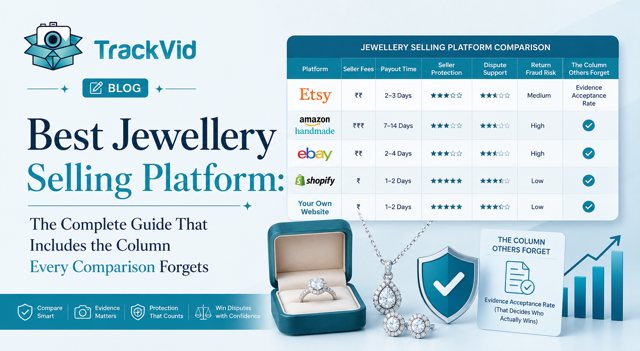
The best jewellery selling platform for your business depends on two things that most comparison guides only cover one of: where your buyers are, and what happens when one of them claims you sent the wrong piece. Every guide covers the first. Almost none cover the second. That gap in the comparison is where most jewellery sellers lose money they did not know they were at risk of losing.
This guide compares the leading jewellery selling platforms on fees, reach, and audience, which is what every other comparison covers. It also compares them on seller protection from return fraud, fake damage claims, and chargebacks, which is the column that gets left out. Together, those two dimensions give you the complete picture for choosing where to sell jewellery online in 2026.
The online jewellery market is projected to reach $117 billion by 2027, growing at 11.3 percent CAGR, according to Statista. Every platform in this comparison is growing with it. The difference in which one is best for you comes down to what you sell, who you sell to, and how protected you are when something goes wrong.
Why Platform Protection Is the Comparison Column Nobody Includes
Every "best jewellery selling platform" guide published in 2026 compares the same four things: listing fees, transaction fees, buyer traffic, and ease of setup. These matter. They are not the only things that matter.
Jewellery is the category with the highest return fraud exposure per order of any ecommerce product type. A piece worth $180 weighs under an ounce. Swapping it for a cheap substitute inside the original packaging takes less than a minute. Claiming it "arrived damaged" after using it takes thirty seconds.
The platforms in this comparison all handle the transaction efficiently. They differ significantly in what they do when a buyer files a false claim after the transaction.
No jewellery selling platform provides complete protection from post-purchase fraud. Each one has a coverage gap. Knowing where the gap sits on each platform tells you what additional protection you need before you list your first piece, not after you lose your first dispute.
That additional protection is TrackVid: an order-linked packing video system that records every dispatch against the specific Order ID and gives you the evidence that wins disputes on every platform in this comparison. The platform comparison comes first. TrackVid is the layer that fills each platform's specific gap.
Platform 1: Etsy
What it is: The world's primary marketplace for handmade, vintage, and one-of-a-kind goods. As of 2025, Etsy draws over 445 million monthly visits and 96 million active buyers, according to BSS Commerce data. Search volume for "handmade jewelry" on Etsy alone is approximately 1.2 million monthly.
Best for: Independent jewellery makers, artisans selling handmade or bespoke pieces, vintage jewellery sellers, and small studios building a brand story alongside their listings.
Fees: $0.20 listing fee per item, renewed every four months. Transaction fee of 6.5 percent of the sale price. Payment processing at 3 percent plus $0.25 per sale. Optional Offsite Ads at 12 to 15 percent on sales generated from Etsy's external advertising.
Buyer audience: Buyers on Etsy specifically seek handmade, unique, and personalised items. They expect handmade variation and pay premium prices for craft and story. This audience is different from Amazon buyers seeking fast delivery on standard items.
Seller protection on disputes: Etsy's Purchase Protection covers sellers for eligible damaged-item cases once per calendar year. It covers INR cases where tracking confirms delivery. It covers "not as described" cases where the item matches the listing. For chargebacks filed directly through the buyer's bank, Etsy forwards seller evidence to the bank and the outcome depends entirely on evidence quality.
The gap: The once-per-year damaged-item protection expires after the first use. Any seller receiving two or more fraudulent damage claims in a year is unprotected from the second onward. Chargebacks above $250 are not covered. The evidence quality the seller submits determines the outcome, not Etsy's intervention.
What TrackVid closes on Etsy: Order-linked packing video showing each piece in dispatch condition is the primary evidence for Etsy "not as described" chargebacks. Sellers using TrackVid for Etsy disputes report win rates of 65 to 75 percent on "not as described" cases compared to the 20 to 30 percent platform average.
Platform 2: Amazon Handmade
What it is: Amazon's vetted marketplace for genuine handmade goods, sitting within Amazon's global buyer infrastructure. Sellers must apply and demonstrate their production process before approval. This creates a community of verified makers with access to Amazon's full buyer base.
Best for: Established handmade jewellery makers who want access to Amazon's volume and trust signals, sellers targeting mid-to-high price points, and artisans ready to scale beyond Etsy's audience.
Fees: 15 percent referral fee on jewellery sales. No separate listing fees for approved Handmade sellers. Amazon FBA fees apply if using fulfilment by Amazon.
Buyer audience: Amazon's 310 million active customer accounts globally, filtered through the Handmade category. Buyers here have higher average transaction confidence than on smaller platforms but lower brand loyalty to individual makers compared to Etsy buyers.
Seller protection on disputes: Amazon's A-to-Z Guarantee gives buyers 90 days from delivery to file a claim. INR claims with tracked delivery to the registered address are typically resolved in the seller's favour. SNAD (Significantly Not as Described) claims require the seller to demonstrate through submitted evidence that the item matched the listing.
The gap: False inauthentic item complaints can trigger automatic ASIN suspension before human review. Each granted A-to-Z claim generates an order defect on the seller's account, affecting account health metrics. The 90-day dispute window means sellers need 90 days of indexed dispatch evidence at all times for every active order.
What TrackVid closes on Amazon Handmade: Order-linked packing video covering the production-to-dispatch stage serves both as SNAD dispute evidence and as Plan of Action evidence for inauthentic item appeals. TrackVid's indexed cloud makes 90-day-old order footage retrievable in under two minutes.
Platform 3: Shopify (Own Store)
What it is: A self-hosted ecommerce platform that gives jewellery sellers complete control over their store, branding, customer relationships, and pricing. Shopify is the answer for jewelry businesses of all levels with strong ecommerce infrastructure but no built-in buyer marketplace.
Best for: Established jewellery brands with their own audience, sellers wanting zero platform commission on sales, makers who have already built a following on social media or other channels and want to convert it independently.
Fees: Subscription plans from $29 to $299 per month. Transaction fee of 0 to 2 percent if not using Shopify Payments. Payment processing at approximately 2.9 percent plus $0.30 per transaction on standard plans.
Buyer audience: Your audience entirely. No built-in discovery. Shopify does not send buyers to your store. All traffic must come from your own marketing, SEO, social media, and paid advertising.
Seller protection on disputes: Shopify has no native buyer dispute framework. Disputes are handled through the payment processor (Shopify Payments, PayPal, Stripe) and the card network's chargeback process. The seller responds directly to the payment processor with evidence. There is no platform mediation.
The gap: No platform protection at all. Every chargeback is handled between the seller and the card issuer. The seller's evidence quality is the entirety of their protection. PayPal Goods and Services gives buyers 180 days to file disputes, meaning sellers need indexed dispatch evidence going back six months for every PayPal order.
What TrackVid closes on Shopify: For Shopify sellers, TrackVid is the only dispute protection that exists. Without order-linked packing video, Shopify jewellery sellers have no evidence for "not as described" or condition chargebacks beyond their listing. With TrackVid, every order has a permanent, indexed packing record that serves as the primary chargeback evidence with any payment processor.
Platform 4: Meesho (India)
What it is: India's fastest-growing marketplace for value-focused products, particularly strong in Tier-2 and Tier-3 cities. Artificial jewellery is one of the highest-volume categories on Meesho, selling in high volumes due to low cost and style variety. Over 100 million downloads with a 4.3 out of 5 app rating.
Best for: Indian sellers of fashion jewellery, artificial jewellery, and occasion wear pieces priced under Rs 1,500. Sellers targeting first-time online buyers in smaller cities. Budget and volume-driven strategy rather than premium positioning.
Fees: Zero commission on most categories. Shipping costs handled by Meesho's logistics partners. Sellers set their own margins above Meesho's base price.
Buyer audience: Primarily price-sensitive buyers in Tier-2 to Tier-6 cities. High volume, lower average order values. Strong demand for bridal and festive jewellery sets, mangalsutras, bangles, and fashion accessories.
Seller protection on disputes: Meesho has a WFR (Wrong Forward Return) classification for return fraud, but limited formal SPF (Seller Protection Fund) compared to Flipkart. Returnless refunds apply to low-value items. Repeated uncontested WFR claims can trigger catalogue suspension.
The gap: Meesho's dispute protection is less structured than Flipkart's SPF. Sellers who cannot contest WFR claims with evidence absorb those losses by default and accumulate catalogue health risk.
What TrackVid closes on Meesho: Tamper-proof order-linked packing video for every Meesho dispatch makes WFR disputes contestable with specific evidence. TrackVid's automated claim filing within Meesho's required window prevents the uncontested loss pattern that leads to catalogue suspension.
Platform 5: Flipkart (India)
What it is: India's largest domestic marketplace, with 10 million daily visits according to EarnKaro data. Dominant in fashion and accessories, with a structured Seller Protection Fund for return disputes.
Best for: Indian jewellery sellers targeting established online buyers, mid-range to premium price points, and sellers who want the strongest platform-side dispute support of any Indian marketplace.
Fees: Category-dependent commission of 10 to 15 percent on jewellery. Fulfillment fees if using Flipkart's logistics. GST-applicable pricing.
Buyer audience: India's largest domestic marketplace buyer base. High engagement with fashion categories. Buyers expect fast delivery and trust Flipkart's return policy.
Seller protection on disputes: Flipkart's SPF covers damaged, wrong, and missing return claims with a 14-day filing window from return receipt. Missing item claims have a 120-day window. VMS compliance is mandatory for SPF eligibility.
The gap: VMS compliance is a hard gate. Sellers without a compliant video management system are disqualified from SPF regardless of claim validity. The 14-day window is unforgiving for manual processes during high-volume periods.
What TrackVid closes on Flipkart: VMS compliance from setup. Automated SPF claim filing within the 14-day window. Order-linked packing video for every jewellery dispatch showing metal grade, stone setting, and hallmark where applicable.
Platform 6: AJIO (India)
What it is: Reliance's fashion-focused marketplace with a rapidly growing seller base and strict quality standards. Strong in premium fashion and jewellery categories.
Best for: Indian jewellery sellers targeting fashion-forward buyers, premium artificial jewellery, and contemporary design categories. Sellers who can meet AJIO's quality and documentation standards.
Fees: Commission rates of 15 to 20 percent on jewellery. AJIO maintains higher curation standards than Meesho, which creates higher average order values.
Seller protection on disputes: AJIO has the strictest claim window of any Indian marketplace: 3 days from return cargo receipt for Commerce sellers to raise the claim, and a 24 to 48 hour CCTV-required email response window for dispute triggers. Auto-rejection with no human review if the window is missed.
The gap: The 24 to 48 hour window, which also governs CCTV-required emails, means AJIO claims cannot be managed manually at volume. Any manual process will miss windows regularly.
What TrackVid closes on AJIO: CCTV-required email detection and automatic response with the correct Order ID-linked video. TrackVid's AJIO automation is the only system that handles the 24-to-48-hour window without any manual step from the seller.
The Protection Comparison: What No Other Guide Shows You
| Platform | Claim Window | Coverage Cap | VMS Required | TrackVid Closes |
|---|---|---|---|---|
| Etsy | 10 to 20 day chargeback | Once/year damaged | No | NAD disputes, swap fraud |
| Amazon Handmade | 48-hr A-to-Z response | No $ cap but ASIN risk | No | SNAD, inauthentic appeal |
| Shopify | Payment processor only | None | No | All disputes (only protection) |
| Meesho | Category-dependent | Limited SPF | No | WFR, returnless refund |
| Flipkart | 14 days from return | SPF up to value | Yes | VMS gate + window |
| AJIO | 24 to 48 hr | Auto-reject | Yes | CCTV email automation |
TrackVid works on every platform in this table simultaneously. One setup, one dashboard, six platforms covered. Every order on every platform has an indexed, Order ID-linked packing video from the first dispatch after activation.
Amsterdam Seller Zara: Three Platforms, One Problem, One Fix
Zara sells sterling silver and semi-precious stone jewellery from her studio in Amsterdam across Etsy, her own Shopify store, and Amazon EU. She dispatches approximately 55 orders per week across the three channels.
For eighteen months, she managed disputes separately per platform. Etsy cases through the Seller Dashboard. Amazon A-to-Z through Seller Central. Shopify chargebacks through Stripe's dispute interface. Each platform had a different process, a different deadline, and a different evidence format.
Her win rate across all three platforms was 14 percent.
When she reviewed her losses, the same failure appeared on every platform. For "not as described" and "wrong item" disputes, she had submitted her listing photos. On Etsy, listing photos prove catalogue accuracy. They do not prove what was in the specific order. Amazon ruled the same way. Stripe passed the same listing evidence to the card issuer with the same outcome.
The platform was not the problem. The evidence was the problem. And the evidence problem existed identically on all three platforms.
I had thought of each platform as a different business with different rules. The fraud problem was the same on all of them. So was the evidence gap.
After implementing TrackVid across all three channels, packing video was linked to every Order ID from the first dispatch. When a dispute arrived on any platform, the evidence was retrieved by order number in under two minutes. The same video, formatted correctly, submitted through whichever platform's process applied.
Her dispute win rate across all three platforms moved from 14 percent to 71 percent within 60 days. The platform did not change. The evidence did.
How to Choose the Best Jewellery Selling Platform for Your Specific Business
The answer depends on four specific variables.
Your product category. Handmade and bespoke pieces suit Etsy and Amazon Handmade, where buyers expect and pay for maker story. Fashion and artificial jewellery suit Meesho for volume and price-sensitive buyers. Gold and diamond pieces suit Flipkart and Amazon for trust signals and higher average order values.
Your market. India-focused sellers with high daily order volumes should evaluate Flipkart, AJIO, and Meesho alongside Amazon India. Global sellers targeting the US, UK, and EU market should evaluate Etsy and Amazon Handmade as the primary channels and Shopify for brand independence.
Your volume. Below 20 orders per week, Etsy's lower setup friction is practical. Above 50 orders per week, the claim management implications of each platform's dispute process become a meaningful operational consideration. Above 100 orders per week, manual claim management on any platform fails under volume pressure.
Your evidence infrastructure. Regardless of which platform you choose, the disputes you will face are structurally similar: fake damage, wrong item, swap fraud. Your evidence infrastructure, specifically whether you have Order ID-linked packing video for every dispatch, determines your win rate on disputes more than which platform you sell on.
The best jewellery selling platform for your business is the one that matches your buyer audience. The protection infrastructure, TrackVid, is the same regardless of which platform that turns out to be.
Related: How to sell jewellery online safely: the two-category protection framework →
Related: Jewellery return fraud: how to stop swap fraud and fake damage claims →
Schedule a free TrackVid demo at trackvid.in/book-demo.html
TrackVid works with existing cameras. Setup takes under 15 minutes. Evidence is live and indexed from the first packing session after activation across every platform you sell on.
Frequently Asked Questions
What is the best jewellery selling platform in 2026?
The best jewellery selling platform in 2026 depends on your product type and target market. For handmade and bespoke jewellery globally, Etsy leads with 445 million monthly visits and 96 million active buyers, according to 2025 platform data. For premium handmade pieces at scale, Amazon Handmade provides access to Amazon's 310 million active customers with seller vetting that builds buyer trust. For independent brand control with no commission, Shopify is the strongest option. For Indian sellers, Flipkart offers the most structured seller protection through its SPF system, while Meesho provides highest volume for fashion jewellery under Rs 1,500. No single platform is universally best. The right answer depends on your category, price point, and target buyer. Regardless of platform, TrackVid provides the order-linked packing video documentation that wins disputes on all of them.
Which platform is best for selling jewellery online?
For selling jewellery online, the best platform by category is: Etsy for handmade and artisan pieces (1.2 million monthly "handmade jewelry" searches on Etsy alone), Amazon Handmade for established makers wanting Amazon's reach, Shopify for brand-led D2C jewellery with an existing audience, Flipkart for Indian sellers prioritising structured dispute protection, and Meesho for Indian sellers targeting high-volume fashion jewellery at accessible price points. The missing dimension in most comparisons is post-purchase protection: no platform fully covers jewellery sellers from swap fraud, fake damage claims, and "not as described" chargebacks. TrackVid closes that gap across every platform by providing order-linked packing video evidence that wins disputes regardless of which marketplace the order came from.
Etsy vs Amazon Handmade for jewellery sellers: which is better?
Etsy is better for jewellery sellers whose products carry a strong maker story and whose buyers value uniqueness and personalisation. Amazon Handmade is better for sellers wanting Amazon's buyer volume and trust infrastructure, particularly at mid-to-high price points where buyers research before purchasing. Etsy's Purchase Protection covers damaged items once per calendar year per seller. Amazon Handmade's A-to-Z Guarantee gives buyers 90 days to file claims, with ASIN suspension risk on inauthentic complaints before human review. Both platforms leave post-purchase fraud protection largely to the seller's submitted evidence. For both, order-linked packing video through TrackVid is the specific evidence that wins "not as described" and condition disputes, which are the most common chargeback types for jewellery sellers on both platforms.
What platform protects jewellery sellers from fraud and chargebacks?
No single jewellery selling platform provides complete protection from post-purchase fraud. Etsy covers eligible damaged-item cases once per year per seller and forwards chargeback evidence to banks. Amazon Handmade handles A-to-Z claims but grants ASIN suspensions on inauthentic complaints before review. Shopify has no native buyer dispute framework. Flipkart's SPF is the most structured but requires VMS compliance as an eligibility gate. AJIO's 3 day claim window auto-rejects missed submissions. In all cases, the seller's submitted evidence determines chargeback outcomes. TrackVid provides the order-linked packing video documentation that wins disputes across every platform, making it the practical fraud protection layer that no single platform provides natively.
How to sell jewellery online: which platform is safest?
The safest jewellery selling platform is the one whose protection gap you are equipped to close. Etsy is safest for sellers with order-linked packing video evidence who can contest the "not as described" chargebacks that account for the majority of jewellery seller losses. Flipkart is safest for Indian sellers with a compliant VMS and automated SPF claim filing within the 14-day window. For complete safety on any platform, implement TrackVid before your first dispute, not after. TrackVid records every packing session linked to the Order ID, stores evidence in indexed cloud, and makes the specific dispatch documentation available in under two minutes when any dispute arrives on any platform.
Best jewellery selling platform in India in 2026?
The best jewellery selling platform in India in 2026 depends on your jewellery category. For fashion and artificial jewellery at accessible price points, Meesho provides the highest volume reach, particularly in Tier-2 and Tier-3 cities. For structured seller protection and mid-range pricing, Flipkart's SPF is the most formal dispute framework on any Indian marketplace. For premium and branded jewellery, Amazon India offers trust signals that support higher price points. For modern fashion-forward jewellery, AJIO provides a growing premium-adjacent audience. For gold and diamond jewellery, Flipkart and Amazon India are preferred. Regardless of platform, TrackVid provides claim automation across Flipkart, AJIO, Meesho, and Snapdeal simultaneously and is the only system officially authorised by Snapdeal.
Can I sell jewellery on multiple platforms at once?
Yes. Selling jewellery on multiple platforms simultaneously is common and often the most effective strategy. The recommendation from Brand Chanakya's 2026 analysis is a multi-platform approach: start on Meesho for Indian volume validation, build Amazon presence for brand and margin, and use Flipkart selectively for category scale. The operational challenge of multi-platform selling is managing different dispute windows, different evidence formats, and different claim processes for each platform. TrackVid solves this by providing a single dashboard where every order across every platform has the same Order ID-linked packing video evidence, searchable and retrievable regardless of which platform the dispute arrives from.
What is the best online jewellery selling platform for beginners?
For beginners, Etsy is the most accessible starting point: lower setup complexity, a built-in community of jewellery buyers, and a marketplace structure where individual pieces can find buyers without the seller managing their own traffic. Meesho is the easiest entry for Indian sellers targeting fashion jewellery volume. Shopify is appropriate for beginners only if they already have an audience to drive to their store. For beginners on any platform, the most important early decision is implementing order-linked packing documentation through TrackVid before the first dispute arrives. The most common beginner mistake is building listing photography and brand assets before building dispatch evidence infrastructure. Disputes arrive within the first month of selling at volume. Evidence infrastructure should be in place from the first order.
Sources: Statista 2025 Global E-Commerce Jewelry Report, BSS Commerce Best Place to Sell Jewelry Online October 2025, Etsy Seller platform data 2025, Amazon Handmade Seller Programme 2026, Shopify Merchant Benchmark Report 2026, Brand Chanakya Amazon vs Flipkart vs Meesho April 2026, EarnKaro jewellery reselling apps data 2025, Shiprocket Meesho top selling products May 2026, TrackVid internal seller data
TrackVid is a video proof and claim management platform used by 1,100+ ecommerce sellers globally on Flipkart, AJIO, Meesho, Snapdeal, Amazon, and Etsy. Officially authorised by Snapdeal. Learn more at trackvid.in.

Get the Marketplace Claim Recovery Checklist
A 12-point checklist used by 1,100+ sellers to recover 85-90% of marketplace claim losses. Free, instant access.
- Marketplace-specific evidence formats (AJIO, Flipkart, Amazon, Myntra)
- Claim window deadlines for every major platform
- The 6-step process that pushes approval from 85-90%
- Common rejection reasons and how to avoid them
No spam. Unsubscribe anytime. Used by sellers at Rare Rabbit, HRX, Da Milano + 1,100 more.
Stop Losing Money to Fake Returns
Join 1,100+ sellers who recover lakhs every month with TrackVid