
For merchants on Shopify, WooCommerce, BigCommerce, Amazon, and any store running a holiday peak. Updated August 2026.
Direct Answer
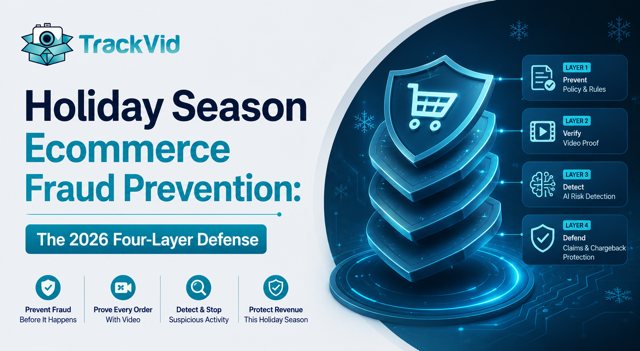
Holiday season ecommerce fraud prevention fails for most merchants in a specific and expensive way: they tighten fraud rules going into peak, and the rules block their best customers. Every classic fraud signal is also a gift-buyer signal. Billing and shipping address mismatch, first-time high-value orders, expedited shipping, and new accounts all describe gift shopping as accurately as they describe fraud. The address mismatch rule alone generates 20 to 30 percent false positive rates. Global merchant losses from false declines are projected above $231 billion in 2026, and retailers lose roughly nine times more revenue to false declines than to the fraud those declines prevent, yet only about 64 percent of merchants track their false decline rate at all. The working answer is a four-layer defense: filter automated traffic before it reaches checkout, score orders probabilistically rather than with blunt rules, capture dispatch evidence on every approved order, and defend claims and disputes with that evidence afterwards.
What Is Holiday Season Ecommerce Fraud?
Holiday season ecommerce fraud is the concentrated set of fraud and abuse types that target online merchants across the peak trading window, roughly late October through February.
It is not one threat. It is at least eight, and they attack at three different points in the order lifecycle. Sorting them by attack point is what makes a defense buildable, because a control that works at one point is useless at another.
Attacks before the order exists:
Bot traffic and scalping. Automated traffic is no longer a background nuisance. F5 Labs research found that during the 2024 holiday season, 57 percent of ecommerce website traffic was generated by bots, the first holiday period in which automated non-DDoS bot traffic exceeded human shoppers. Advanced AI-driven bots now account for close to 60 percent of bot traffic, mimicking mouse movement and varying browsing patterns to appear human.
Card testing and enumeration. Fraudsters validate stolen card numbers with small transactions against your checkout. The fingerprint is high attempt volume combined with a high decline rate at low amounts, which real customers never produce. The damage is not the tested charges. It is that a flood of failed attempts wrecks your approval-to-attempt ratio, which processors and networks watch closely.
Account takeover. Credential stuffing against your existing customer accounts. Industry reporting has recorded ATO attempts rising over 300 percent year on year during peak shopping periods, and Sift's Global Data Network recorded ATO attack rates climbing from 1.64 percent to 1.87 percent across BFCM. ATO is uniquely dangerous because the fraudster is inside a real account, using saved payment methods, shipping to an address your system has never flagged.
Attacks at the moment of purchase:
Stolen card fraud. The classic card-not-present case, using validated card data from the testing phase.
Synthetic identity fraud. Real and fabricated data combined into identities that pass standard checks. Sumsub recorded synthetic identity document fraud surging 311 percent between Q1 2024 and Q1 2025.
Promo and discount abuse. Stacked codes, recycled first-order discounts, and referral loops. It peaks alongside the promotional calendar for obvious reasons.
Attacks after delivery:
Refund and policy abuse. This is the category that has changed most. According to the Merchant Risk Council's 2026 report, refund and policy abuse has displaced payment fraud as the number one threat named by merchants, the first time that has happened since the report began tracking the category.
First-party misuse and return fraud. Chargebacks on delivered goods, empty-box returns, wardrobing, and overstated return quantities.
Why the three-part split matters. Most merchants buy one fraud tool and assume it covers holiday risk. A checkout screening tool does nothing about bot traffic hitting your site before checkout, and nothing about an empty-box return arriving in January. The gaps between the tools are where peak-season losses concentrate.
The two post-delivery categories are large enough that they have their own playbooks. For returns and claims, see our Black Friday Return Fraud playbook. For card disputes and ratio exposure, see our BFCM Chargeback Surge playbook at trackvid.in.
Why Does Fraud Spike During the Holiday Season?
Holiday season ecommerce fraud rises because four conditions converge, and each one weakens a different part of a normal defense.
Volume becomes camouflage. ACI Worldwide's peak analysis recorded transaction volumes up 27 percent year on year across the BFCM window, with mobile transactions up 30 percent. A fraudulent order that would stand out in July disappears in November.
Buying behaviour stops looking like your baseline. Every behavioural model you have is trained on your normal customer. In December, that customer is buying different products, at different values, for different people, to different addresses. Your model's definition of normal is wrong for eight weeks.
Your review capacity is fixed while attempts multiply. An Experian and Forrester Consulting study found that 70 percent of ecommerce retailers still rely on manual reviews to resolve fraud alerts, and 35 percent of fraud teams take a week or more to complete one review. At peak volume, that queue either becomes a bottleneck that delays shipping or gets cleared by bulk-approving, and both outcomes cost money.
Automation scaled faster than defenses did. Beyond the 57 percent bot traffic figure, a newer category has arrived: agentic traffic capable of executing logins and payments autonomously surged 450 percent in 2025. Most merchant defenses were designed for humans committing fraud manually.
The result is that peak season does not just increase fraud volume. It degrades the accuracy of your detection at exactly the moment volume rises, which is what produces the problem in the next section.
Every fraud rule you wrote is also a gift-buyer detector. In December, that is not a coincidence. It is the whole problem.
Why Do Fraud Filters Cost More Than Fraud at Peak?
This is the most expensive misunderstanding in holiday season ecommerce fraud prevention, and it is invisible on every dashboard most merchants look at.
The arithmetic. Fraud losses are visible. They arrive as chargebacks with amounts attached. False declines are invisible. A legitimate customer gets blocked, does not complain, buys from a competitor, and never appears in any report.
So teams over-invest in tightening rules and under-invest in measuring what the tightening costs. Global merchant losses from false declines are projected to exceed $231 billion in 2026, rising toward $265 billion in 2027, against a global average false decline rate of 1.51 percent of sales. Retailers lose roughly nine times more revenue to false declines than to the actual fraud. And only about 64 percent of merchants track their false decline rate at all.
Now apply that to December specifically. Look at the rules most merchants tighten going into peak, and what each one actually describes:
| Common fraud rule | What it catches | What else it catches |
|---|---|---|
| Billing and shipping address mismatch | Card thieves shipping to a drop address | Every gift sent directly to the recipient. This rule alone generates 20 to 30 percent false positive rates |
| First-time customer, high order value | Stolen card cashing out | The single most valuable customer type of the year, buying a gift from a store they found through a holiday ad |
| Expedited or overnight shipping | Fraudsters racing detection | Last-minute gift buyers, who are your highest-margin December cohort |
| New account, no order history | Throwaway fraud accounts | Every new customer your holiday marketing budget just paid to acquire |
| Multiple payment attempts | Card testing | A real customer whose first card was declined by their own bank and who tried a second |
| Unusual IP or geography | Fraud rings abroad | Customers travelling, expats buying for family, and anyone using a VPN |
The compounding damage. A false decline is not one lost order. It is the acquisition cost you already spent, the order margin, the lifetime value of a customer who now believes your store rejected them, and in many cases a public review saying so. Fraud costs you the goods. A false decline costs you the customer.
The correct target metric. Most merchants optimise for a low fraud rate, which is trivially achievable by declining everything. The right metric is the highest acceptance rate your risk tolerance allows, measured alongside fraud loss rather than instead of it. If you measure one new thing before this peak season, measure how many of your declined orders were actually good customers.
The Four-Layer Holiday Season Ecommerce Fraud Defense
Each layer handles a different attack point in the order lifecycle. The layers are not alternatives. Gaps between them are where peak-season losses concentrate.
Layer 1: Filter Automated Traffic Before It Reaches Checkout
If more than half of holiday traffic is automated, the cheapest fraud you will ever stop is the fraud that never reaches your payment page.
- Rate limiting and velocity controls at the network edge, capping attempts per source. This directly breaks the economics of a card-testing run, which depends on high attempt volume at near-zero cost.
- Bot detection ahead of checkout, not at it. Detection at the payment step means the attack has already consumed your infrastructure and polluted your analytics.
- Watch the approval-to-attempt ratio as an attack signal. A volume spike alongside a collapsing approval rate at small transaction amounts is a card-testing attack until proven otherwise. This is the single clearest fingerprint available.
- Protect the login endpoint separately from checkout. Credential stuffing targets accounts, not carts, and most merchants monitor only one of the two.
- Set this up in October. Edge controls tuned during an attack are tuned badly.
Layer 2: Decide Orders Probabilistically, Not With Blunt Rules
This is the layer where the false decline problem lives, and where the largest recoverable revenue sits.
- Audit every hard-decline rule against the gift-buyer table above before peak. Any rule that describes normal gift shopping should be converted from an auto-decline into a scoring input.
- Score, then band. Auto-approve the clean majority, auto-decline the small clear-fraud tail, and route only the genuine middle to review. A rule that declines outright removes your ability to be right about the exceptions.
- Add a seasonal exception set that runs from November through early January: relax address-mismatch weighting, raise the first-order value threshold, and treat expedited shipping as neutral rather than negative.
- Use positive signals, not just negative ones. Prior undisputed orders, account age, device familiarity, and email history are evidence of legitimacy. Most rule sets only look for reasons to say no.
- Size the manual review queue against projected peak volume, and set a documented rule for what happens when it overflows. The default of bulk-approving to clear the backlog is the worst possible answer and the one most teams reach for.
- Apply step-up authentication instead of declining. 3D Secure on a borderline order converts a lost sale into a completed one and shifts liability on the transactions that go through.
For the customer-level version of this scoring logic, see our Customer Risk Scoring playbook and Fake COD Order Detection playbook at trackvid.in.
Layer 3: Capture Dispatch Evidence on Every Approved Order
Layers 1 and 2 decide which orders you accept. Layer 3 decides what happens when an accepted order is disputed later, and it is the only layer that cannot be built retroactively.
Once you approve an order, the fraud question changes from "should we ship this" to "can we prove what we shipped." Those are answered by completely different systems, which is why merchants with excellent screening still lose post-delivery cases.
- Capture per order, linked to Order ID: the item, quantity, condition, calibrated weight, tamper-evident seal, and shipping label in the same frame.
- Capture on every order, not selectively. Fraud selects for the gaps, and by the time you know which orders mattered, the parcel has shipped.
- Deploy before peak. Systems introduced under surge volume get abandoned under surge volume.
- Reconcile returns against dispatch weight on receipt, which closes empty-box and short-shipment cases without investigation.
This layer is what makes an approved-but-risky order survivable. It is also why a merchant with strong Layer 3 can afford to run Layer 2 looser, approving more revenue with less exposure. The layers compound.
See our Order Accuracy playbook and Packaging Best Practices playbook at trackvid.in for the operational build.
Layer 4: Defend the Post-Delivery Wave With What You Captured
The final layer runs from late December through February and handles the two categories that now dominate merchant-reported fraud: refund and policy abuse, and first-party misuse.
- Route claims by evidence, not by argument. With a dispatch record, an empty-box or wrong-item claim resolves in minutes rather than becoming a judgement call.
- File marketplace claims inside platform windows, which are short and unforgiving at peak.
- Submit complete representments on card disputes, and treat the February wave as a staffed process rather than an overflow task.
- Feed outcomes back into Layer 2. Customers who filed abusive claims should carry that history into next season's scoring. Most merchants never close this loop, which is why the same accounts abuse them every year.
The two deep-dives for this layer are our Black Friday Return Fraud playbook for claims and returns, and our BFCM Chargeback Surge playbook for card disputes and ratio exposure, both at trackvid.in.
Case Study: $340,000 in Recovered Revenue
A beauty and wellness D2C brand running Shopify with a small in-house risk function processed approximately $3.1 million across its November to January peak window, average order value $96.
The prior peak season, with a rules-based fraud posture:
Going into peak, the team did what most teams do. They tightened. Address mismatch became a hard decline. First-order value cap dropped. Expedited shipping on a new account triggered automatic review.
- Order decline rate across the peak window: 4.2 percent
- Manual review queue: averaged 5.5 days during December, against a 48-hour shipping promise
- Fraud loss across the window: approximately $86,000
- False decline rate, measured retrospectively through retry analysis and support-contact matching: an estimated 2.9 percent of orders, the majority legitimate
- Estimated good revenue declined: approximately $412,000
- Chargeback ratio: 0.71 percent, inside thresholds
On the fraud dashboard, the season looked like a success. Fraud loss was contained and the chargeback ratio never approached a monitoring threshold. The problem only became visible when someone asked what the declines had cost, which nobody had asked before.
What changed the following season:
September: false decline rate instrumented properly for the first time, using retry-purchase tracking and support-contact matching on declined orders. The estimated $412,000 figure was what moved the decision.
October: Layer 1 deployed. Rate limiting and bot detection moved ahead of checkout, login endpoint monitored separately. Approval-to-attempt ratio added to the daily dashboard.
October: Layer 2 rebuilt. Address mismatch converted from hard decline to a scoring input. Seasonal exception set written for November through early January. Positive signals added, including account age, device familiarity, and prior undisputed orders. Step-up authentication replaced decline on borderline orders. Review queue capacity sized against projected volume with a documented overflow rule.
Late October: Layer 3 deployed. Order ID-linked dispatch evidence via TrackVid across all pack stations, four weeks ahead of peak, with calibrated weight and tamper-evident sealing.
December through February: Layer 4 run as a staffed process rather than an overflow task.
Results across the following peak window:
- Order decline rate: 4.2 percent to 1.6 percent
- Estimated false decline rate: 2.9 percent to 0.8 percent
- Manual review queue: 5.5 days to under 12 hours, by routing far fewer orders into it
- Card-testing attempts reaching checkout: down 91 percent after Layer 1
- Fraud loss across the window: $86,000 to $51,000
- Post-delivery claim win rate: 34 percent to 81 percent on dispatch evidence
- Chargeback ratio: 0.71 percent to 0.44 percent
- Recovered good revenue: approximately $340,000
The counterintuitive result is the one worth sitting with. They approved substantially more orders and their fraud loss went down, because Layer 1 removed automated attack traffic entirely and Layer 3 made the remaining marginal orders defensible after delivery. Looser approval plus stronger evidence beat tighter approval with no evidence, by roughly $375,000 across a single season.
The founder's summary was that they had spent three years optimising a number that was costing them five times more than the number they were trying to protect.
See what your false decline rate is really costing and what dispatch evidence would let you safely approve. 30 minutes. No commitment.
How Do You Screen Orders Without Blocking Real Customers?
The practical answer is to replace binary decisions with graduated responses, and to make legitimacy provable rather than assumed.
Replace decline with a ladder. Between approve and decline sit several options most merchants never use: step-up authentication, a verification email or SMS, holding for a short review, requiring signature on delivery, or approving with dispatch evidence captured and flagged. Each converts a would-be lost sale into a completed one at a different risk level.
Weight positive signals as heavily as negative ones. A customer with three prior undisputed orders, a two-year-old account, and a familiar device is low risk even if today's order ships to a new address. That is a person buying a gift. Rule sets that only accumulate negative points cannot represent this, which is why they fail hardest in December.
Segment by what the order is, not just who placed it. A first-time buyer at $60 and a first-time buyer at $600 warrant different treatment, and neither warrants a blanket rule. Set thresholds by category and margin rather than a single store-wide number.
Instrument the invisible side. You cannot manage a false decline rate you do not measure. Two workable methods: track retry purchases where a declined customer succeeded on a second attempt, and match support contacts against your decline log. Neither is perfect and both are far better than the nothing that roughly a third of merchants currently have.
Make the marginal order survivable rather than avoidable. This is where Layer 3 changes the economics of Layer 2. If you can prove exactly what shipped, an order that looks 75 percent legitimate becomes worth accepting, because the downside case is now defensible instead of automatic. Merchants with dispatch evidence can operate a materially higher acceptance rate at the same net loss, which is the entire commercial argument for capturing it.
What Does Holiday Fraud Actually Cost?
Most merchants measure the chargeback amount and stop, which understates the true cost of holiday season ecommerce fraud by a wide margin.
The direct multiplier. Every dollar of fraud costs US retailers $4.61, according to the LexisNexis True Cost of Fraud study, a figure that has climbed 32 percent since 2022. The extra $3.61 comes from chargeback fees, manual review labour, operational drag, replacement shipping, and reputation damage.
The five cost buckets to model before peak:
- Direct fraud loss: goods plus shipping plus the refunded amount
- Dispute and administrative cost: chargeback fees, representment labour, and the time cost of review queues
- False decline cost: lost order margin, wasted acquisition spend, and forfeited lifetime value. For most merchants this is the largest bucket and the least measured
- Compliance and ratio cost: monitoring program fees, reserves, and processing rate increases at renewal
- Operational drag: analytics polluted by bot traffic, shipping delays caused by review backlogs, and team hours diverted during your busiest weeks
A worked comparison. A merchant with $3 million in peak revenue and 0.4 percent fraud loss is losing $12,000 directly, or roughly $55,000 once the 4.61 multiplier is applied. The same merchant running a 2.5 percent false decline rate on legitimate orders is losing $75,000 in gross revenue before acquisition cost and lifetime value are counted.
The fraud number is the one that gets reported to leadership. The larger number usually is not reported at all.
For the full profitability picture this feeds into, see our Where Ecommerce Profit Margins Leak playbook and our Sale Season Operations Playbook at trackvid.in.
Where TrackVid Fits in the Four-Layer Defense
Layers 1 and 2 are traffic and decisioning work, handled by your edge provider, your fraud platform, and your own rule configuration. TrackVid does not compete with those and does not try to.
Layer 3 is where TrackVid sits, and Layer 3 is what makes the other layers economically viable. Screening decides what you accept. Evidence decides what happens to what you accepted.
TrackVid is a video proof and claim management platform used by 1,100+ ecommerce sellers on Shopify, WooCommerce, Amazon, eBay, TikTok Shop, Flipkart, Myntra, AJIO, Nykaa, Meesho, and Snapdeal. Officially authorized by Snapdeal. Brands using TrackVid include Rare Rabbit, Wrogn, The Indian Garage Co, The Bear House, HRX, Nike, Jordan, Tommy Hilfiger, and Snitch.
For holiday season ecommerce fraud specifically, TrackVid delivers:
- Automatic Order ID-linked packing video at every pack station, with no workflow change and no added seconds per parcel, which is the only version that holds up at peak volume.
- Calibrated weight and tamper-evident seal capture on every order, closing empty-box and short-shipment claims through reconciliation rather than argument.
- Retrieval by Order ID in under two minutes, which turns a several-hundred-case January queue into routine work instead of triage.
- A higher safe acceptance rate. Because marginal orders become defensible after delivery, Layer 2 can approve more revenue at the same net risk. This is the commercial return most fraud tooling cannot offer.
- One evidence layer for both post-delivery channels. The same record defends a marketplace claim and a card representment, which matters because peak generates both at once.
- Works with existing warehouse cameras, with setup typically under 30 minutes, making a pre-peak deployment realistic.
WROGN's pilot data shows the pattern at scale. Across 94,904 packing videos and 95,836 tracked orders, 868 claims were filed with structured dispatch evidence, and approval moved from 42.3 percent in June to 60.3 percent in July within a single month of systematic capture.
For the surrounding playbooks, see our Black Friday Return Fraud playbook, BFCM Chargeback Surge playbook, Customer Risk Scoring playbook, Reduce RTO playbook, and Build Customer Trust in an Online Store at trackvid.in.
In 30 minutes our team walks through your peak-season risk posture across all four layers and shows what evidence capture would let you safely approve.
Five Questions to Audit Your Holiday Fraud Posture
1. What is your false decline rate, and how did you measure it? If you do not have a number, you are managing the smaller half of your fraud economics and ignoring the larger half.
2. Which of your fraud rules would decline a gift shipped directly to the recipient? Every rule that would is costing you money in December specifically, and probably more than the fraud it prevents.
3. What share of your holiday traffic is automated, and where do you detect it? If the answer is "at checkout," the attack has already reached your infrastructure and your analytics.
4. How long does your manual review queue run in December, and what is the documented rule when it overflows? If the answer is bulk approval, you have a fraud policy that inverts under load.
5. For an order you approved in November and had disputed in January, can you prove what was in the box? If not, your acceptance rate is capped by what you can afford to lose rather than by what you can defend.
Approve more, lose less, and prove what shipped. 30 minutes. No commitment.
Frequently Asked Questions
What is holiday season ecommerce fraud?
The concentrated set of fraud and abuse types targeting merchants from late October through February. It spans bot traffic and card testing before the order, stolen card and synthetic identity fraud at purchase, and refund abuse after delivery. MRC's 2026 report found refund and policy abuse has displaced payment fraud as merchants' top threat.
Why is my fraud filter blocking real customers?
Because classic fraud signals describe holiday shopping. Address mismatch, first-time high-value orders, expedited shipping, and new accounts all match gift buying as well as fraud. The address mismatch rule alone generates 20 to 30 percent false positive rates. Convert these from hard declines into scoring inputs before peak.
What is a false decline rate?
The share of legitimate orders your system or the issuing bank wrongly rejects as fraudulent. The global ecommerce average is around 1.51 percent of sales. Projected global merchant losses exceed $231 billion in 2026, rising toward $265 billion in 2027, yet only about 64 percent of merchants track the metric.
Do false declines really cost more than fraud?
Yes, by a wide margin. Retailers lose roughly nine times more revenue to false declines than to the fraud those declines prevent. Fraud is visible because it arrives as a chargeback with an amount attached. A false decline is invisible: the customer does not complain, buys elsewhere, and never appears in any report.
Is bot traffic higher during Black Friday?
Substantially. F5 Labs research found 57 percent of ecommerce website traffic during the 2024 holiday season was bot-generated, the first holiday where automated non-DDoS bot traffic exceeded human shoppers. Advanced AI-driven bots make up close to 60 percent of that traffic, and autonomous agentic traffic surged 450 percent in 2025.
How do I screen orders without losing sales?
Replace binary approve-or-decline with a ladder: step-up authentication, verification, short hold, signature on delivery, or approve with dispatch evidence flagged. Weight positive signals such as account age and prior undisputed orders as heavily as negative ones. Set thresholds by category and margin rather than one store-wide rule.
What fraud types spike most at Christmas?
Account takeover leads before purchase, with attempts up over 300 percent year on year at peak. Card testing spikes alongside it. At purchase, stolen card and synthetic identity fraud rise. After delivery, refund abuse and first-party misuse dominate, arriving from late December through February on a lag from the original orders.
How much does ecommerce fraud actually cost per dollar?
Every dollar of fraud costs US retailers $4.61 according to the LexisNexis True Cost of Fraud study, up 32 percent since 2022. The extra $3.61 covers chargeback fees, manual review labour, operational drag, replacement shipping, and reputation damage. This excludes false decline costs, which are typically larger still.
When should I start holiday fraud prevention?
September for measurement and October for deployment. Edge controls tuned during an attack are tuned badly, and evidence systems introduced under surge volume get abandoned under it. Rule audits, seasonal exception sets, and dispatch evidence capture all need four weeks of stable operation before the surge arrives.
Holiday ecommerce fraud se kaise bache?
Char layer ka defense banao. Layer 1: bot aur card testing traffic checkout se pehle roko. Layer 2: hard rules hatao, scoring lagao, kyunki gift aur fraud orders ke signals ek jaise dikhte hain. Layer 3: har order ki packing video Order ID se link karo. Layer 4: usi evidence se claims defend karo.
Sources: Signifyd and Datos Insights False Declines Research 2026, Riskified False Decline Analysis, LexisNexis True Cost of Fraud Study 2025, Merchant Risk Council 2026 Global Fraud and Payments Report, F5 Labs 2025 Advanced Persistent Bots Report, Sift Global Data Network BFCM 2025 Fraud Trends, ACI Worldwide 2025 Peak Season eCommerce Analysis, Experian and Forrester Consulting 2026 Fraud Report, Sumsub Identity Fraud Report 2025, TrackVid platform data across 1,100+ sellers, WROGN pilot data (94,904 videos, 95,836 tracked orders, 868 claims filed)
Fraud and false-decline benchmarks are vendor-aggregated and move quickly. Treat the figures here as directional and validate your own acceptance, decline, and chargeback rates against your processor's reporting before acting.
TrackVid is a video proof and claim management platform used by 1,100+ ecommerce sellers on Shopify, WooCommerce, Amazon, eBay, TikTok Shop, Flipkart, Myntra, AJIO, Nykaa, Meesho, Bol.com, Zalando, MyDeal, and Snapdeal. Officially authorized by Snapdeal. Brands trusting TrackVid include Rare Rabbit, Wrogn, The Indian Garage Co, The Bear House, HRX, Nike, Jordan, Tommy Hilfiger, and Snitch. Learn more at trackvid.in.


Get the Marketplace Claim Recovery Checklist
A 12-point checklist used by 1,100+ sellers to recover 85-90% of marketplace claim losses. Free, instant access.
- Marketplace-specific evidence formats (AJIO, Flipkart, Amazon, Myntra)
- Claim window deadlines for every major platform
- The 6-step process that pushes approval from 85-90%
- Common rejection reasons and how to avoid them
No spam. Unsubscribe anytime. Used by sellers at Rare Rabbit, HRX, Da Milano + 1,100 more.
Stop Losing Money to Fake Returns
Join 1,100+ sellers who recover lakhs every month with TrackVid