
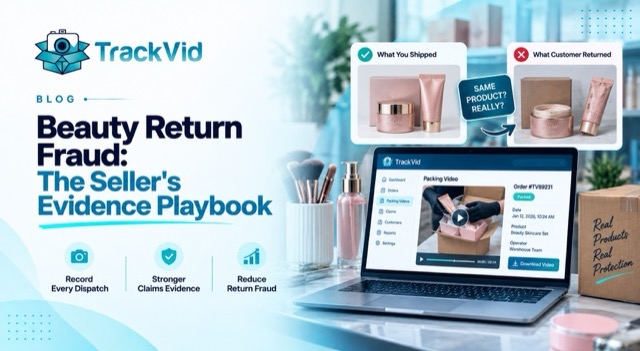
For beauty, cosmetics and personal care sellers worldwide. Updated September 2026.
Direct Answer
Beauty return fraud costs sellers more than the category's return rate suggests, because beauty is one of the few categories where a return can arrive genuinely unusable regardless of whether the underlying claim is honest. A cosmetic that has been opened, swatched or tested is not always resaleable even if the buyer's complaint is valid, and one that has been used and returned as sealed is a total loss that the seller absorbs twice, once on refund and once on the discarded unit. The category faces five fraud patterns that most others do not: used-product returns dressed as sealed, tamper seal disputes where the buyer claims the product arrived opened, counterfeit substitution on premium brands, expiry and batch swaps, and hygiene-status disputes. What makes beauty different from apparel or electronics is not the return rate, which at roughly 4 to 12 percent sits well below both, but the fact that fraud outcomes are frequently non-recoverable in kind: a returned lipstick that has been used cannot be resold, even if the seller wins the marketplace claim. Order-linked evidence captured at dispatch, specifically of the tamper seal and batch code, is what shifts the burden of proof and unlocks statutory refusal rights that already exist in most markets.
Quick Answer: What Makes Beauty Different From Other Categories?
Three things, none of them frequency. First, hygiene statutes: many markets grant sellers explicit rights to refuse returns on opened cosmetic and personal-care products, but only if the seller can demonstrate the product was sealed at dispatch. Second, resale value: a returned beauty product that has been used, sampled or tampered with is often unsaleable regardless of the outcome of the claim, so a fraudulent return costs the seller the unit even in a partial win. Third, individual identification runs on batch and lot codes rather than serial numbers, which changes how counterfeit substitution and expiry-swap fraud is proven.
Why Does Beauty Return Fraud Cost More Than the Return Rate Suggests?
Return rates in beauty are moderate compared to other categories. Category benchmarking puts beauty at roughly 4 to 12 percent, well below apparel at around 25 percent and electronics at 11 to 15 percent. That looks like a low-fraud category on paper, and it misleads a lot of sellers into treating it as one.
Beauty return fraud sits at the wrong end of a different set of numbers.
Non-recoverable inventory outcomes. In most categories, a rejected fraudulent return still leaves the seller with a resaleable unit if the claim is won. In beauty, a product that has been opened, swatched or tested, whether honestly or as part of a swatch-and-return scheme, is frequently unsaleable even if the marketplace or payment dispute resolves in the seller's favor. The fraud costs the unit as well as the refund, in both cases.
High counterfeit exposure on premium brands. The counterfeit substitution pattern that affects premium electronics also affects premium beauty at scale. Fake versions of established fragrance, skincare and cosmetics brands are widely available and visually close to identical, and a buyer who purchases a genuine unit and returns a counterfeit of the same product is executing exactly the same scheme as a phone or GPU swap, on a smaller unit basis but at higher volume.
Small enough per-unit value to escape attention. Where an electronics seller reviews every high-value return closely, a beauty seller often processes returns at speed under the assumption that the individual loss is small. That assumption is what a serial abuser or organized reseller looks for.
The result is a category where the total fraud cost frequently exceeds what the return-rate figure implies, and where the loss is often invisible because the returned unit is discarded rather than resaleable, breaking the feedback loop that would otherwise flag the pattern.
Bring one month of your beauty returns and we will help you work out the real fraud cost, including the discarded-unit loss. 15 minutes. No commitment.
What Are the Five Beauty Return Fraud Patterns?
Some overlap with other categories. All five apply here with characteristics that need beauty-specific evidence to counter.
1. Used-product returns dressed as sealed. The buyer purchases a cosmetic or skincare product, uses it once or multiple times, then reseals the outer packaging or a similar-looking box and returns it claiming it arrived opened or that they never used it. Detection is difficult once the return is in hand, and the received-item photograph the buyer supplies as evidence usually does not distinguish an honest arrival-opened claim from a used-and-resealed one.
2. Tamper seal disputes. The buyer claims the product arrived with a broken or missing tamper seal and requests a full refund on that basis. Without proof of the seal being intact at dispatch, this is a claim the seller almost cannot contest.
3. Counterfeit substitution. The buyer purchases a genuine premium unit and returns a convincing counterfeit of the same product, most common on established fragrance, luxury skincare and premium cosmetics brands. Batch codes and manufacturing marks are the primary identifier since serial numbers generally do not exist at unit level.
4. Expiry and batch swaps. The buyer holds a similar older or expired unit of the same product, purchases a fresh one, and returns the older unit claiming the product arrived past its expiry. The scheme depends on the seller not having recorded which batch or lot shipped for that specific order.
5. Fill-level disputes. The buyer receives the product intact but claims it arrived partially used, half-empty, or that the fill level is below what the label indicates. This works precisely because most sellers do not document fill level at dispatch and cannot dispute a comparison against a specific reference.
The Statutory Wrinkle: Hygiene-Based Return Refusal
Beauty is one of the few categories where the law already gives sellers a defensive position stronger than what marketplace policies alone provide, in most major markets. The defense is real, and it is almost entirely unused by small sellers, because it depends on evidence most of them do not have.
The general shape of the rule. In many jurisdictions, statutory return rights explicitly exclude sealed goods that are unsuitable for return once unsealed for hygiene or health reasons. Cosmetics, skincare, fragrance and personal care products routinely fall inside this exclusion when the tamper or hygiene seal has been broken. This is not a marketplace policy the seller has to negotiate. It is a statutory position most consumer-protection frameworks provide by default.
Why the position is usually not used. Enforcing it requires the seller to prove two things: the product was sealed when it left, and the seal was broken by the time the buyer submitted a return. Without dispatch-side evidence of the intact seal, the refusal cannot be substantiated, and marketplaces default to buyer-favorable resolution.
Verify locally before relying on this defense. Statute varies significantly by market and by product sub-category, and the marketplaces you sell on may have their own policies that go beyond, or interact with, the statutory position. Confirm the specific rule for your market and product category directly rather than assuming it applies exactly as described.
The practical implication. For a beauty seller, evidence of tamper seal integrity at dispatch is not a nice-to-have. It is the piece that converts a defensible statutory position into an actually-used one, and it is completely category-specific.
What Evidence Resolves a Beauty Return Fraud Dispute?
The evidence standard for beauty is different from electronics or apparel in one respect: identification runs on batch and lot codes rather than serial numbers, and seal condition matters more than any single other data point.
The five things worth capturing at dispatch:
- The tamper seal or hygiene seal, intact and clearly visible, on that specific unit. This is the single highest-value piece of evidence in the category, because it underwrites both the marketplace claim and any statutory refusal position.
- The batch or lot code, legible in the frame, linked to the specific order. This is the beauty analog of a serial number, and it is what distinguishes a legitimate return from a counterfeit swap or expiry substitution.
- The expiry date, visible where printed on the unit, which forecloses the expiry-swap fraud pattern before it can be attempted.
- Fill level and product condition at dispatch, which addresses fill-level dispute claims directly.
- Order-linked indexing, so all of the above is retrievable by order number rather than by scrolling a timeline, on a claim window that is often measured in days.
A note on packaging photography as evidence. A single dispatch photograph of the sealed outer box is substantially weaker than video showing the seal and codes on the unit itself before it goes into the box. A resealed outer carton looks identical to an intact one in a still image, which is precisely the gap the used-product-returned-as-sealed pattern exploits.
What does not resolve these disputes. A written description of what was shipped. A photograph of a SKU rather than the specific unit's seal and batch code. General warehouse CCTV. A batch record kept in a spreadsheet with no visual proof tying it to the parcel that shipped.
Where You File, and How Long You Have
Check the terms for your own market before acting on this section. Claim routes, evidence formats and deadlines are set by each marketplace and each country, and they are revised without notice. Everything else in this guide holds wherever you sell.
Beauty sellers typically file through one of three routes depending on where and how they sell:
Marketplace claim programs. Each marketplace runs its own protection and dispute mechanism with its own window and evidence format. Windows vary substantially, from as little as 48 to 72 hours on some platforms to several months on others. Beauty-specific policies also vary, particularly on how strictly a marketplace enforces hygiene-return restrictions in favor of the seller versus defaulting to buyer-favorable outcomes.
Payment and card disputes for direct-to-consumer sales, where the timeline runs from the transaction or dispute notification rather than from the return, and the evidence is submitted to a payment processor rather than a marketplace.
Statutory-refusal invocation. Where the applicable market's statute provides for hygiene-based return refusal on sealed cosmetics, this is a separate route that runs before a marketplace or payment dispute, invoked at the point of return receipt rather than after. It requires the same dispatch evidence but is exercised earlier in the process.
The practical rule that holds in every market. Map your longest and shortest claim windows before building any evidence process, and tune capture and retrieval speed to the shortest one, not the average.
How Do You Build a Beauty Return Fraud Evidence System?
Five steps, applicable in any market.
1. Capture the seal and codes on the unit, not just the outer box. This is the change that matters most in beauty. Dispatch evidence needs to show the tamper seal intact and the batch, lot and expiry visible on the specific unit, before the unit goes into any outer packaging.
2. Capture on every order, not a sample. The order that becomes a dispute is the one that was not recorded, and beauty fraud selects for gaps just as much as electronics fraud does.
3. Trigger capture automatically. Recording that depends on a packer remembering to start it will be skipped under volume, particularly for lower-value beauty units where individual attention is scarce.
4. Capture the return side too. Dispatch proof shows what you sent sealed. Return proof shows what came back, opened, resealed, or with a different batch code. Both are needed to make used-product and counterfeit-swap claims arguable rather than one-sided.
5. Make retrieval fast enough to matter. Beauty claim windows on some platforms are among the shortest of any category. Evidence that exists but cannot be found and submitted inside the window is functionally the same as no evidence.
See tamper seal and batch code capture running on real beauty orders. 15 minutes. No commitment.
Where TrackVid Fits
TrackVid is a video proof and claim management platform used by 1,100+ ecommerce sellers and fulfillment operations.
What applies to beauty return fraud specifically:
- Order-linked video capture at packing, triggered automatically from the shipping label scan, tied to Order ID, AWB and SKU, which is what puts the tamper seal, batch code and expiry on record for that specific order rather than a generic dispatch photo of an outer carton
- Return-side video capture, so a used-and-resealed return can be compared against the sealed-at-dispatch record, which is how used-product and counterfeit-swap claims are actually resolved
- Retrieval by order ID in under two minutes, which matters disproportionately on the short claim windows that apply on some beauty channels
- Automated claim filing on supported marketplace channels via robotic process automation operating the seller's own portal access, with filing time reduced from 15 to 20 minutes per claim to under a minute
- Return reconciliation surfacing eligible claims that would otherwise expire unfiled
What to confirm for your specific setup. Supported claim-filing channels vary by marketplace and by market, so confirm coverage for the platforms you sell on rather than assuming it from this guide. The statutory hygiene-return position described above should also be confirmed against your market's current rules before invoking it as a defense.
Where this does not help. It does not prevent a fraudulent return from being attempted, and it does not repair a returned unit into a resaleable one. It changes whether the loss is contestable, and where statute allows, refusable, which is a different question from making the returned product usable again.
Bring one month of your recent beauty return disputes and we will walk through what evidence would have changed each outcome. 15 minutes. No commitment.
Read Next
- Electronics Return Fraud, the sister vertical page on how unit-level evidence differs
- Ecommerce Return Statistics 2026, the full category benchmarking data behind the figures here
- Returns Fraud in Ecommerce, the cross-category view of how these fraud patterns work
Frequently Asked Questions
What is beauty return fraud?
Return fraud targeting beauty, cosmetics, skincare and personal care specifically, including used-product returns dressed as sealed, tamper seal disputes, counterfeit substitution on premium brands, expiry and batch swaps, and fill-level disputes. It costs sellers more than the modest category return rate implies because returned units are frequently unsaleable regardless of the claim outcome.
How do beauty sellers stop used-product returns?
Prevention is difficult once a buyer commits to the scheme. What changes the outcome is order-linked dispatch evidence of the tamper or hygiene seal intact on that specific unit, which converts an unwinnable he-said-she-said dispute into a documented seal-condition comparison at receipt.
Can I refuse a beauty return on hygiene grounds?
In many markets, yes, on sealed cosmetic and personal-care items where the tamper or hygiene seal has been broken, provided you can prove the seal was intact at dispatch. Verify the specific rule for your market and product category directly, since statute varies and marketplaces may layer their own policies on top.
What evidence wins a cosmetics return dispute?
Order-linked video captured at dispatch showing the tamper seal intact, the batch or lot code legible, the expiry date visible, and the fill level and condition, retrievable by order number. Written descriptions and photos of the outer carton alone are substantially weaker.
How do I prove a beauty product was sealed at dispatch?
By capturing video of the seal on the specific unit before it goes into any outer packaging, linked to the Order ID at the moment of capture. A sealed outer carton in a photograph looks identical to a resealed one, which is exactly the gap the used-product-returned-as-sealed pattern exploits.
Do batch codes matter for return disputes?
Yes, particularly in beauty. Batch and lot codes are the closest analog to a serial number in a category where individual units do not carry unique identifiers, and they are what distinguishes a legitimate return from a counterfeit swap or an expiry substitution.
Why is beauty return fraud harder to spot than the return rate suggests?
Because the returned unit is often discarded rather than resaleable, which breaks the feedback loop that would otherwise flag a fraud pattern. Sellers see individually small losses on modest return rates and treat the category as low fraud, while the cumulative unit-loss cost frequently exceeds what the headline number implies.
What is the return rate for beauty products?
Category benchmarking puts beauty at roughly 4 to 12 percent, below apparel at around 25 percent and electronics at 11 to 15 percent. The category's problem is not return frequency but the non-recoverable nature of the unit and the specific fraud patterns it faces.
Does documenting fill level at dispatch help with beauty returns?
Yes. Fill-level disputes, where a buyer claims the product arrived partially used, are common in the category and difficult to contest without a specific dispatch reference. Video showing the fill level at the moment of packing directly addresses this pattern.
Can I claim for a beauty return discovered to be counterfeit after receipt?
Depends entirely on the claim window for that channel and on your dispatch evidence. If the batch code you shipped was recorded and the returned unit's code differs, the case is substantially stronger. Without either, the dispute reduces to your word against the buyer's, and marketplaces typically default to buyer-favorable outcomes.
Sources: Branvas category return-rate benchmarking, April 2026; NRF Retail Returns Landscape and Return Fraud Survey data; industry reporting on counterfeit cosmetics substitution and used-product return patterns; consumer-protection statute on hygiene-based return exclusions across major markets (EU Consumer Rights Directive Article 16, comparable US, UK and India rules); TrackVid platform data across 1,100+ ecommerce sellers
Return fraud rates, category benchmarks and hygiene-return statutes vary by market and change over time. Verify current figures, your marketplace terms and the applicable statute for your product category before relying on this guidance for a specific decision.
TrackVid is a video proof and claim management platform for ecommerce sellers and fulfillment operations, providing order ID-linked evidence capture and automated claim filing on supported channels. Learn more at trackvid.in.


Get the Marketplace Claim Recovery Checklist
A 12-point checklist used by 1,100+ sellers to recover 85-90% of marketplace claim losses. Free, instant access.
- Marketplace-specific evidence formats (AJIO, Flipkart, Amazon, Myntra)
- Claim window deadlines for every major platform
- The 6-step process that pushes approval from 85-90%
- Common rejection reasons and how to avoid them
No spam. Unsubscribe anytime. Used by sellers at Rare Rabbit, HRX, Da Milano + 1,100 more.
Stop Losing Money to Fake Returns
Join 1,100+ sellers who recover lakhs every month with TrackVid