
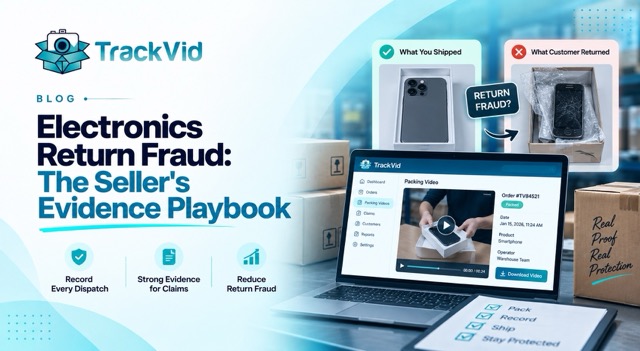
For electronics, mobile and accessories sellers worldwide. Updated September 2026.
Direct Answer
Electronics return fraud costs more per incident than fraud in any other ecommerce category, because the products are high value, highly resaleable, and easy to substitute with a convincing fake or an identical-looking dead unit. The category faces six distinct fraud patterns that other categories do not: component stripping, where RAM, SSD or graphics cards are removed and the empty shell is returned as faulty; counterfeit substitution; same-model dead-unit swaps; wardrobing, where a device is used for a specific purpose then returned as unopened; empty box returns; and false damage claims. What makes electronics different from apparel or beauty is not the return rate, which at roughly 11 to 15 percent sits below apparel, but the value per fraudulent incident and the fact that a stripped or swapped device often passes a basic visual inspection. The only evidence that reliably resolves these disputes is order-linked proof captured at dispatch showing the specific unit, its serial or IMEI, and its complete condition before the box was sealed.
Quick Answer: What Makes Electronics Different From Other Categories?
Three things. First, the value per incident: a single stripped graphics card or swapped phone can exceed the entire monthly fraud loss of an apparel seller. Second, the unit is individually identifiable by serial number or IMEI, which means proof is possible in a way it is not for a generic t-shirt, but only if that identifier was actually captured at dispatch. Third, the fraud often survives inspection: a device missing internal components, or a counterfeit of the same model, looks correct on the receiving bench and is frequently only discovered weeks later during refurbishment or resale, by which point the claim window has usually closed.
Why Does Electronics Return Fraud Cost the Most Per Incident?
Return fraud across all ecommerce categories is large and growing. Industry data puts fraudulent returns at roughly 13.7 percent of all returns, with US retail return fraud losses reported at over 101 billion dollars in 2023 and projected to exceed 115 billion by 2026. Separate analysis puts the cost at approximately 10 dollars lost to fraud for every 100 dollars of merchandise returned, with the average fraudulent return valued around 120 dollars.
Electronics return fraud sits at the wrong end of every one of those averages.
Electronics return fraud is not primarily a frequency problem. The category return rate itself is moderate. Category benchmarking puts electronics at roughly 11 to 15 percent, meaningfully below apparel at around 25 percent. The problem is not frequency. It is what each fraudulent return costs and how hard it is to detect.
Three structural factors drive this:
High resale value on the genuine article. A returned phone, GPU or laptop has immediate secondary-market liquidity. The incentive to keep the real unit and return something else is substantially higher than for a pair of jeans.
Individual identifiability cuts both ways. Electronics carry serial numbers and IMEIs, which makes proof theoretically straightforward. But that only helps if the identifier was recorded against the specific order at dispatch. Most sellers record what SKU was shipped, not which individual unit, and a SKU-level record cannot distinguish the unit you sent from a different unit of the same model.
Detection is delayed. A stripped laptop still boots to a POST screen. A counterfeit charger still looks like the original in a photograph. A same-model dead unit is visually identical. These returns frequently pass receiving inspection and are only discovered during refurbishment, testing or resale, which can be weeks after the return arrived and long after the marketplace claim window closed.
What Are the Six Electronics Return Fraud Patterns?
Other categories see some of these. Electronics return fraud covers all six, and the first three are close to category-exclusive.
1. Component stripping, also called bricking. Internal components with independent resale value, RAM modules, SSDs, graphics cards, are removed before return, and the device is sent back as faulty or dead on arrival. The external casing is untouched. Unless you opened and inventoried every returned unit immediately, the loss is invisible at receiving.
2. Counterfeit substitution. The buyer purchases a genuine unit and returns a convincing counterfeit of the same model. Most common in accessories, chargers, cables, earphones and peripherals, where counterfeits are cheap, widely available and visually near-identical.
3. Same-model dead-unit swap. The buyer already owns a broken unit of the same model, buys a working one, and returns their broken unit claiming it arrived faulty. Nothing about the return looks suspicious because it is genuinely the same product.
4. Wardrobing. The device is purchased for a specific short-term need, a camera for one trip, a laptop for one deadline, a console for a weekend, then returned as unopened or unused. Electronics is one of the two categories most affected by this pattern, alongside apparel.
5. Empty box returns. The original packaging is returned, sometimes weighted with filler to pass a basic weight check, with the device removed entirely.
6. False damage claims. The buyer claims the device arrived damaged, cracked screen, dead pixels, physical impact, when it left in perfect condition. A growing share of these claims now arrive with AI-generated damage photographs attached as supporting evidence, which raises the evidentiary bar for the seller rather than lowering it.
What Evidence Resolves an Electronics Return Fraud Dispute?
The evidence standard for electronics is higher than for most categories, and specifically different in one respect: unit-level identification matters more than anything else.
The five things worth capturing at dispatch:
- The serial number or IMEI, visible and legible, linked to that specific order. This is the single highest-value piece of evidence in the category, because it is the only thing that distinguishes the unit you shipped from a different unit of the same model. Without it, a same-model swap is nearly impossible to disprove.
- The device in complete condition before sealing, including that it is assembled, undamaged and powered or screen-visible where practical.
- Included accessories and inbox contents, since partial-contents claims are common and a charger or cable missing from a return is a claim in its own right.
- Seal and packaging integrity at the point of sealing, which supports both tamper claims and damage-in-transit disputes.
- Order-linked indexing, so all of the above can be retrieved by order number rather than by scrolling a timeline. Evidence that exists but cannot be found inside a claim window is functionally the same as no evidence.
A note on weight verification. Some operations add a weight check at dispatch and again at return receipt, comparing the two to flag likely component removal or empty-box returns before a manual inspection happens. This is a legitimate and increasingly common practice in electronics fulfillment specifically, and worth asking any prospective vendor whether they support it, though it should be evaluated as a distinct capability rather than assumed present in every system.
What does not resolve electronics return fraud disputes. A written description of what was shipped. A photo of a SKU rather than a unit. General warehouse CCTV indexed by time rather than by order. A serial number recorded in a spreadsheet with no visual proof tying it to the specific parcel that shipped.
Bring a recent disputed electronics return and we will walk through what evidence would have closed it. 15 minutes. No commitment.
Where You File, and How Long You Have
Check the terms for your own market before acting on this section. Claim routes, evidence formats and deadlines are set by each marketplace and each country, and they are revised without notice. Everything else in this guide holds wherever you sell.
Electronics sellers typically file through one of three routes depending on where and how they sell:
Marketplace claim programs. Each marketplace runs its own protection and dispute mechanism with its own window and evidence format. Windows vary enormously, from as little as 48 to 72 hours on some platforms to several months on others, and each marketplace specifies its own accepted evidence format. Confirm the exact window and format for every marketplace you sell on, since a process tuned to a generous window will silently fail on a short one.
Payment and card disputes for direct-to-consumer sales, where the timeline runs from the transaction or dispute notification rather than from the return, and the evidence is submitted to a payment processor rather than a marketplace.
Carrier and logistics claims where the loss or damage occurred in transit rather than at the buyer's end, which is a separate route with separate documentation requirements.
The practical rule that holds in every market. Map your longest and shortest claim windows before building any evidence process, and tune retention and retrieval speed to the shortest one, not the average. The short-window channel is where valid claims are lost most often, regardless of country.
How Do You Build an Electronics Return Fraud Evidence System?
Five steps, applicable in any market.
1. Capture at the unit level, not the SKU level. This is the change that matters most in electronics. Your system needs to record which specific unit went to which specific order, with the serial or IMEI visible, not merely that a unit of that model shipped.
2. Capture on every order, not a sample. Sampling fails predictably: the order that becomes a dispute is the one that was not recorded. Fraud selects for gaps, and high-value electronics orders are exactly where an opportunistic buyer looks for them.
3. Trigger capture automatically. Recording that depends on a packer remembering to start it will be skipped under volume pressure, which is precisely when high-value orders are moving fastest.
4. Capture the return side too. Dispatch proof shows what you sent. Return proof shows what came back. Component stripping and same-model swap disputes are resolved by comparing the two, not by either one alone.
5. Make retrieval fast enough to matter. In a category where detection is often delayed until refurbishment, the gap between discovering a loss and the claim window closing is frequently small. If retrieving the evidence for a specific order takes longer than a few minutes, valid claims will be abandoned for lack of time.
See unit-level capture and order ID retrieval running on real electronics orders. 15 minutes. No commitment.
Where TrackVid Fits
TrackVid is a video proof and claim management platform used by 1,100+ ecommerce sellers and fulfillment operations.
What applies to electronics return fraud specifically:
- Order-linked video capture at packing, triggered automatically from the shipping label scan, tied to Order ID, AWB and SKU, which is what puts a specific unit and its visible serial or IMEI on record against a specific order
- Return-side video capture, so the unit that came back can be compared against the unit that went out, which is how component stripping and same-model swap claims are actually resolved
- Retrieval by order ID in under two minutes, which matters disproportionately in a category where the loss is often discovered late
- Automated claim filing on supported marketplace channels via robotic process automation operating the seller's own portal access, with filing time reduced from 15 to 20 minutes per claim to under a minute
- Return reconciliation surfacing eligible claims that would otherwise expire unfiled
What to confirm for your specific setup. Supported claim-filing channels vary by marketplace and by market, so confirm coverage for the specific platforms you sell on rather than assuming it from this guide. Weight verification, described above as a general industry practice, should also be confirmed directly rather than assumed.
Where this does not help. It does not prevent a fraudulent return from being attempted, and it does not recover a loss discovered after the claim window has closed. It changes whether a disputed return is arguable or provable, which is a different thing from prevention.
See what unit-level dispatch evidence looks like for your product mix. 15 minutes. No commitment.
Read Next
- Ecommerce Return Statistics 2026, the full category benchmarking data behind the figures here
- Returns Fraud in Ecommerce, the cross-category view of how these fraud patterns work
- Swap Fraud in Ecommerce Returns, deeper detail on substitution fraud specifically
Frequently Asked Questions
What is electronics return fraud?
Return fraud targeting electronics specifically, including component stripping, counterfeit substitution, same-model dead-unit swaps, wardrobing, empty box returns and false damage claims. It costs more per incident than fraud in other categories because the products are high value, resaleable and easy to substitute convincingly.
What is component stripping fraud?
Also called bricking. Internal components with independent resale value, such as RAM, SSDs or graphics cards, are removed before the device is returned as faulty. The external casing appears untouched, so the loss is usually invisible at receiving inspection and discovered only during testing or refurbishment.
How do I prove an electronics return was swapped?
With order-linked dispatch evidence showing the specific unit's serial number or IMEI, captured visibly at packing against that specific order. SKU-level records cannot distinguish the unit you shipped from a different unit of the same model, which is exactly what a same-model swap exploits.
How do electronics sellers stop counterfeit returns?
Prevention is difficult, since a counterfeit of the same model can be visually near-identical. What changes the outcome is provable dispatch evidence showing the genuine unit and its identifiers leaving your facility, which shifts the dispute from your word against the buyer's to a documented comparison.
What evidence wins an electronics return dispute?
Order-linked video or photographic proof captured at dispatch showing the serial or IMEI, the device in complete condition, inbox contents, and seal integrity, retrievable by order number. Written descriptions, SKU-level photos and time-indexed CCTV generally do not meet the bar.
Do I need to record serial numbers when packing?
For electronics, yes. The serial or IMEI is the only thing that distinguishes your unit from another unit of the same model, which makes it the single highest-value piece of evidence in the category. A serial recorded in a spreadsheet without visual proof tying it to the shipped parcel is substantially weaker.
Why is electronics return fraud harder to detect than other categories?
Because the fraud frequently survives inspection. A stripped laptop still powers on, a counterfeit charger photographs identically, and a same-model dead unit is visually indistinguishable. Detection is often delayed until refurbishment or resale, by which point the claim window has usually closed.
What is the return rate for electronics?
Category benchmarking puts electronics at roughly 11 to 15 percent, below apparel at around 25 percent. The category's problem is not return frequency but the value and detectability of each fraudulent incident.
Does weight verification help with electronics returns?
It can. Comparing dispatch weight against return receipt weight flags likely component removal or empty-box returns before manual inspection. This is a distinct capability that varies by system, so confirm it directly with any vendor rather than assuming it is included.
Can I claim for a fraudulent return discovered weeks later?
Depends entirely on the claim window for that channel, which in some cases is measured in days. This is why delayed detection is such a structural problem in electronics, and why capturing evidence at dispatch matters more than being able to investigate thoroughly after the fact.
Sources: NRF Retail Returns Landscape and Return Fraud Survey data; Signifyd consumer research on return substitution; Branvas category return-rate benchmarking, April 2026; Appriss Retail Total Retail Loss Benchmark Report 2026; industry reporting on component stripping and product switching fraud patterns; TrackVid platform data across 1,100+ ecommerce sellers
Return fraud rates, category benchmarks and claim windows change over time and vary by market. Verify current figures and your own marketplace terms before relying on this guidance for a specific decision.
TrackVid is a video proof and claim management platform for ecommerce sellers and fulfillment operations, providing order ID-linked evidence capture and automated claim filing on supported channels. Learn more at trackvid.in.



Get the Marketplace Claim Recovery Checklist
A 12-point checklist used by 1,100+ sellers to recover 85-90% of marketplace claim losses. Free, instant access.
- Marketplace-specific evidence formats (AJIO, Flipkart, Amazon, Myntra)
- Claim window deadlines for every major platform
- The 6-step process that pushes approval from 85-90%
- Common rejection reasons and how to avoid them
No spam. Unsubscribe anytime. Used by sellers at Rare Rabbit, HRX, Da Milano + 1,100 more.
Stop Losing Money to Fake Returns
Join 1,100+ sellers who recover lakhs every month with TrackVid