
For sellers on Shopify, Amazon, eBay, Walmart, Etsy, TikTok Shop, and every marketplace running a peak season. Updated August 2026.
Direct Answer
Black Friday return fraud is the concentrated spike in fraudulent and abusive returns that hits ecommerce sellers during the Black Friday to Cyber Monday window and the eight weeks that follow. Roughly 9 percent of all returns are fraudulent year-round per NRF 2025 data, but holiday return fraud runs 2 to 3 percentage points higher because order volume, discount stacking, gift purchases, and staffing pressure all peak at once. The three dominant tactics are overstated return quantity (reported by 71 percent of retailers), empty box or "box of rocks" returns (65 percent), and decoy or counterfeit item returns (64 percent). Sellers who capture Order ID-linked dispatch evidence during the peak window win 80 to 90 percent of the resulting disputes, versus 25 to 35 percent for sellers relying on tracking screenshots and written statements. The defense has to be built in the six weeks before Black Friday, because the disputes arrive in January when the evidence can no longer be created.
Why Peak Season Breaks Normal Fraud Defense
Most sellers run an adequate fraud defense for eleven months of the year and a broken one for the twelfth. The reason is structural, not a failure of effort.
During a normal month, your team can investigate a suspicious return. Someone pulls the order, checks the customer history, looks at the weight on the return receipt, and makes a judgement call. Twenty of those a month is manageable.
During the Black Friday to Cyber Monday window, transaction volumes rise sharply. ACI Worldwide's 2025 peak-season analysis recorded transaction volumes up 27 percent year on year across the BFCM window, with mobile transactions up 30 percent. Sift's Global Data Network recorded BFCM transaction volume up 13.8 percent year on year. Your return volume follows about three to six weeks behind, which means the investigations that were manageable at twenty a month become impossible at four hundred.
So the manual process collapses. And when the manual process collapses, sellers do one of two things, and both are expensive.
Response one: approve everything. Refund all claims to clear the queue and protect ratings. This is the choice most sellers make under pressure, and it is exactly the behaviour organised refund abusers count on. It converts your peak season from your most profitable window into a subsidy for people gaming the return policy.
Response two: tighten everything. Reject aggressively, add friction, hold refunds. This creates a different loss. Riskified data puts global false-decline losses at $443 billion per year, and retailers lose roughly nine times more revenue to false declines than to the fraud they are trying to block. You lose the fraud and the legitimate customers together.
The sellers who avoid both traps do something different. They do not decide during the peak. They build the evidence during the peak and let the evidence decide afterwards. That is the entire premise of this playbook.
Across the TrackVid platform of 1,100+ ecommerce sellers, the pattern is consistent every peak season. The sellers who arrive at Black Friday with Order ID-linked dispatch evidence already running do not investigate faster. They stop needing to investigate at all, because the answer to "what was actually in that box" is already recorded before anyone asks the question.
In November you are shipping. In January you are defending. The evidence has to be captured in November.
What Is Black Friday Return Fraud?
Black Friday return fraud is the seasonal concentration of fraudulent and abusive return claims across the peak shopping window, typically running from late November through mid-January.
It is not one scheme. It is a family of them, and the mix shifts during peak season because different tactics scale differently under high volume.
The six tactics that dominate the peak window:
1. Overstated return quantity. The customer claims to have returned more units than they actually sent back. NRF's 2025 returns research found 71 percent of retailers tracking these incidents reported an increase, making it the single most-reported tactic. It scales brutally during peak because multi-item orders are the norm and receiving teams are processing at speed.
2. Empty box or "box of rocks" returns. The customer returns a sealed parcel containing nothing, or containing weight-matched filler. NRF put this at 65 percent of retailers reporting increases. Peak season is its ideal environment: the returns queue is long, inspection is rushed, and refunds are often auto-triggered on scan rather than on inspection.
3. Decoy or counterfeit item returns. The customer returns a substituted or counterfeit item in place of the genuine product. NRF recorded 64 percent of retailers reporting increases. High-value gift categories, electronics, and premium fashion take the worst of it during the holiday window.
4. Wardrobing. The item is worn or used for an event, then returned as new. Appriss Retail and Deloitte's survey found wardrobing was the tactic cited most often by retail executives, flagged by 60 percent. December is wardrobing's peak month for obvious reasons: party season.
5. Friendly fraud and first-party misuse. The customer files a chargeback on a legitimate delivered order rather than requesting a return. ACI Worldwide projected a 25 percent rise in friendly fraud across the Thanksgiving to Cyber Monday window, with the average friendly-fraud transaction value climbing to $291, up 21 percent year on year. This is the most expensive category per event because you lose the product, the revenue, the shipping, and the chargeback fee.
6. Bracketing abuse escalating into claims. Bracketing (ordering multiple sizes or colours with intent to return most) is normalised rather than fraudulent, and NRF found roughly two-thirds of online shoppers do it. It becomes a fraud vector at peak when the customer decides to keep one item free by claiming the box arrived short.
The underlying attitude shift matters as much as the tactics. NRF's 2025 consumer research found 45 percent of consumers believe it is acceptable to bend the truth when making a return. That number is why policy alone does not solve this. A policy restrains people who consider return rules binding. Evidence is what resolves cases with people who do not.
For the year-round version of this problem across all return categories, see our How to Reduce Ecommerce Return Rate playbook and our Customer Risk Scoring playbook at trackvid.in.
Why Does Return Fraud Spike During Black Friday and Cyber Monday?
Five structural conditions converge in the same six-week window. None of them is unique to peak season on its own. Together they produce the highest-risk stretch of the retail year.
Condition 1: Volume becomes camouflage. Professional fraud hides inside legitimate traffic. When your daily order count triples, a fraudulent claim stops standing out. Sift's data on peak periods shows account takeover attack rates climbing from 1.64 percent to 1.87 percent during BFCM, and separate industry reporting has recorded ATO attempts rising sharply during peak specifically because credential-stuffing attacks blend into surge traffic.
Condition 2: Discount stacking distorts refund value. A customer buys at 60 percent off during the sale, then claims a refund. Depending on how your refund logic is configured, poorly handled promo interactions can refund at a value the customer never paid. Promo abuse is a separate discipline in its own right, but at peak it compounds directly into return fraud.
Condition 3: Gift orders break identity matching. The buyer and the recipient are different people, shipping to a different address, often with no order history at either end. Every behavioural signal your risk system relies on gets weaker in December. Gift receipts, gift wrapping, and delayed opening all extend the window between dispatch and inspection.
Condition 4: The return horizon stretches. This is the change most sellers have not adjusted for. As early holiday promotions moved into October and extended holiday return windows became standard, the effective return horizon widened from the traditional four to six weeks to ten to twelve weeks, per NoFraud's analysis of the 2025 holiday return season. A longer horizon means more time for wardrobing, more time for the customer to lose the packaging, and far more time for your own memory of the order to disappear.
Condition 5: Your team is at capacity when the claims land. Staffing is optimised for shipping in November and for holidays in late December. The claim wave arrives in the gap. Support tickets, WISMO queries, dispute filings, and return inspections all peak while the people who handle them are least available. For the operational side of that surge, see our Sale Season Operations Playbook and our WISMO Reduction playbook at trackvid.in.
The compounding effect is what makes Black Friday return fraud disproportionate. Each condition alone raises risk modestly. Stacked, they raise the fraudulent share of returns from roughly 9 percent to the 12 to 16 percent range that NRF and Appriss data have repeatedly recorded across holiday windows.
When Do Black Friday Chargebacks Actually Hit?
This is the question almost nobody answers, and it is the single most useful thing to understand about peak-season fraud economics.
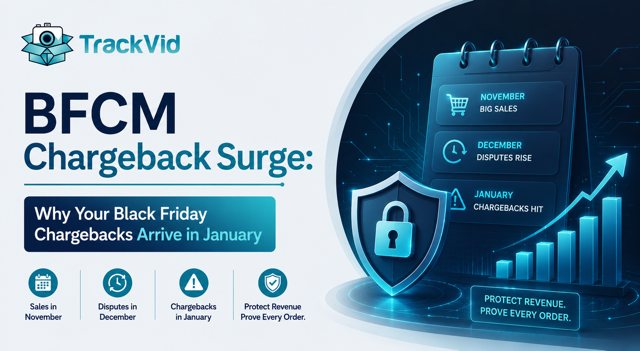
Black Friday return fraud does not cost you money in November. It costs you money in January and February.
The lag is structural. A card dispute is filed after the cardholder sees the charge on a statement, which can be four to eight weeks after the transaction. Sift's peak-season analysis makes the mechanism explicit: holiday account takeover surges lead to higher disputes in the following quarter, because compromised accounts are monetised at peak and only surface on billing statements weeks later. Adobe's holiday data has repeatedly shown the post-Christmas return spike running through mid-January.
The realistic peak-season dispute timeline:
| Window | What is happening | What it costs |
|---|---|---|
| Late Oct to Nov 26 | Early promos, order volume ramps, evidence either is or is not being captured | Nothing yet. This is the only window where the outcome is still in your control |
| Nov 27 to Dec 1 (BFCM) | Peak transaction volume, peak fraud attempt volume, peak staffing strain | Fraudulent orders enter the system. Losses are incurred but not yet visible |
| Dec 2 to Dec 24 | Fulfilment sprint, WISMO surge, first wave of "not received" claims | Support cost surge, early INR claims, first refunds |
| Dec 26 to Jan 15 | The post-Christmas return spike. Wardrobing returns arrive. Empty-box and short-shipment claims land | The largest single wave of return fraud losses in the year |
| Jan 15 to Feb 28 | The chargeback cascade. November and December card disputes hit. Representment deadlines run | Chargeback losses, fees, and ratio damage. Evidence must already exist |
| March onward | Chargeback ratio consequences. Reserve requirements, processor reviews, marketplace metrics | Structural cost that outlasts the season |
If your peak-season plan is a fraud filter and a stricter return policy, you have prepared for the wrong month. Filters and policies act at the point of order. Chargebacks and abusive claims act eight to twelve weeks later, when the only thing that resolves the case is a record of what left your warehouse.
A card network representment is decided on documentation. So is an Amazon A-to-Z appeal, a marketplace seller-controllable classification, and a wrong-item claim. In every one of those processes, the seller who captured Order ID-linked dispatch evidence in November wins in February. The seller who did not is arguing from memory.
The 6-Week Black Friday Return Fraud Defense Calendar
This is the operating framework. Six weeks, six moves, each one designed to produce evidence that is still usable during the January and February dispute wave.
Week 6 Before: Baseline Your Real Peak-Season Exposure
You cannot defend a number you have never measured. Pull last peak season's data and calculate four figures.
- Peak return rate versus annual return rate. The gap is your seasonal exposure.
- Dispute win rate on wrong-item, damaged, and not-received claims filed between November and February.
- Chargeback ratio during December to February versus your annual average. Above 0.9 percent is a warning zone. Above 1 percent triggers processor programmes.
- Total peak-window write-off, including refunded fraudulent claims, unrecovered shipping, and support cost.
Most sellers running this for the first time find peak-window losses are 2 to 4 times their assumed number, because refunds, shipping, support hours, and chargeback fees sit in four different reports. For the full cost-allocation method, see our Where Ecommerce Profit Margins Leak playbook at trackvid.in.
Week 5 Before: Deploy Order ID-Linked Dispatch Evidence
This is the single most important move on the calendar and the only one that cannot be added retroactively.
Every outbound parcel gets a packing record linked to the Order ID, capturing the item, the quantity, the condition, the calibrated weight, and the tamper-evident seal, with the shipping label visible in the same frame.
Deploy in week 5 rather than week 1 for a specific reason: you need the workflow stable and the staff trained before volume arrives. A system introduced during peak gets abandoned during peak. A system running for four weeks before peak survives it.
Critically, this covers the entire dispute surface at once. The same artefact answers a wrong-item claim, an empty-box claim, a short-shipment claim, a damage claim, and a card-network representment. For the operational build, see our Order Accuracy playbook and our Packaging Best Practices playbook at trackvid.in.
Week 4 Before: Instrument Returns Receiving, Not Just Dispatch
Dispatch evidence proves what left. Returns evidence proves what came back. You need both ends of the chain to close an empty-box or decoy case.
- Weigh every return on receipt and reconcile against the recorded dispatch weight. A 200 gram parcel returned against a 1.4 kilogram dispatch is a resolved case, not an investigation.
- Record the unboxing of returns above a value threshold. Set the threshold at your average order value.
- Separate refund trigger from scan event. Refunding on carrier scan rather than on inspection is the single configuration that makes empty-box fraud frictionless. Move the trigger to inspection for the peak window, and say so plainly in your returns policy.
- Log the reason code and the claimed quantity on every return so January analysis has something to work with.
Week 3 Before: Risk-Tier Your Customer Base Before Volume Hides Everything
Segment now, while the data is still readable. A simple three-tier model handles most of the value.
- Green (roughly 75 to 85 percent): normal return behaviour. Keep friction at zero. These customers are the reason you run a generous policy.
- Yellow (roughly 10 to 15 percent): elevated return rate or repeated claim history. Route claims to manual review during peak instead of auto-approving.
- Red (roughly 3 to 8 percent): multiple unresolved claims, mismatched addresses, or a pattern of high-value claim-only behaviour. Require inspection before refund, restrict high-risk payment methods, and consider capping order value.
The tiering matters most in the peak window precisely because volume destroys your ability to make case-by-case calls. Decide the rules in October so November executes them automatically. The full framework sits in our Customer Risk Scoring playbook at trackvid.in.
Week 2 Before: Close the Policy and Communication Gaps Fraudsters Read
Abusers read return policies more carefully than your customers do. Audit yours for the exploitable gaps.
- State the extended holiday return window explicitly, with the exact end date. Ambiguity is what turns a policy dispute into a chargeback.
- Publish the condition standard for a refundable return, including packaging, tags, and unused state.
- Describe your dispatch documentation in one line on the product page and order confirmation. This is a deterrent, not just a defence. Sellers deploying visible dispatch documentation consistently report attempted false claims dropping 35 to 60 percent within a quarter, because the easiest target is always the seller who cannot prove anything.
- Set proactive shipping notifications for the peak window. A large share of "not received" claims are genuine confusion that a delivery-exception alert would have prevented. See our Post-Purchase Experience playbook at trackvid.in.
Week 1 Before and Through Peak: Run the Evidence Loop, Defer the Judgement Calls
During the peak window itself, the discipline is simple and counterintuitive: stop investigating, keep capturing.
- Capture on every order, without exception. Selective capture is the same as no capture, because fraud selects for the gaps.
- Do not batch-approve claims to clear the queue. Approve Green-tier claims automatically, queue Yellow and Red for post-peak review with the evidence attached.
- File marketplace claims inside the platform window, which is where most recoverable revenue quietly dies. Windows are short and unforgiving during peak: Amazon SAFE-T runs 7 days from return delivery, Flipkart 48 to 72 hours, AJIO 3 days with mandatory video, Myntra around 48 hours, Meesho 7 days, and TikTok Shop allows 24 hours for Aftersales Dispute evidence and 7 calendar days for a chargeback appeal with no extensions.
- Reserve one person per shift for the dispute queue. Not a manager splitting attention. One named owner.
- Then defend in January with what you captured in November. Chargeback representments, marketplace appeals, and claim reversals all run off the same evidence set.
Case Study: Peak Season Losses Down 71 Percent
A mid-market apparel and accessories D2C brand selling across Shopify, Amazon, and two marketplaces went into the 2025 peak season with no dispatch evidence layer. Peak-window revenue from November 1 to January 31 was approximately $4.2 million, roughly 34 percent of annual revenue.
The 2025 peak season, before any of this was in place:
- Peak return rate: 31 percent versus a 22 percent annual average
- Wrong-item and empty-box claims: 640 across the window
- Dispute win rate on those claims: 29 percent
- Chargeback ratio, December to February: 1.38 percent, which put the merchant account into processor review
- Total peak-window fraud and dispute write-off: approximately $128,000
- Average claim filing time: 22 minutes, with an estimated 18 percent of marketplace claims missed entirely because the window closed first
The January reality was the part that changed their thinking. Roughly 61 percent of the total loss landed after December 25, when the season already felt finished and the team had moved on to Q1 planning.
What they deployed over the six weeks before the 2026 peak:
Weeks 6 and 5: baseline measurement, then Order ID-linked packing video via TrackVid at all four pack stations, with calibrated weight capture and tamper-evident sealing.
Week 4: returns receiving instrumented with mandatory weigh-in and reconciliation against dispatch weight. Refund trigger moved from carrier scan to inspection for the peak window.
Week 3: three-tier customer risk model deployed, with 6.2 percent of the customer base classified Red and routed to inspection-before-refund.
Week 2: return policy rewritten with an explicit window end date, a stated condition standard, and a one-line dispatch documentation notice on the product page and order confirmation.
Week 1 through peak: capture on every order, one named dispute owner per shift, marketplace claims filed same-day inside platform windows.
Results across the following peak window:
- Peak return rate: 31 percent to 24 percent
- Wrong-item and empty-box claims filed against them: 640 to 447 (down 30 percent, attributed to the visible-documentation deterrent effect)
- Dispute win rate on those claims: 29 percent to 84 percent
- Empty-box losses: effectively eliminated through weight reconciliation, from 1.7 percent of peak revenue to 0.1 percent
- Chargeback ratio, December to February: 1.38 percent to 0.41 percent, clearing processor review
- Average claim filing time: 22 minutes to 5 minutes
- Marketplace claims missed due to window expiry: 18 percent to under 2 percent
- Total peak-window fraud and dispute write-off: $128,000 to $37,000, a 71 percent reduction
The recovered $91,000 came from the same order volume and the same return volume. Nothing about their traffic, their pricing, or their product mix changed. The only change was that the answer to "what was in the box" existed before anyone asked.
Their operations lead described the shift in a single line: the team stopped arguing about returns and started closing them.
See exactly where your peak-season exposure sits and what dispatch evidence would recover for you this Black Friday. 30 minutes. No commitment.
How Do You Spot a Fraudulent Black Friday Return?
No single signal is proof. Stacked signals are what separate a genuine unhappy customer from an abusive claim, and during peak you need the stack because you do not have time for the investigation.
The seven peak-season signals worth scoring:
1. Weight mismatch on return receipt. The strongest single indicator available, and the least used. A return that weighs materially less than the recorded dispatch weight resolves empty-box and short-shipment claims outright.
2. Claim filed inside 24 hours of delivery, on a gift-window order. Genuine damage complaints cluster immediately. So does organised abuse. The distinguishing factor is whether the claim includes specific product detail or only a category-level assertion.
3. Claim-only relationship history. The customer has multiple orders and multiple claims, and no order without a claim. A high return rate is normal behaviour. A 100 percent claim rate is a pattern.
4. Mismatch between claimed quantity and dispatch record. The most-reported tactic in NRF's data, and the easiest to disprove when the packing record shows the count.
5. High-value SKU with a low-value return weight. Common in electronics and premium fashion, where a decoy item approximates the original's weight but not its dimensions or serial.
6. Address and payment signals that only appear at peak. New account, gift shipping address, expedited delivery, high-discount cart, and a payment method with weak recourse. Individually unremarkable. Together, a scoring trigger.
7. Language mirroring platform policy wording. Claims that quote the exact policy language required to trigger an automatic refund often indicate the claimant knows the threshold. This is the fingerprint of coordinated refund abuse rather than an isolated unhappy customer.
How to use the stack during peak: score, do not investigate. One signal proceeds normally. Two signals route to manual review after the peak with evidence attached. Three or more signals hold the refund until inspection. This is the only workable posture at volume, because it converts a judgement call into a rule.
For the year-round version of this detection framework, including the eight-signal model for pre-shipment risk, see our Fake COD Order Detection playbook at trackvid.in.
What Evidence Wins Peak-Season Disputes?
Every dispute resolution process, whether it is a card network representment, a marketplace appeal, or a direct customer claim, runs on the same question: can you document the condition and contents of the shipment at the moment it left your control?
The five-piece evidence stack that wins peak-season claims:
Piece 1: Order ID-linked packing video showing the item, the quantity, the condition, and the shipping label in the same frame. Retrievable by Order ID in under two minutes, which matters more during peak than at any other time because dispute windows are short and volume is high.
Piece 2: Calibrated dispatch weight recorded at packing, to two decimal places. This is what converts an empty-box claim from a dispute into a closed case when reconciled against return receipt weight.
Piece 3: Tamper-evident seal documentation captured at packing. This defeats the post-delivery substitution narrative, which is the core of decoy and counterfeit return fraud.
Piece 4: Carrier tracking with delivery confirmation, including signature or photo confirmation where the order value justifies it. This addresses item-not-received claims specifically, which surge hardest in the gift window.
Piece 5: Listing screenshot at time of order showing exactly what was advertised. This addresses "not as described" claims, which spike during sales because discounted items are bought faster and read less carefully.
Why the stack beats its parts. Tracking proves delivery but says nothing about contents. A photo of a packed box proves a box existed. A written statement is an assertion. The combination produces a documented chain from pack station to doorstep, and it is the chain rather than any single element that reviewers act on.
The win-rate difference is not marginal. Sellers submitting complete stacks consistently resolve wrong-item and empty-box claims at 80 to 90 percent. Sellers submitting tracking and a written explanation resolve them at 25 to 35 percent. That gap, applied to peak volume, is usually the difference between a profitable Q4 and a Q4 that looked profitable until the February statements arrived.
Where TrackVid Fits in Your Peak-Season Defense
Weeks 6, 4, 3, and 2 of the calendar above are process work you can run with your existing team. Week 5, the dispatch evidence layer, is the piece that needs infrastructure, and it is the piece that decides the outcome of every dispute in January.
TrackVid is a video proof and claim management platform used by 1,100+ ecommerce sellers on Shopify, WooCommerce, Amazon, eBay, TikTok Shop, Flipkart, Myntra, AJIO, Nykaa, Meesho, and Snapdeal. Officially authorized by Snapdeal. Brands using TrackVid include Rare Rabbit, Wrogn, The Indian Garage Co, The Bear House, HRX, Nike, Jordan, Tommy Hilfiger, and Snitch.
For Black Friday return fraud specifically, TrackVid delivers:
- Automatic Order ID-linked packing video at every pack station with no workflow change and no added seconds per parcel, which is the only version of this that survives peak volume.
- Calibrated weight capture and reconciliation between dispatch and return receipt, closing the empty-box and short-shipment categories that peak season amplifies most.
- Under two-minute retrieval by Order ID, which is what makes short marketplace dispute windows achievable at peak rather than theoretical.
- Auto-filed marketplace claims across supported platforms, removing the 15 to 20 minutes of manual filing per claim that causes windows to be missed when hundreds of disputes arrive in a week.
- Evidence formatted for card-network representment, so the January and February chargeback cascade is defended with the same artefacts captured in November.
- Works with existing warehouse cameras, with setup typically under 30 minutes, which is why a week-5 deployment is realistic rather than aspirational.
WROGN's pilot data shows the pattern at scale. Across 94,904 packing videos and 95,836 tracked orders, 868 claims were filed with structured dispatch evidence, and claim approval moved from 42.3 percent in June to 60.3 percent in July within a single month of systematic capture.
For the surrounding playbooks that make up a complete peak-season posture, see our Sale Season Operations Playbook, How to Reduce RTO in Ecommerce, NDR Management playbook, How to Build Customer Trust in an Online Store, and our TikTok Shop Return Fraud guide at trackvid.in.
In 30 minutes our team walks through your last peak season's numbers, quantifies what dispatch evidence would have recovered, and shows you what a week-5 deployment looks like in your specific operation.
Five Questions to Audit Your Black Friday Return Fraud Exposure
1. What did last peak season actually cost you across refunded claims, unrecovered shipping, chargeback fees, and support hours? If you cannot answer in one number, the exposure is almost certainly larger than you assume.
2. What share of last year's peak-window losses landed after December 25? For most sellers it is over half, which means the season you plan for and the season that costs you money are not the same season.
3. Can you retrieve the packing record for any order from last November in under five minutes? If not, every dispute from that window was decided on the customer's account of events rather than yours.
4. Does your refund trigger fire on carrier scan or on inspection? Refunding on scan is the single configuration that makes empty-box fraud effortless, and peak season is when it gets exploited.
5. Who owns the dispute queue during peak, by name and by shift? If the answer is "whoever has time," the marketplace claim windows will close before anyone gets to them.
Six weeks is enough time to build the evidence layer that decides your January. 30 minutes. No commitment.
Frequently Asked Questions
What is Black Friday return fraud?
Black Friday return fraud is the seasonal spike in fraudulent and abusive returns across the peak window and the eight weeks after. NRF 2025 puts fraudulent returns at 9 percent year-round, rising 2 to 3 points at holidays. Main tactics: overstated quantity, empty-box returns, decoy returns, wardrobing, and friendly fraud.
How do I stop return fraud during Black Friday?
Build the defense six weeks before peak. Baseline exposure, deploy Order ID-linked dispatch evidence at week 5, add returns weight reconciliation at week 4, risk-tier customers at week 3, close policy gaps at week 2, then capture on every order through peak. Sellers running this cut peak-window losses 60 to 75 percent.
Why did my chargebacks spike in January?
Peak-season disputes lag peak-season orders by four to eight weeks. Cardholders file after seeing the charge on a statement, and Sift data shows holiday account takeover surges converting into disputes the next quarter. November orders become February chargebacks, defended only by evidence captured at dispatch.
What percentage of holiday returns are fraudulent?
NRF 2025 puts fraudulent returns at 9 percent of all returns year-round, with holiday windows 2 to 3 points higher. Appriss Retail and Deloitte 2024 data put return and claims fraud at 15.14 percent of returns, worth $103 billion. Methodologies differ, so plan against the range.
What is the most common Black Friday return fraud tactic?
Overstated return quantity, where the customer claims to have returned more units than they sent. NRF 2025 found 71 percent of retailers reported an increase, ahead of empty-box or box-of-rocks returns at 65 percent and decoy or counterfeit returns at 64 percent. Wardrobing leads executive-reported tactics at 60 percent.
How do I prove a customer returned an empty box?
Reconcile the calibrated dispatch weight recorded at packing against the parcel weight on return receipt. A material shortfall closes the case without investigation. Pair it with Order ID-linked packing video showing the item and tamper-evident seal. This resolves empty-box claims at 80 to 90 percent versus 25 to 35 percent.
When should I start preparing for holiday return fraud?
Six weeks before Black Friday, with the dispatch evidence layer deployed at week 5. Deploying during peak fails because new workflows get abandoned under volume pressure. Four weeks of stable operation before the surge is what makes the system survive it. Peak-week preparation produces no usable January evidence.
Does a stricter return policy stop Black Friday return fraud?
Only partly. Policy restrains customers who treat return rules as binding, but NRF 2025 found 45 percent of consumers consider it acceptable to bend the truth. Strict policies also cost more than they save: false declines cost retailers roughly nine times more revenue than the fraud they block.
How long do I have to file a peak-season marketplace claim?
Windows are short. Amazon SAFE-T runs 7 days from return delivery, Flipkart 48 to 72 hours, AJIO 3 days with mandatory video, Myntra around 48 hours, Meesho 7 days, and TikTok Shop 24 hours for Aftersales Dispute evidence. Missed windows are unrecoverable revenue.
Black Friday return fraud kaise roke?
Peak se 6 hafte pehle taiyari karo. Har order ki packing video Order ID se link karo, calibrated weight record karo, aur return aane par weight reconcile karo. Claim window ke andar file karo. Dispatch evidence wale sellers ka dispute win rate 80 se 90 percent rehta hai.
Sources: NRF and Happy Returns 2025 Retail Returns Landscape, NRF 2025 Consumer Returns Survey, Appriss Retail and Deloitte 2024 Return Fraud Report, ACI Worldwide 2025 Peak Season eCommerce Analysis, Sift Global Data Network BFCM 2025 Fraud Trends, NoFraud 2025 Holiday Return Season Analysis, Adobe Analytics Holiday Returns Data, Riskified False Decline Research, Juniper Research Ecommerce Fraud Forecasts, TrackVid platform data across 1,100+ sellers, WROGN pilot data (94,904 videos, 95,836 tracked orders, 868 claims filed)
TrackVid is a video proof and claim management platform used by 1,100+ ecommerce sellers on Shopify, WooCommerce, Amazon, eBay, TikTok Shop, Flipkart, Myntra, AJIO, Nykaa, Meesho, Bol.com, Zalando, MyDeal, and Snapdeal. Officially authorized by Snapdeal. Brands trusting TrackVid include Rare Rabbit, Wrogn, The Indian Garage Co, The Bear House, HRX, Nike, Jordan, Tommy Hilfiger, and Snitch. Learn more at trackvid.in.

Get the Marketplace Claim Recovery Checklist
A 12-point checklist used by 1,100+ sellers to recover 85-90% of marketplace claim losses. Free, instant access.
- Marketplace-specific evidence formats (AJIO, Flipkart, Amazon, Myntra)
- Claim window deadlines for every major platform
- The 6-step process that pushes approval from 85-90%
- Common rejection reasons and how to avoid them
No spam. Unsubscribe anytime. Used by sellers at Rare Rabbit, HRX, Da Milano + 1,100 more.
Stop Losing Money to Fake Returns
Join 1,100+ sellers who recover lakhs every month with TrackVid